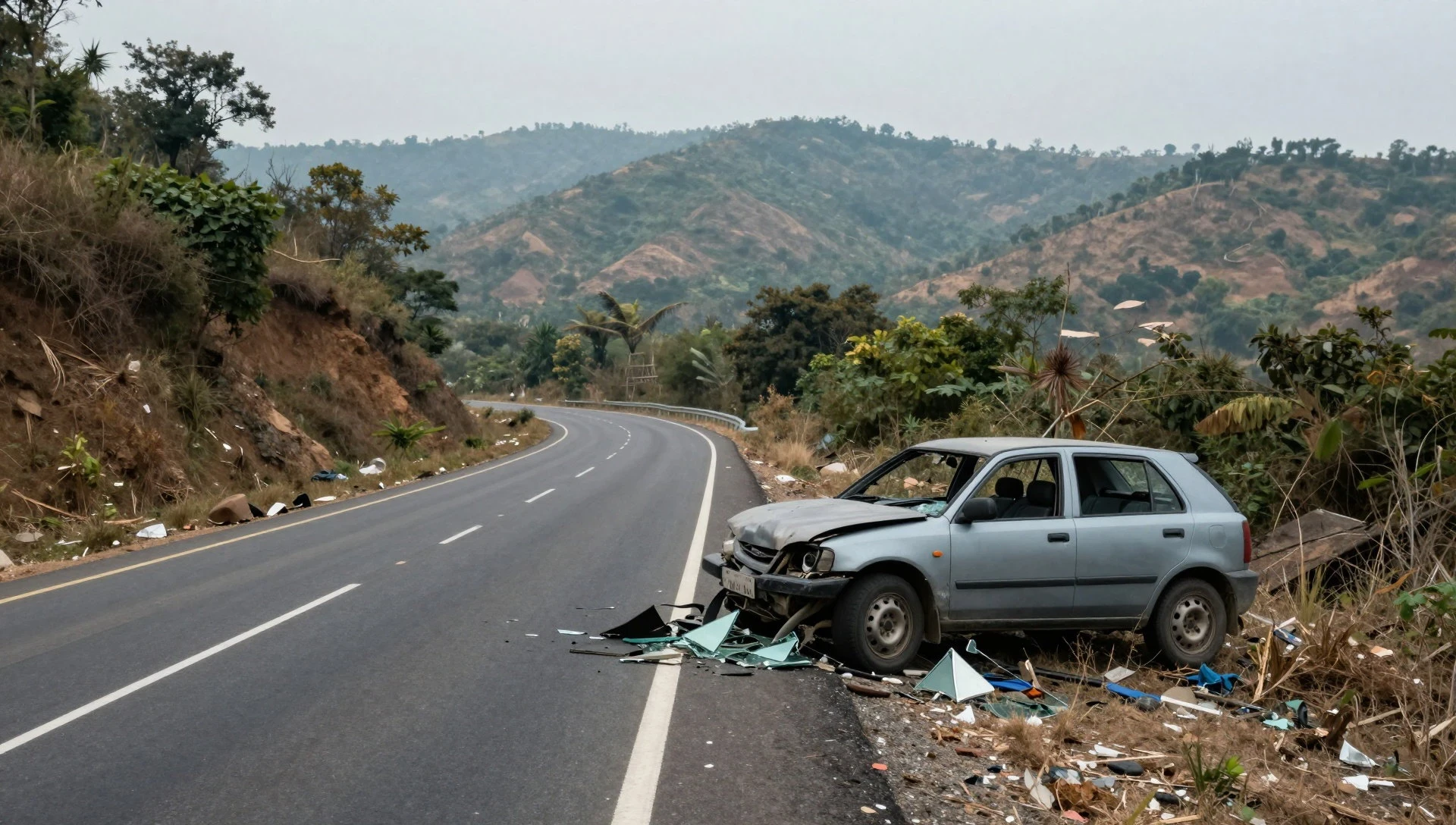
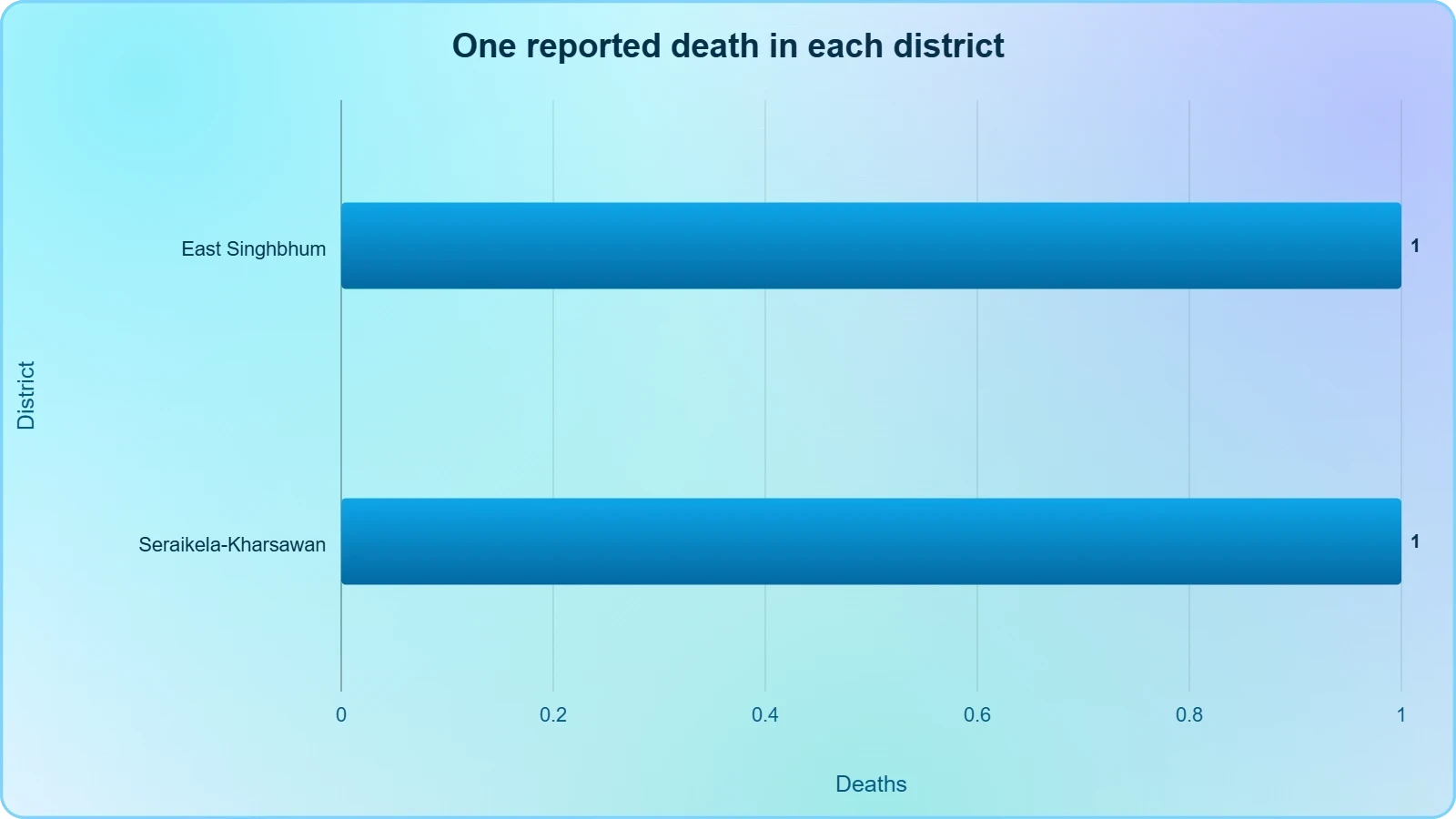
The report records two fatal motorcycle-related collisions in Jharkhand within a period of 48 hours, one in East Singhbhum and the other in Seraikela-Kharsawan. The deaths occurred in separate incidents, involving two men travelling on different local routes. Police identified the victims as 19-year-old Sujay Mahto and 30-year-old Ujjwal Mandal.
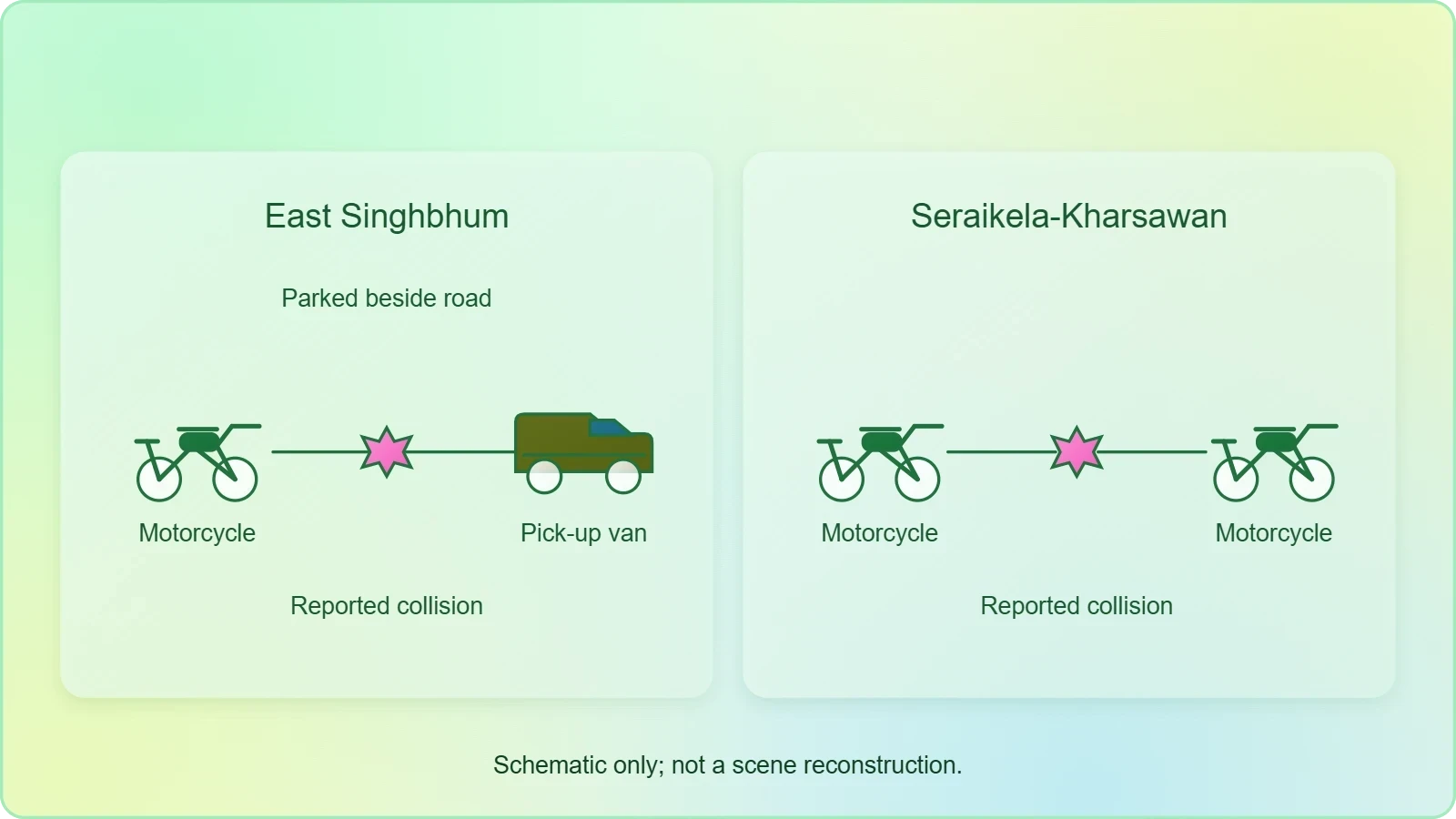
Although both incidents involved two-wheelers, the reported circumstances were not the same. Mahto’s motorcycle struck a pick-up van parked beside the road near Jamboni village, while Mandal’s motorcycle collided with another motorcycle on Dobo Road. The account does not establish why either collision occurred or whether any further investigation findings were available.
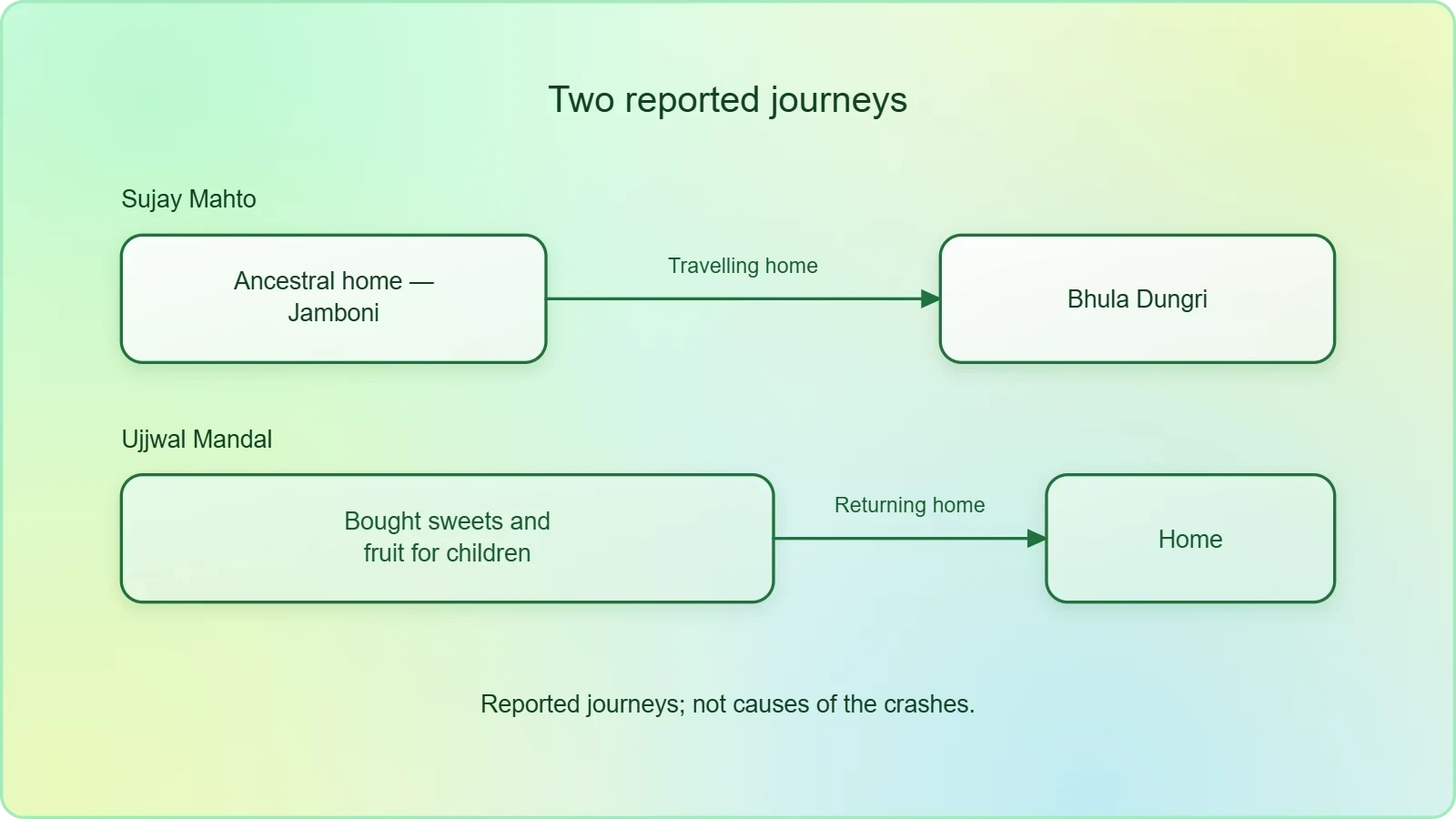
The journeys described in the report make the losses especially tangible: Mahto was travelling home from his ancestral village, and Mandal was returning with sweets and fruit for his children.
On This Page
Their deaths also invite a careful discussion of road safety, while the known facts must remain distinct from broader questions about prevention and responsibility.
TL;DR Police reported two deaths in separate road accidents in Jharkhand within 48 hours. Sujay Mahto, 19, died after his two-wheeler hit a roadside-parked pick-up van near Jamboni village in East Singhbhum. Ujjwal Mandal, 30, died after his motorcycle collided with another motorcycle on Dobo Road in Seraikela-Kharsawan.The report provides the victims’ ages, travel circumstances and broad locations, but does not establish speed, visibility, road conditions, helmet use, fault or the outcome of any investigation. Those details should not be assumed. The cases nevertheless underline why safe parking, alert riding, protective equipment and reliable crash information matter.
Two separate crashes, two deaths
The central fact is that two people died in distinct road accidents in neighbouring Jharkhand districts within 48 hours. The report does not describe a single collision or a shared cause; each incident had its own location, vehicle interaction and personal context.
What police reported in East Singhbhum
Sujay Mahto was 19 and lived in Bhula Dungri, according to the report. On Monday morning, he was travelling home from his ancestral home in Jamboni when his two-wheeler hit a pick-up van parked beside the road near Jamboni village.
The location was described as being under Bodam police station. That administrative detail helps identify the area, but it does not by itself explain the road layout, the vehicle’s visibility, the condition of the roadside or the circumstances that preceded the impact.
The report says Mahto died in the collision. It gives no account of his speed, whether he was wearing a helmet, the lighting or weather conditions, or whether the van was legally or safely positioned. These unanswered points should not be turned into assumptions about responsibility.
His reported journey was between Jamboni and Bhula Dungri, a familiar local trip rather than a long-distance journey. That distinction does not lessen the seriousness of the event: fatal risks can arise on ordinary roads as well as on highways.
What police reported in Seraikela-Kharsawan
Ujjwal Mandal, 30, was from Adardih, under Nimdih police station. Police told the report that he died on Sunday after another motorcycle collided with his bike on Dobo Road. The available account does not provide additional details about the other rider.
Mandal had been returning home after buying sweets and fruit for his children. This personal detail gives the news human context without changing what is known about the collision: the report does not identify either rider’s speed, direction of travel or precise manoeuvre.
Kapali police were cited in connection with the Seraikela-Kharsawan incident. The report does not say whether the other motorcyclist was injured, whether a formal case was registered, or what later inquiries concluded. Those facts remain outside the information supplied.
Unlike the East Singhbhum collision, which involved a parked pick-up van, this crash involved two moving motorcycles. The distinction matters when describing the incidents accurately, but it is not enough to determine fault or establish a common cause.
Locations and the 48-hour window
The deaths occurred in East Singhbhum and Seraikela-Kharsawan, two separate districts in Jharkhand. The report places one collision near Jamboni village and the other on Dobo Road, creating a concise local account rather than a district-wide statistical picture.
Local geography in the account
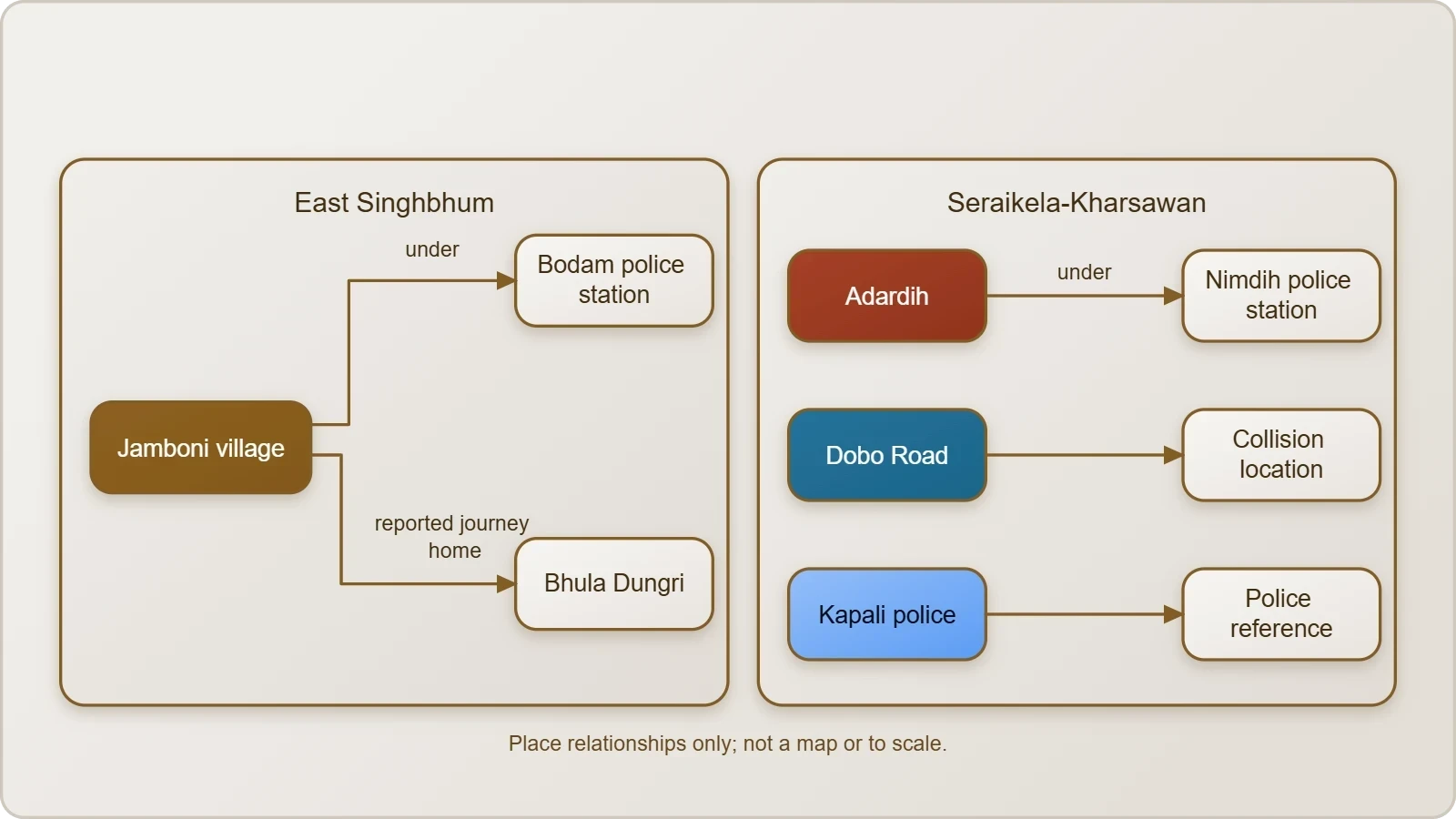
For the East Singhbhum incident, the report links Jamboni village with Bodam police station and identifies Bhula Dungri as Mahto’s home. These place names help readers understand the journey described, but they do not supply a route map or exact crash coordinates.
In the second incident, Mandal’s residence is given as Adardih, under Nimdih police station, while the collision is placed on Dobo Road. The report also attributes information to Kapali police, making clear that more than one locality or police reference appears in the coverage.
Local place names can be valuable for community awareness, especially when residents use the same roads for routine travel. However, without precise kilometre markers, junction descriptions or verified crash-site assessments, readers cannot reliably infer whether either stretch has a recurring hazard.
Nor does the report compare traffic volume, road design or accident frequency between the two districts. It documents two fatal events at particular locations; it should not be treated as evidence that either district or road is more dangerous overall.
What the timing establishes—and what it does not
The source says the deaths occurred within 48 hours: Mandal died on Sunday, and Mahto died on Monday morning. This sequence establishes proximity in time, not a connection between the crashes or a sudden district-wide rise in risk.
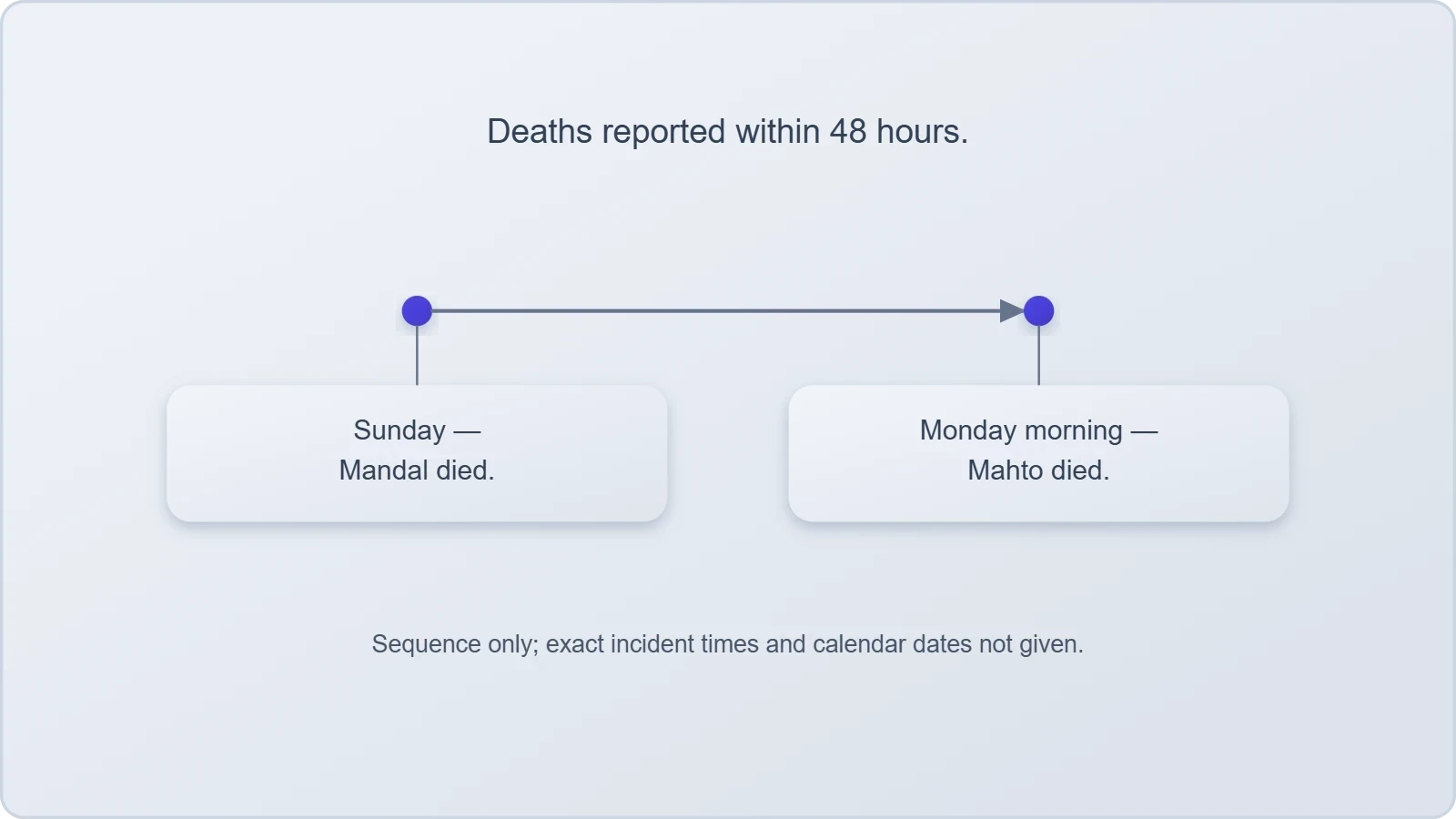
The report carries a timestamp of November 9, 2026, at 17:31 UTC. The incident descriptions themselves identify the days of the week rather than supplying separate calendar dates for each crash. Keeping that distinction avoids implying more precise timing than the account provides.
A short cluster of news reports can draw attention to road safety, but it cannot alone establish a trend. Trend assessment requires consistent records over a longer period, clear definitions of crash severity and comparable data on exposure, such as traffic or journeys.
For readers, the practical lesson is not to treat the 48-hour window as a forecast. It is to recognise that two families experienced fatal losses close together and that each crash deserves accurate reporting, careful inquiry and appropriate safety attention.
Journeys and the human cost
The article’s brief descriptions of each journey give the incidents a human dimension. Mahto was coming back from his ancestral home; Mandal was heading home with food for his children. These details convey ordinary lives interrupted without speculating beyond the report.
Everyday travel is still road travel
Mahto’s trip between Jamboni and Bhula Dungri appears to have been a local journey. Local familiarity can make routes feel routine, but it does not remove the need to watch for parked vehicles, changing traffic, road edges and other unexpected conditions.
Mandal’s reported return after shopping was similarly part of daily life. The account does not say whether he carried the purchases on the motorcycle or whether they affected his riding, so no such explanation should be attached to the collision.
These details matter because road safety is often discussed through abstract counts, while individual reports show how ordinary travel links people to homes and families. They also remind readers that each fatality represents a personal loss, not merely an entry in a tally.
Human context should be handled with restraint. Reporting the victims’ ages, home areas and journeys can make the account more complete, but dignity requires avoiding sensational language or using family details to imply facts about the crash.
Understanding vulnerability without assigning blame
Motorcycle riders have less physical protection than occupants enclosed in a car. Helmets and other protective equipment can reduce some injury risks, but the source does not say whether either rider used protective gear or what injuries were sustained.
That general safety context should not be mistaken for a conclusion about these deaths. The known accounts identify collisions, but they do not establish whether protective equipment, road design, vehicle condition, speed or another factor contributed to either outcome.
Likewise, a collision involving a parked vehicle raises questions about parking visibility and roadside space, while a motorcycle-to-motorcycle collision raises different questions about interaction between road users. Neither description alone answers those questions or establishes fault.
Careful public discussion separates prevention from blame. Communities can support safer riding and safer roads while leaving determinations about individual conduct to evidence-based investigation and avoiding unsupported conclusions about the victims or other people involved.
Road-safety issues raised by the incidents
The two reports point to different kinds of vehicle conflict: a motorcycle striking a roadside-parked van, and one motorcycle colliding with another. They offer a reason to consider practical safeguards, but provide too little evidence to diagnose either crash.
Visibility and roadside parking
A vehicle stopped beside a road can become a hazard when its position, visibility or surroundings leave little time or space for another road user to respond. That is a general safety concern, not a finding about the pick-up van near Jamboni.
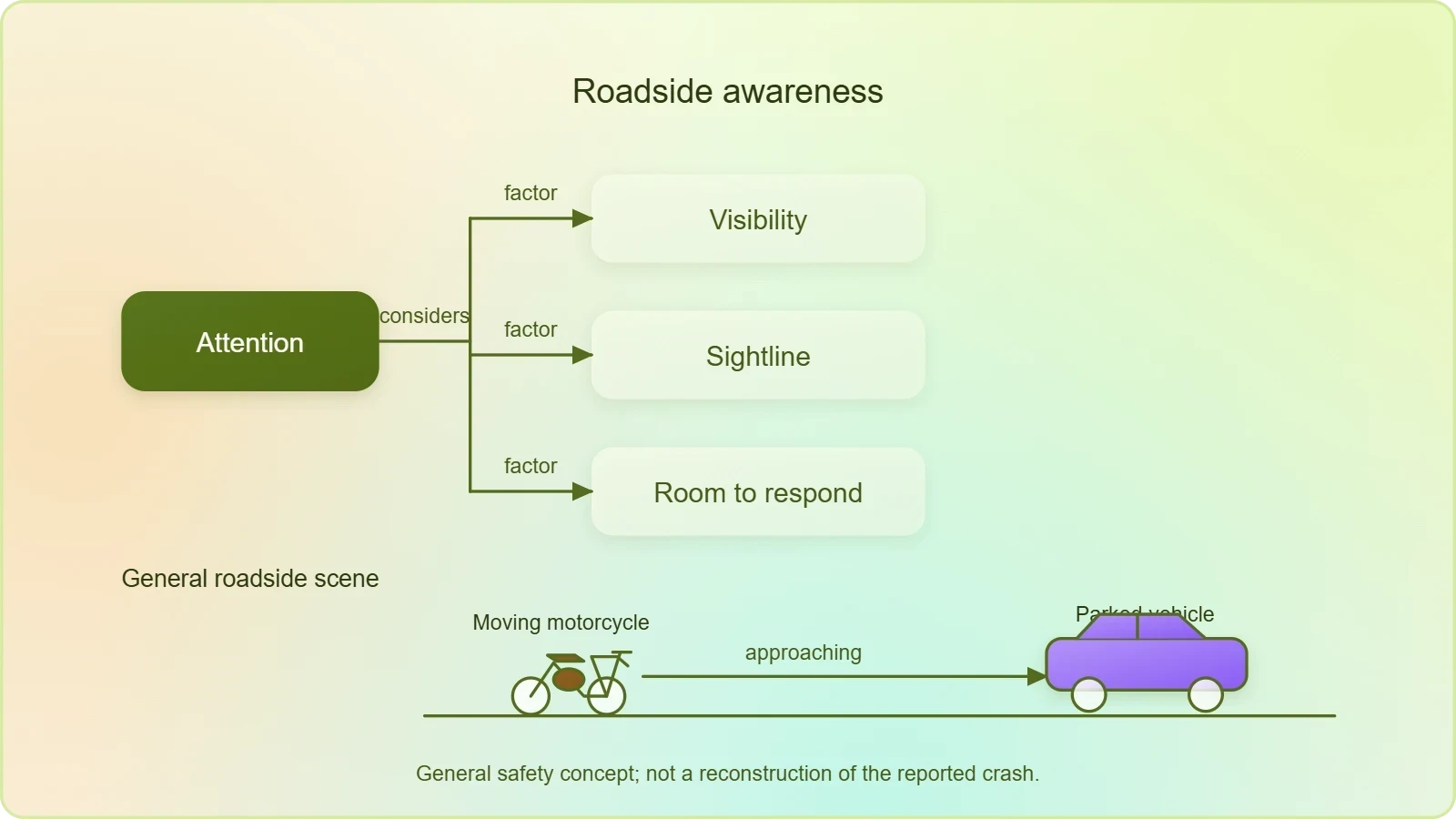
Safer parking practice includes choosing a place that does not obstruct moving traffic or sightlines, making a stopped vehicle visible where appropriate, and following applicable traffic rules. The report does not say how the van was parked or whether it had warning indicators or lights.
Riders can reduce some risks by scanning ahead, maintaining a speed suited to the visible conditions and leaving room to react. These are broad defensive-riding principles; the source does not establish whether any particular action could have prevented Mahto’s collision.
Road authorities and local communities may also assess recurring parking or visibility concerns when supported by evidence. A single account can identify a site for attention, but a proper assessment needs reliable location details and examination of the road environment.
Interactions between motorcycles
When motorcycles meet or travel near one another, safe spacing, predictable movement and attention to surrounding traffic are important. The report confirms a collision on Dobo Road, but does not explain the riders’ relative positions, directions or actions before impact.
Protective helmets are an important element of motorcycle safety, and properly fitted equipment can reduce the risk of severe head injury. Yet no helmet information is given here, and the cause or medical details of Mandal’s death should not be inferred from that general principle.
Road users can support safer interactions by avoiding abrupt manoeuvres, allowing sufficient following distance and remaining attentive at junctions and on narrow or busy stretches. Whether any of these conditions applied on Dobo Road at the time is not stated.
For investigators, the distinction between what is observed and what must be established is essential. Vehicle damage, witness accounts, site conditions and other evidence may help clarify a crash, but this report does not provide those investigative findings.
Reporting, investigation and reliable interpretation
Police are the stated source for the basic facts, and the article attributes details to the relevant local police references. Readers should distinguish those reported details from unanswered questions, particularly when discussing cause, fault, road conditions or possible legal outcomes.
Known details and missing evidence
The report gives the victims’ names and ages, the broad locations, the vehicle types involved and the journeys each man was making. It also places the deaths on Sunday and Monday morning, within a 48-hour period.
It does not provide exact collision times, measured speeds, weather, road surface conditions, helmet use, vehicle inspection results, witness statements or the identities of other involved road users. The absence of these details in the article does not prove that investigators lacked them.
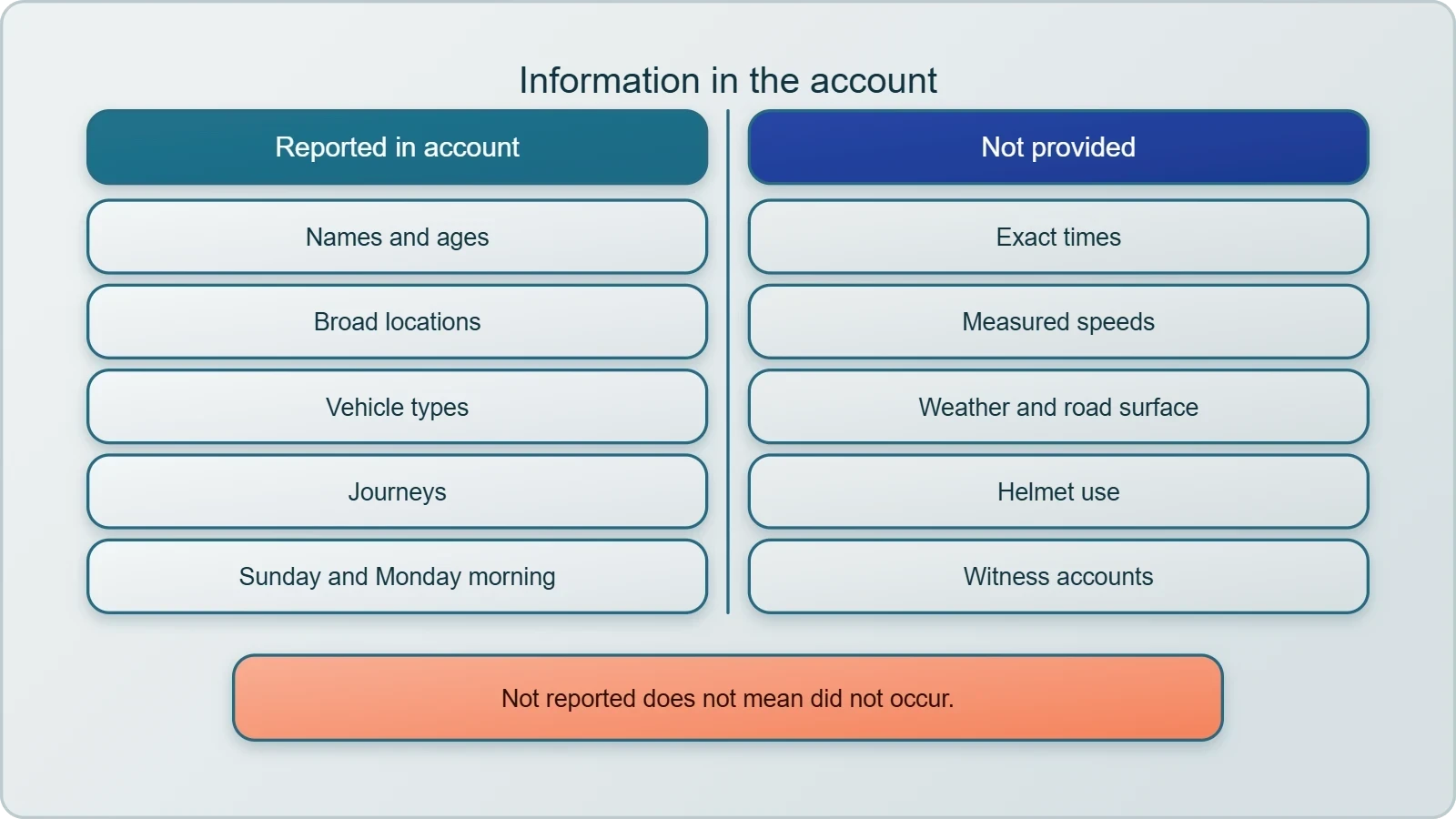
It also does not state whether criminal or traffic proceedings followed, whether the families received support, or whether any road-safety review was initiated. These are separate matters that would require additional verified reporting or official records.
Responsible interpretation means describing the report faithfully and marking uncertainty clearly. In particular, “hit a parked pick-up van” and “collided with another motorcycle” describe the reported events; neither phrase alone establishes negligence or the full sequence of events.
Why accurate local reporting matters
Local reporting can help residents identify incidents on roads they use and can prompt questions about safe travel. Its value is strongest when locations, timing and police attribution are presented clearly, while unverified details are not added for dramatic effect.
Names and family references should be handled with care because fatal-crash coverage concerns people in moments of profound loss. The reported journey details explain context; they should not become a basis for speculation about private circumstances or individual behaviour.
Readers sharing accident reports can preserve accuracy by retaining the distinction between confirmed information and commentary. Avoiding unsupported claims about fault also protects public understanding while investigations, where applicable, determine what the evidence supports.
Further updates could clarify details that this account leaves open, such as investigative findings or road conditions. Until then, the soundest approach is to report the two deaths as separate tragedies and not present unanswered questions as established facts.
- 01
- 02
- 03
- 04
Prevention, community awareness and the wider message
These deaths cannot be reduced to a single prescribed remedy because the report does not establish their causes. Still, individual caution, responsible vehicle use, safer roadside practices and evidence-led local road assessments are useful areas for prevention across communities.
Practical steps for riders and other road users
Riders can make a habit of scanning the road ahead, adjusting speed to visibility and traffic, keeping a safe distance and wearing a properly secured helmet. Such precautions lower exposure to some risks, though they cannot guarantee protection from every collision.
Drivers and operators should avoid stopping where a vehicle blocks traffic or sightlines and should make a stationary vehicle visible in accordance with local rules. This general advice does not imply that the van in the reported incident was improperly parked.
All road users benefit from predictable movements and attention to others, particularly where motorcycles share limited space. Passengers and family members can reinforce safe habits, but responsibility for road safety also extends to enforcement, vehicle standards and road design.
Communities may raise specific concerns with relevant authorities when they have recurring evidence of dangerous parking, poor visibility or conflict points. Reporting the exact location and observed conditions is more useful than assuming that a single crash proves a broader pattern.
What the two deaths ask of public discussion
The report’s most direct message is a human one: two men died during routine journeys, leaving families and communities to absorb the consequences. The personal details deserve attention, but the account should remain grounded in verified information.
Its broader safety message is equally measured. A parked vehicle and a second motorcycle were involved in separate collisions, yet the available facts cannot determine whether road layout, visibility, speed or any other factor caused either death.
Public awareness is most constructive when it leads to careful riding, responsible parking and better-informed local safety reviews rather than blame based on incomplete reports. Evidence can guide action; speculation can obscure what happened and unfairly stigmatise those involved.
Ultimately, the incidents call for compassion, precision and prevention. Remembering Sujay Mahto and Ujjwal Mandal means acknowledging their reported journeys and the lives affected, while supporting road-safety measures and investigations that are proportionate to the evidence.
From our network :
- How AI Agents Will Change the Way We Manage Personal FinancesExplore how AI agents are transforming personal finance through automated budgeting, bill payment, and investment management, while examining the critical security protocols and governance frameworks required for safe deployment.
- Forbidden Matrix Patterns and Visible Lattice Points: A Geometric DictionaryExplore how multidimensional 0–1 matrices encode geometric truths, linking forbidden patterns to visible lattice points and hypergraph theory, with applications in combinatorics and computational geometry.
- University Language Proficiency Exams: Why Institutional Tests Demand Different Preparation Than IELTS and TOEFLDiscover why university-specific language proficiency examinations differ fundamentally from IELTS and TOEFL, and learn strategic preparation approaches for institutional assessment success.
- The Hidden Cost of AI Convenience: Why Over-Permissioned Agents Are a Security Time BombDiscover why AI agents with excessive permissions create dangerous single points of failure, and learn how implementing least privilege principles can protect your organization from exploitation.
- Committed Mediterranean Precipitation Decline: Why Emissions Cuts Alone Cannot Restore Winter RainsNew NOAA research reveals that Mediterranean winter rains may decline irreversibly even with emissions cuts. Explore the science of committed climate change and regional impacts.
- Live Online English Classes for Kids: Do They Actually Reduce Anxiety?A ten-week study reveals that synchronous online English classes can significantly reduce child language anxiety while improving listening and reading skills. Discover what makes these programs effective and how parents can select the right one.
- The Final Descent: How ESA Retired the Legendary Cluster Constellation After 24 Years of Space Weather ScienceAfter 24 years mapping Earth’s magnetosphere, ESA’s Cluster mission concluded with a precisely controlled reentry over the South Pacific. This analysis explores the scientific legacy, engineering decisions, and debris mitigation principles behind one of space exploration’s most responsible retirements.
- CISA’s Ten-Advisory Wave: Why Generic Patching Fails in OT and How to Build Product-Specific PlaybooksCISA released ten ICS advisories in one week, exposing critical infrastructure risks. Generic patching fails in OT. Learn to build product-specific remediation playbooks.
- Mobile Learning and VR in English: What Global Evidence Reveals About Effective Language TechnologyA systematic review across 14 countries reveals which language-learning technologies genuinely work. Mobile learning, AI, and VR show measurable benefits when pedagogically integrated. This evidence-based guide helps educators and learners select technology that delivers real return on investment.
RESOURCES
- Incidence and pattern of road traffic injuries in tribal population of ...pubmed.ncbi.nlm.nih.govOct 30, 2020 ... Road safety education should be promoted. Keywords: Head injury; Jharkhand; injury pattern; road traffic accident; the tribal population.
- Incidence and pattern of road traffic injuries in tribal population of ...pmc.ncbi.nlm.nih.govOct 30, 2020 ... Road safety education should be promoted. Keywords: Head injury, injury pattern, Jharkhand, road traffic accident, the tribal population ...
- iRAD – Integrated Road Accident Database - Pakurpakur.nic.inGovernment Of Jharkhand · GOJ LOGO. पाकुड़ PAKUR. Search Search. Digital ... The project would generate various types of insights by analyzing the collected ...
- Transport Department, Government of Jharkhandtransport.jharkhand.gov.inTraffic Related · LL Test Question Bank · Do's and Don'ts for traveling · Driving License · Enforcement · Permits · Pollution Control ·…
- A tragic road accident in Ranchi's Bundu subdivision claimed four ...facebook.comOct 30, 2025 ... At least 18 Kanwariyas died and several others sustained injuries after a bus carrying pilgrims collided with a truck in…
- road accidents in jharkhand 2021transport.jharkhand.gov.inShri Hemant Soren. Shri Champai Soren. Hon'ble Chief Minister. Hon'ble Transport Minister. ROAD ACCIDENTS. 2021 www.jhtransport.gov.in. सतकता.
- ROAD SAFETY - District Ranchiranchi.nic.inMore than 3000 people die in road accident in Jharkhand State. This problem indicates the high exigency to fight against Road accidents in every…
- Helping Road Accident Victims - Jharkhand Policejhpolice.gov.inClearing Airway · Turn the victim onto the back and start mouth-to-mouth resuscitation immediately. · Tilt head back, support jaw, keep your fingers clear…
- ROAD ACCIDENTS IN INDIA 2023morth.gov.in... Jharkhand. Bihar. Mizoram. Accident Severity. Sta tes/UTs. Analysis of Road Accidents and Deaths,. Registered Vehicles and Road Length. 1.19 The broad trend ...
- India coronavirus lockdown: Road accident kills 24 migrant workersbbc.comMay 16, 2020 ... Most of the workers were reportedly from the western states of Jharkhand and West Bengal. The government imposed a lockdown…
- Road accidents in Jharkhand, Punjab, Bihar & UP caused more ...indianexpress.comOct 5, 2025 ... While the number of accidents have increased almost 4% from 4.72 lakh in 2022 to 4.91 lakh in 2023, fatalities…
- Bari Brahmana Road Accident - Instagraminstagram.com4 days ago ... A heartbreaking tragedy in Jharkhand's Khunti district, where a horrific road accident claimed seven lives and left another person injured.
- 5 Of Family, Including Children, Killed In Road Accident In Jharkhandndtv.comJun 12, 2026 ... Five members of a family, including three children, were killed and four others seriously injured on Thursday after their vehicle…
- 5 killed, 14 injured in separate road accidents in Jharkhand - ThePrinttheprint.inMar 14, 2026 ... Ranchi/Hazaribag, Mar 14 (PTI) Five people were killed and 14 others injured in two separate road accidents in Ranchi and…
- Common Causes of Road Accidents - Jharkhand Policejhpolice.gov.inVehicles: Failure of brakes or steering, tyre burst, insufficient headlights, overloading, projecting loads. Road Conditions: Potholes, damaged road, eroded ...
- 01
- 02
- 03
- 04
- 05
- 06
- 07
- 08
0 Comments