The decision by the United States Department of Justice to seek dismissal of Steve Bannon's conviction for contempt of Congress represents far more than a single procedural footnote in the long aftermath of January 6, 2021. It sits at the intersection of prosecutorial discretion, executive influence over law enforcement, and the durability of legal accountability when political power changes hands. Bannon, a former senior adviser to President Donald Trump, had already been found guilty by a jury, and a federal appeals court had upheld that verdict. The department's request to vacate the conviction "in the interests of justice" therefore reverses a result that the judicial system had already validated through trial and appellate review.
What makes the episode especially consequential is the absence of genuine adversarial argument. Bannon's own lawyers raised no objection to erasing the conviction, and no outside counsel was appointed to defend the original verdict. Legal scholars describe this as a departure from the Anglo-American tradition in which courts hear competing arguments before disturbing a final judgment. When the government and the defendant align, the courtroom loses the tension that normally tests evidence and protects institutional credibility. The pattern extends beyond one case: roughly a dozen leaders of the Oath Keepers and Proud Boys saw similar requests, following months of trials built on detailed January 6 evidence.
This analysis examines the legal architecture, the political context, and the institutional consequences of that alignment. It considers how pardons, dismissals, and selective investigations interact to reshape accountability, and why the reasoning offered by the department has drawn scrutiny from former prosecutors, members of the House January 6 committee, and constitutional scholars. The central question is not merely whether Bannon walks free, but whether the justice system can preserve the appearance and substance of impartiality when the executive branch effectively stands on both sides of a case.
On This Page
TL;DR The Justice Department asked a court to dismiss Steve Bannon's contempt-of-Congress conviction "in the interests of justice," with no party defending the original verdict. The move follows similar requests for Oath Keepers and Proud Boys leaders after Trump's January 6 pardons, and coincides with investigations into Trump's perceived opponents. Legal experts warn that when prosecutors and defendants align, courts lose the adversarial testing that legitimizes outcomes, weakening accountability for attacks on the peaceful transfer of power.
The Legal Mechanics of Vacating a Valid Conviction
A criminal conviction is not a provisional arrangement that dissolves when political winds shift. It is the product of indictment, trial, jury deliberation, and appellate review, each stage designed to test evidence and protect defendants from arbitrary state action. When the Justice Department moves to dismiss a case after a jury has spoken and an appeals court has affirmed, it invokes a narrow but real authority: prosecutorial discretion to abandon a prosecution. That authority is broad in theory, yet historically exercised with restraint precisely because final judgments carry institutional weight and public expectations of finality.
The Bannon matter illustrates how that restraint can erode. The department framed its request as serving justice, but offered no new exculpatory evidence and no legal error requiring correction. Instead, the government simply declined to continue defending a result its own prosecutors had secured. Because Bannon's counsel consented, the court confronted a motion with no opposing party, a configuration that former federal prosecutor Bruce Searby described as a matter between the department, acting at the president's direction, and the president's political ally. Such alignment removes the adversarial friction courts rely upon when evaluating whether to disturb a verdict.
The Role of Amicus Counsel and Adversarial Testing
Federal courts possess discretion to appoint amicus curiae, or friends of the court, when a case implicates broader public interests and no party adequately represents them. Lawyers for Representative Jamie Raskin, a Maryland Democrat who served on the House January 6 committee, urged the appeals court to take that step, citing precedent from controversial matters involving former national security adviser Michael Flynn and former New York City Mayor Eric Adams. In those instances, judges appointed outside counsel to argue positions the government had abandoned, preserving a semblance of contested proceedings.
The January 6 cases did not receive that treatment. The court dismissed the charges without appointing an amicus, leaving the convictions undefended and the record unexamined. Raskin's lawyers argued that this outcome diminishes the seriousness of January 6, undermines the work of prosecutors and law enforcement officers who secured the convictions, and effectively excuses criminal acts that threatened the peaceful transfer of presidential power. Their objection frames the procedural choice as substantive: how a court disposes of a case shapes what the public understands about the underlying conduct and its consequences.
Prosecutorial Discretion Versus Institutional Credibility
Prosecutors dismiss cases routinely, and discretion is a legitimate feature of any justice system. Charging decisions require judgment about evidence, resources, and public interest, and no serious observer demands that every indictment proceed to judgment. The difficulty arises when dismissal follows a completed trial and affirmance on appeal, particularly in matters of national significance. At that point, the decision no longer reflects an early assessment of whether a case is worth bringing; it reflects a choice to erase a result the system already produced, which invites scrutiny of motive rather than merit.
Credibility depends on consistency. If the same department that pursued Bannon vigorously now abandons the conviction without new facts, observers reasonably ask whether enforcement depends on who holds power rather than what the law requires. That perception matters beyond any single defendant, because public confidence in impartial justice is itself a component of the rule of law. Courts and commentators have long recognized that legitimacy is a resource, spent carefully and difficult to rebuild once depleted.
The Broader Pattern Across January 6 Prosecutions
Bannon's case did not emerge in isolation. Earlier, the department asked courts to vacate the convictions of about a dozen leaders and deputies of the far-right Oath Keepers and Proud Boys groups, whose trials had consumed months and produced detailed evidence about the January 6 attack. Those proceedings involved extensive testimony, documentary records, and jury findings about coordinated action against the Capitol. The requests to set aside those outcomes used the same "interests of justice" formulation later applied to Bannon, suggesting a consistent approach rather than an isolated exercise of leniency in one matter.
The sequence matters. On his first day back in office, President Trump pardoned most people charged in connection with January 6, describing them as patriots. For more senior members of the groups, whose conduct and sentences were more serious, the administration pursued judicial dismissal rather than clemency alone. Pardons and dismissals differ in legal effect and symbolism: a pardon accepts the fact of conviction while forgiving its consequences, whereas a dismissal seeks to erase the conviction itself. Choosing the latter for senior figures implies an effort to rewrite the record, not merely to extend mercy.
Pardons, Dismissals, and the Difference That Matters
The distinction between clemency and vacatur deserves careful attention because it shapes how history will treat January 6. A pardon is an act of grace that presupposes wrongdoing; it says the offender was guilty but will not bear the full penalty. Dismissal, by contrast, suggests the prosecution should never have produced a conviction, or that the conviction cannot be defended. When the government seeks dismissal after affirmance, it implicitly questions the integrity of the original case without identifying any flaw in it, leaving the public with an unresolved contradiction between the jury's finding and the state's later position.
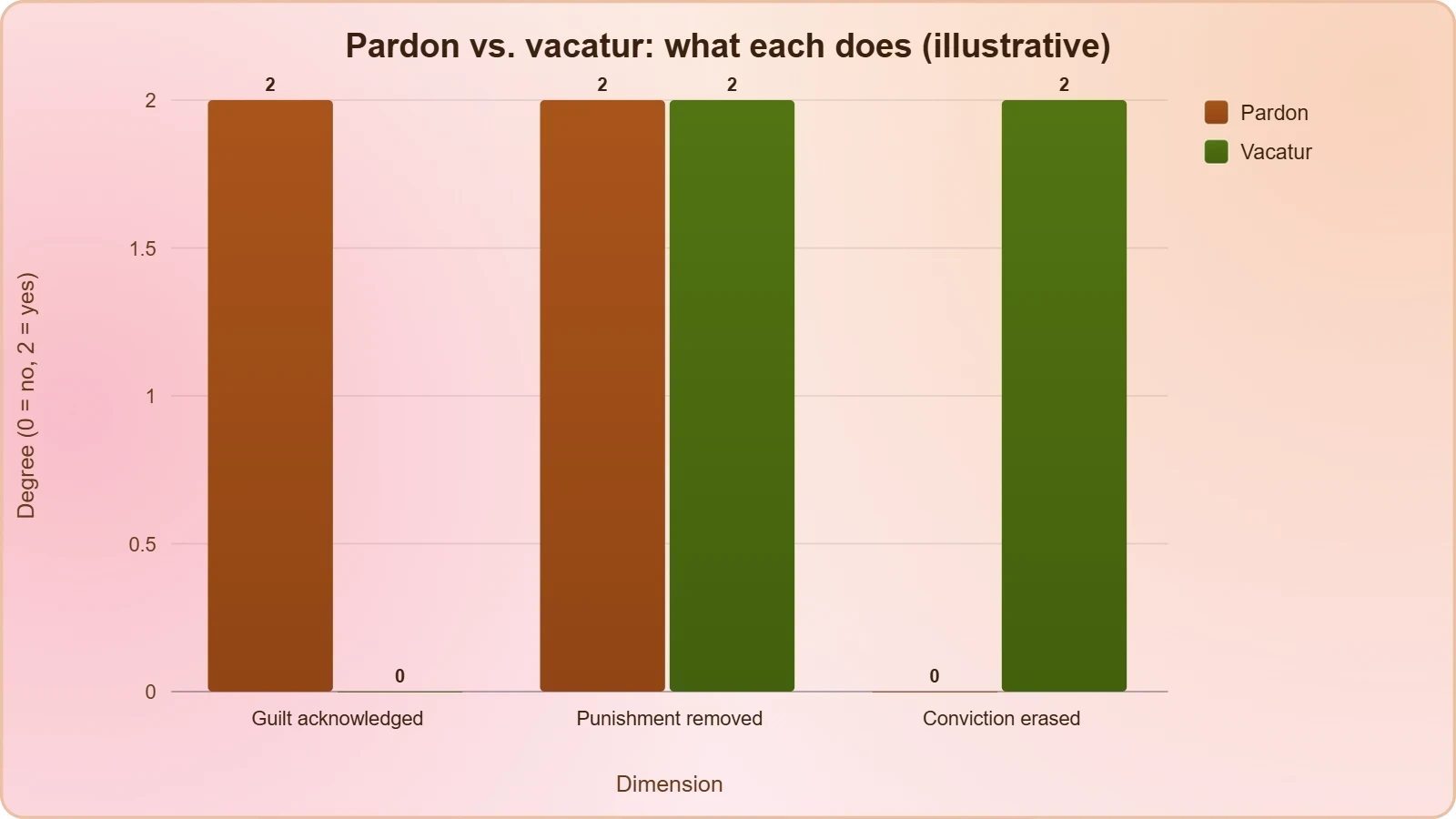
For the Oath Keepers and Proud Boys leaders, the practical result is similar to a pardon: no punishment, no continuing legal disability. The symbolic result is different. Erasing convictions signals that the underlying conduct is no longer treated as criminal by the state, which complicates future prosecutions of similar conduct and complicates the historical record. Courts that grant such requests become participants in that revision, even if they do so on procedural grounds rather than substantive disagreement with the jury.
Selective Enforcement and Investigations of Perceived Opponents
Parallel to the dismissals, the department has brought investigations against figures perceived as Trump's opponents. The coexistence of leniency toward allies and scrutiny of adversaries forms the core of the concern voiced by legal experts, who describe a pattern rather than a series of unrelated decisions. Prosecutorial discretion necessarily involves selection, but the legitimacy of that selection depends on neutral principles applied consistently across political lines. When the direction of enforcement tracks political affiliation, the appearance of impartiality collapses, and defendants in future cases gain a plausible argument that the process itself is compromised.
This dynamic is not unprecedented in American legal history, but its scale and visibility in the January 6 context are unusual. The cases involve a direct attack on the Capitol and the certification of a presidential election, making the stakes institutional rather than merely individual. How the justice system resolves them will influence how future administrations, and future defendants, understand the boundaries of accountability. A system that appears to punish opponents and release allies invites retaliation when power changes hands again, creating a cycle that erodes the norm of neutral enforcement.
Institutional Consequences for Courts and Prosecutors
Judges who approve unopposed dismissals of affirmed convictions assume a role they generally avoid: validating a result no party is willing to defend. Courts prefer adversarial presentation because it exposes weaknesses in each position and produces reasoned outcomes that withstand scrutiny. When the government and defense agree, the judge must either accept the request on faith or independently interrogate the record, a task for which the adversarial system provides limited tools. The January 6 dismissals, granted without amicus appointment, suggest courts may defer rather than probe when the executive branch speaks with one voice.
Prosecutors face a parallel dilemma. Career attorneys who secured convictions now watch their own department abandon them, a development that affects morale and future willingness to take on politically sensitive matters. The message transmitted to line prosecutors is that rigorous work can be undone by a change in administration, which may encourage caution or delay in cases touching powerful figures. Institutional memory of this kind shapes behavior long after any single controversy fades, and it can quietly weaken enforcement capacity across the board.
The Amicus Question and Judicial Independence
The decision not to appoint amicus counsel in the January 6 cases contrasts with earlier practice in matters involving Michael Flynn and Eric Adams, where judges took steps to ensure contested argument. That inconsistency invites the question of whether judicial willingness to safeguard adversarial testing depends on the political salience of the moment. Courts retain discretion, and reasonable judges may differ on when outside counsel is warranted. Yet the appearance of selective procedural rigor is itself a problem, because it suggests that the intensity of judicial scrutiny varies with the identity of the parties rather than the legal stakes.
Judicial independence is measured not only in rulings against the government but in the willingness to insist on process when the government prefers speed and quiet. Appointing an amicus is a modest step, but it signals that the court treats the conviction as worthy of defense. Declining that step, especially after a jury verdict and appellate affirmance, leaves the impression that the judiciary is ratifying an executive decision rather than exercising independent judgment. That impression is difficult to dispel once established.
Public Confidence and the Rule of Law
Public confidence in courts and prosecutors rests on observable consistency rather than stated intentions. Citizens cannot audit every charging decision, so they rely on patterns: who is prosecuted, who is released, and how similar cases are treated. When those patterns correlate with political alignment, confidence erodes regardless of the legal technicalities involved. The January 6 dismissals are visible, widely reported, and easy to compare with investigations of Trump's opponents, making the pattern legible to ordinary observers who may never read a legal brief.
Erosion of confidence has practical consequences. Witnesses become less willing to cooperate, juries become more skeptical of government evidence, and public officials face weaker deterrents. The rule of law depends on a shared expectation that rules apply regardless of station, and that expectation is sustained by visible practice. Each unopposed dismissal of a politically connected defendant chips away at that expectation, and the cumulative effect may prove harder to reverse than any individual decision.
We Also Published
- 01
- 02
- 03
- 04
Historical Parallels and Comparative Perspective
American history contains episodes in which prosecutions were abandoned for political reasons, from the post-Civil War retreat from Reconstruction enforcement to the pardon of Richard Nixon after Watergate. Each case produced debate about whether mercy served national healing or undermined accountability. The January 6 dismissals differ in one respect: they follow completed trials and appellate affirmance, meaning the state is not declining to prosecute but actively undoing results it previously defended. That distinction makes the current episode a sharper test of institutional norms than a pardon issued before trial would have been.
Comparative perspective is instructive. Democracies that have confronted internal attacks on their institutions, from Germany's treatment of extremist parties to Colombia's transitional justice arrangements, have generally insisted that accountability mechanisms be insulated from the political preferences of the moment. Where such insulation failed, the result was often cyclical retaliation, with each new government prosecuting the previous one. The American system's reliance on prosecutorial discretion and executive control of the Justice Department makes insulation difficult, which is why norms of restraint matter as much as formal rules.
Lessons From Prior Clemency Controversies
The Nixon pardon remains the canonical reference. Gerald Ford's decision spared the nation a prolonged trial but permanently associated clemency with elite impunity in the public mind, a cost that shaped subsequent debates about accountability for senior officials. Later controversies, including the Iran-Contra pardons and the commutations issued at the end of various administrations, reinforced a pattern in which clemency at the top receives scrutiny that ordinary pardons do not. The lesson is not that mercy is always wrong, but that its exercise for powerful figures carries distinctive institutional costs.
Those costs are amplified when clemency is paired with investigations of opponents. The combination suggests a two-track system, one lenient toward allies and one rigorous toward adversaries, which is precisely the arrangement that comparative experience associates with democratic backsliding. Avoiding that outcome requires visible countermeasures, such as independent review, transparent reasoning, and procedural safeguards that apply regardless of who benefits. Absent such measures, each decision reinforces the perception it was meant to avoid.
What Accountability Requires Going Forward
Accountability does not require that every conviction survive every political transition, but it does require that changes be justified on grounds the public can evaluate. A dismissal accompanied by new evidence, identified legal error, or a documented policy rationale would invite scrutiny of the reasoning rather than the motive. A dismissal justified only by the interests of justice, with no opposing party and no explanation, invites the opposite inference. The difference lies in transparency, which is the currency of institutional legitimacy.
Going forward, courts could insist on amicus participation when the government abandons a conviction of national significance, and legislatures could consider statutory guidance for such situations. Prosecutors could publish reasoned memoranda explaining departures from prior positions, allowing the public to assess the basis for change. None of these measures would resolve the underlying political conflict, but they would preserve the procedural record on which future accountability depends. The alternative is a system in which outcomes track power, and the record is whatever the current majority says it is.
Reading the Signal in the Bannon Dismissal
The Bannon request is best understood as a signal rather than an isolated act. It tells prosecutors, defendants, and the public that convictions tied to January 6 can be undone when political conditions change, provided the right actors align. That signal travels faster than any legal brief, shaping expectations about risk and reward for future conduct. When the state demonstrates that accountability is negotiable, the deterrent effect of criminal law weakens, not only for the individuals involved but for anyone calculating whether institutional boundaries can be crossed with impunity.
The absence of opposition in court compounds the signal. A contested dismissal would at least have produced a record, with arguments on both sides and a reasoned judicial response. An unopposed dismissal produces silence, leaving the public to infer motive from context. Legal experts quoted in reporting on the case emphasize precisely this point: the problem is not that the department changed its mind, but that no one was positioned to argue the other side. The procedural vacuum becomes the story, and the story becomes the precedent.
Questions the Record Leaves Unanswered
Several questions remain unresolved. Did the department identify any legal defect in the conviction, or did it rely solely on a policy judgment about the interests of justice? Why did the court decline to appoint amicus counsel when it had done so in comparable matters? What criteria distinguish the senior group leaders whose convictions were dismissed from the ordinary January 6 defendants who received pardons? Answers to these questions would clarify whether the decisions reflect a coherent legal theory or an ad hoc response to political priorities.
The department declined to comment on its decision or on the lack of opposition, and Bannon's lawyers did not return messages seeking comment. That silence is itself informative. Public institutions ordinarily explain significant departures from prior positions, especially when those departures affect the meaning of a completed trial. When explanation is withheld, observers fill the gap with inference, and inference tends toward the least charitable reading. Transparency would not resolve the political controversy, but it would provide a basis for evaluating the legal reasoning on its merits.
Implications for Future Transitions of Power
Every administration inherits the enforcement decisions of its predecessor, and every transition tests whether those decisions will be honored or reversed. The January 6 cases establish a template in which reversals are pursued through dismissal rather than clemency, with courts asked to ratify the outcome. If that template becomes routine, future administrations may face pressure to investigate the officials who pursued the original cases, creating a cycle of reciprocal accountability that consumes institutional capacity and distracts from governance. Avoiding that cycle requires restraint from whichever coalition holds power next.
Restraint is easier to recommend than to practice. Political coalitions that believe they were treated unfairly have strong incentives to retaliate once empowered, and the January 6 dismissals provide a ready justification. The only durable check is a shared commitment to procedural regularity that transcends partisan advantage, enforced by courts willing to insist on adversarial testing and by prosecutors willing to explain their choices. Whether the American system can sustain that commitment under current polarization is the deeper question the Bannon case poses, and it will not be answered by any single ruling.
From our network :
- Live Online English Classes for Kids: Do They Actually Reduce Anxiety?A ten-week study reveals that synchronous online English classes can significantly reduce child language anxiety while improving listening and reading skills. Discover what makes these programs effective and how parents can select the right one.
- University Language Proficiency Exams: Why Institutional Tests Demand Different Preparation Than IELTS and TOEFLDiscover why university-specific language proficiency examinations differ fundamentally from IELTS and TOEFL, and learn strategic preparation approaches for institutional assessment success.
- Mobile Learning and VR in English: What Global Evidence Reveals About Effective Language TechnologyA systematic review across 14 countries reveals which language-learning technologies genuinely work. Mobile learning, AI, and VR show measurable benefits when pedagogically integrated. This evidence-based guide helps educators and learners select technology that delivers real return on investment.
- Committed Mediterranean Precipitation Decline: Why Emissions Cuts Alone Cannot Restore Winter RainsNew NOAA research reveals that Mediterranean winter rains may decline irreversibly even with emissions cuts. Explore the science of committed climate change and regional impacts.
- The Hidden Cost of AI Convenience: Why Over-Permissioned Agents Are a Security Time BombDiscover why AI agents with excessive permissions create dangerous single points of failure, and learn how implementing least privilege principles can protect your organization from exploitation.
- CISA’s Ten-Advisory Wave: Why Generic Patching Fails in OT and How to Build Product-Specific PlaybooksCISA released ten ICS advisories in one week, exposing critical infrastructure risks. Generic patching fails in OT. Learn to build product-specific remediation playbooks.
- The Final Descent: How ESA Retired the Legendary Cluster Constellation After 24 Years of Space Weather ScienceAfter 24 years mapping Earth’s magnetosphere, ESA’s Cluster mission concluded with a precisely controlled reentry over the South Pacific. This analysis explores the scientific legacy, engineering decisions, and debris mitigation principles behind one of space exploration’s most responsible retirements.
- How AI Agents Will Change the Way We Manage Personal FinancesExplore how AI agents are transforming personal finance through automated budgeting, bill payment, and investment management, while examining the critical security protocols and governance frameworks required for safe deployment.
- Forbidden Matrix Patterns and Visible Lattice Points: A Geometric DictionaryExplore how multidimensional 0–1 matrices encode geometric truths, linking forbidden patterns to visible lattice points and hypergraph theory, with applications in combinatorics and computational geometry.
RESOURCES
- Justice Department moves to toss Steve Bannon's conviction tied to ...nbcnews.com6 days ago ... Steve Bannon. Steve Bannon was convicted of contempt of Congress in 2022 and served a four-month prison sentence. Shelby Tauber…
- DOJ moves to erase Bannon conviction for evading Jan. 6 committeethehill.comFeb 9, 2026 ... The Justice Department seeks to dismiss Steve Bannon's conviction for evading a subpoena from the committee that probed the Jan.
- Judge declines to dismiss Steve Bannon's criminal contempt ...abcnews.comA Trump-appointed judge has declined a request from the Justice Department to dismiss the contempt of Congress conviction for Trump ally Steve Bannon.
- Court allows Steve Bannon to move forward on dismissal of criminal ...scotusblog.comApr 6, 2026 ... ... convicted of contempt of Congress, back to the lower court, where the Department of Justice has filed a motion…
- Judge refuses to dismiss Steve Bannon's conviction - Spectrum Newsspectrumlocalnews.comAug 26, 2026 ... WASHINGTON — A federal judge on Wednesday rejected the Justice Department's request to erase Trump ally Steve Bannon's criminal conviction ...
- Justice Department seeks to wipe out Bannon conviction for defying ...politico.comFeb 9, 2026 ... The Justice Department is seeking to erase the criminal conviction of longtime Trump adviser Steve Bannon for defying a 2021…
- Supreme Court hands Steve Bannon a win likely to lead to dismissal ...pbs.orgApr 6, 2026 ... ... dismiss Bannon's conviction and indictment "in the interests of justice ... The Justice Department brought the case against Bannon…
- Supreme Court Clears the Way for Dismissal of Bannon Convictionnytimes.comApr 6, 2026 ... The Supreme Court on Monday agreed to clear the way for the dismissal of the criminal conviction ... Justice Department,…
- Judge, for now, refuses to dismiss Steve Bannon's conviction in ...washingtonpost.comAug 26, 2026 ... A federal judge has rejected the Justice Department's request to dismiss Trump ally Steve Bannon's criminal conviction for refusing to ...
- DOJ drops past cases against Trump allies, sparking criticism - NPRnpr.org7 hours ago ... The DOJ moved to dismiss criminal convictions of former Trump adviser Steve Bannon ... The Biden-era Justice Department portrayed the ...
- A Trump-appointed judge has declined a request from the Justice ...facebook.comAug 26, 2026 ... ... Justice Department to dismiss the contempt of Congress conviction for Trump ally Steve Bannon. Judge declines to dismiss Steve…
- Justice Department seeks to toss Steve Bannon conviction - UPI.comupi.com6 days ago ... The Justice Department has filed a motion Thursday to vacate the contempt of Congress conviction of former White House strategist…
- Trump justice department moves to dismiss Steve Bannon criminal ...theguardian.comFeb 9, 2026 ... Former Trump adviser convicted of contempt of Congress for refusing to testify before House January 6 committee.
- Judge refuses to dismiss Steve Bannon's contempt conviction caseapnews.comAug 26, 2026 ... A federal judge has rejected the Justice Department's request to dismiss Trump ally Steve Bannon's criminal conviction for refusing to ...
- DOJ asks to dismiss Steve Bannon's criminal charges - CBS Newscbsnews.comFeb 9, 2026 ... The Justice Department is moving to toss out its case against former Trump adviser Steve Bannon, who was jailed for…
- 01
- 02
- 03
- 04
- 05
- 06
- 07
- 08
0 Comments