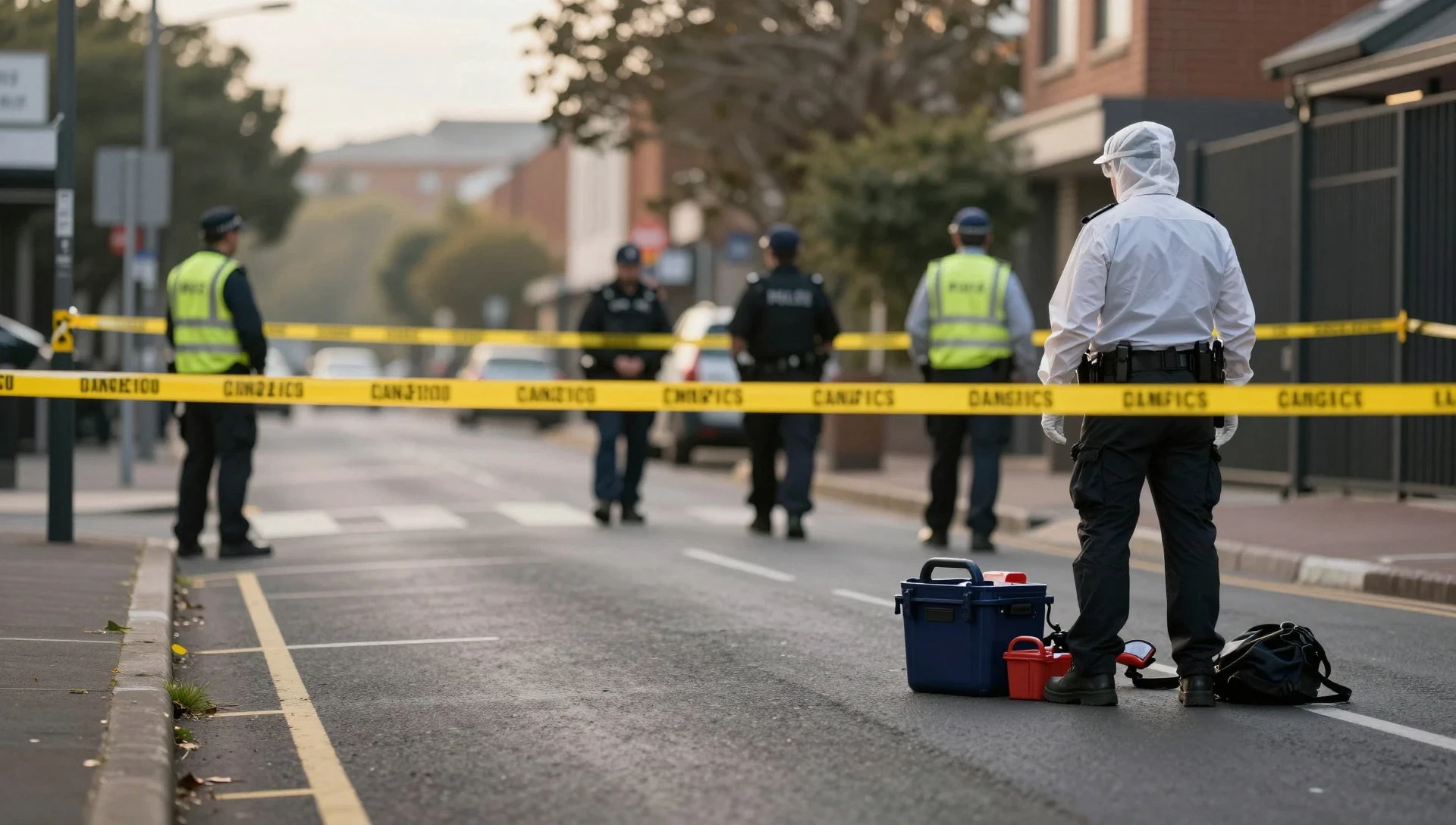
A single address on Woodlee Street in Dandenong became the centre of a homicide investigation after three people were found injured on a Friday morning, and one of them — a 28-year-old woman — later died in hospital. The case matters less for its shock value than for what it reveals about how suburban violence is investigated, how public institutions respond, and how a community absorbs the aftershocks of an incident that unfolded within sight of a primary school. The facts are sparse but consequential, and each one carries weight.
What follows is a careful reading of the available reporting: the sequence of events, the relationships between the people involved, the role of Homicide Squad detectives, the school lockdown that briefly altered the rhythm of an ordinary neighbourhood, and the appeal for dash cam footage that may yet prove decisive. Rather than speculate about motive or identity, this analysis concentrates on the procedural and social dimensions that give the story its broader significance, and on the questions that remain unanswered as investigators continue their work.
Violence of this kind rarely stays contained to a single household or a single street. It ripples outward through emergency services, school communities, local businesses, and the quiet networks of neighbours who suddenly find their routine interrupted. Understanding the Dandenong stabbing means understanding that wider ecology of response — from the first triple-zero call to the hospital bedside where a life ended, and from the police cordon to the public appeal that may determine whether the case is resolved.
On This Page
- The Sequence of Events and the Anatomy of a Suburban Emergency
- Relationships, Police Statements, and the Meaning of "Known to Each Other"
- The School Lockdown and the Institutional Response to Local Violence
- Digital Evidence and the Expanding Role of Dash Cam Footage
- Grief, Media Reporting, and the Human Cost Behind the Headline
- Open Questions and the Path Ahead for Investigators
TL;DR A 28-year-old Dandenong woman died in hospital on Wednesday morning after being found with life-threatening injuries at a Woodlee Street address the previous Friday, alongside two men who were also injured. Police have confirmed all three people knew each other and are not seeking anyone else in connection with the incident, while Homicide Squad detectives continue to investigate. A nearby primary school entered lockdown during the emergency response, and authorities have appealed for public information and dash cam footage.
The Sequence of Events and the Anatomy of a Suburban Emergency
Reconstructing the timeline is essential to understanding how a routine Friday morning became a homicide investigation. Emergency services were called to an address on Woodlee Street at approximately 11:30am, where they discovered three people with injuries. Two of those individuals — a 35-year-old man and a 26-year-old man — were transported to hospital, while the 28-year-old woman was found with injuries described as life-threatening. She survived for five more days before dying on Wednesday morning, a detail that shifts the legal and investigative character of the case considerably.
The Critical Interval Between Injury and Death
The gap between Friday and Wednesday is not a minor procedural footnote. When a victim dies after a period of hospitalisation, investigators must establish whether the death resulted directly from the injuries sustained, a question that typically involves medical evidence, clinical records, and in some circumstances a post-mortem examination. This interval also affects how the matter is characterised formally, since the death converts what began as a serious assault investigation into a homicide inquiry. The timing shapes everything that follows.
Hospitalisation under police guard, meanwhile, indicates that at least one person of interest remains both a patient and a subject of scrutiny. The 35-year-old man from Dandenong was reported to be under police guard while receiving treatment, a standard arrangement when investigators need to preserve access to a potential witness or suspect who cannot yet be interviewed formally. It is a careful balancing act between medical necessity and investigative integrity, and it underscores how the case has evolved since the initial emergency call.
Why the Location Matters
Woodlee Street sits within a residential pocket of Dandenong, a suburb in Melbourne's south-east that has long functioned as one of the city's most culturally diverse and densely settled corridors. Incidents in such settings tend to generate substantial witness pools, which can be both an advantage and a complication for investigators. Neighbours notice comings and goings, but memory is fallible and accounts diverge. The street itself becomes a temporary forensic landscape, cordoned and examined while residents adjust to an unfamiliar presence.
The proximity of a primary school adds a further dimension. Schools are among the most sensitive institutions in any community, and their decision-making during emergencies is governed by protocols designed to protect children first and explain later. When a school enters lockdown, parents receive notifications, traffic patterns shift, and the ordinary choreography of the school run is suspended. These are not trivial disruptions; they are the visible edge of a much larger disturbance that begins with violence and radiates outward through the day.
We Also Published
Relationships, Police Statements, and the Meaning of "Known to Each Other"
The most consequential sentence in the reporting is also the most understated: police said all three people knew each other and that they were not looking for anyone else in connection with the incident. In investigative language, this is a signal of considerable importance. It tells the public that the violence is not believed to be random, that there is no unidentified assailant at large, and that the inquiry is focused inward on a closed network of relationships rather than outward on a stranger threat. That distinction shapes public anxiety as much as it shapes police strategy.
What Investigators Signal Through Public Statements
When authorities state that they are not seeking additional parties, they are managing risk perception as much as they are reporting fact. Random violence generates broad fear; violence within known relationships tends to be contained, statistically and socially. Police communications are calibrated accordingly, offering reassurance without prematurely closing investigative options. The phrasing leaves room for the possibility that circumstances may change, while giving residents a reason to resume normal life rather than remain on alert for an unknown danger.
At the same time, the statement carries evidentiary weight. If the people involved were known to one another, the investigative focus shifts toward establishing the precise dynamics of those relationships, the sequence of events within the address, and the accounts provided by survivors. The 35-year-old man under police guard and the 26-year-old man from Lyndhurst both become central figures in that reconstruction, whether as witnesses, participants, or something more ambiguous that only evidence can clarify.
The Role of Homicide Squad Detectives
Homicide Squad involvement signals that the matter is being treated with the seriousness its outcome demands. Specialist detectives bring particular expertise in death investigation: scene examination, forensic coordination, witness management, and the painstaking assembly of a brief that may eventually support charges. Their presence does not imply that charges are imminent or that any individual has been identified as responsible; it reflects standard practice when a death follows an assault and the circumstances require formal scrutiny.
These investigations are rarely swift. Forensic analysis, medical evidence, and witness statements must be gathered and reconciled, and the legal threshold for charging is deliberately high. For the community, this means a period of uncertainty in which public attention fades but investigative work continues. For those directly affected, it means waiting — for answers, for accountability, and for the formal processes that will determine how a death is legally understood and publicly recorded.
The School Lockdown and the Institutional Response to Local Violence
Among the details that deserve closer attention is the lockdown of a nearby primary school. When emergency services respond to a violent incident in a residential area, nearby schools activate protective procedures almost immediately, often before the full picture is known. Children are moved indoors, external doors secured, and parents notified through established channels. The measures are precautionary by design, but they carry real emotional weight for families who receive an alert mid-morning and must wait for clarity.
How Schools Manage Proximity to Danger
Lockdown protocols exist because uncertainty is the dominant condition in the early minutes of any emergency. Authorities cannot immediately confirm whether a threat is contained, so institutions closest to the scene act conservatively. For a primary school, this means prioritising physical safety over instructional continuity, and communicating with parents in language calibrated to reassure without minimising. The process is rehearsed, but rehearsal never fully prepares a community for the genuine article, particularly when the incident involves serious injury on a street children walk past daily.
The aftermath matters as much as the lockdown itself. Schools typically provide debriefing for staff, age-appropriate conversations for students, and counselling where needed. Children absorb adult anxiety with remarkable sensitivity, and the way a school frames an unsettling event can shape how students process fear and safety for years. The visible disruption lasts hours; the quieter work of restoring a sense of normalcy continues well beyond the police cordon being removed and the news cycle moving on to other stories.
Community Trust and the Machinery of Public Cooperation
Police appeals for information are only as effective as the community's willingness to respond. The request for dash cam footage is a practical recognition that modern streets are continuously recorded by private vehicles, and that digital evidence may capture movements no witness observed. It is also an invitation to civic participation, asking residents to review their own recordings and come forward even if they believe they saw nothing of consequence. Such appeals succeed when trust exists between police and the communities they serve.
Dandenong's diversity makes that trust both more valuable and more delicate. Communities with histories of mistrust toward authorities may hesitate to engage, and language barriers can complicate reporting. Effective investigations therefore depend on liaison officers, community leaders, and accessible reporting channels. Crime Stoppers, with its anonymous reporting option, exists precisely to lower the threshold for cooperation. The 1800 333 000 number is not merely a procedural detail; it is an institutional acknowledgement that information often flows most freely when identity remains protected.
Digital Evidence and the Expanding Role of Dash Cam Footage
The appeal for dash cam footage reflects a transformation in how modern investigations are conducted. A generation ago, detectives relied almost entirely on eyewitness testimony and physical evidence. Today, the streets are saturated with cameras mounted in vehicles, affixed to doorbells, and carried in pockets. Each device produces a potential record of movement, timing, and presence that can corroborate or contradict witness accounts. The request is routine, but its implications are profound for how cases are built and contested.
Why Vehicle Recordings Matter in Homicide Inquiries
Dash cam footage offers something witnesses rarely provide: an impartial, time-stamped account of what occurred on a street during a specific window. It can establish who arrived when, which vehicles were present, and whether anyone fled the scene. In an incident where the people involved knew one another, such footage may help reconstruct the sequence of events inside a residence by documenting movements immediately before and after. It is evidence that does not tire, forget, or reinterpret under pressure.
The practical challenge lies in collection. Footage is often overwritten within days as storage cycles, which is why appeals are issued quickly and why investigators urge residents and drivers to preserve recordings even if they seem unremarkable. A vehicle passing a suburban street at 11:25am may capture nothing of apparent interest, yet the timestamp alone can anchor a timeline. The public's role in preserving such material is a quiet but decisive contribution to the investigative process.
Privacy, Consent, and the Boundaries of Surveillance
The growing reliance on private recordings raises legitimate questions about privacy and the boundaries of surveillance in public space. Drivers who install dash cams for insurance purposes do not anticipate contributing to homicide investigations, yet their devices become instruments of public interest when violence occurs nearby. The legal frameworks governing access, retention, and use of such footage vary, and investigators must navigate them carefully to ensure evidence remains admissible and rights remain protected.
There is also a social dimension. Communities that feel over-surveilled may resist cooperation, while communities that feel under-protected may demand more cameras. The balance is never settled, and each high-profile incident reopens the debate. What remains constant is the practical reality that digital evidence now shapes outcomes. Cases that might once have stalled for lack of witnesses can advance on the strength of a single recording, and cases with abundant testimony can unravel when footage tells a different story.
Grief, Media Reporting, and the Human Cost Behind the Headline
Behind every procedural detail is a person whose life ended and a network of people whose lives are permanently altered. A 28-year-old woman from Dandenong died after five days in hospital, and the reporting that follows such deaths tends to compress a life into a few identifying details: age, suburb, injury, outcome. This compression is a function of news conventions, but it can obscure the fuller reality of loss — the family, the friendships, the ordinary routines that will never resume in quite the same way.
- 01
- 02
- 03
- 04
How Crime Reporting Shapes Public Understanding
Media coverage of violent death operates under competing pressures. Journalists must inform the public while respecting the dignity of the deceased and the sensitivities of grieving families. They must report what is known without speculating beyond evidence. The result is often a spare, factual account that leaves readers with questions the reporting cannot answer. That restraint is appropriate, but it also means public understanding of violence is shaped by fragments rather than full narratives, and by the frequency of coverage rather than the depth of it.
There is a further consideration: the cumulative effect of reporting on communities that experience violence repeatedly. When a suburb appears in headlines primarily in connection with crime, residents internalise a distorted sense of their own neighbourhood. The vast majority of daily life in Dandenong is unremarkable in the best sense — work, school, commerce, neighbourliness — yet the incidents that make news are the ones that define external perception. Responsible reporting must reckon with this asymmetry.
Support Systems and the Long Tail of Violence
For those directly affected, the aftermath extends far beyond the investigation. Families navigate grief, legal processes, and media attention simultaneously, often without preparation. Victim support services, counselling, and community organisations play a role that rarely features in news reports but is essential to recovery. The death of a young woman in hospital after an assault is not an isolated event; it is the beginning of a long process for everyone connected to her, and for the professionals who must support them.
Communities, too, carry a long tail. Neighbours who witnessed emergency vehicles, parents who received school lockdown alerts, and local workers who saw the cordon all absorb the event in their own ways. Most will move on quickly, as human beings must. Some will not. The measure of a community's resilience is not the absence of such events but the quality of its response to them — the willingness to support, to cooperate, and to remember that statistics are always, underneath, people.
Open Questions and the Path Ahead for Investigators
Several questions remain unresolved in the public record, and their resolution will determine how this case is ultimately understood. The precise circumstances inside the Woodlee Street address have not been disclosed. The nature of the relationships among the three people has been confirmed only in the broadest terms. Whether any individual will face charges, and what those charges might be, depends on evidence still being assembled. These gaps are normal in an active investigation, but they are worth naming rather than glossing over.
What the Public Record Does Not Yet Establish
Reporting has not identified a weapon, a motive, or a sequence of events beyond the discovery of three injured people. It has not indicated whether the injuries were inflicted by one person or several, or whether any of the injured parties was responsible for the others' wounds. The statement that police are not seeking anyone else does not, by itself, establish who did what. These distinctions matter legally and ethically, and responsible analysis must resist the temptation to fill them with assumption.
The role of the 35-year-old man under police guard is similarly ambiguous in the public account. Being guarded in hospital is a custodial arrangement, not a charge, and it may reflect concerns about flight risk, evidence preservation, or the need for formal interview once medically appropriate. Readers should be cautious about inferring guilt from procedural facts. The justice system's central promise is that inference gives way to proof, and that promise is tested most severely in cases that attract public attention.
How the Case May Develop
Homicide investigations typically proceed through phases: scene and forensic work, witness and survivor interviews, medical and post-mortem evidence, and finally the assembly of a brief for prosecutorial consideration. Each phase can take weeks or months, and the public visibility of a case often declines precisely as the substantive work intensifies. For Dandenong, the coming period will likely be characterised by quiet procedural activity rather than dramatic developments, and that quiet is a sign of diligence rather than neglect.
Whatever the eventual outcome, the case will be remembered locally for the death of a young woman and the disruption of an ordinary Friday. It will also serve as a reminder of how much depends on public cooperation — on the neighbour who reviews a dash cam, the passer-by who calls Crime Stoppers, the witness who comes forward despite hesitation. Investigations are institutional undertakings, but they are powered by ordinary people choosing to participate. That is the quiet civic machinery on which justice depends.
From our network :
- University Language Proficiency Exams: Why Institutional Tests Demand Different Preparation Than IELTS and TOEFLDiscover why university-specific language proficiency examinations differ fundamentally from IELTS and TOEFL, and learn strategic preparation approaches for institutional assessment success.
- The Hidden Cost of AI Convenience: Why Over-Permissioned Agents Are a Security Time BombDiscover why AI agents with excessive permissions create dangerous single points of failure, and learn how implementing least privilege principles can protect your organization from exploitation.
- Committed Mediterranean Precipitation Decline: Why Emissions Cuts Alone Cannot Restore Winter RainsNew NOAA research reveals that Mediterranean winter rains may decline irreversibly even with emissions cuts. Explore the science of committed climate change and regional impacts.
- Forbidden Matrix Patterns and Visible Lattice Points: A Geometric DictionaryExplore how multidimensional 0–1 matrices encode geometric truths, linking forbidden patterns to visible lattice points and hypergraph theory, with applications in combinatorics and computational geometry.
- Mobile Learning and VR in English: What Global Evidence Reveals About Effective Language TechnologyA systematic review across 14 countries reveals which language-learning technologies genuinely work. Mobile learning, AI, and VR show measurable benefits when pedagogically integrated. This evidence-based guide helps educators and learners select technology that delivers real return on investment.
- Live Online English Classes for Kids: Do They Actually Reduce Anxiety?A ten-week study reveals that synchronous online English classes can significantly reduce child language anxiety while improving listening and reading skills. Discover what makes these programs effective and how parents can select the right one.
- How AI Agents Will Change the Way We Manage Personal FinancesExplore how AI agents are transforming personal finance through automated budgeting, bill payment, and investment management, while examining the critical security protocols and governance frameworks required for safe deployment.
- The Final Descent: How ESA Retired the Legendary Cluster Constellation After 24 Years of Space Weather ScienceAfter 24 years mapping Earth’s magnetosphere, ESA’s Cluster mission concluded with a precisely controlled reentry over the South Pacific. This analysis explores the scientific legacy, engineering decisions, and debris mitigation principles behind one of space exploration’s most responsible retirements.
- CISA’s Ten-Advisory Wave: Why Generic Patching Fails in OT and How to Build Product-Specific PlaybooksCISA released ten ICS advisories in one week, exposing critical infrastructure risks. Generic patching fails in OT. Learn to build product-specific remediation playbooks.
RESOURCES
- Homicide Squad detectives are investigating the circumstances ...facebook.comAug 18, 2025 ... ... Homicide Squad investigate Dandenong death' ... A 39-year-old man has died outside a BP in Dandenong this morning after…
- Woman dies in hospital after Dandenong stabbing - ABC Newsabc.net.au11 hours ago ... ... Homicide Squad detectives continue their investigation. abc.net.au/news/woman-dies-in-hospital-after-dandenong-stabbing/107374174. Link ...
- Police investigate stabbing on Woodlee Street in Dandenongfacebook.com6 days ago ... Police are still working to establish the exact circumstances surrounding his death. Anyone with information is urged to contact Crime…
- Woman dies following Dandenong stabbing - Victoria Policepolice.vic.gov.au11 hours ago ... Homicide Squad detectives are continuing to investigate the circumstances surrounding a stabbing in Dandenong last week after a woman has ...
- 39-year-old man fatally stabbed in Dandenong unitdandenong.starcommunity.com.auAug 20, 2025 ... Homicide investigation: 39-year-old man fatally stabbed in Dandenong unit ... stabbing may have occurred. The man had yet to be…
- Breaking news | Victoria Policepolice.vic.gov.auHomicide Squad detectives have arrested a man following a fatal stabbing in the ... Police investigate Dandenong stabbing. www.police.vic.gov.au/police ...
- Woman Dies After Dandenong Stabbing | Mirage Newsmiragenews.com12 hours ago ... Homicide Squad detectives are continuing to investigate the circumstances surrounding a stabbing in Dandenong last week after a woman has ...
- Baljit Kaur, 28, has died in hospital five days after suffering life ...instagram.com11 hours ago ... DANDENONG STABBING UPDATE | Baljit Kaur, 28, has died in hospital ... Homicide Squad detectives have joined the investigation. A…
- Peak Hour Images on X: "Homicide Squad detectives are continuing ...x.com12 hours ago ... Homicide Squad detectives are continuing to investigate the circumstances surrounding a stabbing in Dandenong last week after a woman has ...
- Woman, 28, dies in hospital after stabbing in Melbourne home - Ninenine.com.au12 hours ago ... ... Dandenong with life-threatening stab wounds about 11.30am on November 6 ... Homicide Squad detectives have now joined the investigation.
- Woman dies after Dandenong stabbing - KNOX NEWSknoxnews.com.au11 hours ago ... A 28-year-old woman has died in hospital after a Woodlee Street stabbing in Dandenong on 6 November. Homicide Squad detectives…
- Man charged in UW student's fatal stabbing found incompetent to ...reddit.comSep 29, 2026 ... Police initiated an attempted murder investigation after officers responded to a stabbing on Ke'eaumoku St. at approximately 7:11 a.m. ·…
- 'Targeted' fatal stabbing outside servo sparks manhunt - AAP Newsaapnews.aap.com.auAug 18, 2025 ... ... Dandenong death on the radio. The Berwick MP detoured to ... The death of a critically injured woman has…
- Man arrested after woman stabbed to death in Victoria's south-westsmh.com.auAug 2, 2025 ... Police are also investigating the deaths of an elderly couple, after a woman was found dead inside a home on…
- Update: Sudden death investigation, Manly West - Centenarymypolice.qld.gov.auSep 29, 2025 ... Police have charged a 45-year-old man following the death of a man in Manly West yesterday, 28 September. Around 1am…
- 01
- 02
- 03
- 04
- 05
- 06
- 07
- 08
0 Comments