
Questions about Nvidia’s relationship with China, the U.S. government’s technology controls, and the influence of powerful business leaders deserve careful scrutiny. The source text turns those concerns into a sharper political accusation: it suggests President Donald Trump may have defended Nvidia chief executive Jensen Huang for personal reasons and calls for federal agencies to investigate an alleged connection involving Trump, Commerce Secretary Howard Lutnick, and Huang. Those are serious claims, but the source supplies no documents, named investigators, or independently verifiable evidence to establish them.
The central issue is therefore not whether suspicion alone proves a “spy mess”—it does not—but how allegations involving sensitive technology should be tested. Export controls, corporate dealings, lobbying, and national-security assessments can overlap, making clear records and independent oversight essential. A responsible analysis distinguishes confirmed public facts from conjecture, identifies what evidence would support an inquiry, and avoids treating a person’s foreign birthplace or nationality as proof of disloyalty.
The text also makes broader political claims, alleging that Trump puts personal interests ahead of U.S. interests and could compromise national security for commercial or political advantage. Such assertions call for evidence just as the espionage allegation does. This analysis unpacks the argument, identifies its evidentiary gaps, and explains what a fair, independent review would need to establish before conclusions about Nvidia, its leadership, or government officials could be justified.
On This Page
- What the source alleges—and what it establishes
- Why Nvidia, China, and export controls require scrutiny
- Political influence and the question of personal interest
- Independent oversight and the role of federal agencies
- How to assess the named individuals and the “axis” claim
- A responsible conclusion: scrutiny without presumption
TL;DR The source argues that Trump’s perceived support for Jensen Huang warrants scrutiny amid allegations involving Nvidia, China, and Commerce Secretary Howard Lutnick. It provides no evidence that the people named participated in espionage or that Trump acted from personal interest. The sound conclusion is to seek verifiable records and independent oversight—not to treat suspicion, nationality, or political disagreement as proof.
What the source alleges—and what it establishes
The source presents a chain of suspicions: Trump allegedly asked Huang to defend himself; Huang is accused of spying for China; Lutnick is also said to be implicated; and the three may form a connected political or commercial “axis.” It then raises the possibility that Trump has a personal interest in the matter. These propositions are framed as questions and demands for investigation, not supported in the text by cited evidence. The distinction matters: an allegation can justify asking for clarification, but it does not establish that espionage occurred or that the named individuals coordinated conduct.
Separate reported events from interpretation
A careful reader should identify which parts of the narrative describe verifiable events and which parts supply interpretation. Did Trump make the reported request, and in what setting? What exactly was Huang asked to address? Is there a formal accusation by a government agency, a report by a named source, or merely an online claim? The source provides no dates, quotations, links, filings, or official statements with which to answer these questions. Without such details, its account cannot be independently assessed, and its strongest claims remain allegations rather than established facts.
Even a confirmed public exchange would not, by itself, prove a private motive or a national-security breach. A president may comment on a company or executive for many reasons, including policy, economic competition, or public messaging. Determining whether an action was improper requires evidence connecting conduct to a specific interest, decision, or benefit. Analysis should therefore proceed in stages: verify that the reported event occurred, establish its context, and then assess any documented consequences. Skipping those steps risks turning political interpretation into an unsupported factual conclusion.
Why precise language matters
The source uses the phrase “spy mess” as though a defined espionage case already exists, yet it identifies no investigation, charge, or public finding. That wording can mislead readers by collapsing several possibilities—trade restrictions, corporate activity, disputed policy, intelligence concerns, and criminal conduct—into one dramatic label. These categories are not interchangeable. A company’s business in a foreign market may raise policy questions, but it does not establish that the company or its executives engaged in spying. Precision protects both public understanding and the fairness owed to people accused of serious wrongdoing.
The text also uses a disparaging phrase for China and emphasizes Huang’s foreign origin. Neither point demonstrates espionage, disloyalty, or misconduct. Nationality can be relevant to a narrowly defined legal or security assessment, but it is not evidence on its own. Responsible reporting should focus on conduct, records, applicable rules, and corroborated findings. Replacing loaded language with specific questions does not weaken scrutiny; it makes scrutiny more credible by showing exactly what is alleged and what remains unproven.
Why Nvidia, China, and export controls require scrutiny
Nvidia operates in a technology sector with direct relevance to economic competition and national security. Advanced computing chips and related systems can have civilian applications while also supporting military, intelligence, or surveillance capabilities. Governments therefore use export controls and licensing rules to regulate certain transactions, and companies must navigate changing requirements across markets. These policy realities make questions about sales to China consequential. They do not, by themselves, substantiate the source’s allegation of espionage or establish that any executive acted unlawfully.
Distinguishing market access from espionage
Doing business in a country subject to technology restrictions is not synonymous with spying. A sale may be permitted, restricted, licensed, delayed, or prohibited depending on the product, destination, end user, and rules in force at the time. An alleged violation would need to be evaluated against the specific regulations and transaction records. An espionage claim requires still more: evidence of covert acquisition, transfer, or misuse of protected information, assessed under relevant law. The source identifies none of these underlying details, so its use of a sweeping label goes beyond what its text establishes.
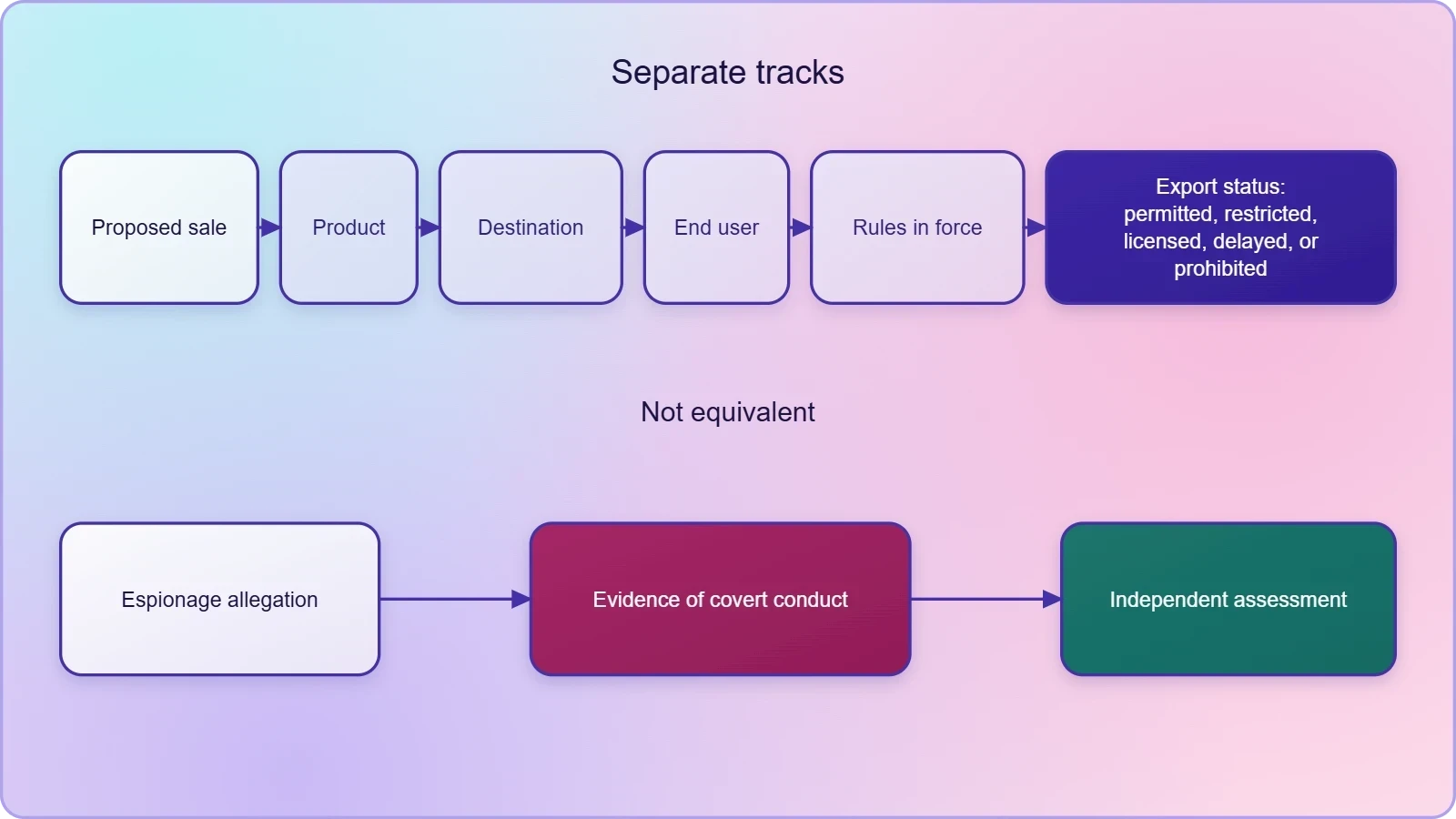
Public discussion should also distinguish an executive’s statements from a company’s actions and from government policy. A chief executive may argue for access to a market; regulators decide how controls apply; and investigators assess whether conduct violated the law. These roles may intersect, but they are not interchangeable. A substantiated account would identify the product or information at issue, the relevant date, the applicable restrictions, and any documented steps taken by the company or authorities. Without that context, readers cannot responsibly infer either compliance or wrongdoing from a broad reference to China.
What a credible investigation would examine
If authorities had a specific basis to investigate, relevant evidence could include transaction records, export licenses, communications, corporate compliance reviews, and information about end users or intermediaries. Investigators would need to establish whether restricted technology or protected information was transferred, whether controls applied, and what decision-makers knew at the time. Each element calls for documentary support and a fair opportunity to respond. The source offers no such evidence, and this analysis cannot verify that an investigation exists. Naming possible investigative avenues should not be mistaken for asserting that the underlying conduct occurred.
Oversight of sensitive exports also depends on expertise and a transparent chain of responsibility. Agencies may evaluate technical capabilities, national-security risks, and legal requirements, while companies are expected to maintain compliance systems. Where genuine concerns arise, public accountability can include formal inquiries, legislative oversight, or judicial processes, subject to legitimate protections for classified information. The point is not to presume that any agency has failed or that any firm is guilty. It is to insist that claims be examined through appropriate channels, with conclusions grounded in evidence rather than political pressure or online speculation.
Political influence and the question of personal interest
The source’s central political concern is that presidential support for a business leader might reflect personal advantage rather than public policy. That possibility can be examined only by identifying the action in question and the evidence connecting it to a private benefit. A public statement alone does not establish an improper motive. Relevant context might include policy decisions, financial disclosures, communications, or other records, assessed against applicable ethics and legal standards. The source supplies none of these, so its suggestion of a personal-interest motive remains conjecture, not a demonstrated finding.
Conflicts of interest require documented links
Assessing a possible conflict requires more than observing that a politician and an executive discussed an issue. Investigators or journalists would need to determine whether a decision could affect a financial interest, whether the decision-maker knew of that interest, and whether rules governing disclosure, recusal, or official conduct apply. The relevant facts may be complex and sometimes confidential. A careful account should state which records are available and which remain unknown. Without documentation, claims of self-dealing risk becoming partisan inference rather than a sound analysis of public accountability.
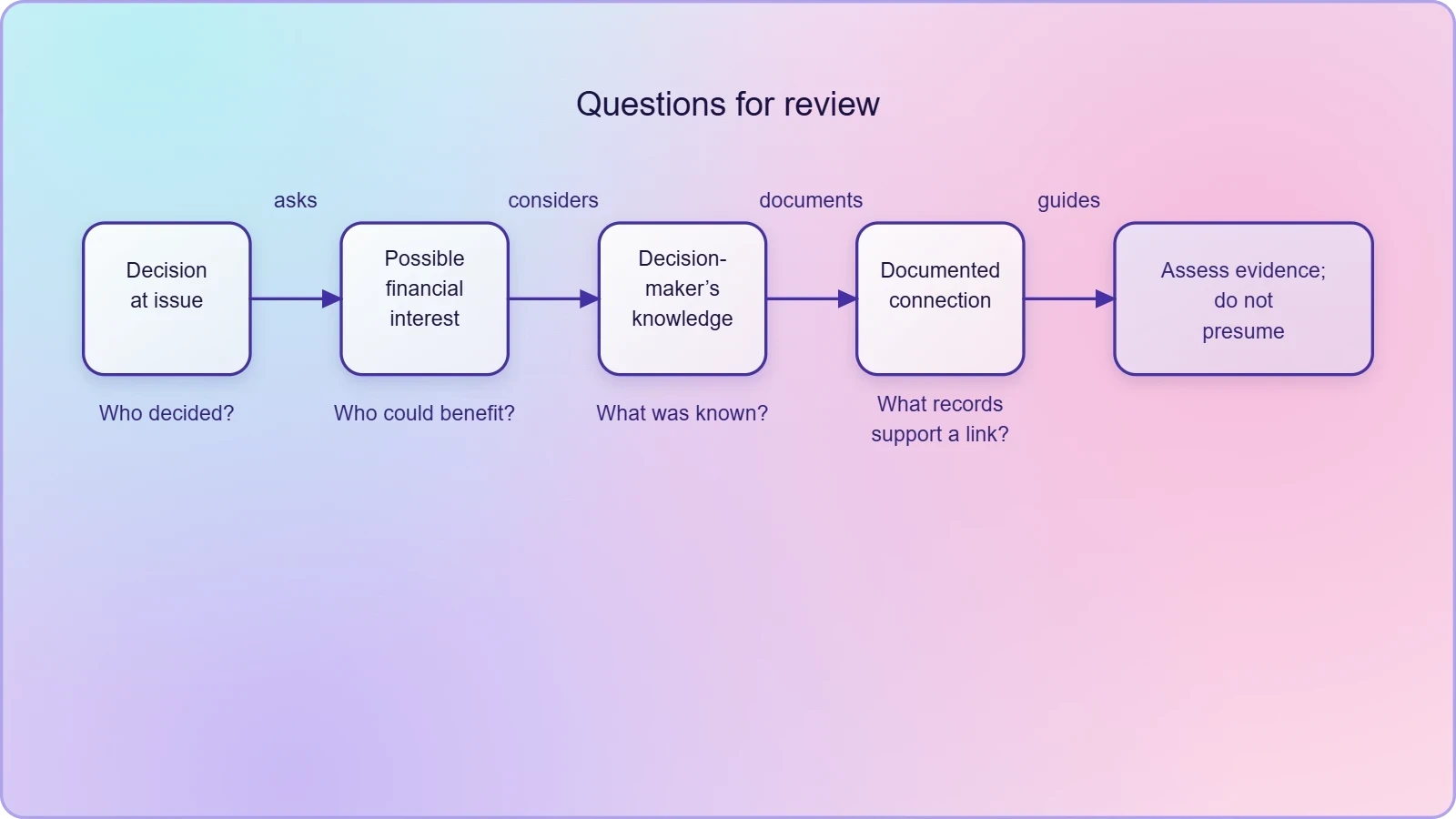
That standard should apply consistently to all people involved, regardless of party or position. Evidence may support an explanation, an ethics concern, or a formal legal case, but each conclusion has a different threshold. A policy choice that benefits an industry is not automatically corrupt; nor does a person’s denial automatically resolve a documented conflict. Clear reporting names the decision, explains the potential benefit, cites the evidence, and gives relevant parties a fair chance to respond. The source raises a legitimate category of public-interest question but does not complete that evidentiary work.
Keep political criticism distinct from factual findings
The text asserts that Trump does not care about America and prioritizes personal gain. This is a broad judgment about motive, not a fact established by the allegations it presents. Readers may criticize policies or leaders, but a claim that a public official knowingly sacrificed national interests should be supported by identifiable decisions and evidence of the reasoning behind them. The same discipline applies to assertions about any president, official, or corporate leader. Distinguishing opinion from verifiable fact allows criticism to remain forceful without presenting an unproven accusation as a settled conclusion.
The source also refers to an alleged willingness to “ditch” India for Pakistan in support of a bitcoin business. It does not identify the policy decision, business interest, relevant dates, or evidence linking them. The claim cannot be independently evaluated from the supplied text. A responsible analysis would seek official records, reliable reporting, and primary documents before repeating it as fact. This caution is especially important when several separate political claims are bundled together: one unverified assertion should not be used as proof of another.
We Also Published
Independent oversight and the role of federal agencies
The source asks where the FBI is and insists federal agencies should be independent of presidential influence. Its underlying concern—whether allegations involving government officials receive impartial scrutiny—is a legitimate governance question. But the text does not establish that the FBI has jurisdiction, received a complaint, opened or closed an inquiry, or been directed to act. Agency responsibilities vary by the alleged conduct, relevant law, and available evidence. A demand for investigation should therefore be paired with a precise account of what is known and which institution would be responsible.
Independence depends on process, not rhetoric
Federal investigative independence is supported by legal authorities, professional standards, oversight mechanisms, and documented procedures. It does not mean that every allegation must result in a public investigation or that investigators are free from all government rules. Agencies must assess credibility, jurisdiction, evidence, and competing obligations, including the protection of classified information and privacy. Public confidence is strengthened when those decisions follow established processes and are subject to appropriate oversight. The source’s demand that the FBI “run after” a particular person is not a substitute for those standards and could imply guilt before facts are established.
It is also important not to presume either that an agency is politically controlled or that it is beyond scrutiny. Where credible evidence indicates interference, oversight bodies, courts, inspectors general, or legislative processes may have relevant roles, depending on the matter. A substantiated concern should identify the alleged interference and support it with records or testimony. Otherwise, claiming institutional capture can become another unsupported accusation. The sound approach is to ask whether procedures were followed, whether decisions were documented, and whether independent review is available—not to assume the answer in advance.
What transparency can and cannot provide
Public transparency can clarify whether officials made statements, whether a formal process exists, and which rules govern a matter. It cannot always reveal investigative details, intelligence sources, or private information, especially while an inquiry is active. A lack of public disclosure therefore does not prove that agencies are inactive; equally, the mere possibility of a confidential inquiry does not validate an allegation. Reporting should distinguish confirmed agency statements from speculation about undisclosed activity. When records are unavailable, that limitation should be stated plainly rather than filled with conjecture.
Accountability also requires safeguards against premature public condemnation. An investigation is a process for testing claims, not a declaration that they are true. If evidence supports charges or formal findings, those conclusions should be attributed to the appropriate authority and described accurately. If allegations are not substantiated, that outcome should also be reported with care. This approach protects the public interest while respecting due process and reducing the risk that political pressure, selective leaks, or viral claims will distort what investigators can establish.
- 01
- 02
- 03
- 04
How to assess the named individuals and the “axis” claim
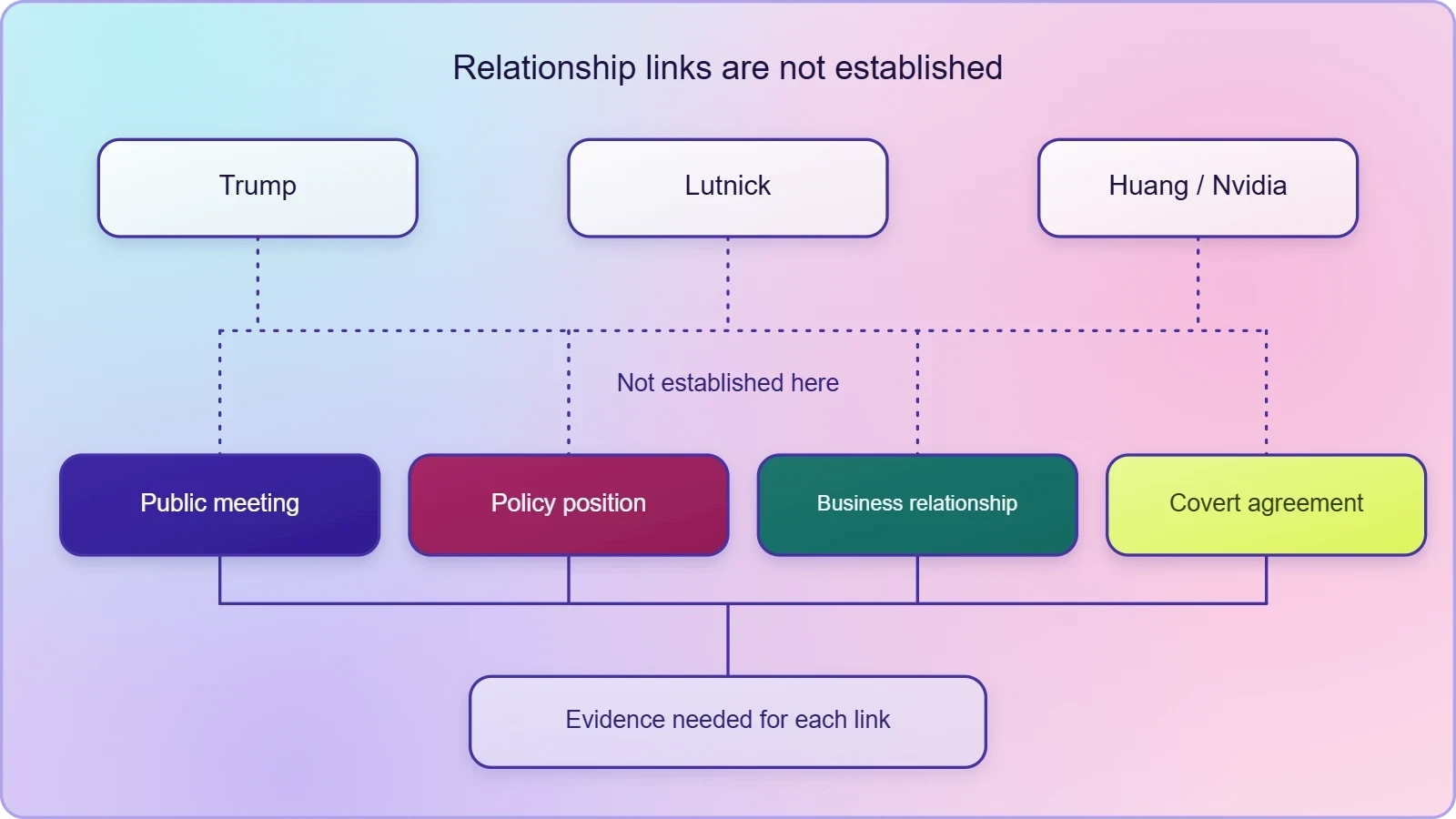
The source groups Trump, Lutnick, and Huang into a supposed “axis,” implying a relationship relevant to an alleged Nvidia espionage event. Yet it does not describe a meeting, agreement, transaction, communication, or shared action that would substantiate the connection. Being named together in an argument is not evidence of coordination. To assess whether a meaningful link exists, reporting would need to establish each person’s specific role, the timeline of relevant decisions, and the records supporting any claimed relationship. Until then, “axis” functions as a rhetorical suggestion, not a verified description.
Assess each person’s role separately
Fair analysis begins by treating each named person and organization separately. What action is attributed to Trump? What official responsibilities or relevant decisions are associated with Lutnick? What conduct is attributed to Huang or Nvidia? The source answers none of these questions in enough detail to evaluate them. It is not sound to transfer suspicion from one person to another merely because their names appear in the same narrative. Specific attribution matters for legal fairness and for public understanding, particularly when the accusation involves spying or betrayal of national interests.
Connections, where they exist, must be described precisely. A public meeting, a policy position, a business relationship, and a covert agreement are different kinds of links, each requiring different evidence and carrying different implications. A timeline can help clarify whether events overlap, but sequence alone does not establish causation. Strong reporting should distinguish confirmed contact from alleged coordination and should state when a connection remains unverified. This standard applies equally to elected leaders, cabinet officials, private executives, and companies, regardless of how prominent or politically controversial they are.
Use a fair standard for serious allegations
Espionage is an exceptionally serious allegation because it implies covert conduct that may violate national-security laws. It should not be presented as fact unless reliable evidence and appropriate findings support that description. Depending on the case, such evidence may be evaluated by investigators, prosecutors, or courts, and some relevant details may not be public. A source that offers no evidence should use cautious terms such as “alleges” or “claims,” identify the limits of what is known, and avoid turning an accusation into a headline that reads like a verdict.
Fairness does not mean suppressing questions or shielding influential people from scrutiny. It means applying consistent standards: provide the basis for the allegation, seek corroboration, request responses, distinguish inference from documentation, and correct errors. If the evidence is incomplete, say so. If a formal authority makes a finding, attribute it accurately and describe its scope. The source’s call for scrutiny can be retained as a question worth examining, while its accusations must remain unverified unless supported by dependable evidence beyond the text itself.
A responsible conclusion: scrutiny without presumption
The source’s strongest defensible message is a demand for accountability where national security, technology exports, corporate influence, and political decision-making may intersect. That concern is worthy of careful examination. Its stronger conclusions—that a spy event occurred, that the named people formed a coordinated axis, or that Trump acted to advance personal interests—are not established by the text. A responsible account should preserve the questions while clearly marking the evidence gap. It should not repeat accusations as facts, imply guilt from nationality, or treat a call for investigation as confirmation of wrongdoing.
What readers can reasonably conclude
From the supplied text alone, readers can conclude that its author distrusts the political handling of an alleged Nvidia-related security issue and wants federal scrutiny. They cannot conclude that Huang or Nvidia spied for China, that Lutnick participated in espionage, that Trump intervened improperly, or that any official agency failed to act. The source gives no verifiable particulars to support those findings. This distinction is not an endorsement of any person or company; it is a straightforward account of what the text does and does not demonstrate.
Readers can also conclude that the subject raises issues suitable for evidence-based inquiry: the rules governing advanced technology exports, the transparency of official decisions, and the safeguards that limit conflicts of interest. Those topics can be explored through reliable reporting, public records, official statements, and, where available, formal legal or oversight findings. A balanced assessment should disclose uncertainty, distinguish allegations from established facts, and update its account when credible new evidence emerges. That approach serves national security and public accountability better than repeating a dramatic claim without substantiation.
How a fair inquiry would proceed
A fair inquiry would begin with a clearly defined allegation and a verified timeline. It would identify relevant transactions, decisions, communications, and laws; establish which agency or oversight body has authority; and separate documented facts from interpretations about motive. It would seek responses from the people and organizations named, respect lawful confidentiality, and assess evidence consistently. If evidence warranted further action, appropriate authorities could determine the next steps. If the claim could not be substantiated, that result should be stated. No outcome should be assumed merely because the allegation is politically compelling.
The source ultimately expresses suspicion and demands vigilance, not a proven account of espionage. Its public-interest concern can be retained without adopting its unsupported conclusions: sensitive technology policy deserves scrutiny, government decision-making should be accountable, and investigations must remain independent and evidence-led. The most credible response is neither to dismiss every concern nor to accept every accusation. It is to ask what can be verified, identify what is missing, and let reliable evidence—not insinuation, identity, or partisan certainty—determine what the record supports.
From our network :
- CISA’s Ten-Advisory Wave: Why Generic Patching Fails in OT and How to Build Product-Specific PlaybooksCISA released ten ICS advisories in one week, exposing critical infrastructure risks. Generic patching fails in OT. Learn to build product-specific remediation playbooks.
- How AI Agents Will Change the Way We Manage Personal FinancesExplore how AI agents are transforming personal finance through automated budgeting, bill payment, and investment management, while examining the critical security protocols and governance frameworks required for safe deployment.
- Forbidden Matrix Patterns and Visible Lattice Points: A Geometric DictionaryExplore how multidimensional 0–1 matrices encode geometric truths, linking forbidden patterns to visible lattice points and hypergraph theory, with applications in combinatorics and computational geometry.
- Live Online English Classes for Kids: Do They Actually Reduce Anxiety?A ten-week study reveals that synchronous online English classes can significantly reduce child language anxiety while improving listening and reading skills. Discover what makes these programs effective and how parents can select the right one.
- Committed Mediterranean Precipitation Decline: Why Emissions Cuts Alone Cannot Restore Winter RainsNew NOAA research reveals that Mediterranean winter rains may decline irreversibly even with emissions cuts. Explore the science of committed climate change and regional impacts.
- Mobile Learning and VR in English: What Global Evidence Reveals About Effective Language TechnologyA systematic review across 14 countries reveals which language-learning technologies genuinely work. Mobile learning, AI, and VR show measurable benefits when pedagogically integrated. This evidence-based guide helps educators and learners select technology that delivers real return on investment.
- The Final Descent: How ESA Retired the Legendary Cluster Constellation After 24 Years of Space Weather ScienceAfter 24 years mapping Earth’s magnetosphere, ESA’s Cluster mission concluded with a precisely controlled reentry over the South Pacific. This analysis explores the scientific legacy, engineering decisions, and debris mitigation principles behind one of space exploration’s most responsible retirements.
- The Hidden Cost of AI Convenience: Why Over-Permissioned Agents Are a Security Time BombDiscover why AI agents with excessive permissions create dangerous single points of failure, and learn how implementing least privilege principles can protect your organization from exploitation.
- University Language Proficiency Exams: Why Institutional Tests Demand Different Preparation Than IELTS and TOEFLDiscover why university-specific language proficiency examinations differ fundamentally from IELTS and TOEFL, and learn strategic preparation approaches for institutional assessment success.
RESOURCES
- Nvidia espionage allegations spark bipartisan scrutiny, raising ...abc7news.com4 days ago ... ... congressional oversight and the growing influence of Silicon Valley in American politics. ... China, publicly defended the Nvidia chief…
- Espionage allegations involving Nvidia CEO Jensen - Facebookfacebook.com4 days ago ... ... congressional oversight and the growing influence of Silicon Valley in American politics. ... Nvidia CEO, Targeted by Chinese Spy…
- Nvidia's Jensen Huang faces Congress scrutiny after affair - CNBCcnbc.comNvidia's CEO turmoil gives newly empowered Democrats fresh ammunition in pursuit of oversight. Published Mon, Nov 9 20267:00 AM EST ... Nvidia CEO Jensen ...
- Steve Inskeep talks to ex-CIA analyst about alleged Nvidia Chinese ...npr.org3 days ago ... NPR's Steve Inskeep talks with former CIA analyst Emily Harding about China's spy tactics in light of the alleged plot…
- Nvidia CEO Jensen Huang and Allegations of a Chinese Espionage ...criminallawlibraryblog.com6 days ago ... Congressional scrutiny and possible government oversight. The controversy has also reached Congress, where members of both political parties ...
- Calls for Nvidia probes, new chip export limits intensify - Roll Callrollcall.com1 day ago ... ... Nvidia chips to China. “There is no reason to do that. That hurts ... “Because otherwise, you're going to…
- 2 key Democrats signal tougher scrutiny of Nvidia chip exportspolitico.com4 days ago ... These negotiations are taking on additional weight amid allegations that Nvidia CEO Jensen Huang was having an affair with a…
- Beyond the spy scandal: What the Nvidia-Megaspeed case reveals ...atlanticcouncil.org2 days ago ... Jensen Huang's departure from Nvidia has drawn attention to alleged Chinese espionage, but the case also brings to light gaps…
- Bessent blames Lutnick's department for Nvidia chip sales to ... - BBCbbc.com20 hours ago ... ... political spectrum to explain his ... Ex-Nvidia CEO Jensen Huang summoned to testify before Congress about affair with alleged…
- Jensen Huang: Security risk or witch hunt? - ThinkChina.sgthinkchina.sg4 days ago ... An extramarital affair involving an alleged Chinese spy puts Nvidia's founder Jensen Huang under intense political scrutiny, testing whether ...
- Huang vs Democrats: 3 Nvidia Oversight Risks [2026] - shattered.ioshattered.ioNov 6, 2026 ... Reporting alleges she has links to Chinese intelligence. That claim remains unconfirmed. This analysis separates what is confirmed from what…
- Nvidia dismisses report alleging Chinese executive tied to CEO ...thehill.comOct 29, 2026 ... Nvidia dismissed claims that CEO Jensen Huang was targeted by a Chinese asset, stating the allegations were thoroughly investigated and ...
- The Nvidia Scandal Is Not a Spy Thriller — It's Corruption - CIPinternationalpolicy.org4 days ago ... ... China's intelligence services read like a spy ... Nvidia, which appear to violate existing rules and dodge congressional oversight.
- GOP senator feels 'strongly' Jensen Huang should resign at Nvidiathehill.com3 days ago ... He was referring to Megaspeed executive and alleged Chinese spy Alice Huang who was accused of illegally smuggling advanced AI…
- Undone by a honey trap? Nvidia's Jensen Huang at heart of China ...france24.com3 days ago ... ... oversight for politicians and boardrooms alike. For the wider world ... Nvidia shares tumble as CEO faces probe over…
- 01
- 02
- 03
- 04
- 05
- 06
- 07
- 08
0 Comments