
The question of whether a green economy can genuinely slow climate change has moved from the margins of environmental debate to the centre of economic policy-making. Earth has already crossed seven of the nine planetary boundaries that regulate the stability of life on this planet, including ocean acidification and biosphere integrity, and that sobering threshold reframes the entire conversation. The green economy proposition is deceptively simple: keep economies growing while cutting emissions and resource consumption, substituting wind, solar and other renewable sources for coal and gas, retrofitting gas-fired furnaces, and closing material loops through recycling and reuse. Yet the gap between that promise and measurable planetary outcomes is where the real analytical work begins.
Helmut Haberl, a social ecology professor at BOKU University in Vienna, captured the tension with unusual candour when he described the green economy as "business as usual, but with more sustainable technologies." That formulation is worth sitting with, because it concedes that the model preserves the underlying growth imperative while changing the technological inputs. Haberl and his colleagues published a major 2020 report evaluating more than 800 studies on green growth, and their conclusion was nuanced rather than dismissive: absolute decoupling of economic output from emissions is technically feasible and has already occurred in several developed economies, but it remains relatively rare and unevenly distributed across the globe.
What follows examines the evidence behind that claim, the sectors where decarbonisation resists easy solutions, and the resource-consumption ceiling that emissions accounting alone tends to obscure. The analysis draws on the empirical record of the United Kingdom, the United States, Japan, Australia and the European Union, where years of growth have coincided with falling carbon dioxide emissions even when offshore production is included, and contrasts that record with India, Africa and Southeast Asia, where efficiency gains are real but absolute emissions continue to climb. The central argument is that a green economy can slow climate change, but only under conditions far more demanding than current policy settings imply.
On This Page
TL;DR A green economy can slow climate change, but the evidence suggests it does so conditionally rather than automatically. Absolute decoupling of growth from emissions has been demonstrated in the EU, the UK, the US, Japan and Australia, yet it remains rare globally, and emissions are still rising in India, Africa and Southeast Asia. Hard-to-abate sectors such as steel, cement and chemicals release carbon as part of their chemistry, not merely their energy use, so substitution demands heavy capital investment. Resource consumption adds a second constraint that emissions metrics alone conceal. The green economy is therefore a necessary framework, not a sufficient one.
The Planetary Boundaries That Frame the Debate
Any serious assessment of the green economy must begin with the physical science, because the boundaries framework establishes the stakes in terms that economics cannot negotiate away. Of the nine planetary boundaries identified by Earth-system scientists, seven have now been transgressed, and the two that remain within safe operating space are under mounting pressure. Ocean acidification and biosphere integrity are not abstract concerns; they describe the chemical and biological conditions under which agriculture, fisheries and freshwater systems have functioned throughout human civilisation. Once those conditions shift, the costs arrive as food insecurity, infrastructure damage and displacement rather than as line items in a quarterly report.
The implication for economic policy is that growth which degrades these systems is borrowing against a future that cannot repay. A green economy attempts to reconcile the two by decoupling output from environmental pressure, but the boundaries framework insists that decoupling must be absolute rather than relative. Relative decoupling, where emissions per unit of GDP fall while total emissions rise, is the pattern observed across much of the developing world and is insufficient to prevent the worst climate impacts. The distinction matters enormously, because it separates genuine progress from the appearance of progress generated by accounting conventions and efficiency statistics.
Why Seven of Nine Boundaries Changes the Calculus
The crossing of seven boundaries means that environmental constraints are no longer hypothetical future risks but present operating conditions. Climate change, biodiversity loss, land-system change, freshwater use, biogeochemical flows, novel entities and ocean acidification all now sit outside the safe zone, and each interacts with the others in ways that amplify risk. Nitrogen and phosphorus loading, for instance, drives both eutrophication and biodiversity decline, while land conversion releases stored carbon and erodes the biosphere's capacity to absorb further emissions. These feedbacks mean that incremental efficiency improvements may be outpaced by cascading system stress.
For economists, this reframes the green economy as a stabilisation project rather than a growth strategy alone. The relevant question is not whether GDP can rise while emissions fall, which has been demonstrated, but whether the throughput of energy and materials can fall fast enough to restore boundary integrity within the available time. That requires treating natural capital as a binding constraint rather than a free input, and it implies that some forms of economic activity must contract even as others expand. The political difficulty of that proposition is considerable, which is precisely why the empirical record deserves close scrutiny.
The Difference Between Relative and Absolute Decoupling
Relative decoupling describes a falling emissions intensity of economic output, and it is the default outcome of industrial modernisation almost everywhere. Absolute decoupling describes a fall in total emissions alongside rising output, and it is far rarer. Haberl's review of more than 800 studies found that complete decoupling has occurred in a limited set of wealthy economies but has not become the global norm. The distinction is not academic: a country can report improving carbon productivity for a decade while its cumulative atmospheric contribution continues to grow, and global emissions are the sum of national totals rather than of national efficiency ratios.
Understanding this gap is essential to evaluating any green growth claim. When the European Union reports economic expansion of more than 70 percent since 1990 alongside a roughly 40 percent reduction in carbon emissions, that is genuine absolute decoupling within the bloc's territory and, on consumption-based measures, largely holds even after accounting for imported goods. When India or Vietnam reports falling energy intensity alongside rising emissions, that is relative decoupling, and it is consistent with rapid development rather than with climate stabilisation. Both observations are true, and neither alone settles the question of whether a green economy can slow climate change at the required pace.
We Also Published
The Empirical Record of Green Growth
The strongest evidence for green growth comes from the industrialised economies that have already achieved sustained absolute decoupling. The United Kingdom, the United States, Japan and Australia have each recorded years of economic expansion alongside declining carbon dioxide emissions, and those declines persist even when emissions embedded in imported goods are attributed to the consuming country. The European Union offers the most cited example, combining economic growth of more than 70 percent since 1990 with a reduction in territorial carbon emissions of roughly 40 percent. These are not projections or modelled scenarios; they are observed outcomes from real economies operating under real policy regimes.
Researchers with the Intergovernmental Panel on Climate Change have reinforced this record through modelled scenarios in which global economic output continues to grow while emissions fall sharply, driven by renewable energy deployment and efficiency improvements. The scenarios have moved from theoretical possibility to demonstrated practice in several regions, which is why the green economy argument carries genuine weight. Yet the same body of evidence contains a cautionary counterpoint: the countries achieving absolute decoupling are a minority, and their success has coincided with the offshoring of energy-intensive manufacturing to economies where emissions are rising.
Europe's Decoupling in Numbers
Europe's performance deserves careful reading because it is frequently invoked as proof that the green economy works at scale. Between 1990 and the present, the bloc's economy expanded by more than 70 percent while territorial carbon emissions fell by around 40 percent, a combination achieved through renewable electricity deployment, efficiency standards, carbon pricing and the gradual retirement of coal generation. Consumption-based accounting, which adjusts for trade, narrows the gap but does not eliminate it, suggesting that a substantial share of the reduction is genuine rather than merely relocated across borders.
The European experience also illustrates the limits of the model. Progress has been fastest in power generation, where wind and solar have displaced fossil fuels at scale, and slower in transport, buildings and heavy industry. Emissions from agriculture have barely moved, and the continent's remaining industrial emitters face the same chemistry problem that confronts steel and cement producers everywhere. Europe has therefore demonstrated that decoupling is achievable in the easier sectors while leaving the harder ones largely untouched, which is a meaningful but partial vindication of the green growth thesis.
Where Emissions Continue to Rise
In India and across several countries in Africa and Southeast Asia, the pattern is different and more complicated. Economic performance is outpacing emissions growth, meaning that energy and carbon intensity per unit of output are improving, but absolute emissions continue to rise as industrialisation, urbanisation and electrification expand access to energy for large populations. This is relative decoupling, and it is broadly consistent with development rather than with climate failure. The difficulty is that global emissions are the sum of national totals, so improvements in intensity in fast-growing economies do not offset the arithmetic of rising absolute volumes.
Haberl's response to this pattern was notably measured: the fact that decoupling has not yet worked everywhere, he argued, does not mean it could not work in the future. That position is defensible on the evidence, since the technologies and policy instruments that delivered decoupling in wealthy economies are available to others and are falling in cost. But it also implies a timeline problem, because the countries where emissions are rising fastest are precisely those with the largest remaining development needs and the least fiscal room to finance a rapid transition away from cheap fossil energy.
The Hard-to-Abate Sectors That Resist Substitution
Even where growth and emissions have decoupled, eliminating all greenhouse gases from polluting industries remains a formidable engineering and financial challenge. Steel, chemicals and cement do not merely release carbon by burning fossil fuels for heat; carbon is embedded in the chemical processes that transform raw materials into products. In cement production, calcium carbonate is calcined to produce clinker, and the carbon dioxide released in that reaction is a stoichiometric consequence of the chemistry rather than a byproduct of the fuel used. No amount of renewable electricity eliminates it, which is why the sector is described as hard to abate.
Replacing that process carbon requires either greener substitutes, such as calcined clay or supplementary cementitious materials, or an alternative reducing agent such as green hydrogen produced from renewable electricity. Both routes demand substantial capital investment, new plant configurations and, in the hydrogen case, enormous volumes of clean power. The economics are further complicated by the fact that cement and steel are traded commodities with thin margins, so producers in jurisdictions with carbon pricing face competitive disadvantage unless border adjustment mechanisms equalise costs. Progress is occurring, but at a pace set by investment cycles rather than by policy ambition.
Process Emissions in Cement and Steel
Cement accounts for a significant share of global emissions, and roughly half of that total originates from the calcination reaction rather than from fuel combustion. Steel presents a parallel problem: blast furnaces use coke both as a fuel and as a reducing agent that strips oxygen from iron ore, and substituting hydrogen for coke changes the entire furnace architecture. These are not efficiency problems amenable to better insulation or smarter controls; they are thermodynamic and chemical constraints that require different production routes altogether, and those routes currently cost more per tonne than the incumbents they would replace.
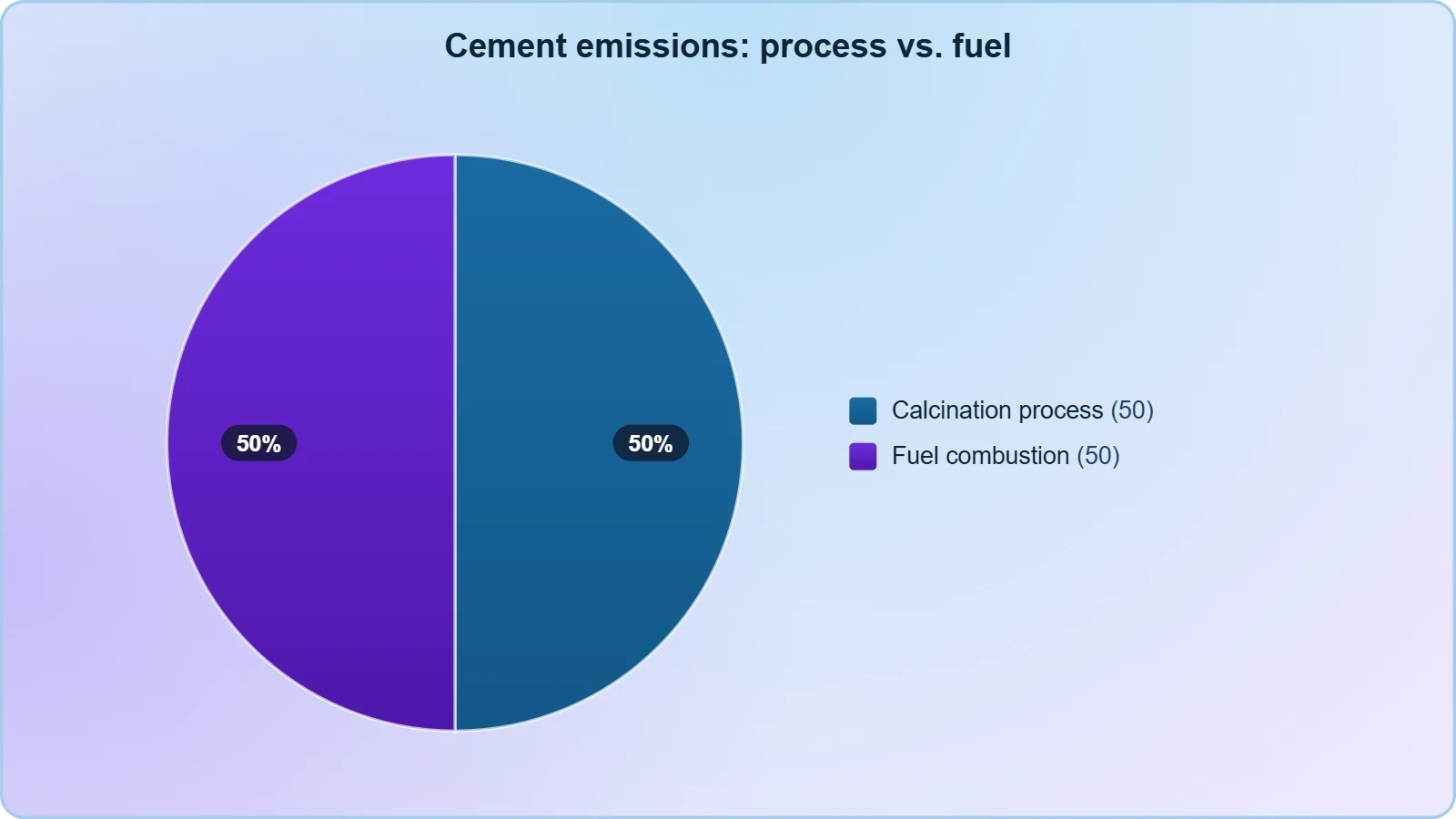
The investment arithmetic is sobering. A single low-emissions steel plant can require billions in capital expenditure, and the assets it replaces have operating lives measured in decades. Producers therefore face a classic stranded-asset dilemma, reluctant to write down existing capacity before the replacement is proven at scale and uncertain whether carbon prices will hold at levels that justify the premium. Public policy can accelerate the transition through contracts for difference, advance market commitments and shared infrastructure for hydrogen and carbon capture, but the underlying requirement is patient capital on a scale that markets alone have not supplied.
Why Hydrogen and Electrification Are Not Panaceas
Green hydrogen is frequently presented as the universal solution for industrial decarbonisation, and it will certainly play a role, but its economics depend on abundant cheap renewable electricity and on electrolyser costs that remain elevated. Converting electricity to hydrogen and back to usable heat or chemical reductant involves substantial energy losses at each stage, so the round-trip efficiency is far below direct electrification. For processes that can be electrified directly, such as low-temperature heat in food processing or paper manufacture, hydrogen is an unnecessarily expensive detour.
Electrification itself faces grid constraints. Replacing gas-fired furnaces with heat pumps, converting transport fleets to electric drivetrains and powering data centres all increase electricity demand simultaneously, and transmission networks, storage capacity and firm low-carbon generation must expand in step. The green economy's technological promise is therefore real but conditional on infrastructure investment that unfolds over decades. Where grids are congested or renewable build-out is slow, electrification simply shifts emissions from the point of use to the power station, delivering accounting improvements without corresponding atmospheric benefit.
- 01
- 02
- 03
- 04
The Resource Consumption Ceiling
Emissions are not the only constraint on the green economy, and treating carbon as the sole metric risks substituting one form of environmental pressure for another. A productive economy depends on a wide array of raw materials: ores, chemicals, wood, sand, glass and agricultural products, each carrying its own extraction footprint, water demand and land-use consequence. Many countries are deploying green technologies to reduce the material intensity of manufacturing, and circular economy strategies around recycling and reuse genuinely lower primary resource demand. But the aggregate trajectory of material consumption remains upward, and efficiency gains have historically been outpaced by rising volumes of production.
This is the resource dimension of the decoupling debate, and it is less tractable than the emissions dimension because renewable energy infrastructure itself requires substantial mineral inputs. Wind turbines, solar panels, batteries and grid equipment depend on copper, lithium, nickel, cobalt and rare earth elements, all of which must be mined, refined and transported. The transition therefore reduces fossil fuel extraction while increasing demand for critical minerals, and the environmental and social costs of that extraction fall disproportionately on producing regions. A green economy that ignores material throughput may simply relocate environmental damage rather than eliminate it.
Material Footprints and Circular Strategies
Circular economy approaches offer the most credible route to reducing primary material demand without sacrificing economic output. Design for disassembly, extended producer responsibility, industrial symbiosis and high-quality recycling all extend the service life of materials and reduce the need for virgin extraction. The European Union's circular economy action plan and similar frameworks in Japan and China have demonstrated that policy can shift material flows, particularly in packaging, electronics and construction. Yet recycling rates for many critical minerals remain low, and downcycling often degrades material quality in ways that limit repeated reuse.
The scale of the challenge becomes clearer when the energy transition's mineral requirements are quantified. Meeting renewable energy and battery targets implies multiplying demand for several critical minerals within a decade or two, a rate of increase that mining projects, which typically take fifteen to twenty years from discovery to production, cannot easily match. Recycling can close part of the gap over the long run, but in the near term the transition is unavoidably extractive. Recognising that trade-off honestly is a precondition for designing policies that manage it rather than pretending it away.
Efficiency Gains and the Rebound Effect
Efficiency improvements occupy a central place in green growth theory, and with good reason: producing more output per unit of energy or material is the mechanism through which decoupling occurs. But efficiency carries a well-documented complication known as the rebound effect, whereby cost savings from greater efficiency are reinvested in additional consumption that partially or wholly offsets the original savings. At the household level, a more efficient appliance may be used more intensively; at the economy-wide level, efficiency gains can lower prices and stimulate demand across sectors, raising aggregate resource use even as intensity falls.
The rebound effect does not invalidate efficiency policy, but it does mean that efficiency alone cannot deliver absolute reductions without complementary measures. Carbon pricing, material caps, consumption-based targets and sufficiency-oriented policies address the demand side that efficiency improvements tend to expand. The green economy's promise of growth with reduced resource use therefore depends on a policy mix that constrains total throughput rather than merely improving the ratio of output to input. Where that mix is absent, efficiency becomes a recipe for doing more with less per unit while doing more overall.
Policy Levers That Determine Whether Green Growth Delivers
The difference between economies that have achieved absolute decoupling and those that have not is largely a matter of policy architecture rather than geography or resource endowment. Carbon pricing, renewable portfolio standards, efficiency mandates, building codes and public investment in grid infrastructure all contributed to the European and British outcomes, and their absence or weakness explains much of the divergence elsewhere. The green economy is therefore not a spontaneous market outcome but a constructed one, dependent on deliberate institutional choices sustained over decades and across electoral cycles.
Policy design matters as much as policy ambition. Carbon prices set too low fail to shift investment in hard-to-abate sectors, while prices set high without border adjustments export emissions and industrial capacity rather than eliminating them. Subsidies for renewable generation have driven dramatic cost reductions in solar and wind, but poorly designed support schemes have sometimes overcompensated mature technologies. The lesson from the empirical record is that instrument choice, sequencing and credibility shape outcomes as decisively as headline targets, and that policy uncertainty deters the long-lived capital investment the transition requires.
Carbon Pricing and Border Adjustments
Carbon pricing remains the most economically efficient instrument for reducing emissions where abatement options exist, because it allows firms and households to identify the cheapest reductions rather than having them dictated by regulators. The European Union's emissions trading system, despite early design flaws that delivered a prolonged period of very low prices, has matured into a meaningful constraint on power and industrial emissions. Complementary mechanisms, including the carbon border adjustment mechanism, extend the price signal to imported goods so that domestic decarbonisation is not simply offset by carbon-intensive production elsewhere.
Border adjustments are politically contentious and administratively complex, requiring accurate accounting of embedded emissions across global supply chains. Yet without them, carbon pricing in open economies risks competitiveness losses and carbon leakage, undermining the political coalition that sustains the policy. The design challenge is to impose the adjustment without erecting protectionist barriers that penalise developing country exporters unable to document or reduce their emissions. Getting this right is essential, because the alternative is a patchwork of national measures that fragments trade and slows the diffusion of clean technology.
Public Investment and the Credibility Problem
Private capital will finance most of the transition, but it will not finance everything, and the gaps cluster precisely where the transition is hardest. Grid expansion, hydrogen infrastructure, carbon transport and storage networks, and first-of-a-kind industrial plants all involve public-good characteristics, long payback periods or technology risk that markets underprovide. Public investment, whether through direct expenditure, guarantees or contracts for difference, reduces the cost of capital for these projects and signals commitment that encourages private co-investment in adjacent assets.
Credibility is the scarce resource. Investors evaluating a twenty-five-year steel plant or a thirty-year offshore wind farm need confidence that carbon prices will hold, that subsidies will not be retroactively withdrawn and that planning consent will not be reversed. Policy reversals in several jurisdictions have raised the risk premium on green investment, slowing deployment even where economics are favourable. The green economy's capacity to slow climate change therefore depends not only on the availability of technology and capital but on the durability of the political settlement that supports them.
What the Evidence Implies for Climate Outcomes
The honest conclusion is that a green economy can slow climate change, but not automatically and not at the pace implied by its most optimistic advocates. The empirical record demonstrates that absolute decoupling is achievable, that renewable energy and efficiency technologies work at scale, and that several major economies have sustained growth while reducing emissions. It also demonstrates that these outcomes are concentrated in wealthy economies, that global emissions continue to rise, and that the hardest industrial sectors remain largely untouched by the technologies that transformed power generation.
Haberl's characterisation of the green economy as business as usual with more sustainable technologies captures both its strength and its limitation. The strength is that it works within existing economic structures, mobilising familiar institutions and market mechanisms rather than requiring their replacement. The limitation is that it leaves the growth imperative and the material throughput that accompanies it largely intact, relying on technological substitution to reconcile expansion with environmental limits. Whether that reconciliation can occur fast enough to restore planetary boundary integrity is the question on which the entire framework turns.
Reconciling Growth With Planetary Limits
Reconciliation requires more than technological substitution, though substitution is indispensable. It requires that decoupling become absolute rather than relative across the global economy, that hard-to-abate sectors receive the capital and policy support needed to change their chemistry, and that material throughput be constrained rather than merely made more efficient. Each of these conditions is achievable in principle, and each has been partially demonstrated somewhere. None has been achieved at the scale and speed the climate requires, and the gap between demonstration and deployment is where the next decade of policy will be decided.
The arithmetic of the remaining carbon budget leaves little room for gradualism. Emissions must fall steeply and continuously, which means that the countries where emissions are still rising must bend their trajectories downward while the countries that have decoupled must accelerate. That combination is conceivable within a green growth framework, but it depends on finance flowing from wealthy to developing economies, on technology transfer that is genuinely accessible rather than merely available, and on international cooperation that has proven difficult to sustain. The green economy provides the toolkit; whether it is used at the necessary scale remains a political question.
A Conditional Verdict
A conditional verdict is the most defensible one. The green economy can slow climate change where policy is credible, investment is sustained, and the harder sectors are addressed with instruments suited to their chemistry rather than to the easier wins in power generation. It cannot do so where growth is pursued without regard to material throughput, where carbon prices remain too low to shift industrial investment, or where the countries with the fastest-rising emissions lack the finance to transition. The framework is necessary but not sufficient, and treating it as sufficient is the most reliable way to ensure it fails.
What distinguishes the successful cases is not superior technology or favourable geography but institutional persistence. The economies that decoupled did so because they maintained policy direction across changes of government, invested in infrastructure that markets would not finance, and accepted short-term costs for long-term benefit. That is a transferable lesson, and it is more useful than any single technology or target. The green economy's capacity to slow climate change will be determined less by the ingenuity of its engineers than by the durability of its political settlements and the honesty with which its trade-offs are acknowledged.
From our network :
- Live Online English Classes for Kids: Do They Actually Reduce Anxiety?A ten-week study reveals that synchronous online English classes can significantly reduce child language anxiety while improving listening and reading skills. Discover what makes these programs effective and how parents can select the right one.
- The Hidden Cost of AI Convenience: Why Over-Permissioned Agents Are a Security Time BombDiscover why AI agents with excessive permissions create dangerous single points of failure, and learn how implementing least privilege principles can protect your organization from exploitation.
- CISA’s Ten-Advisory Wave: Why Generic Patching Fails in OT and How to Build Product-Specific PlaybooksCISA released ten ICS advisories in one week, exposing critical infrastructure risks. Generic patching fails in OT. Learn to build product-specific remediation playbooks.
- Committed Mediterranean Precipitation Decline: Why Emissions Cuts Alone Cannot Restore Winter RainsNew NOAA research reveals that Mediterranean winter rains may decline irreversibly even with emissions cuts. Explore the science of committed climate change and regional impacts.
- Mobile Learning and VR in English: What Global Evidence Reveals About Effective Language TechnologyA systematic review across 14 countries reveals which language-learning technologies genuinely work. Mobile learning, AI, and VR show measurable benefits when pedagogically integrated. This evidence-based guide helps educators and learners select technology that delivers real return on investment.
- How AI Agents Will Change the Way We Manage Personal FinancesExplore how AI agents are transforming personal finance through automated budgeting, bill payment, and investment management, while examining the critical security protocols and governance frameworks required for safe deployment.
- University Language Proficiency Exams: Why Institutional Tests Demand Different Preparation Than IELTS and TOEFLDiscover why university-specific language proficiency examinations differ fundamentally from IELTS and TOEFL, and learn strategic preparation approaches for institutional assessment success.
- The Final Descent: How ESA Retired the Legendary Cluster Constellation After 24 Years of Space Weather ScienceAfter 24 years mapping Earth’s magnetosphere, ESA’s Cluster mission concluded with a precisely controlled reentry over the South Pacific. This analysis explores the scientific legacy, engineering decisions, and debris mitigation principles behind one of space exploration’s most responsible retirements.
- Forbidden Matrix Patterns and Visible Lattice Points: A Geometric DictionaryExplore how multidimensional 0–1 matrices encode geometric truths, linking forbidden patterns to visible lattice points and hypergraph theory, with applications in combinatorics and computational geometry.
RESOURCES
- Is green growth happening? An empirical analysis of achieved ...thelancet.com... decoupling reflects both physical and monetary changes in the economy. ... 17. Antal, M ∙ Van Den Bergh, JC. Green growth and climate…
- Decoupling debunked – Evidence and arguments against green ...eeb.orgIs it possible to enjoy both economic growth and environmental sustainability? This question is a matter of fierce political debate between green growth and ...
- Decoupling in the IPCC AR6 WGIII - Timothée Parriquetimotheeparrique.comApr 8, 2022 ... ... economic competitiveness” (TS p.65, bold in original). Tags climate change, decoupling, degrowth, green growth, IPCC, mitigation · ← Degrowth ...
- Full article: Decoupling economic growth from climate changetandfonline.comMar 29, 2025 ... 230) decoupling is “the correlation of synchronous changes between economic development and industrial pollution emissions”; and expressed in ...
- Decoupling debunked: Why green growth is not enough - EEBeeb.orgJul 8, 2019 ... Is economic growth compatible with ecological sustainability? A new report shows that efforts to decouple economic growth from environmental ...
- Global mapping of city-level economic growth decoupling from fossil ...nature.comMay 11, 2026 ... In response to climate change ... Although green growth in the strict sense requires absolute reductions in environmental pressures alongside ...
- Why 'decoupling' energy emissions from economic growth ...theconversation.comMar 20, 2026 ... According to analysis from a thinktank called the Energy & Climate Intelligence Unit, economies responsible for roughly 92% of global…
- Can green economic growth and carbon emission reduction coexist ...sciencedirect.comDegrowth strategies may be needed to fulfil climate goals in the energy sector. Abstract. Decoupling greenhouse gas (GHG) emissions from economic growth has ...
- Decoupling and green growth* | Carbone 4carbone4.comThe term “decoupling” is usually used to mean the possibility of economic growth, measured by rise in GDP, that takes place simultaneously with a…
- The decoupling the world is waiting for: China's green growth ...brookings.eduFeb 4, 2020 ... If China succeeds, it will not only play an enormous role in combatting global climate change, but also solidify improvements…
- How to think about the prospects of truly green growth | Aeon Essaysaeon.coMay 7, 2024 ... The basic idea is that economic growth can continue and literally decouple, or part ways, with material growth and environmental…
- Circular economy introduction - Ellen MacArthur Foundationellenmacarthurfoundation.orgThe circular economy tackles climate change and other global challenges ... decoupling economic activity from the consumption of finite resources. The ...
- Is green growth happening? - Uneven Earthunevenearth.orgApr 29, 2021 ... by Timothée Parrique If you follow discussions about climate change, you must have heard of decoupling. The term refers to…
- 92% of the global economy is decoupling emissions from growtheciu.netDec 10, 2025 ... By Frances Green. info@eciu ... "Net zero remains the only solution to halting ever more costly and dangerous impacts from…
- Eco-economic decoupling - Wikipediaen.wikipedia.orgIn economic and environmental fields, decoupling refers to an economy that would be able to grow without corresponding increases in environmental pressure.
- 01
- 02
- 03
- 04
- 05
- 06
- 07
- 08
0 Comments