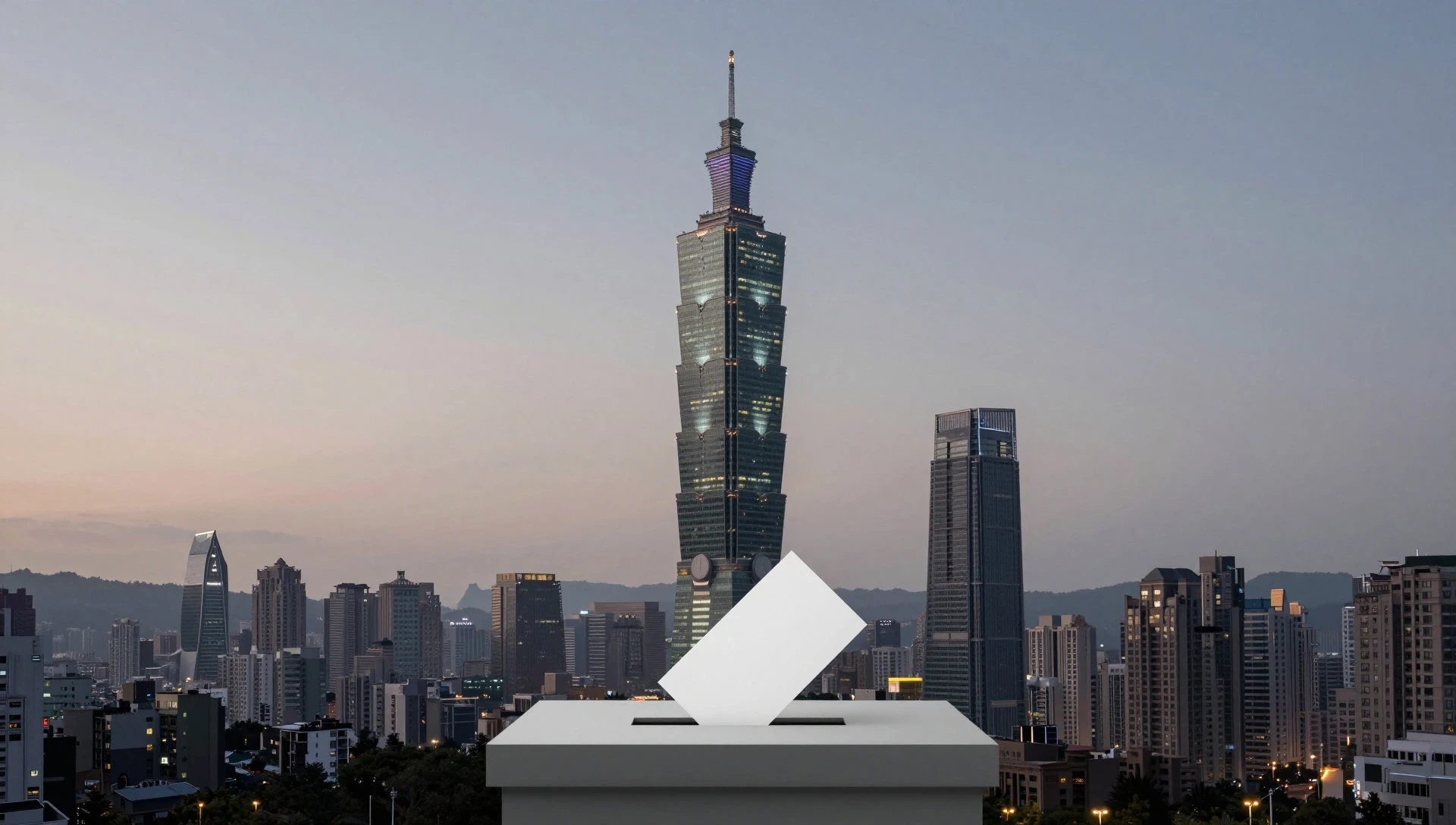
Taipei's mayoral contest has long functioned as a barometer for the broader political weather across the Taiwan Strait, and the re-election of incumbent Chiang Wan-an in a closely watched race offers a revealing snapshot of how the island's capital weighs continuity against confrontation. The result, reported by France 24 and dated to a Saturday vote held alongside local elections across Taiwan, placed Chiang—a figure associated with the Kuomintang—ahead of Puma Shen, a candidate whose public profile was built substantially on a critical stance toward Beijing. The margin was narrow enough to invite competing interpretations, yet decisive enough to hand the incumbent another term.
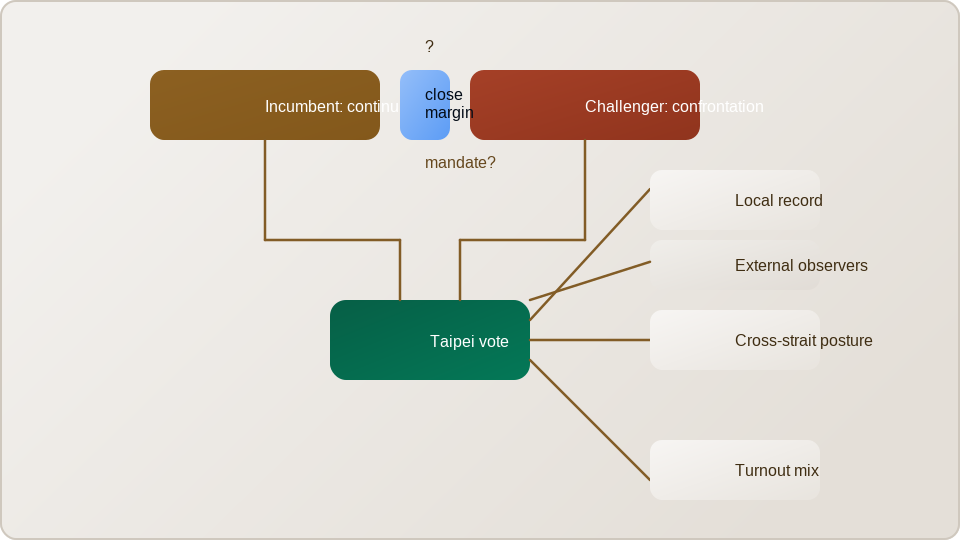
What makes this particular municipal election analytically interesting is the way it compresses several distinct questions into a single ballot. Voters were simultaneously judging a sitting mayor's record on housing, transport, and urban governance; signaling their comfort or discomfort with cross-strait engagement; and casting a verdict on the opposition's ability to convert ideological clarity into electoral arithmetic. The contest between Chiang and Shen therefore operated on at least two registers at once—the practical and the geopolitical—and the outcome suggests that in Taipei, competence narratives retain real purchase even when national identity questions dominate the headlines.
Understanding the significance requires situating the vote within Taiwan's unusual political architecture, where local elections frequently serve as midterm referenda on the ruling party in power nationally. The capital carries outsized symbolic weight: it is the seat of government, the media center, and the stage on which national politicians rehearse future campaigns. A mayoral race here is never merely municipal. It is read in Beijing, in Washington, and in every provincial capital with a stake in the stability of the Taiwan Strait, which is why a result framed as a "close race" by international outlets deserves closer examination than the headline alone conveys.
On This Page
TL;DR Taipei Mayor Chiang Wan-an secured re-election in a tight contest against China critic Puma Shen, part of island-wide local elections in Taiwan. The result blends municipal governance with cross-strait signaling, reinforcing the Kuomintang's foothold in the capital while leaving the opposition's national trajectory uncertain. The narrow margin underscores a polarized electorate, the enduring weight of incumbency, and the degree to which local ballots function as proxies for Taiwan's larger identity debate.
The Political Architecture of a Taipei Mayoral Race
Taipei occupies a peculiar position in Taiwan's electoral map. It is simultaneously the most cosmopolitan municipality on the island and one of the most ideologically contested, a place where white-collar professionals, civil servants, students, and long-established neighborhood networks coexist within a single jurisdiction. Mayoral campaigns here must therefore speak to vastly different constituencies at once, and the candidate who wins is typically the one who manages to frame local service delivery as inseparable from a broader vision of the city's place in the world. Chiang Wan-an's re-election fits that pattern, suggesting his campaign successfully translated incumbency into a narrative of steadiness.
The structural advantage of incumbency in Taiwanese municipal politics is well documented. Sitting mayors command the machinery of local government, control the timing of visible infrastructure announcements, and benefit from name recognition that challengers must spend months and considerable resources to match. Against that backdrop, Puma Shen's ability to force a close race is itself noteworthy, indicating that ideological positioning around China policy can mobilize a substantial bloc even in a city where pragmatic governance messaging usually prevails. The contest thus revealed both the durability of incumbency and the ceiling on purely ideological campaigns.
How Local Ballots Become National Signals
Taiwanese voters have grown accustomed to reading local elections as national omens, and the media ecosystem reinforces that habit. When a mayoral result is announced, commentary immediately pivots to what it implies for presidential and legislative contests two years hence. This interpretive reflex is not irrational: local elections aggregate preferences across the entire electorate and often reveal shifts in turnout among younger voters, swing constituencies, and party-aligned blocs. Analysts therefore treat municipal outcomes as leading indicators, even when the candidates themselves insist their mandates are strictly local.
The risk in this framing is overreading. A narrow mayoral win may reflect candidate quality, a specific scandal, or a well-run ground operation rather than a wholesale verdict on national policy. Still, the symbolic capital of the capital city means that perceptions matter as much as mechanics. Chiang's victory will be cited by his party as evidence that its approach to cross-strait relations retains appeal, while his opponents will argue the margin was too thin to constitute a mandate. Both readings will shape the political conversation for months.
The Candidates and Their Contrasting Appeals
Chiang Wan-an entered the race with the advantages of incumbency and a governing record to defend, campaigning largely on continuity and administrative competence. Puma Shen positioned himself as a sharper critic of Beijing, appealing to voters who prioritize democratic resilience and are skeptical of engagement strategies that might soften the island's defensive posture. The contrast was stark: one candidate promising competent management within existing frameworks, the other arguing that the frameworks themselves required vigilance. In a close race, the balance between these appeals becomes the central analytical question.
What the result suggests is that Taipei's electorate is not monolithic. A substantial share responded to Shen's warnings, enough to make the contest competitive, but not enough to dislodge an incumbent whose local record carried weight. This split reflects a broader pattern in Taiwanese politics, where identity concerns and governance concerns pull in different directions and voters weigh them differently depending on age, occupation, and neighborhood. The candidates' contrasting appeals mapped onto those cleavages with unusual clarity.
Cross-Strait Dynamics and the Meaning of a Close Margin
Few municipal elections anywhere carry the geopolitical freight of a Taipei mayoral race. Beijing watches the island's local contests for signals about the durability of its preferred engagement channels, while Washington and regional capitals monitor them for indications of how Taiwan's electorate is calibrating its security posture. A candidate explicitly identified as a critic of China performing strongly is a data point that analysts in multiple capitals will weigh carefully. The closeness of the race, rather than its outcome alone, is what makes it analytically rich.
Chiang's association with the Kuomintang matters here. The party has historically positioned itself as the steward of cross-strait dialogue, arguing that stable channels of communication reduce the risk of miscalculation. That argument retains a constituency in Taipei, particularly among voters whose livelihoods or family networks span the strait. Yet the strength of Shen's challenge demonstrates that skepticism toward engagement is not a fringe position. The electorate appears to be hedging, rewarding continuity while simultaneously registering unease—a posture that mirrors the broader ambivalence of Taiwanese public opinion.
Reading the Result Through Beijing's Lens
From Beijing's perspective, an incumbent victory by a Kuomintang-affiliated mayor is likely to be characterized as evidence that its preferred approach retains traction in the capital. Official commentary will probably emphasize the rejection of what it frames as confrontational politics. However, analysts should treat such characterizations with caution, since the margin was narrow and the challenger's ideological profile was precisely what made the race competitive. A close result can be spun in multiple directions, and the interpretive contest often matters as much as the ballot itself.
The more substantive question is whether the outcome affects the practical channels of municipal exchange that Taipei maintains with mainland cities. Cultural, commercial, and civic ties have historically operated below the level of national politics, and mayors have discretion over how actively they cultivate them. Chiang's re-election likely preserves the status quo on these fronts, but the narrow mandate may constrain how far he can push engagement without inviting domestic backlash. That tension between opportunity and constraint will define his second term.
What the Opposition Learns From a Near Miss
For Puma Shen and the broader camp he represents, a close loss carries strategic information. It confirms that a campaign centered on vigilance toward Beijing can mobilize substantial support in the capital, but it also reveals the limits of that appeal when facing an incumbent with a defensible record. The lesson for the opposition is likely to be about sequencing: ideological clarity must be paired with credible answers on housing, transit, and the everyday concerns that dominate municipal politics. Candidates who can fuse the two will be formidable in future contests.
The near miss also raises questions about coalition management. Taiwan's opposition landscape is fragmented, and the ability to consolidate support behind a single challenger often determines outcomes. If the Shen campaign drew support primarily from one ideological segment while failing to reach swing voters, the result points toward a structural ceiling that must be addressed. Conversely, if the margin was eroded by late-breaking local factors, the strategic implications are different. Disentangling these threads will occupy party strategists for months.
The Governance Record Behind the Ballot
Beneath the geopolitical commentary lies a straightforward municipal reality: mayors are judged on whether the city works. Taipei's challenges are familiar to any dense Asian metropolis—housing affordability, aging infrastructure, traffic congestion, air quality, and the fiscal pressures of maintaining world-class public services. Chiang Wan-an's first term would have been assessed against these benchmarks, and his re-election implies that a sufficient share of the electorate concluded the city was being managed competently. That verdict, however narrow, is the foundation on which any broader political reading must rest.
Urban governance in Taipei also carries distinctive political weight because the city's residents are among the most educated and internationally connected in the region. They compare their city not only to other Taiwanese municipalities but to Seoul, Singapore, and Tokyo. Mayors who fail to deliver visible improvements in livability face consequences regardless of their national political alignment. This accountability mechanism is often overlooked in coverage that treats local elections purely as referenda on cross-strait policy, yet it may be the single most important variable in explaining why incumbents tend to prevail.
Housing, Transit, and the Everyday Mandate
Housing affordability has emerged as a defining issue in Taipei, where property prices relative to median incomes rank among the least affordable in the developed world. Mayoral administrations have experimented with social housing targets, rental subsidies, and zoning reforms, with mixed results. Voters who feel the squeeze directly are unlikely to be swayed by foreign policy arguments if their rent continues to climb. Any incumbent seeking re-election must therefore demonstrate measurable progress, or at least a credible plan, on this front.
Transit and urban mobility form the second pillar of the everyday mandate. Taipei's metro system is widely admired, but questions of expansion, accessibility, and integration with surrounding municipalities persist. Mayors who invest political capital in unglamorous infrastructure often reap electoral rewards precisely because the benefits are tangible. The contrast between a challenger campaigning on national themes and an incumbent able to point to concrete improvements is a recurring feature of municipal politics, and it likely shaped voter calculations in this race.
Why Competence Narratives Still Matter
There is a temptation, particularly in international coverage, to reduce Taiwanese elections to a single axis of identity. That framing misses the texture of local politics, where potholes, school placements, and park maintenance genuinely move votes. Competence narratives matter because they offer voters a way to support a candidate whose national positions they may not fully endorse. A mayor who is seen as effective can build coalitions that transcend party lines, and that cross-cutting appeal is precisely what makes incumbents difficult to defeat.
The corollary is that challengers must do more than articulate a worldview. They must persuade voters that they can run a complex municipal bureaucracy, negotiate with a fractious city council, and deliver results within a four-year horizon. Puma Shen's strong showing suggests he made progress on this front, but the gap indicates he did not fully close it. Future opposition campaigns will need to pair ideological clarity with granular policy credibility if they hope to convert near misses into victories.
Taiwan's Local Elections as a National Barometer
Taiwan holds local elections on a cycle that deliberately interleaves with national contests, creating a rhythm in which municipal results are endlessly mined for national meaning. This structure has consequences: it incentivizes voters to treat local ballots as protest votes or endorsements, and it encourages parties to nationalize campaigns that might otherwise turn on local records. The Taipei race exemplifies the dynamic, with international coverage framing the outcome primarily through the lens of cross-strait relations rather than urban policy. That framing is understandable but incomplete.
Comparative scholarship on local elections in polarized democracies suggests that voters often split their ballots, supporting one party locally and another nationally. This behavior reflects a sophisticated separation of concerns, allowing citizens to reward competent governance while registering ideological preferences elsewhere. If Taipei's electorate behaves similarly, the close mayoral result may say less about national sentiment than about the specific strengths and weaknesses of the two candidates. Analysts should resist the urge to extrapolate too confidently from a single municipal contest.
The Turnout Question and Its Hidden Signals
Turnout is the variable that often determines close races, and its composition matters as much as its level. If younger voters turned out in higher numbers for the challenger while older voters consolidated behind the incumbent, the aggregate margin can mask significant demographic shifts. Exit polling and precinct-level data, where available, allow analysts to reconstruct these patterns. The headline "close race" conceals a more textured story about which segments of the electorate moved and why, and that story will inform future campaign strategies.
Differential turnout also affects how results are interpreted politically. A narrow win achieved with depressed turnout in opposition strongholds tells a different story than a narrow win achieved amid high overall participation. Without granular data, commentators risk drawing sweeping conclusions from incomplete evidence. Responsible analysis therefore treats the result as one data point among many, to be weighed alongside legislative performance, public opinion polling, and the trajectory of cross-strait tensions over the coming months.
Implications for the Next National Cycle
Every local election in Taiwan is scrutinized for what it portends for the next presidential and legislative contests. Chiang's re-election will be cited as evidence that the Kuomintang remains competitive in the capital, a necessary condition for any national victory. Yet the narrow margin also signals vulnerability: a party that wins the capital by a slim margin while facing a mobilized opposition cannot assume smooth sailing. The result sets the stage for a contested national cycle in which both camps can claim momentum.
For the governing party nationally, the Taipei result may serve as a warning about the limits of ideological mobilization without corresponding local delivery. For the opposition, it offers encouragement alongside a reminder that near misses do not translate automatically into wins. The strategic environment is therefore fluid, and the next two years will be shaped by how each camp interprets and responds to this ambiguous signal. In that sense, the election's most important consequences are yet to unfold.
Similar Posts
- 01
- 02
- 03
- 04
Media Framing and the Politics of Interpretation
International coverage of Taiwanese elections tends to compress complex local dynamics into a single narrative frame, and the France 24 report is illustrative. By foregrounding the challenger's identity as a "critic of China" and describing the race as "close," the reporting establishes a lens through which readers interpret the result. This is not a criticism of the outlet so much as an observation about how foreign correspondence works: limited space, unfamiliar audiences, and the need for immediate legibility push coverage toward familiar binaries. The consequence is that nuance about municipal governance rarely survives the journey to international readers.
Domestic Taiwanese media operate under different constraints, balancing partisan alignments with commercial pressures and a highly engaged audience. The result is a fragmented information environment in which the same election can be presented as a triumph, a warning, or a stalemate depending on the outlet. For analysts, this fragmentation is itself a data source, revealing how political actors and their media allies choose to frame ambiguous outcomes. The battle over interpretation often continues long after the ballots are counted.
How Headlines Shape Perceived Mandates
The phrase "wins re-election" carries an implicit claim about legitimacy, while the qualifier "close race" immediately complicates it. Together they produce a headline that is factually accurate but interpretively open, allowing partisans on both sides to find support for their preferred reading. This is characteristic of election coverage in polarized environments, where the same words can be mobilized for opposing purposes. Readers who encounter only headlines absorb a framing without the underlying evidence needed to evaluate it.
For scholars of political communication, such dynamics are familiar. The framing of an election result influences how citizens understand the legitimacy of the winner and the prospects of the loser, which in turn shapes future political behavior. A result framed as a narrow escape may energize the opposition and constrain the victor, while a result framed as a decisive mandate may do the opposite. The media's interpretive choices therefore have real consequences beyond the news cycle.
Verification and the Limits of Single-Source Reporting
Single-source reporting on foreign elections carries inherent limitations. Details such as exact vote shares, turnout figures, and the composition of the electorate require corroboration from multiple outlets and official electoral commissions. Readers seeking a rigorous understanding should consult the Central Election Commission's published data alongside international coverage. This is not to question the accuracy of any particular report but to acknowledge that election analysis benefits from triangulation across sources with different access and different audiences.
The broader lesson is about epistemic humility. Elections are complex events with multiple causal threads, and any single account will emphasize some and neglect others. The most reliable understanding emerges from comparing accounts, examining primary data, and remaining attentive to what is omitted as much as what is included. In the case of Taipei's mayoral race, the available reporting establishes the essential facts—who won, against whom, and by what kind of margin—while leaving the deeper interpretive questions open.
What the Result Means for Taipei's Next Four Years
With a second term secured, Chiang Wan-an faces the challenge that confronts every re-elected mayor: converting a narrow victory into governing space. A close margin can embolden a city council to extract concessions, empower neighborhood associations to press demands, and signal to national party leaders that the mayor's coattails are limited. The next four years will therefore test whether Chiang can build coalitions beyond his electoral base and deliver on the promises that secured his win. The political capital he holds is real but finite.
On cross-strait matters, the mayor's room for maneuver is constrained by national policy and by the narrowness of his mandate. He may continue to cultivate municipal exchanges where they exist, but any move perceived as too accommodating could provoke domestic backlash. Conversely, a retreat from engagement would disappoint constituencies that value stability. Navigating this terrain requires a delicacy that municipal politics rarely demands, and how Chiang handles it will shape his national profile as much as his local legacy.
Priorities for the Second Term
Housing policy is likely to dominate the second term, both because the problem is acute and because it offers visible opportunities for progress. Expanding social housing, reforming rental markets, and accelerating urban renewal are all areas where a mayor can claim measurable achievements. Transit expansion and environmental improvements will also feature, particularly if they can be tied to quality-of-life gains that voters experience daily. The mayor's team will be judged on whether these initiatives move from announcement to implementation within the term.
Fiscal management will be the quiet constraint on all of this. Taipei's budget must accommodate ambitious social programs while maintaining the infrastructure investments that residents expect. Mayors who overpromise and underdeliver pay a price at the next election, and Chiang has now experienced how narrow the margin can be. A disciplined approach that prioritizes a few high-impact initiatives over a sprawling agenda may prove more politically durable than an expansive list of commitments.
The Longer Arc of Taiwanese Politics
Zooming out, the Taipei result is one tile in a larger mosaic that will only become legible over the coming years. Taiwan's political landscape is shaped by generational change, economic restructuring, and the evolving posture of major powers toward the island. Local elections provide periodic snapshots, but the underlying trends unfold slowly. Analysts who fixate on a single contest risk missing the forest for the trees, while those who ignore local results miss early signals of change.
The most defensible conclusion is that Taipei's electorate remains closely divided, that incumbency retains substantial value, and that cross-strait identity questions are potent but not decisive in municipal contexts. These findings will be tested in future elections and against new evidence. For now, they offer a working framework for understanding a result that resists simple categorization—a close race won by an incumbent, in a city that matters far beyond its boundaries.
From our network :
- The Hidden Cost of AI Convenience: Why Over-Permissioned Agents Are a Security Time BombDiscover why AI agents with excessive permissions create dangerous single points of failure, and learn how implementing least privilege principles can protect your organization from exploitation.
- Committed Mediterranean Precipitation Decline: Why Emissions Cuts Alone Cannot Restore Winter RainsNew NOAA research reveals that Mediterranean winter rains may decline irreversibly even with emissions cuts. Explore the science of committed climate change and regional impacts.
- Forbidden Matrix Patterns and Visible Lattice Points: A Geometric DictionaryExplore how multidimensional 0–1 matrices encode geometric truths, linking forbidden patterns to visible lattice points and hypergraph theory, with applications in combinatorics and computational geometry.
- The Final Descent: How ESA Retired the Legendary Cluster Constellation After 24 Years of Space Weather ScienceAfter 24 years mapping Earth’s magnetosphere, ESA’s Cluster mission concluded with a precisely controlled reentry over the South Pacific. This analysis explores the scientific legacy, engineering decisions, and debris mitigation principles behind one of space exploration’s most responsible retirements.
- How AI Agents Will Change the Way We Manage Personal FinancesExplore how AI agents are transforming personal finance through automated budgeting, bill payment, and investment management, while examining the critical security protocols and governance frameworks required for safe deployment.
- University Language Proficiency Exams: Why Institutional Tests Demand Different Preparation Than IELTS and TOEFLDiscover why university-specific language proficiency examinations differ fundamentally from IELTS and TOEFL, and learn strategic preparation approaches for institutional assessment success.
- CISA’s Ten-Advisory Wave: Why Generic Patching Fails in OT and How to Build Product-Specific PlaybooksCISA released ten ICS advisories in one week, exposing critical infrastructure risks. Generic patching fails in OT. Learn to build product-specific remediation playbooks.
- Mobile Learning and VR in English: What Global Evidence Reveals About Effective Language TechnologyA systematic review across 14 countries reveals which language-learning technologies genuinely work. Mobile learning, AI, and VR show measurable benefits when pedagogically integrated. This evidence-based guide helps educators and learners select technology that delivers real return on investment.
- Live Online English Classes for Kids: Do They Actually Reduce Anxiety?A ten-week study reveals that synchronous online English classes can significantly reduce child language anxiety while improving listening and reading skills. Discover what makes these programs effective and how parents can select the right one.
RESOURCES
- Battle for the Capital: Inside the 2026 Taipei Mayoral Race, Part 2globaltaiwan.org4 days ago ... As the incumbent Taipei mayor, Chiang Wan-an (蔣萬安) of the Kuomintang (KMT, 中國國民黨) faces immense pressure to succeed in his…
- KMT's Chiang Wan-an declares victory in Taipei mayoral reelection ...focustaiwan.tw2 hours ago ... Taipei Mayor Chiang Wan-an (蔣萬安) of the Kuomintang (KMT) declared victory in Saturday's mayoral election over his Democratic Progressive ...
- Battle for the Capital: Inside the 2026 Taipei Mayoral Race, Part 1globaltaiwan.orgOct 30, 2026 ... The KMT incumbent, Chiang Wan-an, was initially viewed as a strong favorite to win re-election; however, the DPP challenger, Puma…
- Taipei's mayoral election will not change Taiwan's courseeastasiaforum.org17 hours ago ... ... mayoral candidates, the Democratic Progressive Party's Puma Shen and the Kuomintang's Chiang ... Taipei Mayor Chiang Wan-an for re-election.
- Ruling party makes gains in Taiwan local elections watched by Chinareuters.com16 hours ago ... In Taipei, the KMT's mayor Chiang Wan-an won a tough reelection battle with the DPP's Puma Shen, an academic-turned-lawmaker and…
- 2026 Elections: Shen launches 'policy island' as Chiang rallies alliestaipeitimes.comOct 25, 2026 ... ... re-election, prepares to open his campaign headquarters tomorro. ... Taipei Mayor Chiang Wan-an speaks to reporters in Taipei yesterday.
- Post - Xx.com3 hours ago ... Chiang Wan-an, the candidate for Taiwan's opposition Kuomintang party (KMT), has secured re-election in the mayoral race for the capital, ...
- 2026 Elections: Candidates make final call for support - Taipei Timestaipeitimes.com24 hours ago ... Taipei Mayor Chiang Wan-an, center, who is seeking re-election, speaks at his campaign rally in Taipei last night. Photo: AFP.…
- Taipei mayor gets angry reception at Pride after gay bar raid - Reutersreuters.comOct 31, 2026 ... Taipei Mayor Chiang Wan-an, in a close race for re-election, got an angry reception on Saturday when he briefly showed…
- Chiang Wan-an - Wikipediaen.wikipedia.orgHe successfully ran for re-election in the 2026 Taipei mayoral election, defeating DPP candidate Puma Shen.
- Rivals in Taipei mayoral race rally on eve of elections - France 24france24.com1 day ago ... I'm confident," Chien Lee told AFP. Underdog. Flags printed with pictures ...
- Could Taipei's unexpectedly tight mayoral race add to cross-strait ...scmp.comNov 1, 2026 ... Taipei Mayor Wayne Chiang Wan-an faces an unexpectedly tough re-election fight in a race closely watched for its potential to…
- Taipei Mayor Chiang Wan-an Defends His Record Against a ...english.cw.com.twNov 10, 2026 ... This reelection race has been harder than expected. Online, Chiang has been mocked with nicknames such as “Empty An” (空安)…
- KMT holds Taipei as Mayor Wayne Chiang fends off fierce DPP ...scmp.com4 hours ago ... Chiang's re-election over Puma Shen gives the main opposition party a vital boost ahead of Taiwan's 2028 race ... Taipei…
- Puma Shen, Critic of China, Could be the Next Mayor of Taipeinytimes.com1 day ago ... ... Taipei's city council who is campaigning for re-election, said in an interview this week. He thought Mr. Chiang had…
Related By Tags
- 01
- 02
- 03
- 04
- 05
- 06
- 07
- 08
0 Comments