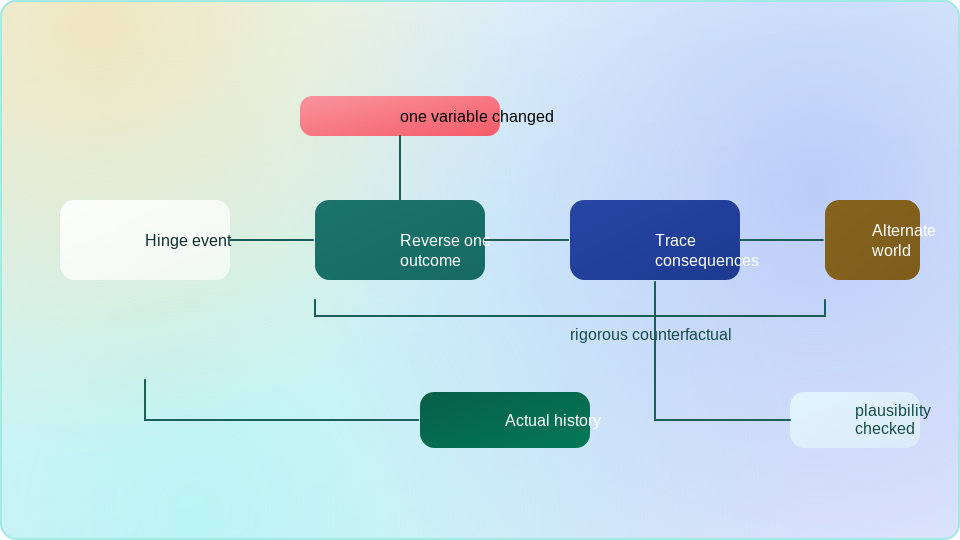
Alternative history is the disciplined art of asking what might have happened had a single decisive moment resolved differently, and it has quietly become one of the most revealing ways we interrogate the past. The premise is deceptively simple: identify a hinge in recorded events, reverse its outcome, and trace the consequences forward with as much rigour as the imagination allows. Yet the form is far more than a parlour game for speculative minds. It exposes the assumptions historians carry about causation, the narrative instincts novelists cultivate, and the deep human discomfort with the idea that history might be contingent rather than destined.
The genre's reach extends well beyond science fiction shelves. Philip K. Dick's The Man in the High Castle and Robert Harris's Fatherland both imagine Axis victories, but they differ sharply in method and intent. Dick uses the premise to destabilise reality itself, layering forged documents and competing narratives until the reader cannot trust any version of events. Harris, by contrast, reconstructs a chillingly plausible bureaucratic state, complete with its own internal logic and administrative texture. Between these poles lies an entire spectrum of counterfactual writing, from scholarly thought experiments to fantasy epics that redraw the map of continents.
What unites these disparate works is a shared conviction that history is not a single fixed channel but a river with many possible courses. Writers and historians approach that conviction from opposite banks. The historian asks whether a different outcome was genuinely possible given the structural forces at play, while the novelist asks what such a world would feel like to inhabit. Both questions matter, and both illuminate the other. This analysis examines how alternative history works as a craft, why it captivates modern audiences, and what its imagined timelines reveal about the real one we actually live in.
On This Page
TL;DR Alternative history imagines how the world might have unfolded had a pivotal event gone differently, and it has become a serious literary and analytical form rather than mere escapism. Historians use counterfactuals to test claims about causation, while novelists use them to explore human nature under altered conditions. Landmark works such as The Man in the High Castle and Fatherland demonstrate the genre's range, from metaphysical uncertainty to bureaucratic realism. The form's enduring appeal rests on a simple insight: imagining what never happened sharpens our understanding of what did.
The Divergent Roots of Counterfactual Thinking
Counterfactual reasoning is not a modern invention, though its formal expression certainly is. Ancient historians occasionally paused to speculate on what might have followed a different battlefield outcome, and Renaissance writers toyed with imagined republics and inverted dynasties. What changed in the nineteenth and twentieth centuries was the scale and seriousness of the exercise. Industrial warfare, totalitarian ideologies, and the sheer documented density of modern history gave writers far more material to reverse, and far more reason to wonder how narrowly catastrophe had been avoided.
The genre's popular explosion coincided with a broader cultural shift toward contingency. Once historians began treating events as products of identifiable forces rather than providence, the question of what else might have occurred became intellectually respectable. Alternative history emerged as the literary counterpart to that shift, translating abstract debates about causation into vivid, inhabitable worlds. It offered readers a way to feel the weight of historical decisions rather than merely catalogue them.
From Antiquarian Curiosity to Popular Form
Early alternative histories were often satirical or moralistic, using inverted outcomes to comment on contemporary politics rather than to explore the past on its own terms. Over time, the form matured. Writers began grounding their speculations in genuine research, consulting military logistics, economic data, and diplomatic records before diverging from the record. This methodological seriousness distinguished the best counterfactual fiction from idle fantasy and earned it a measure of respect among historians willing to engage the exercise on its own terms.
The twentieth century proved especially fertile ground. Two world wars, the spectre of nuclear annihilation, and the rapid redrawing of national borders supplied an inexhaustible catalogue of turning points. Each battlefield stalemate, each assassination, each election became a potential fork in the road. Readers, living through genuinely uncertain times, found something cathartic in exploring the roads not taken, even when those roads led somewhere considerably worse than the one history actually followed.
The Scholarly Counterfactual Tradition
Academic historians have long debated whether counterfactual reasoning belongs in serious scholarship. Critics argue that speculating about unrealised possibilities is unfalsifiable and therefore outside the discipline's proper scope. Defenders counter that causal claims are meaningless without implicit counterfactuals: to say that a decision caused an outcome is to assert that without it, the outcome would have differed. On this view, every historical explanation smuggles in a what-if, whether or not the historian acknowledges it explicitly.
This debate has produced a useful distinction between rigorous and frivolous counterfactuals. A rigorous counterfactual changes one variable while holding everything else constant, then traces the consequences through identifiable mechanisms. A frivolous one simply asserts a different outcome and lets imagination fill the gaps. The former can illuminate structural forces and contingency; the latter entertains but explains little. Serious practitioners of the genre, whether novelists or scholars, tend to respect this distinction even when they bend it for dramatic effect.
Why the Axis-Victory Premise Dominates the Genre
No counterfactual scenario has been explored more thoroughly than an Axis victory in the Second World War, and the reasons are both historical and psychological. The war's outcome was genuinely uncertain for years, its stakes were civilisational, and its documentation is extraordinarily rich. Writers can therefore construct alternate timelines with unusual precision, drawing on real plans, real personnel, and real industrial capacities. The result is a subgenre that feels simultaneously fantastical and disturbingly plausible, a combination that has proven irresistible to readers for more than half a century.
There is also a moral dimension. Imagining a world in which the Allies lost forces readers to confront the fragility of the values they inhabit. It is one thing to know abstractly that fascism was defeated; it is another to inhabit a fictional world where it was not, and to feel the texture of daily life under such a regime. The best works in this tradition do not merely shock; they examine how ordinary people accommodate, resist, or collaborate with extraordinary evil, and in doing so they illuminate uncomfortable truths about human adaptability.
Dick's Metaphysical Uncertainty
Philip K. Dick's The Man in the High Castle remains the genre's most philosophically ambitious entry. Set in a partitioned America under German and Japanese control, the novel refuses to offer a stable reality. Its characters consult the I Ching, encounter a banned book that describes an Allied victory, and gradually lose confidence in the authenticity of their own world. Dick uses the Axis-victory premise not to reconstruct a plausible alternate state but to dissolve the boundary between history and fabrication altogether, suggesting that all versions of the past are constructed artefacts.
This approach has proven enormously influential. Later writers absorbed Dick's lesson that alternative history need not be a straightforward exercise in military logistics; it can be a meditation on epistemology itself. If history is a narrative, then changing the narrative changes the world, and the question of which version is real becomes genuinely unanswerable. Dick's novel thus bridges the gap between genre entertainment and postmodern philosophy, demonstrating that speculative premises can carry serious intellectual freight without sacrificing narrative momentum.
Harris's Bureaucratic Realism
Robert Harris's Fatherland takes the opposite approach, and the contrast is instructive. Set in 1964 Berlin, twenty years after a German victory, the novel follows a police detective investigating a series of murders that threaten to expose state secrets. Harris constructs his alternate world with meticulous attention to administrative detail: the architecture, the bureaucracy, the propaganda apparatus, the uneasy Cold War standoff between Germany and an isolated America. The effect is chilling precisely because nothing feels fantastical; the regime operates with the mundane efficiency of any large state.
Where Dick dissolves reality, Harris solidifies it. His method demonstrates that alternative history can function as a form of historical realism, using a single divergence to illuminate the mechanisms of power that operate in any authoritarian system. The novel's detective structure also reveals something important about the genre's appeal: counterfactual worlds are often best explored through ordinary lives rather than grand strategic narratives, because it is in daily experience that the consequences of a changed history become most vivid and most human.
The Historian's Objection and the Novelist's Defence
Professional historians have raised a persistent objection to alternative history: that it encourages a misleading view of causation, one in which great events hinge on individual decisions rather than deep structural forces. If a single general had acted differently at a single battle, the argument runs, the underlying economic and social pressures would have reasserted themselves soon enough. Counterfactual narratives, by focusing on dramatic hinges, may therefore obscure the slower, more powerful currents that actually shape historical outcomes.
Novelists and sympathetic scholars respond that this objection proves too much. Structural forces operate through specific events and specific decisions; remove those decisions and the structures have no channel through which to express themselves. Moreover, the counterfactual exercise forces historians to specify precisely which forces they believe are decisive, and that specification is itself a valuable analytical discipline. A well-constructed alternate timeline is, in effect, a stress test for causal theories, revealing which explanations survive when a key variable is altered.
Contingency Versus Determinism
At the heart of the debate lies a philosophical question about how much of history is contingent and how much is determined. Determinists hold that large-scale outcomes were essentially inevitable given prevailing conditions, while contingency theorists emphasise the role of accident, personality, and chance. Alternative history is, almost by definition, a contingency-friendly genre: it presumes that things could genuinely have gone otherwise. Yet the best works complicate this presumption by showing how difficult it is to imagine a truly different outcome without importing implausible assumptions.
This tension gives the genre much of its intellectual energy. A novel that simply reverses a battle and lets the consequences unfold according to the author's convenience is less interesting than one that grapples with the resistance of reality to change. Some of the most sophisticated counterfactuals deliberately frustrate their own premises, showing that even a dramatically altered event produces a world recognisably similar to our own because deeper forces reassert themselves. Such works function as arguments in their own right, dramatising the determinist case rather than merely illustrating the contingency one.
What Fiction Reveals That Scholarship Cannot
Fiction possesses tools that scholarship lacks, and alternative history exploits them fully. A historian can describe the structure of an authoritarian state; a novelist can make the reader feel the exhaustion of living under it, the small compromises, the constant low-grade fear. This experiential dimension matters because historical understanding is not purely intellectual. We grasp the past partly through empathy and imagination, and fiction trains both faculties in ways that analytical prose cannot replicate.
Fiction also permits a kind of moral experimentation that scholarship avoids. By placing ordinary characters in extraordinary circumstances, novelists can explore how people behave when the usual constraints are removed or inverted. These explorations are not evidence about the real past, but they are evidence about human possibility, and they inform how we think about responsibility, complicity, and resistance. In this sense, alternative history functions as a laboratory for moral psychology, testing hypotheses about human nature that no real experiment could ethically examine.
Political Counterfactuals and the Present Moment
Alternative history has increasingly turned its attention from distant wars to recent politics, and the results are revealing. The premise that a modern election might have gone differently carries a particular charge because the consequences feel immediate and personal. Readers who lived through the actual events can compare the imagined timeline against their own memories, and the exercise becomes a way of processing political disappointment, anxiety, or relief. The genre thus functions as a form of collective emotional processing, allowing societies to rehearse outcomes they narrowly avoided or narrowly missed.
Journalistic and political writing has begun borrowing the technique. Accounts of recent administrations sometimes pause to imagine how a different electoral outcome might have reshaped policy, alliances, or institutional norms. These passages are rarely rigorous counterfactuals in the scholarly sense, but they serve a similar function: they highlight the contingency of political life and remind readers that the present arrangement of power was never inevitable. In an era of deep polarisation, that reminder carries both analytical and psychological weight.
The Trump 2020 Scenario as Case Study
Recent political commentary has experimented with imagining a second Trump term beginning in 2021, exploring how policy, institutions, and international relations might have diverged. Such speculation is inherently contested because the variables are so numerous and the causal chains so short. Unlike a nineteenth-century battle, a modern election involves thousands of interacting decisions, media narratives, and institutional responses, making any single alternate timeline highly provisional. Yet the exercise remains valuable precisely because it forces analysts to specify which factors they believe were decisive.
The scenario also illustrates the genre's emotional dimension. For some readers, imagining the avoided outcome is a way of reckoning with relief; for others, it is a way of articulating loss or frustration. The counterfactual becomes a vessel for present feelings about past events, and its plausibility matters less than its expressive function. This is not a weakness but a feature of how humans process history: we do not merely record the past, we argue with it, and alternative timelines are one of the forms that argument takes.
Civil War and Global Conflict Scenarios
Older counterfactuals retain their hold on the imagination for different reasons. Imagining a Confederate victory in the American Civil War, or an Axis victory in the Second World War, allows writers to explore the darkest possibilities of modern history and to affirm, by contrast, the significance of the actual outcomes. These scenarios are morally charged in ways that political counterfactuals rarely are, because the defeated causes represent values most readers reject. The imagined world serves as a warning, a reminder of what was at stake and how narrowly it was avoided.
Yet the best works in this tradition resist simple moralising. They show that life under a victorious authoritarian regime would not be uniformly nightmarish; it would be ordinary, complicated, and full of small accommodations. That recognition is more disturbing than any caricature, because it implicates the reader in the imagined world rather than allowing comfortable distance. Alternative history at its most powerful does not merely show us a worse world; it shows us how easily we might have lived in one, and how ordinary people might have made their peace with it.
The Craft of Building a Believable Alternate World
Constructing a convincing alternate timeline is a demanding technical exercise, and the writers who do it well share certain habits. They begin with genuine research into the actual period, because plausibility depends on fidelity to real conditions. They identify a single divergence point and trace its consequences methodically, resisting the temptation to change everything at once. And they attend to the mundane details of daily life, since it is through ordinary experience that readers enter an imagined world and come to believe in it.
The most common failure mode is what might be called cascade convenience: the author reverses one event and then arranges every subsequent development to suit the desired narrative. This produces worlds that feel arbitrary rather than necessary. Skilled practitioners instead allow unintended consequences to accumulate, recognising that a changed history would produce surprises for its inhabitants just as the real one does. The alternate world becomes believable precisely when it resists the author's control, developing its own internal logic and generating outcomes the author did not initially plan.
Research, Plausibility, and Internal Logic
Research serves two functions in alternative history. The first is negative: it prevents errors that would break the reader's trust, such as anachronistic technology or implausible institutional arrangements. The second is generative: it supplies the concrete details that make an imagined world vivid, from the names of bureaucratic departments to the texture of wartime rationing. Writers who skip this labour produce worlds that feel thin and theatrical, while those who immerse themselves in the period can construct alternate realities that carry the weight of genuine historical experience.
Internal logic is the second pillar. Once a divergence is established, the alternate world must operate according to consistent rules, even if those rules differ from our own. Readers will forgive implausible premises but not inconsistent ones. A world in which Germany won the war must explain how the occupation is administered, how resistance is suppressed, how the economy functions, and how ordinary people navigate the resulting constraints. Each of these explanations must cohere with the others, building a system rather than a collection of isolated inventions.
Narrative Technique and Reader Immersion
Technique matters as much as research. The most effective alternate histories often adopt familiar narrative forms, such as the detective story or the domestic drama, and let the unfamiliar world emerge through the familiar structure. This strategy lowers the reader's resistance, allowing the strangeness of the setting to accumulate gradually rather than demanding immediate suspension of disbelief. Harris's use of the police procedural in Fatherland is a textbook example: the investigation provides momentum while the altered world reveals itself through incidental detail.
Point of view is equally important. Stories told from the perspective of ordinary people tend to be more immersive than those narrated from the heights of statecraft, because readers experience the alternate world as a lived environment rather than a strategic diagram. Even when the plot concerns grand events, grounding it in a single consciousness makes the stakes concrete. The reader learns the shape of the imagined world the way its inhabitants did: incrementally, through daily encounters, rumours, and the slow accumulation of unsettling detail.
What Imagined Pasts Teach Us About the Real One
The deepest value of alternative history lies not in the worlds it constructs but in the light it casts back on the world we inhabit. By imagining how things might have gone otherwise, we come to appreciate how remarkable, fragile, and contingent the actual outcome was. The Allied victory in 1945, the survival of democratic institutions, the avoidance of nuclear war: none of these were guaranteed, and counterfactual narratives make that uncertainty vivid in a way that celebratory history rarely does. Gratitude, in this sense, is a counterfactual emotion.
The genre also cultivates intellectual humility. It reminds us that our understanding of the past is shaped by the outcome we know, and that this knowledge bias makes it difficult to assess what seemed possible to people at the time. By forcing us to imagine alternatives, counterfactual thinking loosens the grip of hindsight and restores a sense of genuine uncertainty to historical decision-making. That restoration is valuable not only for historians but for anyone trying to understand how choices are made under conditions of incomplete information.
History, Fiction, and the Ethics of Speculation
There is an ethical dimension to imagining the past differently, particularly when the events in question involved immense suffering. Counterfactuals that trivialise atrocity, or that imagine a world in which genocide did not occur without acknowledging the real one in which it did, risk a kind of imaginative disrespect. Responsible practitioners handle such material with care, using speculation to illuminate rather than to console, and refusing to let the imagined world eclipse the actual victims of the real one.
At its best, alternative history honours the past by taking it seriously enough to ask what else it might have been. It treats history as a domain of genuine human choice rather than a scripted procession, and in doing so it restores agency to the people who lived through it. The imagined worlds are not escapes from reality but arguments about it, and the arguments they make concern freedom, necessity, and the unpredictable interplay of human intention with circumstance.
The Enduring Appeal of the Road Not Taken
Why does the form continue to attract readers and writers across genres and generations? Part of the answer is simply narrative pleasure: alternate worlds are fascinating places to visit, full of unfamiliar details and dramatic reversals. But the deeper appeal is existential. We all live with roads not taken, with choices that might have led elsewhere, and alternative history externalises that universal experience onto the stage of world events. It transforms private regret and curiosity into public spectacle, and in doing so it makes the contingency of existence feel shared rather than solitary.
The genre also satisfies a hunger for understanding that conventional history sometimes fails to meet. Facts alone do not explain why things happened; they must be organised into causal accounts, and those accounts are always tested against the question of what would have happened otherwise. Alternative history makes that test explicit, turning the historian's implicit reasoning into a visible narrative. In this sense, every counterfactual is an argument about causation dressed as a story, and the best ones are arguments worth taking seriously.
Alternative history endures because it addresses a question that never loses its urgency: how much of what happened was necessary, and how much was accident, choice, or luck? Writers and historians answer that question differently, but both are engaged in the same fundamental inquiry into causation and contingency. The imagined worlds they build are not escapes from history but arguments about it, and the arguments they make concern freedom, necessity, and the unpredictable interplay of human intention with circumstance. In imagining the history that never happened, we come to understand the history that did with greater clarity, humility, and appreciation for how narrowly the present was won.
From our network :
- Live Online English Classes for Kids: Do They Actually Reduce Anxiety?A ten-week study reveals that synchronous online English classes can significantly reduce child language anxiety while improving listening and reading skills. Discover what makes these programs effective and how parents can select the right one.
- The Final Descent: How ESA Retired the Legendary Cluster Constellation After 24 Years of Space Weather ScienceAfter 24 years mapping Earth’s magnetosphere, ESA’s Cluster mission concluded with a precisely controlled reentry over the South Pacific. This analysis explores the scientific legacy, engineering decisions, and debris mitigation principles behind one of space exploration’s most responsible retirements.
- University Language Proficiency Exams: Why Institutional Tests Demand Different Preparation Than IELTS and TOEFLDiscover why university-specific language proficiency examinations differ fundamentally from IELTS and TOEFL, and learn strategic preparation approaches for institutional assessment success.
- Forbidden Matrix Patterns and Visible Lattice Points: A Geometric DictionaryExplore how multidimensional 0–1 matrices encode geometric truths, linking forbidden patterns to visible lattice points and hypergraph theory, with applications in combinatorics and computational geometry.
- How AI Agents Will Change the Way We Manage Personal FinancesExplore how AI agents are transforming personal finance through automated budgeting, bill payment, and investment management, while examining the critical security protocols and governance frameworks required for safe deployment.
- Committed Mediterranean Precipitation Decline: Why Emissions Cuts Alone Cannot Restore Winter RainsNew NOAA research reveals that Mediterranean winter rains may decline irreversibly even with emissions cuts. Explore the science of committed climate change and regional impacts.
- CISA’s Ten-Advisory Wave: Why Generic Patching Fails in OT and How to Build Product-Specific PlaybooksCISA released ten ICS advisories in one week, exposing critical infrastructure risks. Generic patching fails in OT. Learn to build product-specific remediation playbooks.
- The Hidden Cost of AI Convenience: Why Over-Permissioned Agents Are a Security Time BombDiscover why AI agents with excessive permissions create dangerous single points of failure, and learn how implementing least privilege principles can protect your organization from exploitation.
- Mobile Learning and VR in English: What Global Evidence Reveals About Effective Language TechnologyA systematic review across 14 countries reveals which language-learning technologies genuinely work. Mobile learning, AI, and VR show measurable benefits when pedagogically integrated. This evidence-based guide helps educators and learners select technology that delivers real return on investment.
RESOURCES
- Counterfactual history - Wikipediaen.wikipedia.orgFor other uses, see Counterfactual (disambiguation). Not to be confused with Pseudohistory, Alternate history, or Historical fiction. Counterfactual history ( ...
- Using Alternative History to Think Through Current and Future ...rand.orgMar 1, 2024 ... Known as counterfactual historical analysis or alternative history, this approach allows us to use our imaginations to create laboratories ...
- What If… Historians Were Honest About Counterfactuals?contingentmagazine.orgMay 5, 2022 ... ... counterfactual thinking is necessary, more inevitable ... history where alternate worlds are only counterfactual, we have moral topology.
- Pre-Birth Hamlet: Counterfactual Narratives and the Boundaries of ...nalans.comJun 30, 2025 ... Counterfactual thinking, Alternative history, Moral responsibility, Nutshell, Hamlet. Abstract. This article analyses the function of ...
- Towards a counterfactual criticism: alternate history and the study of ...tandfonline.comAug 7, 2023 ... This involves more than simply thinking about literature in terms of its absences – the letters lost, the novels left…
- If only I hadn't done that... - Daily Philosophydaily-philosophy.comNov 1, 2021 ... ... counterfactuals and alternative histories ... When we indulge in counterfactual thinking we often privilege the alternative history we're ...
- ESIL Reflection: What If? Alternative Realities of International Lawesil-sedi.euOct 14, 2014 ... [10] Counterfactual thinking helps those fools in articulating and assessing alternative realities. ... counterfactuals in history ...
- The case for counterfactual history - by Matthew Yglesiasslowboring.comApr 8, 2024 ... ... history professors) is that historians don't like alternate history and counterfactuals. They think it's just a silly game since…
- Does Alternate History Have to Be Very Accurate? - Redditreddit.comJan 22, 2024 ... I just thought that he was treating alternate history like the ... counterfactual history is based on stupid notions around…
- Discussion of Chance Causes in Historiographyilkogretim-online.orgDec 11, 2023 ... Keywords: Counterfactual thinking and counterfactual history, alternative history, historiography, history education, history teaching ...
- Teaching What Didn't Happen - Inside Higher Edinsidehighered.comOct 17, 2022 ... Counterfactual history is best understood as a kind of thought ... alternative, even if virtual or imaginary, counterfactuals. Steven Mintz ...
- Can you do historical counter-factuals? - Dietrich Vollrathgrowthecon.comDec 16, 2016 ... ... think of causality and counterfactuals. The culprits filling up ... We don't have to think about writing down an…
- Review of Gallagher's Telling It Like It Wasn't: The Counterfactual ...sfrareview.orgSep 4, 2020 ... It is an important and timely text which broadens our thinking about counterfactual thought beyond the alternate history novel, military…
- Multiperspectivity through Alternative History in the Classroomscholarworks.umb.edu... alternative history will include alternate history and counterfactual history. ... analytical thinking through a creative method such as alternative history ...
- Friday essay: What if …? The imaginative adventure of reading ...theconversation.com2 days ago ... Counterfactual thinking. Alternative history fiction is often treated as a relatively contemporary form of speculation and storytelling. But the ...
Related By Tags
- 01
- 02
- 03
- 04
- 05
- 06
- 07
- 08
0 Comments