
Market anxiety rarely announces itself with precision, yet it often finds a seasonal voice. When a major financial publication raises the spectre of a November sell-off and pairs that warning with a quiet recommendation to hold dividend-paying equities, the underlying message deserves careful reading. The Globe and Mail's commentary does not forecast a crash with certainty; instead, it frames dividend stocks as a psychological and financial buffer against the possibility of one. That distinction matters enormously for investors who confuse prediction with preparation.
Dividend equities occupy a peculiar position in portfolio theory. They are not immune to drawdowns, and their prices fall alongside broader indices during sharp corrections. What they offer is a contractual rhythm of cash distributions that continues regardless of headline volatility, converting paper losses into a tolerable waiting period rather than a panic trigger. Understanding why this reassurance works requires examining payout mechanics, sector composition, interest-rate sensitivity, and the behavioural biases that make investors sell at precisely the wrong moment.
This analysis unpacks the logic behind defensive dividend positioning, the structural forces that shape November market behaviour, and the practical criteria that separate durable income stocks from yield traps. It also examines what the original commentary leaves unsaid: that dividend strategies are not a substitute for asset allocation discipline, and that the comfort they provide is only as reliable as the underlying business quality.
On This Page
TL;DR Dividend-paying stocks are frequently presented as a stabilising force when equity markets wobble, and a Globe and Mail commentary framed them as reassurance against a possible November crash. The core insight is behavioural as much as financial: regular cash distributions reduce the impulse to sell during drawdowns, while quality dividend payers with sustainable payout ratios and resilient cash flows tend to recover faster than speculative names. However, dividends do not eliminate market risk, and investors must scrutinise payout sustainability, sector concentration, and interest-rate exposure before treating income stocks as a defensive anchor.
The Psychology of Reassurance in Volatile Markets
Financial commentary shapes investor behaviour far more than most participants admit. When a respected outlet suggests that a dividend stock will let you "rest easy" even if markets crash, it is offering an emotional anchor as much as an investment thesis. The phrasing acknowledges a fundamental truth about equity investing: losses hurt disproportionately, and the decision to hold through a downturn is often governed by psychology rather than valuation models. Dividend income interrupts that emotional spiral by delivering tangible returns while prices fluctuate.
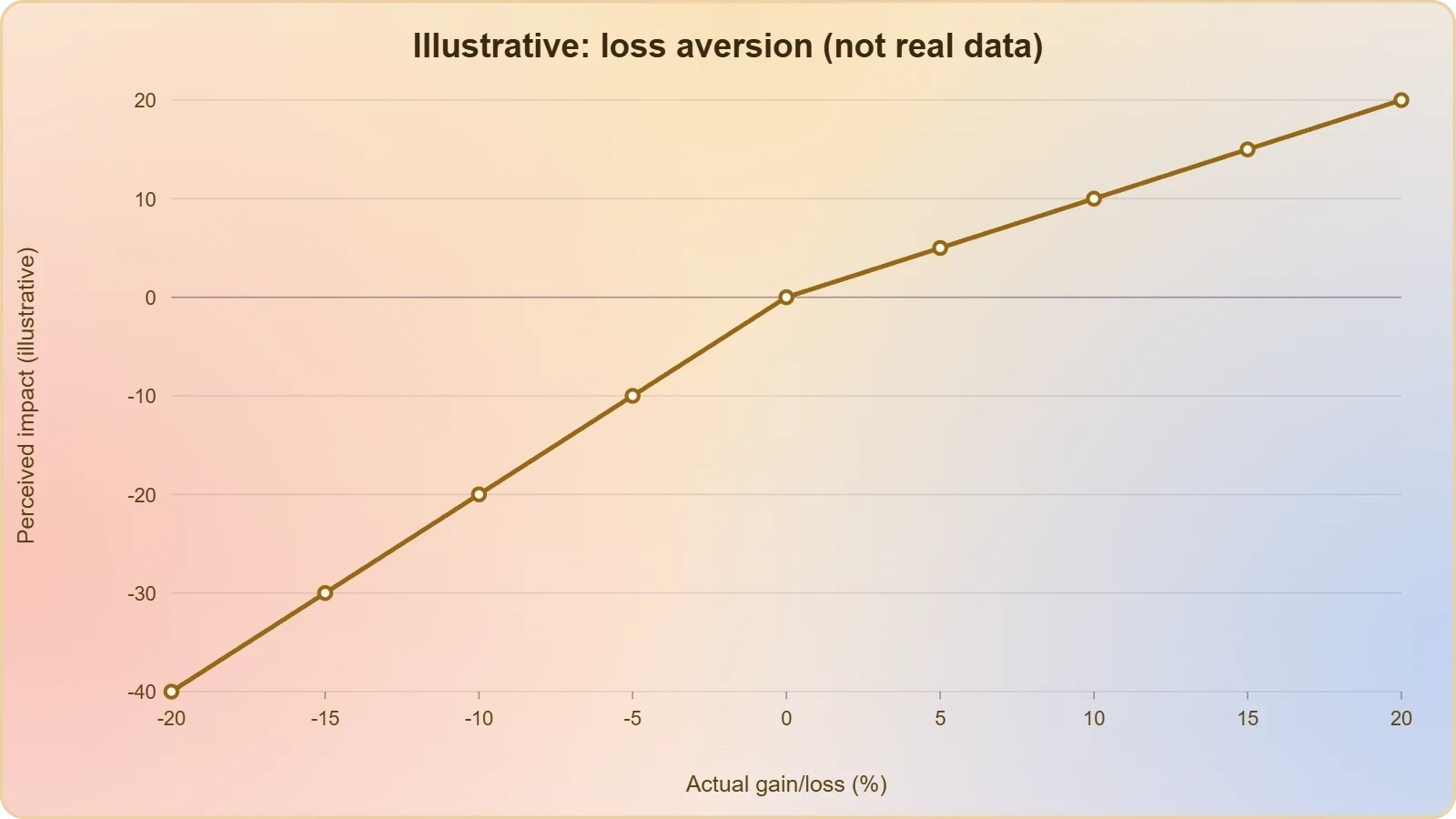
Behavioural finance literature consistently documents loss aversion, the tendency for investors to feel losses roughly twice as intensely as equivalent gains. A portfolio declining fifteen percent feels catastrophic even when the underlying businesses remain sound. Dividend payments do not prevent that decline, but they provide a counter-narrative: the investor is still being paid to wait. This reframing reduces the probability of capitulation selling, which is precisely the behaviour that converts temporary drawdowns into permanent capital destruction.
Why Cash Distributions Change the Holding Decision
A dividend is a realised return delivered on a schedule, and that predictability has measurable behavioural value. Investors who receive quarterly income can point to concrete cash flow even as their statement balance falls. Research on investor behaviour during the 2008 and 2020 drawdowns shows that income-oriented portfolios experienced lower redemption rates than growth-focused equivalents, partly because the regular distributions gave holders a reason to remain engaged rather than exit entirely.
The mechanism is not purely rational, and that is the point. Markets are driven by aggregated human decisions, many of which are emotional. A dividend policy functions as a commitment device, binding management to return capital and giving shareholders a recurring justification for patience. When volatility spikes, that justification becomes the difference between a portfolio that survives the storm and one that is liquidated at the bottom.
The Limits of Emotional Comfort as Strategy
Reassurance is not the same as protection, and conflating the two is a costly error. Dividend stocks declined sharply in March 2020, and many income-focused portfolios suffered drawdowns comparable to broad indices. The comfort dividend income provides is real but partial; it softens behaviour without insulating capital. Investors who mistake psychological resilience for downside immunity may take on more equity risk than their circumstances warrant.
A disciplined approach treats dividend income as one component of a broader risk framework rather than a standalone safety net. Position sizing, diversification across sectors and geographies, and a clear understanding of personal liquidity needs matter more than any single stock's yield. The Globe and Mail's framing is useful precisely because it is modest: it promises rest, not returns, and that honesty should inform how readers act on it.
November as a Seasonal Flashpoint for Equity Markets
November carries a peculiar reputation in market folklore. It hosts the tail end of the historically weak September-October window, the US midterm election cycle in even years, and the final stretch of tax-loss harvesting before year-end positioning. These overlapping forces create genuine liquidity shifts, and the Globe and Mail's decision to anchor its commentary to the month reflects an awareness that seasonal narratives influence sentiment independently of fundamentals. Whether a crash materialises is unknowable; whether investors anticipate one is measurable.
Historical data offers a nuanced picture. November has produced both severe drawdowns and powerful rallies, and the variance is wide enough that no reliable seasonal rule emerges. What does persist is the tendency for volatility expectations to rise as the year closes, particularly when macroeconomic uncertainty coincides with thin holiday liquidity. Dividend strategies appeal in this environment because they offer a rationale for patience during a period when patience is psychologically difficult.
The Macroeconomic Backdrop That Fuels Crash Speculation
Crash speculation rarely emerges from nowhere. It clusters around identifiable stressors: stretched valuations, tightening credit conditions, elevated rate expectations, and geopolitical friction. When these factors converge in late autumn, commentary tends to shift from opportunity to caution. The Globe and Mail piece fits this pattern, offering a defensive posture without asserting that a downturn is imminent, which is a responsible framing given how frequently crash predictions have failed.
Investors should treat seasonal warnings as prompts for portfolio review rather than trading signals. Reviewing concentration risk, confirming that income needs are covered by reliable cash flows, and stress-testing holdings against a twenty percent decline are constructive responses. Reacting to headlines by rotating wholesale into dividend stocks is not, because it substitutes narrative comfort for analytical discipline and often occurs after the most attractive entry points have passed.
Liquidity, Tax-Loss Harvesting, and Year-End Flows
Institutional behaviour intensifies in the final quarter. Tax-loss harvesting accelerates selling in underperforming positions, rebalancing flows shift allocations, and fund managers window-dress portfolios ahead of reporting dates. These mechanical forces can amplify price moves without any change in underlying business conditions, creating the kind of volatility that makes headlines feel prophetic. Dividend stocks are not exempt from these flows, but their investor base tends to be more income-focused and less momentum-driven.
Understanding these mechanics helps investors distinguish signal from noise. A sharp November decline driven by tax-related selling may present an opportunity rather than a warning, particularly for quality dividend payers whose cash flows remain intact. The critical question is whether the decline reflects deteriorating fundamentals or temporary flow dynamics, and answering it requires examining earnings, payout coverage, and balance-sheet strength rather than reacting to the headline itself.
Anatomy of a Durable Dividend Stock
Not every dividend is created equal, and the difference between a defensive income holding and a value trap is usually visible in the financial statements long before the market recognises it. A sustainable dividend requires free cash flow that comfortably exceeds distributions, a balance sheet that can absorb a downturn without cutting the payout, and a business model whose demand persists through recessions. Yield alone tells investors almost nothing about whether the income will survive the next twelve months.
The Globe and Mail's commentary references a specific stock in its headline, though the excerpt does not name it. That omission is instructive: the analytical work of identifying a durable dividend payer cannot be outsourced to a headline. Investors must examine payout ratios, dividend history through prior recessions, debt maturity profiles, and the competitive dynamics of the sector. These factors determine whether the reassurance the article promises is grounded in financial reality or merely in narrative convenience.
Payout Ratios, Free Cash Flow, and Coverage
The payout ratio, calculated as dividends per share divided by earnings per share, is the most cited sustainability metric, but it can mislead when earnings are distorted by accounting items. A more reliable measure compares dividends to free cash flow, which captures the actual cash available after capital expenditure. Companies distributing more than seventy to eighty percent of free cash flow leave little margin for error if conditions deteriorate.
Coverage ratios should be examined across a full economic cycle rather than a single year. A company that maintained its dividend through 2008, 2020, and the 2022 rate shock has demonstrated a resilience that a high current yield cannot replicate. Investors should also scrutinise the trajectory of the payout relative to earnings growth; a dividend rising faster than underlying profits is a warning sign, not a virtue.
Sector Composition and Rate Sensitivity
Dividend stocks cluster in specific sectors: utilities, consumer staples, healthcare, telecommunications, and financials. Each carries distinct risks. Utilities are sensitive to interest rates because their capital-intensive operations rely on debt financing, and rising yields make their dividends less attractive relative to bonds. Consumer staples offer demand stability but face margin pressure from input costs. Financials depend on credit conditions and regulatory capital requirements.
Interest-rate sensitivity deserves particular attention in the current environment. When risk-free yields rise, the present value of future dividend streams falls, and income stocks often underperform. A portfolio concentrated in rate-sensitive dividend payers may therefore provide less protection than expected during a period of monetary tightening. Diversification across sectors with different rate exposures is essential to building genuine resilience.
Dividend Strategies Versus Broader Defensive Positioning
Dividend investing is one defensive approach among several, and treating it as the only option narrows an investor's toolkit unnecessarily. Bonds, cash equivalents, low-volatility equity factors, and real assets each offer distinct protection profiles. The appropriate mix depends on an investor's liabilities, time horizon, and tolerance for drawdown. A retiree drawing income has different needs from a mid-career professional accumulating capital, and the dividend narrative must be adapted accordingly.
The Globe and Mail's framing implicitly targets income-seeking investors who value predictability. For that audience, dividend stocks can serve as a core holding, provided the portfolio is diversified and the payouts are sustainable. For growth-oriented investors with long horizons, the reassurance dividend stocks provide may be less relevant than the drag on total returns that high-payout policies can impose. Context determines suitability.
Comparing Defensive Asset Classes
Each defensive asset carries trade-offs. Government bonds offer contractual income and capital protection in risk-off environments, but they suffered historic losses during the 2022 rate shock. Cash preserves nominal value but loses purchasing power to inflation. Dividend equities participate in market upside while providing income, but they carry equity risk. Low-volatility factor strategies reduce drawdowns but often lag in recoveries.
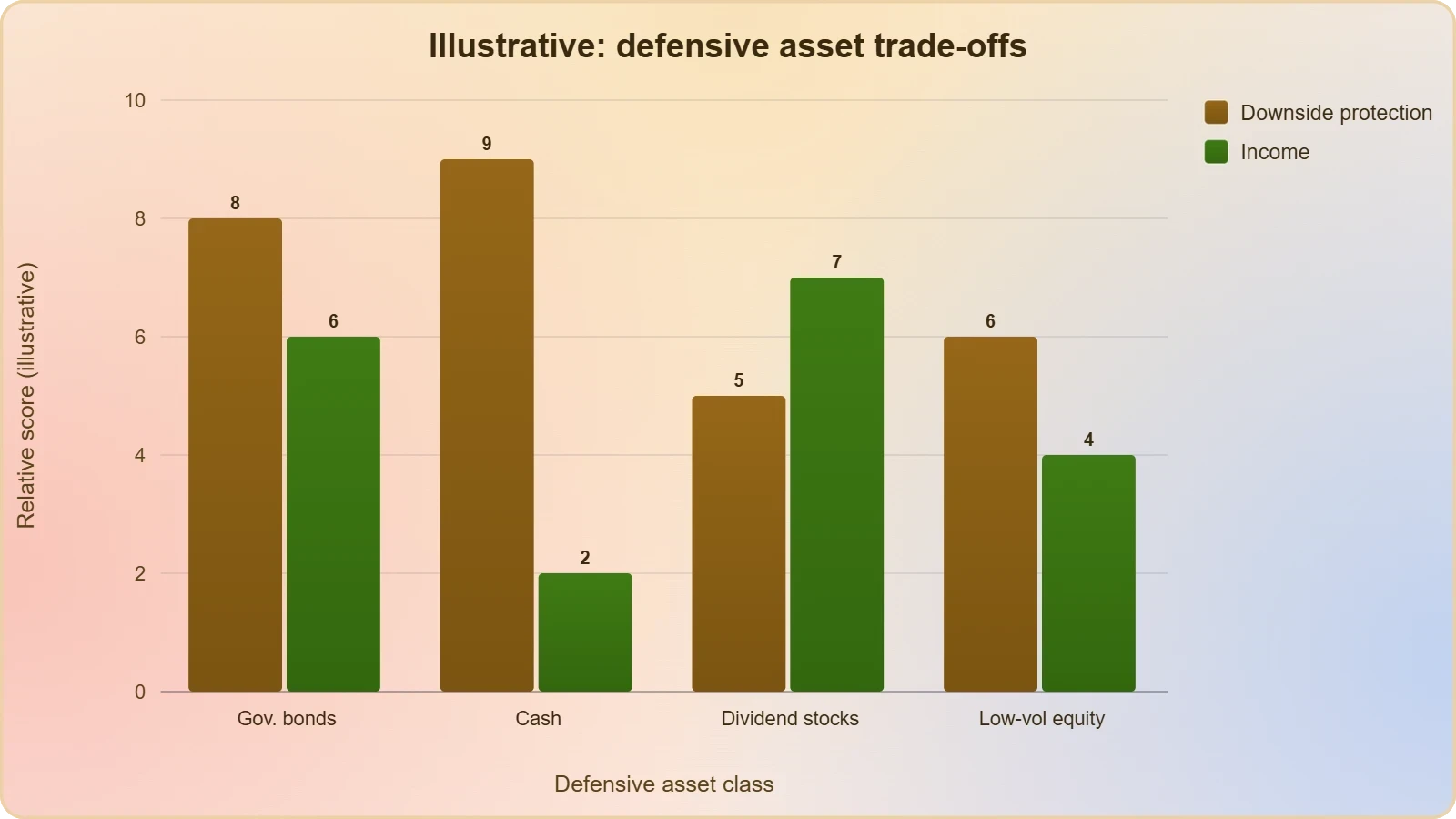
A thoughtful allocation blends these tools rather than relying on any single one. Dividend stocks can anchor the equity portion while bonds and cash provide liquidity and stability. The key is recognising that no asset class delivers both protection and growth simultaneously, and that the dividend reassurance described in the commentary is one input into a broader construction decision rather than a complete solution.
Portfolio Construction and Position Sizing
Position sizing determines outcomes more than security selection in many portfolios. A concentrated bet on a single high-yield stock, however attractive its dividend, exposes the investor to idiosyncratic risk that no payout can offset. Diversifying across ten to twenty dividend payers in different sectors reduces the impact of any single dividend cut, which is the primary risk income investors face.
Rebalancing discipline also matters. Dividend portfolios drift toward sectors that have performed well, increasing concentration over time. Periodic rebalancing restores the intended risk profile and forces the disciplined selling of overvalued positions. Investors who treat dividend investing as a passive set-and-forget strategy often discover that their portfolio has quietly become a concentrated bet on utilities or financials, undermining the defensive rationale entirely.
- 01
- 02
- 03
- 04
We Also Published
Reading Financial Commentary Critically
Financial journalism occupies an ambiguous space between information and entertainment. Headlines are designed to attract attention, and the framing of a possible crash paired with a reassuring dividend recommendation is a proven formula for engagement. Readers benefit from recognising this dynamic and separating the underlying analytical content from the rhetorical packaging. The Globe and Mail piece, read carefully, makes a modest claim: dividend stocks may help investors feel more secure. That is a statement about psychology, not a guarantee of returns.
Critical reading requires asking what the commentary does not say. It does not quantify the probability of a crash, identify the specific stock's financial metrics, or compare the recommendation against alternative strategies. These omissions are not necessarily flaws in a short commentary format, but they mean the reader must supply the analytical rigour. Treating any single article as a complete investment thesis is a category error that exposes investors to avoidable risk.
Distinguishing Prediction from Preparation
Crash predictions have a poor track record, and commentators who make them repeatedly rarely face accountability. The more useful question is not whether a crash will occur but whether the portfolio is prepared if one does. Preparation involves stress-testing holdings, confirming liquidity needs are met, and ensuring that income sources are diversified. These actions are valuable regardless of what November brings, and they do not depend on forecasting skill.
Dividend stocks fit naturally into a preparation framework because they provide ongoing cash flow that reduces the need to sell assets during a downturn. That is a structural advantage, not a prediction. Investors who internalise this distinction avoid the trap of positioning for a specific scenario and instead build portfolios that can withstand a range of outcomes, which is the more durable approach to risk management.
The Role of Media Narratives in Market Cycles
Media narratives both reflect and amplify market sentiment. When caution dominates coverage, it can become self-reinforcing, prompting selling that validates the original warning. This reflexive dynamic is well documented in behavioural finance and explains why sentiment indicators sometimes precede price moves. Recognising the feedback loop helps investors avoid being swept along by narratives that may have little fundamental basis.
Dividend-focused commentary tends to appear during periods of uncertainty because it resonates with anxious readers. That does not make the advice wrong, but it does mean investors should evaluate it against their own circumstances rather than adopting it wholesale. A strategy that provides comfort to a retiree may be suboptimal for a young accumulator, and the media cannot make that determination on the reader's behalf.
Building a Resilient Income Portfolio for Uncertain Times
The practical takeaway from the Globe and Mail's commentary is not that investors should rush into dividend stocks ahead of a possible November crash. It is that resilience is built through deliberate construction rather than reactive trading. A portfolio designed to withstand drawdowns incorporates diversified income sources, sustainable payout ratios, adequate liquidity, and a clear understanding of the investor's own behavioural tendencies. These elements work together, and no single one compensates for the absence of the others.
Dividend stocks deserve a place in many portfolios, particularly for investors who value cash flow and can tolerate equity volatility. But they are a tool, not a talisman. The reassurance they provide is genuine when the underlying businesses are sound and the position sizing is appropriate. When those conditions are absent, the comfort is illusory, and the investor discovers the difference at precisely the moment they can least afford to.
Actionable Steps for the Coming Quarter
Investors concerned about volatility should begin with a portfolio audit rather than a shopping list. Review each holding's payout ratio, free cash flow coverage, and debt profile. Identify positions where the dividend exceeds sustainable earnings and consider trimming them before the market does. Confirm that cash reserves cover at least six months of expenses, reducing the need to sell assets during a downturn.
Next, assess sector concentration. If utilities and consumer staples dominate the income sleeve, consider adding exposure to sectors with different rate sensitivities. Finally, document a response plan for a twenty percent decline, specifying which positions would be added to and which would be held. Pre-commitment reduces the probability of panic decisions when volatility arrives, converting preparation into a genuine behavioural advantage.
Long-Term Perspective and Compounding
Dividends contribute a substantial share of long-term equity returns, particularly when reinvested. Historical analysis of major indices shows that dividend reinvestment accounts for a meaningful portion of total returns over multi-decade periods. This compounding effect rewards patience, and it is the strongest argument for dividend strategies that extends beyond short-term reassurance during volatile months.
Investors who focus on total return rather than yield alone tend to build more durable portfolios. A stock yielding three percent with consistent dividend growth may outperform a stock yielding six percent with a stagnant payout, because the former compounds while the latter risks erosion. The Globe and Mail's emphasis on reassurance captures one benefit of dividend investing, but the compounding dimension is ultimately more consequential for long-term wealth creation.
From our network :
- The Final Descent: How ESA Retired the Legendary Cluster Constellation After 24 Years of Space Weather ScienceAfter 24 years mapping Earth’s magnetosphere, ESA’s Cluster mission concluded with a precisely controlled reentry over the South Pacific. This analysis explores the scientific legacy, engineering decisions, and debris mitigation principles behind one of space exploration’s most responsible retirements.
- The Hidden Cost of AI Convenience: Why Over-Permissioned Agents Are a Security Time BombDiscover why AI agents with excessive permissions create dangerous single points of failure, and learn how implementing least privilege principles can protect your organization from exploitation.
- University Language Proficiency Exams: Why Institutional Tests Demand Different Preparation Than IELTS and TOEFLDiscover why university-specific language proficiency examinations differ fundamentally from IELTS and TOEFL, and learn strategic preparation approaches for institutional assessment success.
- How AI Agents Will Change the Way We Manage Personal FinancesExplore how AI agents are transforming personal finance through automated budgeting, bill payment, and investment management, while examining the critical security protocols and governance frameworks required for safe deployment.
- CISA’s Ten-Advisory Wave: Why Generic Patching Fails in OT and How to Build Product-Specific PlaybooksCISA released ten ICS advisories in one week, exposing critical infrastructure risks. Generic patching fails in OT. Learn to build product-specific remediation playbooks.
- Mobile Learning and VR in English: What Global Evidence Reveals About Effective Language TechnologyA systematic review across 14 countries reveals which language-learning technologies genuinely work. Mobile learning, AI, and VR show measurable benefits when pedagogically integrated. This evidence-based guide helps educators and learners select technology that delivers real return on investment.
- Forbidden Matrix Patterns and Visible Lattice Points: A Geometric DictionaryExplore how multidimensional 0–1 matrices encode geometric truths, linking forbidden patterns to visible lattice points and hypergraph theory, with applications in combinatorics and computational geometry.
- Live Online English Classes for Kids: Do They Actually Reduce Anxiety?A ten-week study reveals that synchronous online English classes can significantly reduce child language anxiety while improving listening and reading skills. Discover what makes these programs effective and how parents can select the right one.
- Committed Mediterranean Precipitation Decline: Why Emissions Cuts Alone Cannot Restore Winter RainsNew NOAA research reveals that Mediterranean winter rains may decline irreversibly even with emissions cuts. Explore the science of committed climate change and regional impacts.
RESOURCES
- Retirees: 3 High-Yielding Dividend Stocks to Buy for Long-Term ...finance.yahoo.comAug 4, 2026 ... ... market instability. Missed Nvidia in 2009? This Rare Signal Is ...
- Do Dividends Matter More When Markets Falter? - Hartford Fundshartfordfunds.com... dividend potential may help soften the effects of a downturn. Moreover, paying dividends takes careful planning and management, reflecting a commitment to ...
- If a Stock Market Crash Is Coming, Investors Will Want to Own This ...finance.yahoo.comSep 8, 2026 ... Worried about a pullback? This Dividend King pairs a 54-year streak with catalysts that could provide income even if the…
- Dividend Stability: History as a Guide - WisdomTreewisdomtree.comMar 20, 2020 ... Yes, some dividends will be cut in the upcoming downturn. The market is pricing that in. Many large-cap energy stocks…
- Why do dividend stocks have a tendency to inverse the overall ...reddit.comFeb 25, 2025 ... Dividend stocks are for cashflow and stability. Hollowpoint38 ... How good will dividends be in the stock market crash of…
- High-Dividend Stocks: A Safer Bet During Market Downturnsinvestopedia.comHigh-dividend stocks are favored in market downturns for their stable income and lower volatility. Dividend yields rise as stock prices fall, drawing investors.
- r/dividends on Reddit: For those of you that remember .com and 08 ...reddit.comAug 2, 2025 ... These companies offer essentials people keep buying even in a downturn, so their cash flows and dividends are more stable.…
- Dividend Stocks ahead of the Next Boom: The Return of a Forgotten ...vpbank.comJun 18, 2025 ... ... equity portfolio. These risk-mitigating qualities became particularly evident during the most recent market downturn in spring 2025: Between ...
- Exploring the effects of board governance and information ...sciencedirect.comBoard governance enhances stock price stability through dividend policies. Effective and reliable information disclosure enhances a company's reputation, making ...
- Do Dividend Stocks Provide Shelter From Recession? - Morningstarmorningstar.comAug 8, 2022 ... ... dividends tend to be less risky because their financial results are inherently more stable. ... stocks that led the…
- The impact of the 2008 global financial crisis on dividend stability in ...sciencedirect.comThis study examines the cash dividend behaviour of a panel dataset of 1,178 firms traded in the London Stock Exchange (LSE) for the period…
- Stable stocks during market crash? - Facebookfacebook.comJul 7, 2026 ... I hedge with SCHD. It's almost complete free of tech and currently outperforming the S&P with a 3.4% dividend. 16w…
- A new hope for stable returns in equity markets | LSEGlseg.comFor details, please see the FTSE Global Target Dividend Series Ground Rules. The periods of market events are as follows: global financial crisis (9…
- Why 2026 Could Be a Breakout Year for Dividend Stocks - Morningstarmorningstar.comDec 1, 2025 ... They name-drop a few undervalued stocks that Morningstar thinks have stable dividends, cover why dividend growth stock investing is ...
- The Stock Market–Real Economy "Disconnect": A Closer Lookfederalreserve.govOct 14, 2020 ... ... dividends from the sixth year onward. Each portfolio is scaled so to have a price of 100 on Feb…
- 01
- 02
- 03
- 04
- 05
- 06
- 07
- 08
0 Comments