When a Formula One team terminates a driver mid-season, the decision rarely arrives as a surprise to those inside the paddock, yet it almost always lands as a shock to the wider public. The dismissal of Esteban Ocon by Haas, confirmed on a Tuesday in early November 2026, carries precisely that dual character: a move that insiders had quietly anticipated for weeks, executed with the clinical brevity that modern motorsport management prefers. Ocon, a Frenchman with 198 Grands Prix and a decade of service across six different teams, found himself replaced by Japanese reserve driver Ryo Hirakawa for the Mexico City round, a substitution that transformed an internal performance review into a very public statement of intent.
What makes this particular separation instructive is not merely the speed of it, but the texture surrounding it. Reports of a physical altercation between team principal Ayao Komatsu and Ocon in Mexico, allegedly sparked by a disagreement over tyre strategy, were firmly denied by the driver, yet the rumour gained enough traction to shape the narrative around the announcement. Komatsu's own statement, delivered on X, emphasised that such decisions are never taken lightly and that the discussions remain an internal matter. That careful phrasing, at once transparent and closed, reveals how contemporary F1 teams manage the boundary between accountability to fans and the confidentiality that protects their competitive interests.
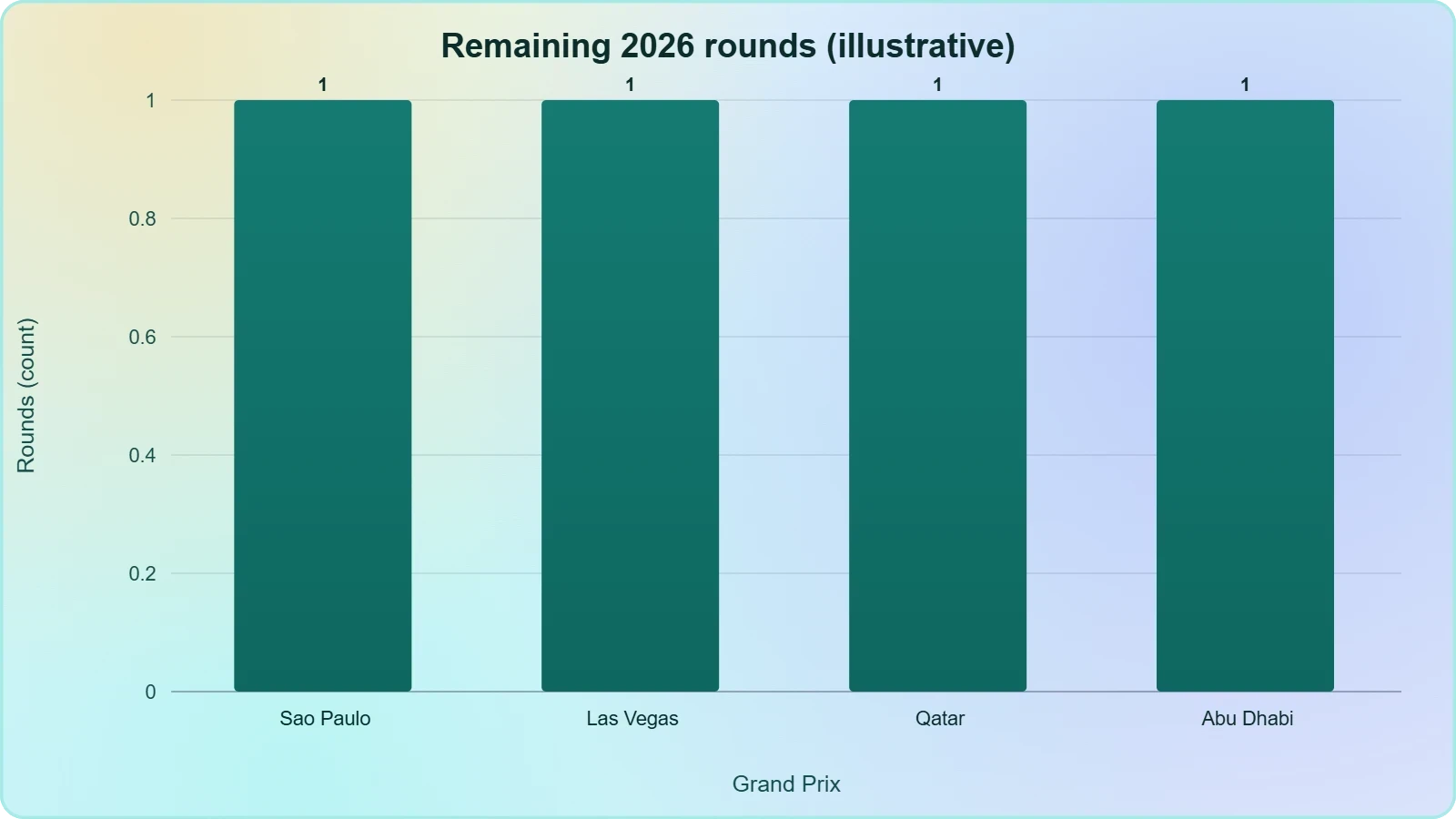
Beneath the headlines lies a structural story about how American-owned teams operate within a European-dominated sport, how driver academies feed the grid, and how a single seat change ripples through the final four races of a season. Haas had already announced that Brazilian Rafael Camara, a Ferrari Driver Academy member, would replace Ocon next year; now Camara steps in earlier than planned, debuting alongside Ollie Bearman at the Sao Paulo Grand Prix before the campaign concludes in Las Vegas, Qatar and Abu Dhabi. This analysis examines the decision, the personalities involved, and the wider mechanics of driver management in Formula One.
On This Page
TL;DR Haas dismissed French driver Esteban Ocon before the 2026 season concluded, replacing him with reserve driver Ryo Hirakawa for Mexico City and promoting Ferrari academy prospect Rafael Camara for the Sao Paulo Grand Prix and the remaining rounds. Team principal Ayao Komatsu framed the decision as a considered, forward-looking move made in the team's best interest, while denying that any physical altercation occurred. The episode illustrates how mid-season driver changes are executed in modern Formula One, how junior academy pipelines accelerate promotions, and how teams balance internal confidentiality with public accountability during the closing stretch of a championship.
The Anatomy of a Mid-Season Driver Dismissal
Mid-season dismissals occupy a peculiar category in motorsport governance. Unlike football, where a manager can be relieved of duties between fixtures with minimal operational disruption, Formula One teams must reconfigure seat fittings, simulator programmes, sponsorship obligations and engineering feedback loops within days. The Haas decision therefore represents more than a personnel judgement; it is a logistical operation executed under intense scrutiny. Ocon had completed both practice sessions on the Saturday in Mexico before being withdrawn, a sequence that suggests the final decision crystallised late in the weekend rather than emerging from a long-planned strategy.
Timing, Logistics and the Mexico City Weekend
The sequencing of events in Mexico City deserves close attention because it reveals how quickly modern teams can pivot. Ocon participated in both practice sessions, meaning engineers had already gathered his telemetry and setup feedback before the substitution was confirmed. Replacing a driver at that stage requires reserve personnel to be physically present, briefed and medically cleared, which is precisely why teams retain travelling reserves throughout the calendar. Hirakawa's readiness to step in reflects a broader professionalisation of the reserve role, which has evolved from a nominal appointment into a genuine operational contingency requiring simulator hours, fitness regimens and technical immersion.
Komatsu's public communication followed a recognisable corporate pattern: acknowledge the gravity, assert institutional rationale, and close the door on detail. His remark that discussions remain an internal matter is not evasion but standard practice, since employment disputes in Formula One frequently involve contractual confidentiality clauses, severance negotiations and potential legal exposure. The team's simultaneous confirmation that Camara would drive in Brazil demonstrates that the forward plan had already been constructed, allowing Haas to present the dismissal as continuity rather than crisis. Such framing matters commercially, particularly for an American outfit cultivating its identity in a sport still anchored in Europe.
The Altercation Rumour and Reputational Management
Rumours of a physical confrontation between Komatsu and Ocon over tyre choice circulated widely before being firmly denied by the driver. In an era where paddock gossip travels through encrypted messaging groups and social platforms within minutes, unverified claims can acquire quasi-factual status before any official response lands. Teams increasingly treat such speculation as a reputational risk requiring direct rebuttal, yet they must do so without litigating private disagreements in public. The tension between transparency and discretion is acute: say too little and the vacuum fills with conjecture; say too much and internal authority appears eroded.
For Ocon personally, the denial carries weight because his career has occasionally been shadowed by perceptions of combative team relationships, a reputation that follows drivers through contract negotiations. His ten-year tenure across six teams, encompassing 198 race starts, demonstrates durability and speed, yet the manner of departures tends to shape how the market values a driver. Formula One's driver ecosystem is small, interconnected and memory-rich; team principals consult one another, and engineers move between organisations carrying assessments with them. Managing that narrative is therefore as consequential as managing the car itself.
We Also Published
Haas, Komatsu and the American Team Identity
Haas occupies an unusual position on the grid as the only American-licensed constructor, a distinction that carries commercial weight but also invites heightened scrutiny of its management style. Ayao Komatsu's elevation to team principal marked a shift toward engineering-led leadership, and his handling of the Ocon situation reflects that orientation: decisions framed around performance data, operational clarity and forward planning rather than sentiment. For a team seeking to establish itself as more than a midfield curiosity, demonstrating the willingness to make uncomfortable calls is itself a form of credibility, signalling to sponsors and partners that accountability is enforced rather than merely advertised.
Leadership Style Under Pressure
Komatsu's public statement, delivered through X rather than a traditional press release, illustrates how Formula One communication has migrated toward direct channels that bypass conventional media gatekeeping. The message was concise, respectful and deliberately limited: acknowledgement of difficulty, assertion of institutional interest, and a firm boundary around internal discussion. This approach protects the team legally while projecting decisiveness, though it also cedes narrative control to speculation. In a sport where broadcasters require hours of content across a race weekend, an information vacuum is never empty for long, and rival outlets will fill it with analysis the team cannot correct without breaching its own confidentiality commitments.
The pressure on Komatsu extends beyond this single decision. Haas has spent recent seasons attempting to stabilise its technical direction, and driver continuity is a component of that stability. Removing a driver mid-season risks disrupting car development feedback, particularly when the replacement has limited race experience in the current machinery. Yet retaining a driver whose relationship with leadership has deteriorated carries its own costs, including potential friction within engineering briefings and divided loyalties among mechanics. Team principals weigh these trade-offs against a background of shareholder expectations, and the calculation is rarely as simple as results alone suggest.
What the Decision Signals to the Paddock
Within the paddock, dismissals communicate as much about a team's trajectory as about the driver's performance. Haas signalling that it will act decisively mid-season tells prospective recruits that underperformance or interpersonal breakdown carries immediate consequence, a message that can attract driven personnel but may deter those seeking security. It also signals to the Ferrari Driver Academy, which supplies Camara, that Haas is a genuine development environment where young drivers can be fast-tracked when circumstances permit. That relationship matters strategically, since academy affiliations increasingly determine access to promising talent and technical partnerships in the modern grid economy.
The decision further underscores the growing influence of reserve drivers as assets rather than afterthoughts. Hirakawa's promotion for Mexico demonstrates that reserve appointments now require genuine readiness, including familiarity with the car's systems, tyre behaviour and procedural protocols. Teams invest in reserve development precisely so that contingency substitutions do not collapse performance. When a reserve steps in and the operation continues without visible disruption, the team's depth is validated publicly, which strengthens its negotiating position with sponsors who value operational resilience as a marker of professional competence.
The Ferrari Academy Pipeline and Camara's Accelerated Debut
Rafael Camara's promotion compresses a development timeline that academies typically protect with careful sequencing. Ferrari Driver Academy members are groomed through junior formulae with staged exposure to Formula One machinery, simulator programmes and media obligations, and premature elevation can distort that progression. Yet the opportunity to place a young driver in a race seat for four rounds, including the high-pressure Las Vegas spectacle and the season-closing Abu Dhabi weekend, offers data that no simulator can replicate. Haas gains an early assessment of a driver it has already committed to, while Ferrari gains real-world evidence about a prospect it may eventually place elsewhere.
How Academy Affiliations Shape Seat Availability
Academy relationships function as a form of structured talent logistics within Formula One. Manufacturers and larger teams cultivate young drivers, absorb their early costs and then place them with partner or customer outfits to accumulate race experience. Haas's connection to Ferrari, which supplies power units and technical collaboration, makes Camara a natural fit for a seat that needed filling. This arrangement benefits all parties: Ferrari retains influence over its prospect's development environment, Haas secures a driver with manufacturer backing, and Camara receives a platform that would otherwise require years of negotiation to obtain through independent channels.
The economics of such placements are rarely disclosed, but the structure typically involves reduced or waived driver fees, shared simulator access and technical data exchange. For a team of Haas's scale, these arrangements materially affect operating budgets, since driver salaries and associated costs represent a meaningful line item relative to the sport's cost cap. When a manufacturer-backed driver occupies a seat, the team effectively converts a payroll expense into a strategic partnership, gaining both a competitor and an ally within the technical regulation debates that shape the sport's future.
Bearman, Camara and the Youth Movement
Pairing Ollie Bearman with Camara creates one of the youngest line-ups on the grid, a configuration that carries both promise and risk. Young drivers arrive with raw pace and adaptability but limited experience in racecraft under variable conditions, tyre management across long stints and the political navigation required in a 24-race season. Teams accepting this trade-off are effectively investing in future performance at the expense of immediate consistency, a calculation that makes sense for organisations building toward a regulatory reset rather than chasing a championship in the current cycle.
The broader grid trend reinforces this logic. Several teams have shifted toward younger driver pairings as cost controls, simulator sophistication and data analytics reduce the premium on veteran experience. Where once a decade of race starts was considered essential for development feedback, modern telemetry and simulation allow teams to extract actionable insight from less seasoned drivers. That shift does not render experience obsolete, but it changes the market: veterans must now demonstrate not only speed but mentorship value, technical leadership and commercial contribution to justify their seats against cheaper, academy-supported alternatives.
- 01
- 02
- 03
- 04
Contractual, Legal and Financial Dimensions
Terminating a driver contract before its scheduled expiry involves more than a sporting judgement. Formula One driver agreements typically contain performance clauses, termination provisions, severance schedules and confidentiality obligations that determine how a separation can be executed and described publicly. The fact that Haas announced the dismissal while stating that discussions remain internal suggests that commercial terms were either settled or under active negotiation, with both parties bound by non-disclosure provisions that constrain what can be said. Such structures are standard, yet they shape public perception by limiting the information available to journalists and fans.
Severance, Confidentiality and Public Statements
Confidentiality clauses serve legitimate commercial purposes: they protect negotiating positions, prevent disclosure of sensitive performance data and shield both parties from reputational damage during transition. However, they also create an asymmetry in public discourse, where speculation flourishes precisely because verified information is withheld. Teams navigate this by issuing carefully worded statements that acknowledge the decision without detailing its causes, a formula Komatsu followed closely. The risk is that silence is interpreted as concealment, particularly when rumours of interpersonal conflict are already circulating and the driver has felt compelled to issue a denial.
From the driver's perspective, the financial dimension matters enormously. A mid-season termination may trigger severance payments, accelerate bonus provisions or release the driver from performance obligations, depending on contract architecture. Ocon's decade-long career and six-team history suggest sophisticated representation accustomed to negotiating such outcomes. Beyond immediate finances, the termination affects future earning potential, since prospective employers will assess not only driving ability but also the circumstances of departure. Reputation, in this market, functions as a form of capital that can appreciate or depreciate rapidly depending on how a separation is handled by both sides.
The Cost Cap and Driver Spending
Formula One's cost cap regulations exclude driver salaries from the capped expenditure, a carve-out that preserves competitive spending on talent while constraining development costs. This exclusion means that driver decisions are driven by performance and strategy rather than direct budgetary pressure, though the indirect effects remain significant. A team paying a departing driver while simultaneously funding a replacement faces a double cost that must be absorbed outside the cap, which can influence how quickly a separation is finalised and how generous the severance terms become. Financial pragmatism and sporting urgency therefore intersect in ways that are rarely visible to outside observers.
The cap's architecture also shapes academy economics. Because manufacturer-backed young drivers often arrive with subsidised costs, teams can allocate resources toward engineering and operations while still fielding competitive talent. This dynamic has accelerated the trend toward younger line-ups and increased the pressure on mid-career drivers to justify their salaries through measurable contribution. Ocon's situation illustrates the squeeze: an experienced driver with proven pace, yet facing a market that increasingly rewards youth, academy affiliation and cost efficiency over accumulated race starts.
The Closing Stretch: Sao Paulo to Abu Dhabi
The remaining four races of the 2026 season now carry altered significance for Haas. Sao Paulo offers Camara a debut on home soil, a circumstance that amplifies both opportunity and pressure, since Brazilian crowds will expect a credible showing from a driver carrying national hope. Las Vegas presents a street circuit with limited margin for error and unusually high commercial visibility, while Qatar and Abu Dhabi conclude the campaign on circuits where tyre degradation and temperature management reward experience. For a young driver, this sequence is a compressed education delivered under maximum scrutiny.
What the Final Races Will Reveal
Performance across these four rounds will inform Haas's assessment of its future line-up and provide Ferrari with data on Camara's readiness for higher expectations. Teams evaluate young drivers on multiple axes: qualifying pace relative to a teammate, racecraft in traffic, tyre management across stints, technical feedback quality and comportment under media pressure. A strong debut in Brazil could accelerate Camara's trajectory; a difficult sequence could prompt a more patient development plan. Either outcome generates information that shapes contract negotiations, simulator allocations and testing schedules for the following season.
The races also matter for Ocon's market position. A driver dismissed mid-season faces questions about whether the separation reflected performance, relationships or circumstance, and prospective employers will seek candid assessments from engineers and team personnel who worked alongside him. His denial of the altercation rumour protects his account of events, but the absence of a public resolution leaves ambiguity that only future employment decisions will clarify. In a sport where seats are scarce and academy pipelines are crowded, the path back to a competitive drive requires both demonstrable pace and a convincing narrative of professional conduct.
Broader Implications for Driver Management
The Haas episode contributes to a wider pattern in which teams treat driver seats as dynamic assets rather than fixed appointments. Reserve drivers are maintained in a state of genuine readiness, academy prospects are promoted on accelerated timelines, and separations are executed with minimal public explanation. This operational model increases competitive responsiveness but reduces the security that once defined a driver's career. For teams, the benefit is flexibility; for drivers, the consequence is that performance must be continuously demonstrated, and relationships with leadership must be managed with the same care as lap times.
Whether this model serves the sport's long-term health remains contested. Continuity helps fans form attachments to drivers and teams, and frequent changes can dilute those bonds. Yet the commercial logic is compelling: younger drivers arrive with lower costs, academy backing and growth narratives that appeal to sponsors. The balance struck by each team will vary according to ownership, ambition and regulatory position, but the direction of travel is clear. Haas's decision, whatever its immediate motivations, sits firmly within that broader evolution of how Formula One manages its most visible human assets.
From our network :
- Live Online English Classes for Kids: Do They Actually Reduce Anxiety?A ten-week study reveals that synchronous online English classes can significantly reduce child language anxiety while improving listening and reading skills. Discover what makes these programs effective and how parents can select the right one.
- How AI Agents Will Change the Way We Manage Personal FinancesExplore how AI agents are transforming personal finance through automated budgeting, bill payment, and investment management, while examining the critical security protocols and governance frameworks required for safe deployment.
- CISA’s Ten-Advisory Wave: Why Generic Patching Fails in OT and How to Build Product-Specific PlaybooksCISA released ten ICS advisories in one week, exposing critical infrastructure risks. Generic patching fails in OT. Learn to build product-specific remediation playbooks.
- Committed Mediterranean Precipitation Decline: Why Emissions Cuts Alone Cannot Restore Winter RainsNew NOAA research reveals that Mediterranean winter rains may decline irreversibly even with emissions cuts. Explore the science of committed climate change and regional impacts.
- Mobile Learning and VR in English: What Global Evidence Reveals About Effective Language TechnologyA systematic review across 14 countries reveals which language-learning technologies genuinely work. Mobile learning, AI, and VR show measurable benefits when pedagogically integrated. This evidence-based guide helps educators and learners select technology that delivers real return on investment.
- The Hidden Cost of AI Convenience: Why Over-Permissioned Agents Are a Security Time BombDiscover why AI agents with excessive permissions create dangerous single points of failure, and learn how implementing least privilege principles can protect your organization from exploitation.
- University Language Proficiency Exams: Why Institutional Tests Demand Different Preparation Than IELTS and TOEFLDiscover why university-specific language proficiency examinations differ fundamentally from IELTS and TOEFL, and learn strategic preparation approaches for institutional assessment success.
- The Final Descent: How ESA Retired the Legendary Cluster Constellation After 24 Years of Space Weather ScienceAfter 24 years mapping Earth’s magnetosphere, ESA’s Cluster mission concluded with a precisely controlled reentry over the South Pacific. This analysis explores the scientific legacy, engineering decisions, and debris mitigation principles behind one of space exploration’s most responsible retirements.
- Forbidden Matrix Patterns and Visible Lattice Points: A Geometric DictionaryExplore how multidimensional 0–1 matrices encode geometric truths, linking forbidden patterns to visible lattice points and hypergraph theory, with applications in combinatorics and computational geometry.
RESOURCES
- Resources will be updated soon.
- 01
- 02
- 03
- 04
- 05
- 06
- 07
- 08
0 Comments