
On a single Wednesday morning, roughly three hundred schools scattered from Rome to Trieste opened their inboxes to find the same chilling message: a bomb threat. Within hours, pupils were filing out of classrooms into winter air, head teachers were conferring with police, and a national government was convening its intelligence apparatus. What could have been a genuine catastrophe instead resolved into something stranger and, in its own way, more unsettling — a coordinated hoax that weaponised fear without ever planting a device. Education Minister Giuseppe Valditara was quick to frame the episode as a probable cyber-attack rather than a physical danger, and Prime Minister Giorgia Meloni convened senior ministers and intelligence officials to monitor the wave of reports.
The Italian case is not an isolated curiosity. It belongs to a broader pattern of mass bomb hoaxes that has swept across Europe, striking airports, airlines, supermarkets, hospitals and now schools in a sequence that suggests deliberate design rather than random malice. The emails followed what officials described as a clear template, and the geography of the targets — Rome, Naples, Vicenza, Florence, Pisa, Trieste and many smaller cities — points to automated distribution rather than individual grievance. Understanding this episode requires looking past the immediate drama of evacuations and asking harder questions about who benefits from manufactured alarm, how institutions verify threats at scale, and why the school has become such an attractive target for digital intimidation.
This analysis examines the Italian school bomb threat wave from several angles: the operational mechanics of the hoax, the government response, the parallel incidents in Northern Ireland and Scotland, and the wider European pattern of false alarms. It also considers what such campaigns reveal about the vulnerability of public institutions to low-cost, high-disruption attacks, and what practical lessons schools and authorities might draw. The story is ultimately less about explosives than about attention, credibility and the fragile infrastructure of public trust.
On This Page
TL;DR Roughly 300 schools across Italy received bomb threats on a single Wednesday, prompting evacuations and a high-level government response. Education Minister Giuseppe Valditara characterised the incidents as a probable cyber-attack rather than a genuine physical danger, noting a clear pattern consistent with recent hoaxes targeting European flights, supermarkets and hospitals. Prime Minister Giorgia Meloni convened senior ministers and intelligence officials, while checks across regions including Umbria returned negative results. Parallel hoaxes hit more than 300 schools in Northern Ireland and several in Scotland, though no connection has been established. The episode illustrates how low-cost digital intimidation can generate disproportionate disruption and public anxiety.
The Anatomy of a Coordinated Hoax
The defining feature of the Italian school threat wave was not the content of the emails but their synchronisation. Hundreds of messages arriving within a narrow window, each carrying the same essential warning, produced a predictable cascade of evacuations across multiple regions. This is the signature of automated distribution: a single actor or small group can compose one message, compile a list of institutional addresses, and trigger nationwide disruption from a laptop. The cost to the perpetrator is negligible; the cost to the state, measured in police hours, disrupted education and public anxiety, is substantial. That asymmetry is the entire point of the tactic.
The Mechanics of Mass Email Intimidation
Mass hoax campaigns typically rely on publicly available contact directories, scraped from school websites, government portals and regional education authorities. Once a target list exists, distribution is trivial. The messages need only be credible enough to trigger protocol, not credible enough to fool a bomb disposal expert. Schools operate under strict safety duties, which means even a low-probability threat must be treated seriously until verified. Perpetrators exploit this duty deliberately, knowing that evacuation is the rational institutional response and that the resulting disruption is guaranteed regardless of whether any device exists.
The Italian authorities described the threats as following a clear pattern, similar to recent hoaxes that targeted flights, supermarkets and hospitals elsewhere in Europe. That continuity matters. It suggests a reusable playbook rather than a one-off stunt, and it implies that the actors involved have learned which sectors respond most dramatically. Schools are especially attractive because they combine high emotional salience with decentralised decision-making: hundreds of head teachers must each independently assess the same threat, multiplying the response burden and the media coverage.
Why Schools Are Attractive Targets
Few institutions carry the same symbolic weight as a school. An evacuation there touches parents, local media and political leaders simultaneously, generating coverage that a threat against an office building rarely attracts. For actors seeking maximum visibility at minimum cost, this is an efficient choice. The presence of children raises the stakes of any risk calculation, forcing authorities to err on the side of caution even when evidence is thin. That caution, entirely appropriate as a safety principle, becomes a lever that hoaxers can pull repeatedly.
There is also a structural vulnerability. Schools are numerous, geographically dispersed and often operate with limited dedicated security staff. Their email systems are typically administered by regional or municipal authorities rather than hardened central teams. Coordinating a consistent response across hundreds of sites is genuinely difficult, and the Italian case showed regional variation: some areas lifted the alarm quickly, while others conducted lengthy checks. That unevenness is itself informative, revealing where institutional readiness is strong and where it is not.
We Also Published
The Government Response and Institutional Readiness
Rome's reaction was swift and, in its public communication, carefully calibrated. Prime Minister Giorgia Meloni convened a meeting of senior ministers and intelligence officials, signalling that the state treated the wave as a security matter rather than a nuisance. Simultaneously, she used social media to reassure the public that checks had found no evidence of concrete danger, describing the reports as linked to a strategy designed to cause alarm and concern. That dual message — we are taking this seriously, and there is no physical threat — is the standard template for managing hoax campaigns without dismissing them.
Coordination Between National and Regional Authorities
The Italian response revealed a layered system at work. National intelligence coordinated with the education ministry, while regional presidents and local law enforcement handled verification on the ground. Stefania Proietti, head of the central Umbria region, reported that checks in Umbrian schools had returned negative results and praised law enforcement for working quickly and carefully through each report. This division of labour is sensible: national bodies assess pattern and intent, while local forces conduct physical searches. The challenge lies in maintaining consistent standards across regions with differing resources and threat experience.
Evacuations proceeded unevenly. Many schools emptied on Wednesday morning, but the alarm was lifted quickly in several regions and pupils returned to class the same day. That variation reflects both the quality of local protocols and the practical reality that a school cannot remain closed indefinitely on the basis of an unverified email. The speed of resolution in some areas is a genuine success story; in others, longer disruptions suggest room for improvement in pre-planned response procedures and communication with parents.
Communication Strategy and Public Trust
Officials faced a familiar dilemma: say too little and appear complacent, say too much and amplify the attacker's message. Meloni's Facebook statement struck a middle path, acknowledging the volume of reports while asserting that no concrete danger had been found. Valditara's television remarks went further, explicitly labelling the episode a probable cyber-attack. That framing matters because it shifts public attention from fear of explosives to awareness of digital manipulation, which is both more accurate and more useful for prevention.
Effective crisis communication in hoax scenarios depends on speed, specificity and consistency. Vague reassurance invites suspicion; detailed explanation builds credibility. The Italian authorities largely managed this balance, though the sheer number of simultaneous incidents inevitably produced confusion in some localities. The lesson for other governments is that pre-drafted communication templates, adaptable to regional circumstances, can dramatically improve coherence when hundreds of institutions must respond at once.
The European Pattern of Mass Bomb Hoaxes
The Italian school threats did not emerge from a vacuum. Just a week earlier, Italian airports and airlines elsewhere in Europe received a series of bomb hoaxes that triggered scares, evacuations and significant disruption. An extremist misogynistic group claimed some of those threats before later denying any connection to the false warnings. That claim-and-retraction pattern is itself a known tactic, designed to generate publicity, confuse investigators and sow doubt about attribution. The school campaign appears to extend the same disruptive logic to a more emotionally charged target.
From Airports to Classrooms
Targeting aviation produces immediate, visible disruption: grounded flights, terminal evacuations, stranded passengers. Targeting schools produces something different but arguably more potent — parental alarm, political pressure and saturation media coverage. The shift from transport infrastructure to education suggests actors who study which sectors generate the strongest public reaction per unit of effort. Hospitals and supermarkets, also recently targeted, occupy similar ground: essential services where any threat demands immediate response and where disruption ripples outward into the wider community.
This progression also complicates attribution. When the same playbook appears across multiple countries and sectors, investigators must determine whether a single group is responsible, whether imitators are copying a publicised method, or whether loosely affiliated individuals are acting on shared inspiration. The Italian authorities have not publicly attributed the school threats, and the earlier denial by the group that claimed the aviation hoaxes leaves the picture genuinely unclear. Uncertainty of this kind is often part of the intended effect.
Parallel Incidents in Northern Ireland and Scotland
On the same day, more than three hundred schools in Northern Ireland received emails that police are treating as a hoax. Police in Scotland likewise treated messages sent to several schools there as hoaxes. Officials stated clearly that it was not clear whether any of the incidents were connected. This caveat is important and should not be glossed over: geographic and temporal proximity does not prove coordination, and premature attribution can mislead both investigators and the public. Copycat behaviour is common in hoax waves and can produce patterns that mimic central direction.
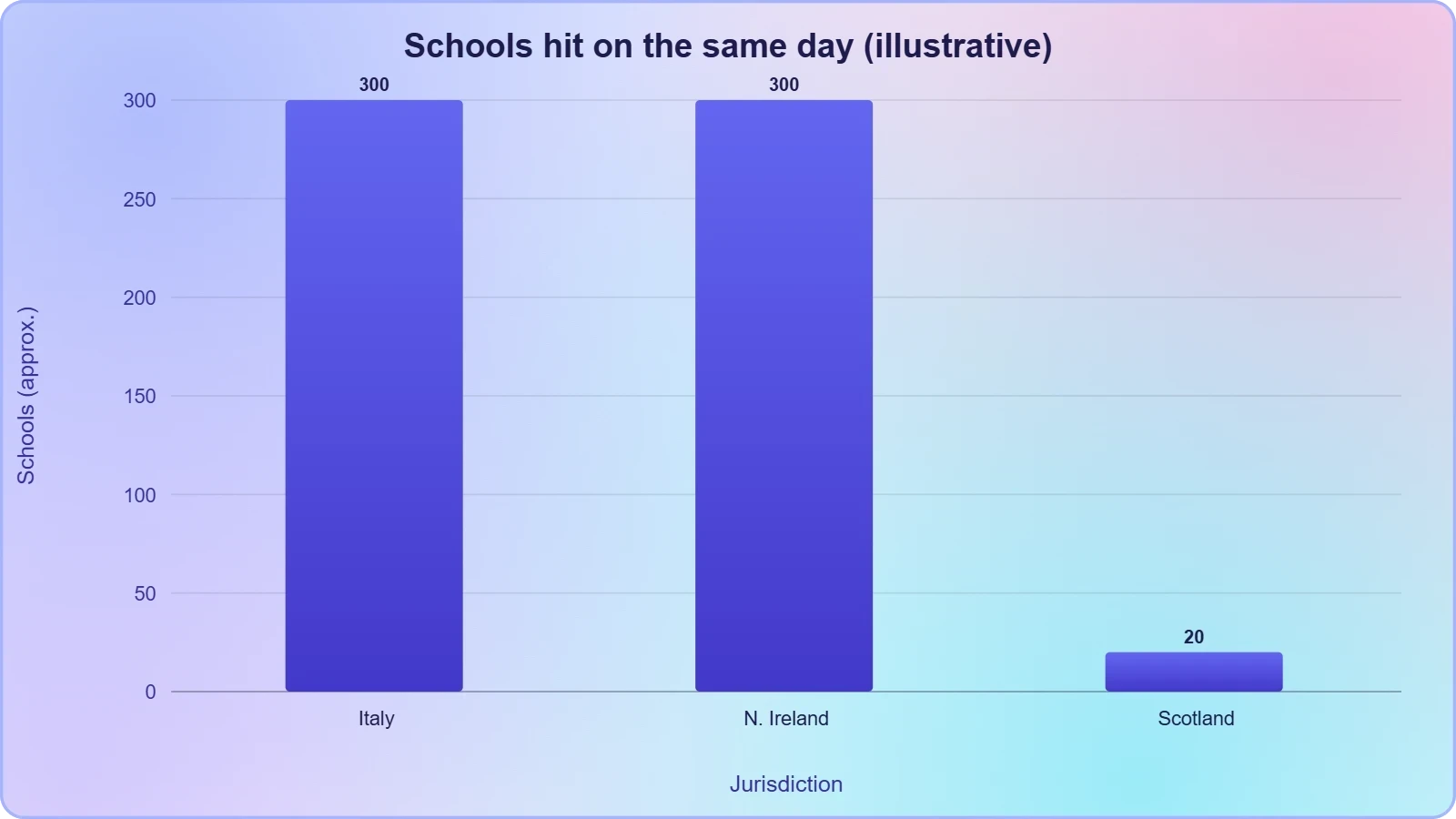
Nevertheless, the simultaneity is striking. Whether coordinated or coincidental, the effect was a single news cycle in which schools across multiple jurisdictions were presented as under threat. That amplification is precisely what hoaxers seek, and it demonstrates how digital communication collapses distance: a message composed once can unsettle institutions separated by hundreds of miles and several legal systems. For authorities, the implication is that response planning must increasingly assume cross-border simultaneity rather than treating each national incident in isolation.
Attribution, Motive and the Psychology of Fear
Who sends three hundred bomb threats to schools? The honest answer, at least publicly, is that Italian authorities have not said. The earlier aviation hoaxes were claimed by an extremist misogynistic group, which then denied involvement in the false warnings, leaving investigators with contradictory signals. This ambiguity is not incidental. Hoax campaigns frequently operate in a fog of claim, counter-claim and imitation, and the resulting uncertainty serves the perpetrators' purposes by consuming investigative resources and eroding public confidence in official statements.
Claim, Denial and the Fog of Attribution
The claim-and-retraction sequence deserves scrutiny. A group that claims responsibility gains immediate attention; a subsequent denial generates a second news cycle and complicates any straightforward narrative. Whether such behaviour reflects internal division, deliberate misdirection or simple attention-seeking is often impossible to determine from outside. What matters operationally is that authorities must resist the temptation to attribute prematurely. Naming a culprit without evidence can legitimise a group, misdirect resources and, if wrong, damage the credibility of future official statements.
Italian officials have been notably restrained on this point, describing a pattern and a probable cyber-attack without naming actors. That restraint is appropriate. It also reflects a genuine analytical difficulty: mass email hoaxes require little technical sophistication, leaving few forensic traces that reliably distinguish one actor from another. The barrier to entry is low, the signature is faint, and the pool of potential imitators is large. Attribution in such cases is slow, uncertain work.
Why Manufactured Alarm Works
The strategic logic of the hoax is straightforward: generate alarm and concern disproportionate to any real danger. Meloni's own description captured this precisely. A bomb threat against a school forces a choice between two risks — the risk of ignoring a genuine device and the risk of disrupting education for no reason. Institutions rationally choose disruption, and the hoaxer knows it. The tactic therefore succeeds not by deceiving anyone about the existence of a bomb but by exploiting the responsible caution of the institutions being targeted.
There is a psychological dimension as well. Repeated false alarms gradually normalise threat messages, which can dull vigilance over time — the opposite of what security planners want. Conversely, each evacuation reinforces the perceived power of the anonymous sender. Managing this dynamic requires communicating clearly that hoaxes are being treated as crimes, that perpetrators face investigation, and that the public should report suspicious messages without amplifying them on social media.
- 01
- 02
- 03
- 04
Operational Lessons for Schools and Authorities
For school leaders, the Italian episode offers a practical curriculum in crisis readiness. The first lesson is procedural: a pre-agreed protocol for receiving and assessing threat messages saves critical minutes and reduces inconsistency. The second is communicative: parents need timely, accurate information, and silence breeds rumour. The third is technical: institutional email systems should be monitored for anomalous bulk messages, and contact directories should be reviewed for unnecessary public exposure. None of these measures is expensive, but each requires deliberate planning before an incident rather than improvisation during one.
Building Verification Capacity
Verification is the bottleneck in any hoax wave. Physical searches take time, and when hundreds of sites require checking simultaneously, local police capacity is stretched. Regional coordination, as demonstrated in Umbria, allows faster triage and clearer communication. Authorities might also consider shared assessment teams that can evaluate message content and distribution patterns centrally, allowing local forces to focus on physical checks. The goal is not to dismiss threats but to resolve them efficiently, freeing resources for genuine emergencies.
Documentation matters too. Each hoax message should be preserved, its sender address and routing data recorded, and the information shared with national investigators. Patterns emerge only when data is aggregated. The Italian authorities appear to have recognised this, describing a clear pattern across incidents. That analytical work is what eventually enables attribution and, ideally, prosecution. Schools that delete threatening emails after an evacuation inadvertently destroy evidence that could prevent the next wave.
Legal and Disciplinary Consequences
Hoax threats are crimes, not pranks, and the legal response must be visible enough to deter. Italian law enforcement is investigating the school threats, and the earlier aviation hoaxes prompted similar scrutiny. Prosecution of mass hoaxers is complicated by jurisdiction, anonymity and the difficulty of proving intent, but publicising successful cases sends a useful signal. The message should be unambiguous: sending a bomb threat to a school carries serious consequences, regardless of whether any device exists.
There is also a role for technology platforms. Many hoax messages circulate through email services that can be compelled to preserve metadata, and public reporting channels can help identify coordinated campaigns early. Cooperation between education authorities, police and service providers is not glamorous work, but it is the practical foundation of deterrence. Without it, the cost-benefit calculation facing a would-be hoaxer remains uncomfortably favourable.
The Wider Implications for Public Institutions
Beyond the immediate disruption, the Italian school threats illuminate a structural vulnerability that extends well beyond education. Any institution that must respond seriously to threats — hospitals, transport hubs, government offices, retail chains — can be manipulated by actors who understand that responsible caution is itself a lever. The cost of a hoax is borne almost entirely by the target, while the cost to the sender approaches zero. Until that asymmetry is addressed, whether through deterrence, technical filtering or faster verification, the tactic will remain attractive.
Digital Intimidation as a Governance Challenge
Governments are increasingly required to defend against attacks that cause no physical harm yet impose real social costs. This is a governance challenge as much as a security one. It demands coordination across education, interior, justice and digital policy portfolios, and it requires public communication that neither dismisses the threat nor amplifies it. Italy's response, convening intelligence officials while publicly stating that no concrete danger had been found, illustrates the balance. Whether that balance holds under repeated waves is an open question.
The international dimension complicates matters further. When similar hoaxes strike Italy, Northern Ireland and Scotland in the same week, national responses must somehow cohere without a central authority. Existing European security cooperation provides channels, but hoax campaigns may not meet the threshold for formal cross-border investigation. Building lighter, faster mechanisms for sharing threat patterns and message templates could improve collective resilience without requiring new treaties or institutions.
What Comes Next
The most likely trajectory is recurrence. Hoax waves tend to cluster, subside and return, often with variations in target and method. Italian authorities will continue investigating, and successful prosecutions, if they come, may deter some imitators. Schools will review their protocols. The deeper question is whether public institutions can learn to absorb such shocks without granting hoaxers the disruption they seek. That requires not just better security but a calibrated public culture: alert, sceptical, and resistant to the amplification that attackers depend upon.
For now, the concrete facts remain modest. Hundreds of schools received threatening emails, many evacuated, checks found nothing, and pupils returned to class. No one was harmed. Yet the episode deserves attention precisely because it succeeded on its own terms: it generated alarm, consumed official attention and demonstrated that a few hundred emails can unsettle a nation's morning. Understanding that mechanism is the first step toward blunting it, and the Italian experience offers a case study that other countries would do well to study closely.
From our network :
- University Language Proficiency Exams: Why Institutional Tests Demand Different Preparation Than IELTS and TOEFLDiscover why university-specific language proficiency examinations differ fundamentally from IELTS and TOEFL, and learn strategic preparation approaches for institutional assessment success.
- CISA’s Ten-Advisory Wave: Why Generic Patching Fails in OT and How to Build Product-Specific PlaybooksCISA released ten ICS advisories in one week, exposing critical infrastructure risks. Generic patching fails in OT. Learn to build product-specific remediation playbooks.
- How AI Agents Will Change the Way We Manage Personal FinancesExplore how AI agents are transforming personal finance through automated budgeting, bill payment, and investment management, while examining the critical security protocols and governance frameworks required for safe deployment.
- Forbidden Matrix Patterns and Visible Lattice Points: A Geometric DictionaryExplore how multidimensional 0–1 matrices encode geometric truths, linking forbidden patterns to visible lattice points and hypergraph theory, with applications in combinatorics and computational geometry.
- Committed Mediterranean Precipitation Decline: Why Emissions Cuts Alone Cannot Restore Winter RainsNew NOAA research reveals that Mediterranean winter rains may decline irreversibly even with emissions cuts. Explore the science of committed climate change and regional impacts.
- Live Online English Classes for Kids: Do They Actually Reduce Anxiety?A ten-week study reveals that synchronous online English classes can significantly reduce child language anxiety while improving listening and reading skills. Discover what makes these programs effective and how parents can select the right one.
- The Hidden Cost of AI Convenience: Why Over-Permissioned Agents Are a Security Time BombDiscover why AI agents with excessive permissions create dangerous single points of failure, and learn how implementing least privilege principles can protect your organization from exploitation.
- Mobile Learning and VR in English: What Global Evidence Reveals About Effective Language TechnologyA systematic review across 14 countries reveals which language-learning technologies genuinely work. Mobile learning, AI, and VR show measurable benefits when pedagogically integrated. This evidence-based guide helps educators and learners select technology that delivers real return on investment.
- The Final Descent: How ESA Retired the Legendary Cluster Constellation After 24 Years of Space Weather ScienceAfter 24 years mapping Earth’s magnetosphere, ESA’s Cluster mission concluded with a precisely controlled reentry over the South Pacific. This analysis explores the scientific legacy, engineering decisions, and debris mitigation principles behind one of space exploration’s most responsible retirements.
RESOURCES
- Hundreds of Italian schools hit by threats in suspected bomb hoaxbbc.com4 hours ago ... ... cyber-attack, not a genuine risk". Valditara told Italian TV that there was a clear strategy behind the rash of…
- Schools across Italy evacuated after receiving email bomb alertsaljazeera.com1 hour ago ... Schools across Italy have been evacuated after about 6,300 of them received the same hoax bomb threat by email, while…
- Bomb threats prompt evacuation of Italian schools in suspected ...cnn.com5 hours ago ... Hundreds of schools were evacuated in Italy on Wednesday after bomb threats were sent via email, police told CNN, becoming…
- Hundreds of Schools in Italy Are Evacuated as More Bomb Threats ...nytimes.com4 hours ago ... ... hoax threats” seriously, but that they were not believed to be ... It is not clear whether the cyberattacks…
- Hundreds of schools in Italy, UK evacuated over 'hoax' bomb threatscnbc.com5 hours ago ... Italy's education minister Giuseppe Valditara told Italian TV that over 300 emailed bomb threats to Italian schools were presumed to…
- Hundreds of Italian schools hit by threats in suspected bomb hoaxbbc.co.uk4 hours ago ... It is unclear whether any of the incidents are connected. Related topics. Italy · Europe · Cyber-crime · Cyber-attacks ...
- Hundreds of schools across Italy, Scotland and Ireland receive ...ft.com5 hours ago ... Hundreds of schools across Italy, Scotland, Ireland and Northern Ireland received bomb threats on Wednesday, in what appeared to be…
- Wave of hoax bomb threats sent to schools in UK, Ireland and Italyfrance24.com5 hours ago ... Hundreds of schools in the UK, Italy and the Republic of Ireland received a "generic" threatening email on Wednesday now…
- Schools in Italy, Ireland and UK evacuated after hoax bomb threatseuronews.com5 hours ago ... The threats follow a series of hoax bomb alerts on flights across Europe in recent weeks. In the same period,…
- Hundreds of schools across Scotland, Northern Ireland and Italy ...facebook.com3 hours ago ... BREAKING: Hundreds of schools across Scotland, Northern Ireland and Italy have been evacuated after a wave of hoax bomb threats.
- Hoax bomb alerts sent to schools in Italy, UK and Ireland - ABC Newsabc.net.au1 hour ago ... Schools across Italy have been evacuated after around 6,300 of them received bomb warnings, the latest in a series of…
- Some 300 Italian schools evacuated due to bomb threats - ABC Newsabcnews.com4 hours ago ... ... bomb threat, the latest disruptions affecting European institutions following hoax bomb threats against airlines and broadcasters in recent ...
- Italy evacuates over 300 schools due to bomb alert, with threats in ...wral.com3 hours ago ... Cyber Security · Family ... Police in Scotland said they were treating similar messages as hoaxes and were not requiring…
- Hundreds of schools across Italy, Scotland and Ireland receive ...facebook.com5 hours ago ... Hoax bomb threats hit school attendance in Scotland as worried parents keep children at home. Attendance plummets in Scottish schools…
- Schools evacuated across Italy after bomb threats - Gulf Newsgulfnews.com4 hours ago ... The threats come after a series of hoax bomb alerts in recent weeks including on flights across Europe and cyber…
- 01
- 02
- 03
- 04
- 05
- 06
- 07
- 08
0 Comments