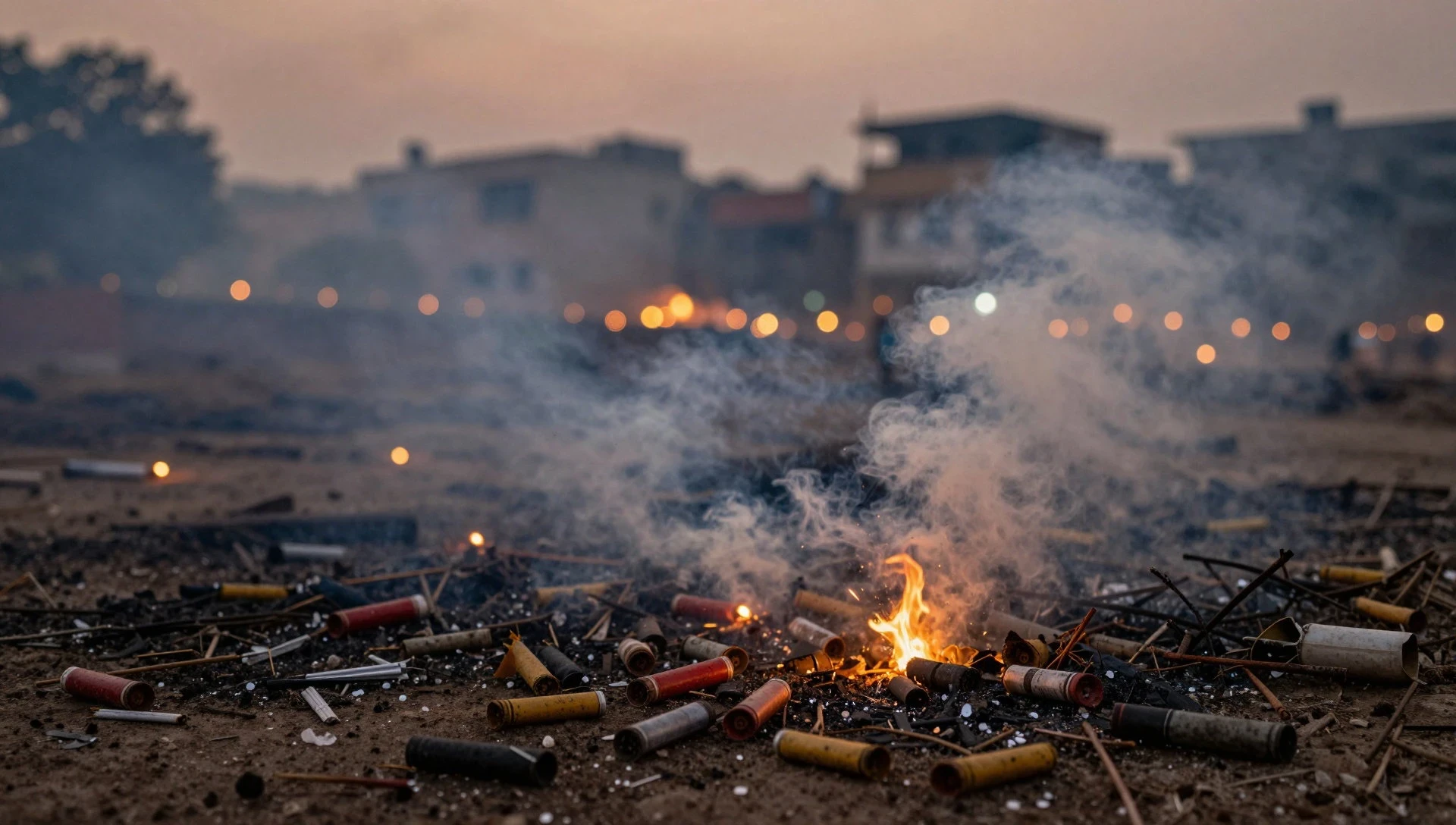
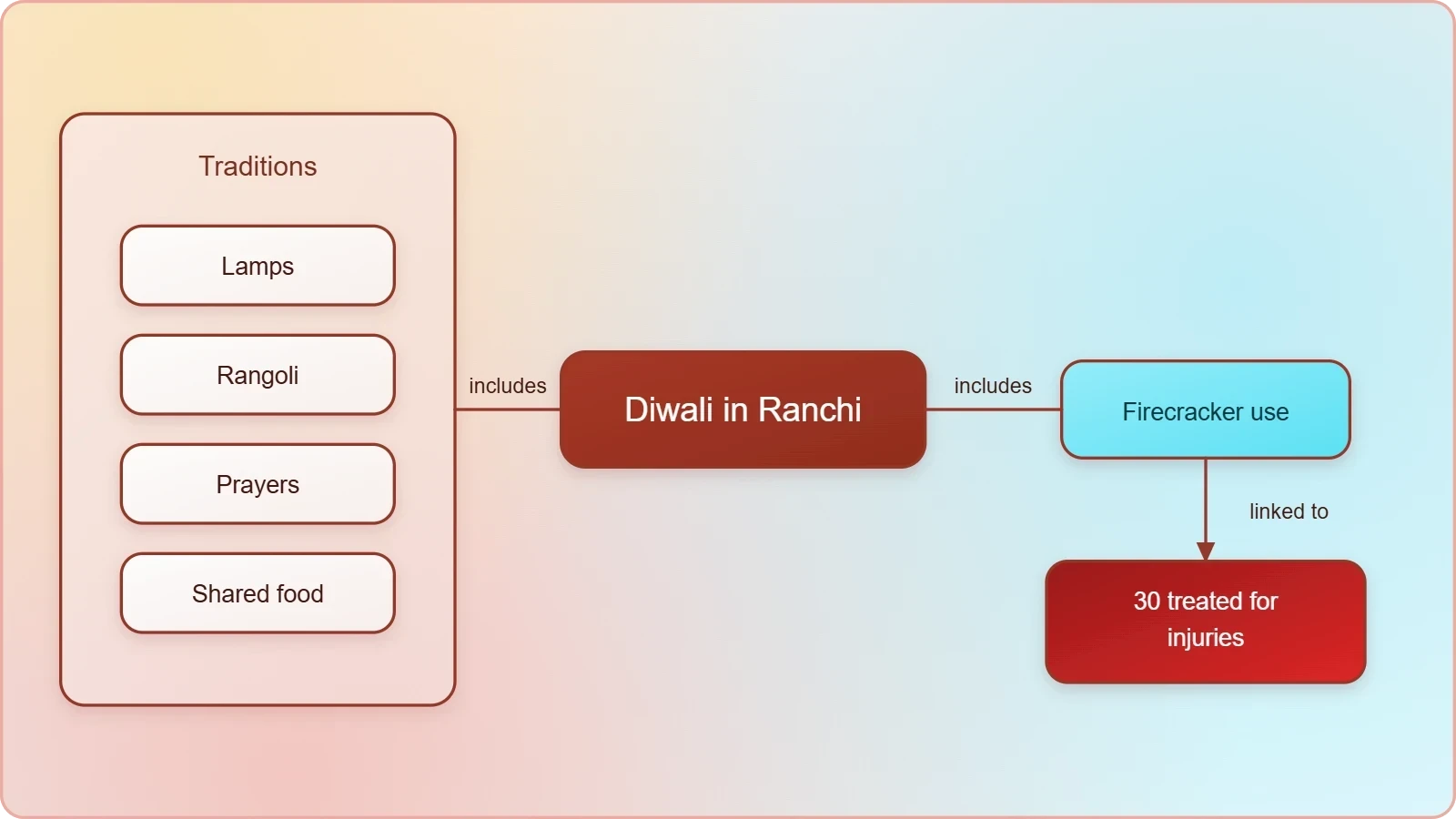
Diwali in Ranchi brought the familiar blend of prayer, lamps, rangoli, shared sweets and lively markets, but the celebrations also left 30 people needing treatment for firecracker-related burns. The reported cases show how a festive evening can hold both communal warmth and sudden, serious medical consequences.
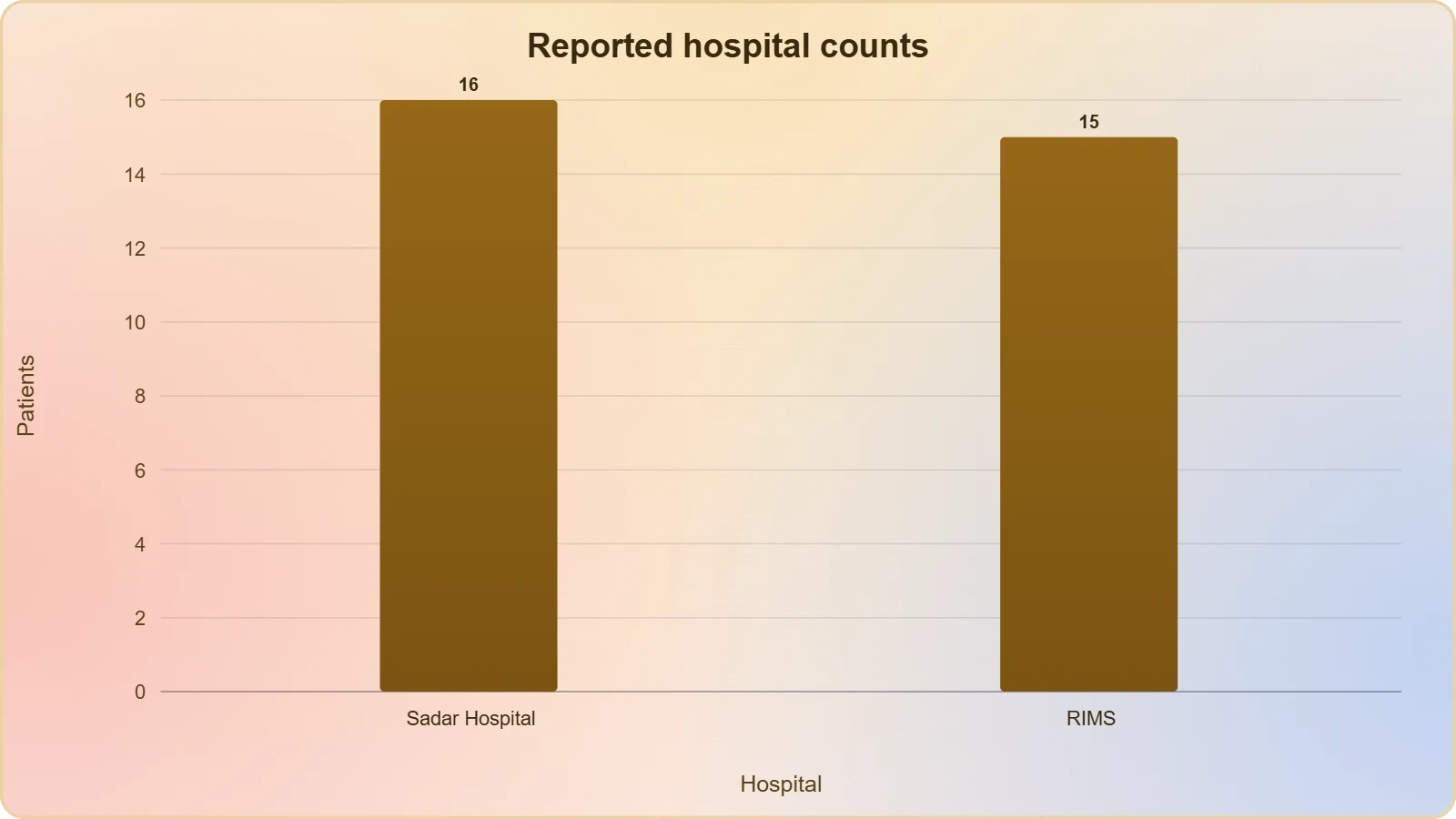
Two government hospitals handled the injured: Ranchi Sadar Hospital treated 16 patients, while the Rajendra Institute of Medical Sciences (RIMS) reported 15 cases, including one patient transferred from Sadar.
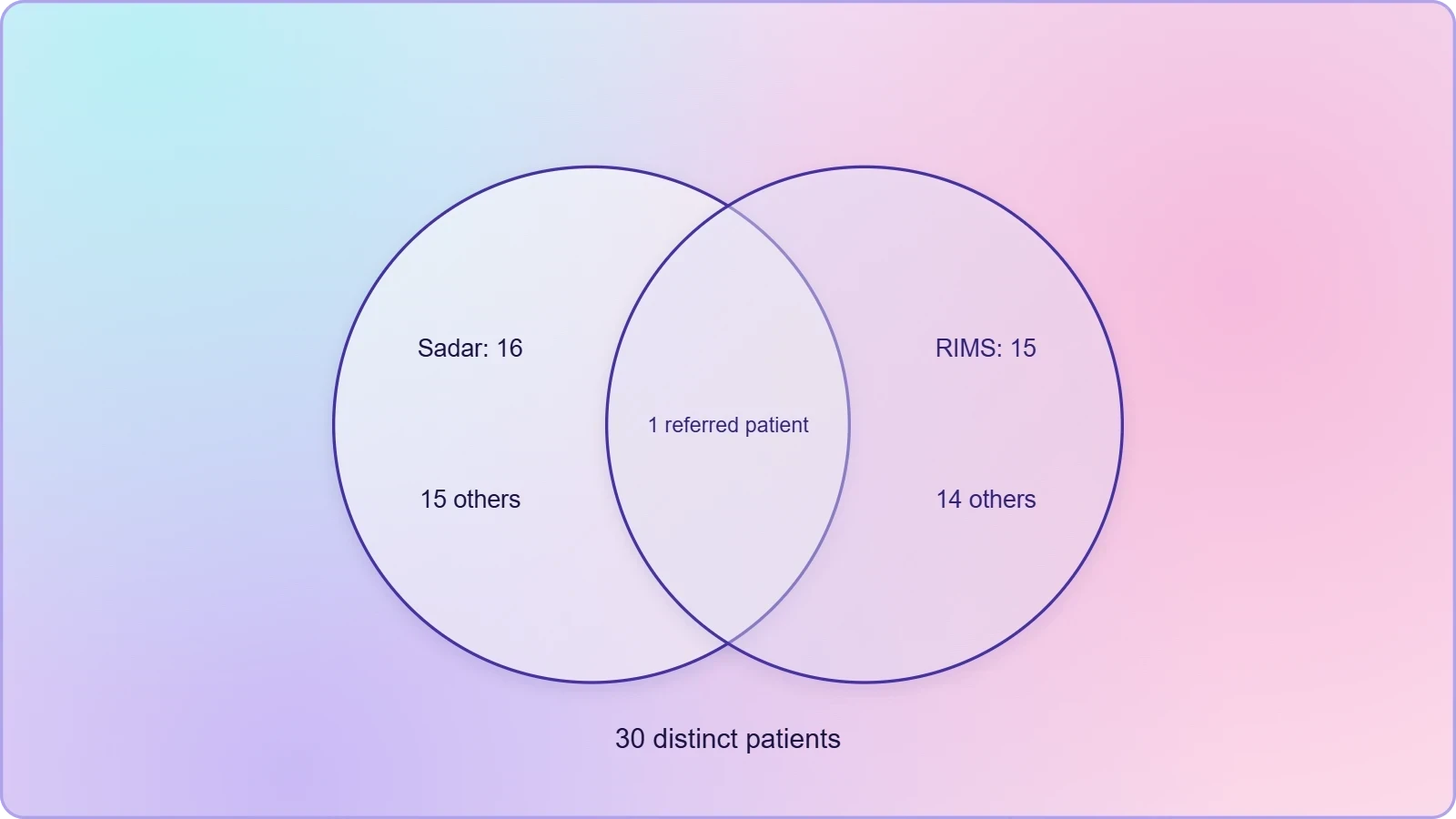
The overlap matters: the figures describe 30 people in total, not 31, and some eye injuries were serious enough to raise concern about permanent vision loss.
On This Page
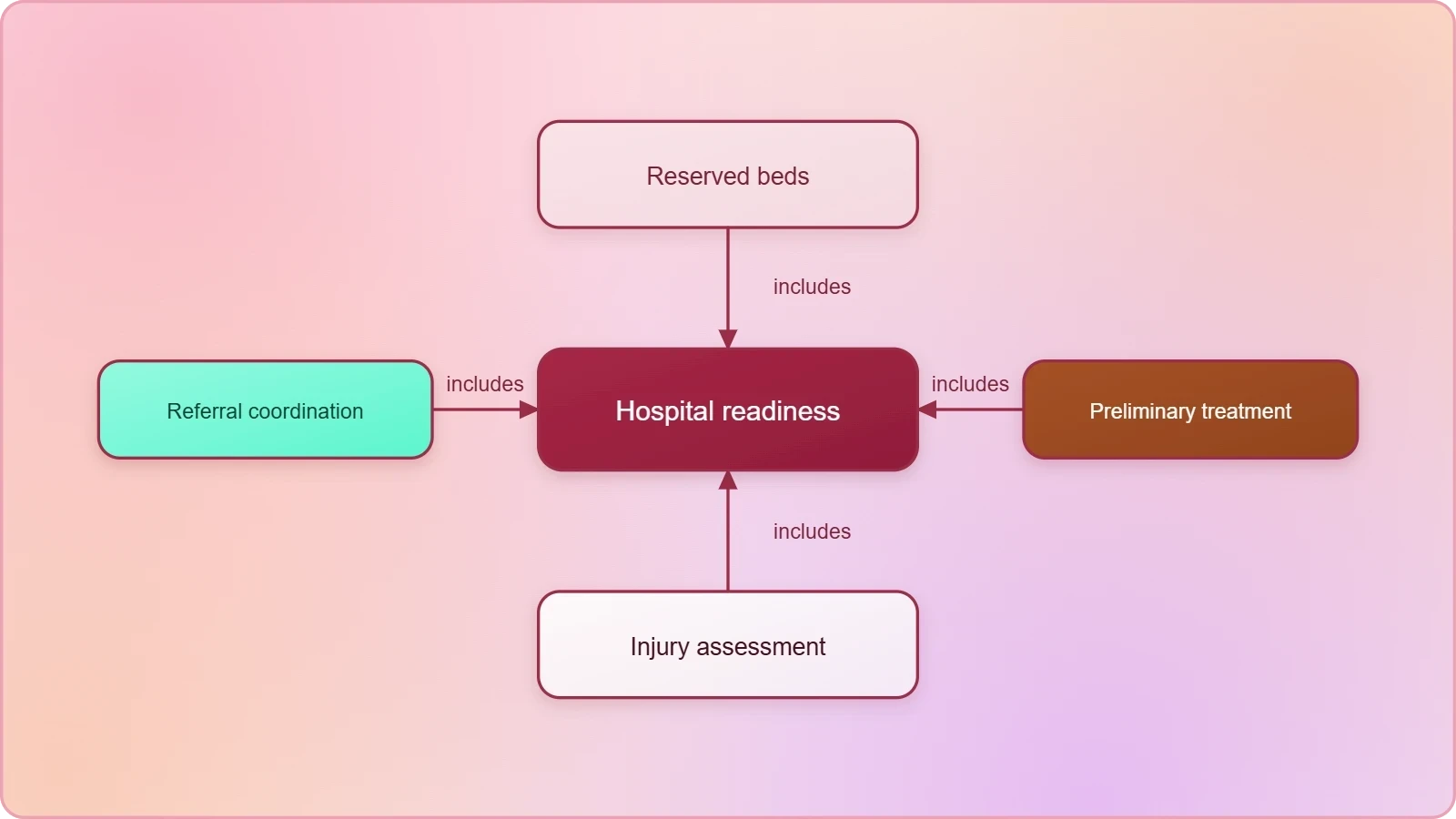
Hospital teams had reserved beds for Diwali-related injuries, and clinicians began preliminary treatment while assessing the extent of burns and eye damage. The episode therefore carries two connected messages: emergency readiness can support timely care, but firecracker injuries—especially those involving the eyes—may require further assessment and a long recovery.
TL;DRRanchi government hospitals treated 30 people for firecracker-related burns during Diwali. Sadar Hospital reported 16 patients and RIMS reported 15, with one person counted at both facilities after referral. Some eye injuries could result in permanent vision loss, while recovery from serious injuries may take weeks.
The city’s celebrations were reported as peaceful overall, with homes and markets decorated and families observing customary rituals. Reserved beds and early treatment supported the hospital response, while the cases underscore the importance of cautious firecracker use and prompt medical assessment after an injury.
What the Ranchi hospital figures show
The reported total captures the immediate medical burden of Diwali night in Ranchi. It combines activity at two government hospitals, while accounting for a transfer between them; reading each hospital’s count independently would incorrectly suggest that one patient was treated as two separate cases.
Understanding the patient count
Ranchi Sadar Hospital received 16 patients with firecracker-related injuries, according to Civil Surgeon Dr Amarendra Prasad. One patient had an eye injury and was referred onward to RIMS, indicating that at least one case required assessment at a higher-level medical facility.
RIMS reported 15 burn cases, and its tally included the patient referred from Sadar Hospital. The two figures therefore overlap by one person. Taken together, they describe 30 individual patients across the facilities, rather than an arithmetic total of 31.
The counts refer to patients treated at these two government hospitals, not necessarily every injury across Ranchi. The source does not provide information about private facilities, people who did not seek medical attention, or patients treated outside the city.
Nor does the report provide a breakdown by age, injury severity, firecracker type or precise time of arrival. Those omissions limit comparisons and make the number most useful as an account of hospital workload, rather than a complete measure of every Diwali-related injury.
Reading the numbers in context
Hospital-level counts can help explain where patients arrived and how care was distributed, but they need careful interpretation when referrals occur. A transfer keeps treatment moving between facilities; it does not create a second injured person or erase the work performed at the first hospital.
The report identifies burns as the principal category and separately notes eye injuries, including a case referred from Sadar. It does not specify how many of the 30 patients had eye involvement, so the total should not be read as an eye-injury count.
Likewise, the reported figure does not establish whether injuries rose or fell compared with previous years. Without comparable counts, definitions and reporting periods, conclusions about a trend would go beyond the available information.
What the tally does establish is a concentrated demand for care during the holiday period. A clearly stated total, with the referral overlap explained, gives readers and planners a more accurate picture of the cases described by the hospitals.
Eye injuries and the risk of lasting harm
The most serious warning in the report concerns possible damage to vision. Clinicians said that some patients with eye injuries could lose their sight permanently, while also stressing that further assessment would be needed before the extent of damage and appropriate treatment could be determined.
Why eye injuries need assessment
Eye injuries can be difficult to judge from outward appearance alone. In the cases described, doctors did not announce final outcomes; they said additional evaluation would establish the severity of damage and guide the treatment required for each affected patient.
The referral from Sadar Hospital to RIMS illustrates how a patient may move from initial treatment to further specialist assessment. The source does not identify the patient’s diagnosis or eventual outcome, so neither permanent damage nor full recovery can be assumed in that individual case.
Doctors’ warning about possible vision loss should be understood as a risk, not a confirmed result for every patient. The report says some people with eye injuries might lose vision permanently, but it does not give a precise number or prognosis.
That distinction matters in public communication. Clear reporting can convey the seriousness of an injury without turning a clinical possibility into a certainty, particularly when examinations and follow-up treatment are still underway.
What the treatment update means
RIMS Public Relations Officer Dr Shishir Kumar said patients had received preliminary treatment for their burns. Further assessment would determine the extent of eye damage and the care needed, making the reported update an early-stage account rather than a final clinical summary.
Preliminary care is an important first step, but it does not necessarily resolve the injury or settle the outlook. The report gives no treatment details, test results or discharge information, and therefore cannot support conclusions about individual recovery.
For readers, the central practical point is to treat an eye injury from a firecracker as potentially serious and seek prompt professional medical attention. The source does not prescribe a specific first-aid procedure, and clinical guidance should come from qualified health professionals.
Hospitals’ ongoing assessment also highlights why follow-up can matter. If doctors identify damage requiring further care, the patient’s needs may extend beyond the initial visit, even when early treatment has already been provided.
Hospital readiness and the care pathway
Both hospitals had reserved beds for Diwali-related burn patients, according to the report. That preparation provided designated capacity during a period when firecracker injuries were expected, while the referral between facilities shows how care could continue when further assessment was needed.
Reserved beds and timely treatment
Setting aside beds can help hospitals prepare for a predictable seasonal increase in demand. The source says both facilities reserved beds to support timely treatment, but it does not specify the number of beds, staffing levels or whether the capacity was fully used.
The report describes patients receiving preliminary treatment, rather than detailing the exact clinical procedures. This distinction keeps the account appropriately grounded: it confirms that care began, while leaving the treatment plan and later outcomes dependent on each patient’s assessment.
Readiness involves more than physical space. Coordination between receiving facilities, communication about referrals and the ability to assess injuries are all relevant to a functioning response, though the source does not document operational details beyond bed preparation and the transfer to RIMS.
It is therefore reasonable to recognize the hospitals’ preparation without overstating what is known about its scale or effectiveness. The available account records readiness measures and patient care, not a full audit of emergency services.
Referral as part of continuing care
The patient sent from Sadar Hospital to RIMS provides a concrete example of movement between care settings. A referral can connect an initial assessment with further evaluation, although the source does not explain the clinical criteria used or describe the receiving team’s subsequent findings.
That transfer is also important when interpreting public statistics. The first hospital reported 16 patients and RIMS reported 15 cases, but because the referred patient appears in both reports, the number of distinct people remains 30.
For healthcare communication, stating that overlap plainly prevents an inflated impression of the number treated. It also gives readers a better understanding of the relationship between hospital-level activity and the citywide total cited in the report.
Beyond this one referral, the article does not describe ambulance arrangements, emergency waiting times or coordination protocols. Those details would help assess the broader care pathway, but they should not be inferred from the limited information available.
Diwali celebrations across the city
The injuries occurred amid a festive night described as peaceful overall. Homes, markets and neighbourhoods were decorated with oil lamps, decorative lights and rangoli, while families performed prayers, exchanged sweets and gifts, and gathered with relatives, friends and neighbours.
Household rituals and neighbourhood life
Residents described familiar elements of the celebration: illuminated homes, colourful rangoli at entrances and courtyards, and gatherings shaped by greetings and shared food. These details place the hospital cases within the wider civic and family setting of the Diwali observance.
Harmu resident Sushil Ram spoke of diyas and fairy lights alongside rangoli designs, describing the visual atmosphere around homes. His account offers a resident’s perspective on the festive setting, rather than a measure of how every household celebrated.
Homemaker Nisha Prasad described rituals followed by exchanges of sweets, gifts and greetings. Her comments also noted that children and adults burst firecrackers, linking the celebratory activity directly to the practice associated with the reported burn injuries.
The coexistence of ceremony and risk is central to the account. The festive traditions are presented as meaningful social practices, while the injuries show how one form of celebration can introduce hazards that extend beyond a single household.
Markets and the public mood
Markets across Ranchi were busy with last-minute purchases of sweets, gifts and decorations. Sweet shops received orders for family gatherings and visits to relatives, illustrating the commercial activity and preparation that often accompany a major festival.
Deputy Commissioner Manjunath Bhajantri said Diwali celebrations in Ranchi remained peaceful. That description concerns the broader public order of the event; it does not mean that no accidents or medical emergencies occurred during the celebrations.
The distinction between a peaceful citywide atmosphere and individual injuries is important. Public celebrations can proceed without major disorder while still producing isolated incidents that place pressure on hospitals and cause lasting harm to those affected.
Read together, the civic and medical details offer a fuller account than either would alone. The city experienced decoration, worship and exchange, but the same evening also required hospitals to respond to firecracker-related burns.
- 01
- 02
- 03
- 04
Recovery, uncertainty and what the report cannot confirm
The account gives an early view of treatment, not final outcomes. Doctors said assessment would determine the extent of eye damage, and the RIMS spokesperson estimated that serious cases might take around a month to return to a normal routine.
Recovery may take time
The estimate of roughly a month applies to serious cases as a possibility, not to every patient. The report does not state how many injuries were classified as serious, whether the estimate referred to a particular patient, or how recovery progressed afterward.
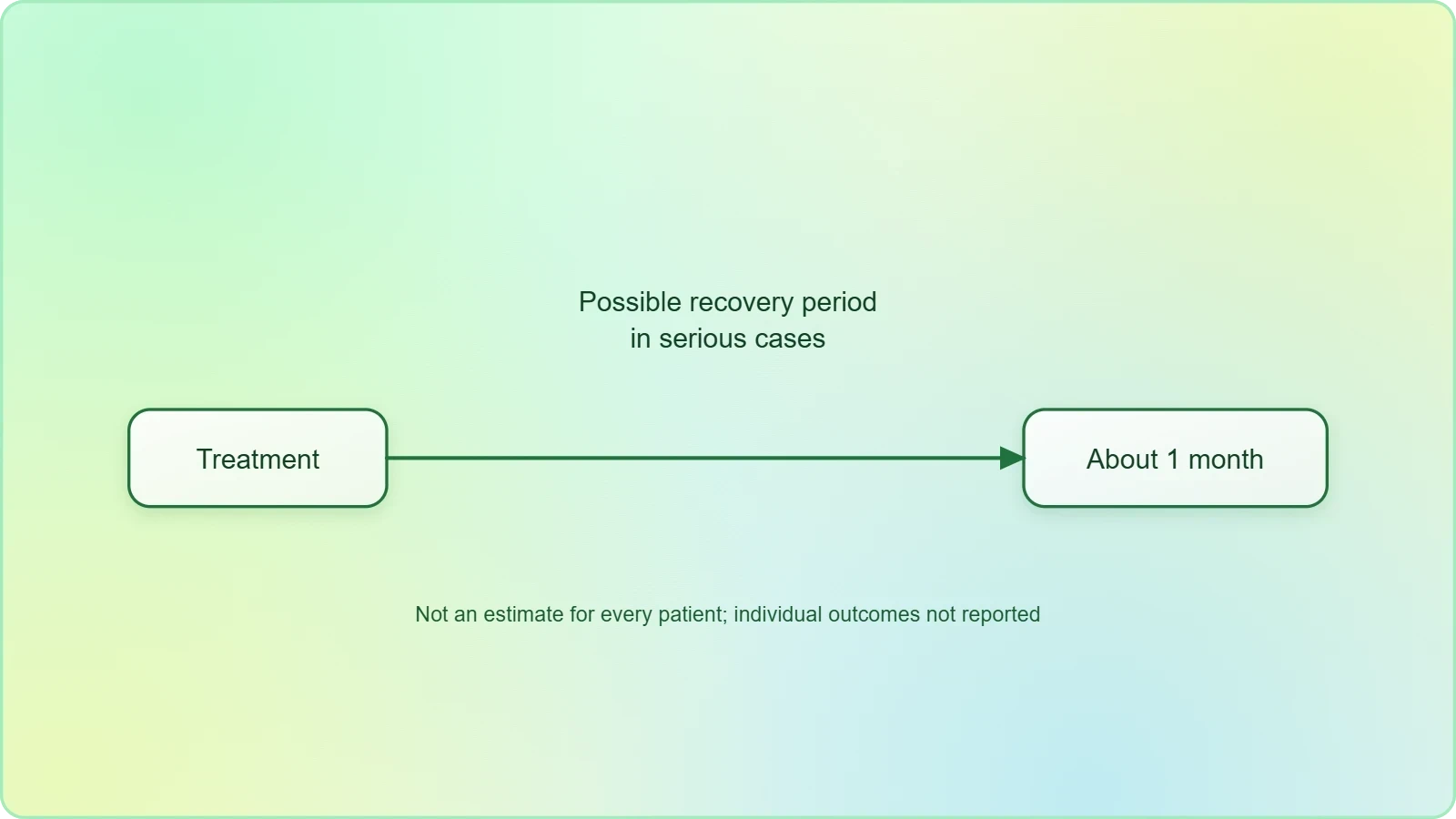
Burn injuries differ in location and severity, and eye damage may require separate evaluation. The source does not supply individual diagnoses or treatment plans, so the recovery estimate should be treated as a general indication rather than a guaranteed timeline.
Returning to a normal routine is also not necessarily the same as complete recovery. The source uses the phrase to describe the possible time required in serious cases, without defining work, school, daily activity or clinical recovery milestones.
These qualifications do not reduce the significance of the warning. They clarify what is known: preliminary treatment had been given, additional assessment remained necessary, and some serious cases could require weeks before normal routines resumed.
Limits of the available information
The report does not identify each patient’s age, location of injury or precise circumstances. It gives no final tally of eye injuries and no information about whether any patient experienced permanent vision loss after the initial assessment.
It also offers no comparative data from earlier Diwali celebrations. Without consistent figures from other years, readers cannot establish whether 30 cases represent an increase, a decrease or a similar level of injury for Ranchi.
Likewise, the account does not detail the firecrackers involved or establish how each injury occurred. It would be inappropriate to assign causes or responsibility to particular individuals or products on the basis of the information provided.
A careful reading keeps the known facts visible while respecting these gaps. The count, referral, preliminary care and medical warning are reported; clinical outcomes, trend comparisons and detailed circumstances remain unconfirmed.
Safety lessons for future celebrations
The Ranchi cases underline the value of reducing avoidable exposure to firecracker hazards while preserving the social and cultural meaning of Diwali. The report does not give a formal safety plan, but its account supports practical caution, readiness and prompt medical attention when injuries occur.
Prevention alongside celebration
Firecrackers were part of the celebrations described by residents, and burn injuries were the central medical concern reported by hospitals. Families can consider how to celebrate while reducing exposure, particularly around children and people who may be less able to move away quickly.
Reasonable precautions include following product instructions, keeping a safe distance and avoiding the handling of damaged or unexploded fireworks. These are general safety considerations, not details supplied by the report or a substitute for local regulations and professional guidance.
Eye protection deserves particular attention because clinicians warned that some eye injuries could cause permanent vision loss. The report does not specify a particular protective product, so any safety measures should be selected in line with reliable local guidance.
Non-firecracker traditions featured prominently in the city’s account: lamps, rangoli, prayers, gifts and shared sweets. Such customs show that the festive atmosphere rests on many practices, allowing households to place emphasis on rituals and community without relying solely on fireworks.
Preparedness as a shared responsibility
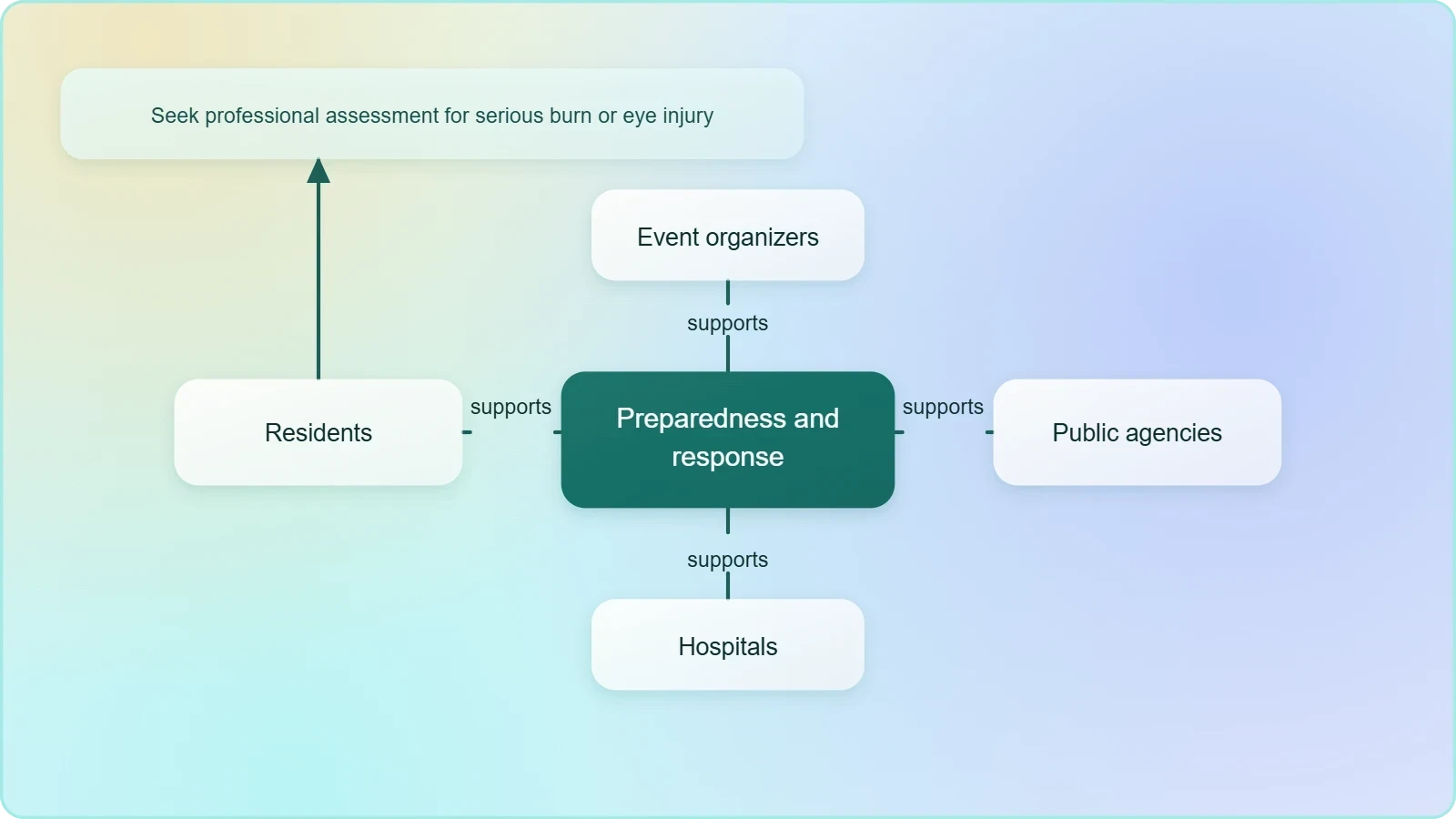
Hospitals’ reserved beds were one part of the response, but prevention begins before an injured person reaches a facility. Families, event organizers and public agencies can each contribute by communicating safety expectations and ensuring people know how to access medical care.
For hospitals and local authorities, clear public information about available services can help residents respond to injuries without delay. The source does not describe any public campaign or emergency contact system, so these remain broader implications rather than reported actions.
For residents, the most responsible response to a suspected serious burn or eye injury is professional assessment rather than relying on assumptions about severity. The clinicians’ comments emphasize that damage and treatment needs may only become clear after further evaluation.
The central lesson is not that celebration and safety must compete. Thoughtful precautions, prompt clinical care and respect for the seriousness of eye injuries can help communities protect health while continuing the traditions that give Diwali its shared meaning.
Ranchi’s Diwali report is ultimately an account of celebration and consequence: a city marked by lights, rituals and busy markets, alongside 30 people treated for firecracker-related burns. The hospital totals, referral overlap and warning about eye damage offer a grounded reminder that festive traditions benefit from care, preparation and attention to injury risks.
From our network :
- Live Online English Classes for Kids: Do They Actually Reduce Anxiety?A ten-week study reveals that synchronous online English classes can significantly reduce child language anxiety while improving listening and reading skills. Discover what makes these programs effective and how parents can select the right one.
- How AI Agents Will Change the Way We Manage Personal FinancesExplore how AI agents are transforming personal finance through automated budgeting, bill payment, and investment management, while examining the critical security protocols and governance frameworks required for safe deployment.
- The Final Descent: How ESA Retired the Legendary Cluster Constellation After 24 Years of Space Weather ScienceAfter 24 years mapping Earth’s magnetosphere, ESA’s Cluster mission concluded with a precisely controlled reentry over the South Pacific. This analysis explores the scientific legacy, engineering decisions, and debris mitigation principles behind one of space exploration’s most responsible retirements.
- Committed Mediterranean Precipitation Decline: Why Emissions Cuts Alone Cannot Restore Winter RainsNew NOAA research reveals that Mediterranean winter rains may decline irreversibly even with emissions cuts. Explore the science of committed climate change and regional impacts.
- The Hidden Cost of AI Convenience: Why Over-Permissioned Agents Are a Security Time BombDiscover why AI agents with excessive permissions create dangerous single points of failure, and learn how implementing least privilege principles can protect your organization from exploitation.
- CISA’s Ten-Advisory Wave: Why Generic Patching Fails in OT and How to Build Product-Specific PlaybooksCISA released ten ICS advisories in one week, exposing critical infrastructure risks. Generic patching fails in OT. Learn to build product-specific remediation playbooks.
- University Language Proficiency Exams: Why Institutional Tests Demand Different Preparation Than IELTS and TOEFLDiscover why university-specific language proficiency examinations differ fundamentally from IELTS and TOEFL, and learn strategic preparation approaches for institutional assessment success.
- Forbidden Matrix Patterns and Visible Lattice Points: A Geometric DictionaryExplore how multidimensional 0–1 matrices encode geometric truths, linking forbidden patterns to visible lattice points and hypergraph theory, with applications in combinatorics and computational geometry.
- Mobile Learning and VR in English: What Global Evidence Reveals About Effective Language TechnologyA systematic review across 14 countries reveals which language-learning technologies genuinely work. Mobile learning, AI, and VR show measurable benefits when pedagogically integrated. This evidence-based guide helps educators and learners select technology that delivers real return on investment.
RESOURCES
- Ranchi govt hospitals treat 30 firecracker burn cases on Diwalitimesofindia.indiatimes.com18 hours ago ... Ranchi govt hospitals treated 30 Diwali firecracker burn cases; RIMS and Sadar Hospital reported eye injuries with possible permanent vision ...
- Ranchi Hospitals on High Alert for Diwali - The Guardian Chronicletheguardianchronicle.com3 days ago ... Dr Amrendra Prasad, civil surgeon, Ranchi, said, “Burn injuries caused by firecrackers, diyas, candles and accidental fires remain among the ...
- Charutar Plastic Surgery Hospital and Laser Center - Facebookfacebook.com5 days ago ... ... Diwali Crackers Based on Injuries" to educate viewers on firework safety. ... Ranchi, delivers a Diwali firecracker safety message.…
- Tag: Firecracker Injuries Ranchi - The Guardian Chronicletheguardianchronicle.comRanchi: Hospitals are on alert mode to deal with possible emergency cases during Diwali, with special attention to burn injuries, firecracker-related ...
- Netrodaya The Eye City on Instagram: "Is Diwali patakhon se safety ...instagram.comNov 2, 2026 ... #diwalisafety #eyecare #ranchi #diwali2026 #kashyapmemorial ... Diwali Eye Safety Tips, Eye Protection During Diwali, Firecracker Eye Injury ...
- Let children enjoy crackers and laser lights safely - The Indian Expressindianexpress.comOct 18, 2025 ... Chandigarh doctors warn of rising eye and burn injuries during Diwali caused by firecrackers and laser A vendor arranges crackers…
- Safe diwali awareness session at ascot international school ranchi ...facebook.com4 days ago ... ... ranchi 2026. Safe diwali awareness session ... firecracker safety and essential precautions to prevent injuries during Diwali celebrations.
- ODM SAPPHIRE Global School on Instagram: " 🛡️ Celebrate with ...instagram.com4 days ago ... [Firecracker Safety Awareness, ODM Sapphire Global School Ranchi, Anant Sinha, festival safety precautions, burn injury first aid, student ...
- Plastic Surgery Blog | Ranchi | Guides in English & Hinglishdrvikrantranjan.comFirecracker burns, sparkler burns and hand blast injuries at Diwali: what to do in the first minutes, what not to do, and which injuries…
- Ranchi Court asks for health report as Lalu Yadav runs high fevernationalheraldindia.comAs many as 131 injured people remained hospitalised, while two people died of burn injuries during the 48-hour Diwali period. Telangana reported 112 fire ...
- Jharkhand protest: JLKM leader Devendra Nath Mahto admitted to ...aninews.inAug 11, 2026 ... ... Diwali meal with them. Updated: Nov 09, 2026 08:27 IST. Hyderabad: 32 suffer eye injury from Diwali firecrackers; 6…
- Diwali eye safety: Doctor shares precautions to prevent firecracker ...hindustantimes.com2 days ago ... Many firecracker-related injuries occur during Diwali. Know which ... Ranchi News · Other Cities · ENTERTAINMENT · Bollywood News ·…
- रांची में पटाखों से झुलसने पर तत्काल मिलेगा इलाज, रिम्स में 18 और सदर ...jagran.com3 days ago ... jharkhand air quality worsens post diwali hazaribagh aqi 336 ... shopkeeper knife attack over firecrackers one arrested in ranchi.
- Over 36 People Suffer Burns in Jamshedpur Diwali Firecracker ...jharkhandheadlines.com8 hours ago ... Representative image of medical treatment for firecracker burn injuries during Diwali celebrations in Jamshedpur ... Ranchi, Jamshedpur ...
- 01
- 02
- 03
- 04
- 05
- 06
- 07
- 08
0 Comments