When Stellantis shares slipped on November 3, 2026, the immediate trigger was deceptively narrow: unconfirmed reports that a shortage of computer chips had begun disrupting production of Fiat vehicles. The automaker declined to publicly verify the accounts, and the reports themselves offered no timeline for resolution and no estimate of how many units might be lost. Yet investors sold first and asked questions later, a reflex that reveals how deeply semiconductor supply has become embedded in the market's valuation of car manufacturers. What looks like a single-company headline is, in truth, a window into the structural fragility of modern vehicle manufacturing.
The episode matters because it compresses several larger realities into one trading session. Automakers now design vehicles as rolling computing platforms, with semiconductors governing everything from engine management and battery control to infotainment, driver assistance, and safety systems. A disruption in chip availability therefore does not merely slow one assembly line; it can idle entire plants, cascade through supplier networks, and distort quarterly guidance. Stellantis, formed from the merger of Fiat Chrysler and PSA Group, carries a particularly complex industrial footprint across Europe and North America, which magnifies the operational consequences of any component shortfall.
This analysis examines the incident from multiple angles: the mechanics of the share-price reaction, the anatomy of the global chip shortage, the specific exposure of the Fiat brand, the information vacuum created by unconfirmed reports, and the strategic lessons for investors and manufacturers alike. The goal is not to speculate about numbers the company has not disclosed, but to explain why a headline about chips and Fiat production carries weight far beyond a single trading day.
On This Page
- The Market Reaction and What It Signals
- The Global Chip Shortage as a Structural Condition
- Fiat's Exposure Within the Stellantis Portfolio
- Information Gaps and the Discipline of Verification
- Strategic Lessons for Manufacturers and Investors
- The Wider Context: Autos, Silicon, and Industrial Policy
- Conclusion: Reading the Signal Beneath the Headline
TL;DR Stellantis shares declined on November 3, 2026, after reports linked a computer-chip shortage to disrupted Fiat production, though the company did not confirm the accounts and no duration or volume estimates were provided. The reaction underscores how semiconductor dependency has become a core valuation risk for automakers, how unverified reporting can move markets, and why supply-chain resilience now sits at the center of industrial strategy. Investors should read the episode as a signal about structural vulnerability rather than a confirmed operational loss.
The Market Reaction and What It Signals
Equity markets are forward-looking machines that price probability rather than certainty, and the Stellantis session illustrated that principle with unusual clarity. The reports were unconfirmed, vague on duration, and silent on volume, yet the stock fell as investors recalibrated their expectations for production continuity. Such a reaction is rational when the underlying risk is asymmetric: if the disruption proves brief, the downside is limited, but if it signals a broader chip constraint, the earnings impact could compound across quarters. Markets routinely price the possibility of bad outcomes before those outcomes are verified.
The decline also reflected the broader mood surrounding legacy automakers, which trade under persistent pressure from electrification costs, tariff uncertainty, and competitive threats from lower-cost producers. In that context, a chip-related headline functions as a confirmation of existing anxieties rather than a standalone shock. When a sector is already priced for turbulence, incremental negative news tends to be absorbed quickly and sometimes disproportionately, because investors have less patience for ambiguity and more incentive to reduce exposure ahead of earnings disclosures.
Why Unconfirmed Reports Still Move Prices
Financial markets have long operated on the principle that information asymmetry creates trading opportunities, and unverified reports sit squarely within that tradition. When a credible outlet publishes claims about production disruption, traders must decide whether to wait for confirmation or act preemptively. Waiting carries the risk of being late; acting carries the risk of overreacting to noise. In practice, institutional investors often trim positions first and investigate afterward, a behavior that amplifies short-term volatility and explains why stocks can move sharply on news that later proves exaggerated or immaterial.
The absence of company confirmation does more than leave a factual gap; it creates a pricing vacuum that rumor and speculation rush to fill. Stellantis, like most large manufacturers, communicates production matters through scheduled disclosures, regulatory filings, and supplier communications rather than rapid public statements. That cadence is prudent but slow, and in the interval between report and confirmation, the market must assign its own probabilities. The resulting price movement is therefore a collective estimate of risk, not a verdict on reality.
The Anatomy of a Single-Session Decline
A one-day share decline is often treated as noise, but its composition deserves scrutiny. Part of the move reflects genuine reassessment of production risk; part reflects mechanical factors such as stop-loss triggers, options hedging, and index rebalancing; and part reflects sentiment contagion from peers. Disentangling these components is difficult in real time, which is why analysts typically wait for volume data, institutional flow reports, and subsequent disclosures before drawing firm conclusions about what a decline actually signifies.
For long-term holders, the more important question is whether the session changed the underlying investment thesis. A temporary chip disruption, even a meaningful one, rarely alters the multi-year trajectory of a global automaker unless it exposes a systemic planning failure. The market's reaction should therefore be read as a prompt for diligence rather than a verdict, a reminder that price movements encode expectations and emotions as much as they encode fundamentals.
The Global Chip Shortage as a Structural Condition
The semiconductor shortage that began disrupting global industry in 2020 was never a single event but a prolonged condition, shaped by pandemic demand shifts, fab capacity constraints, geopolitical export controls, and the extreme complexity of chip supply chains. Automotive manufacturers were hit especially hard because they had historically relied on just-in-time inventory practices and low-margin legacy chip nodes that foundries deprioritized in favor of higher-value consumer electronics. The result was a multi-year recalibration in which vehicles sat incomplete awaiting components, and automakers learned that silicon is as strategic as steel.
By late 2026, the acute phase of the crisis had eased in many segments, but structural vulnerabilities remained. Advanced driver-assistance systems, electric powertrain controllers, and infotainment modules demand increasingly sophisticated chips, often at leading-edge nodes where capacity is concentrated among a handful of foundries. Any disruption—whether from natural disaster, export restriction, or demand surge—can ripple through the automotive value chain with remarkable speed. The Stellantis reports should be understood against this backdrop of persistent, if less visible, fragility.
From Just-in-Time to Just-in-Case
The pandemic exposed the limits of lean inventory philosophy when applied to components with long lead times and concentrated supply. Automakers that once held days of chip inventory discovered they needed months, and many began signing direct supply agreements with foundries, stockpiling critical semiconductors, and redesigning vehicle architectures to accommodate multiple chip sources. This shift from just-in-time to just-in-case represents one of the most consequential changes in automotive manufacturing strategy in decades, with implications for working capital, supplier relationships, and plant flexibility.
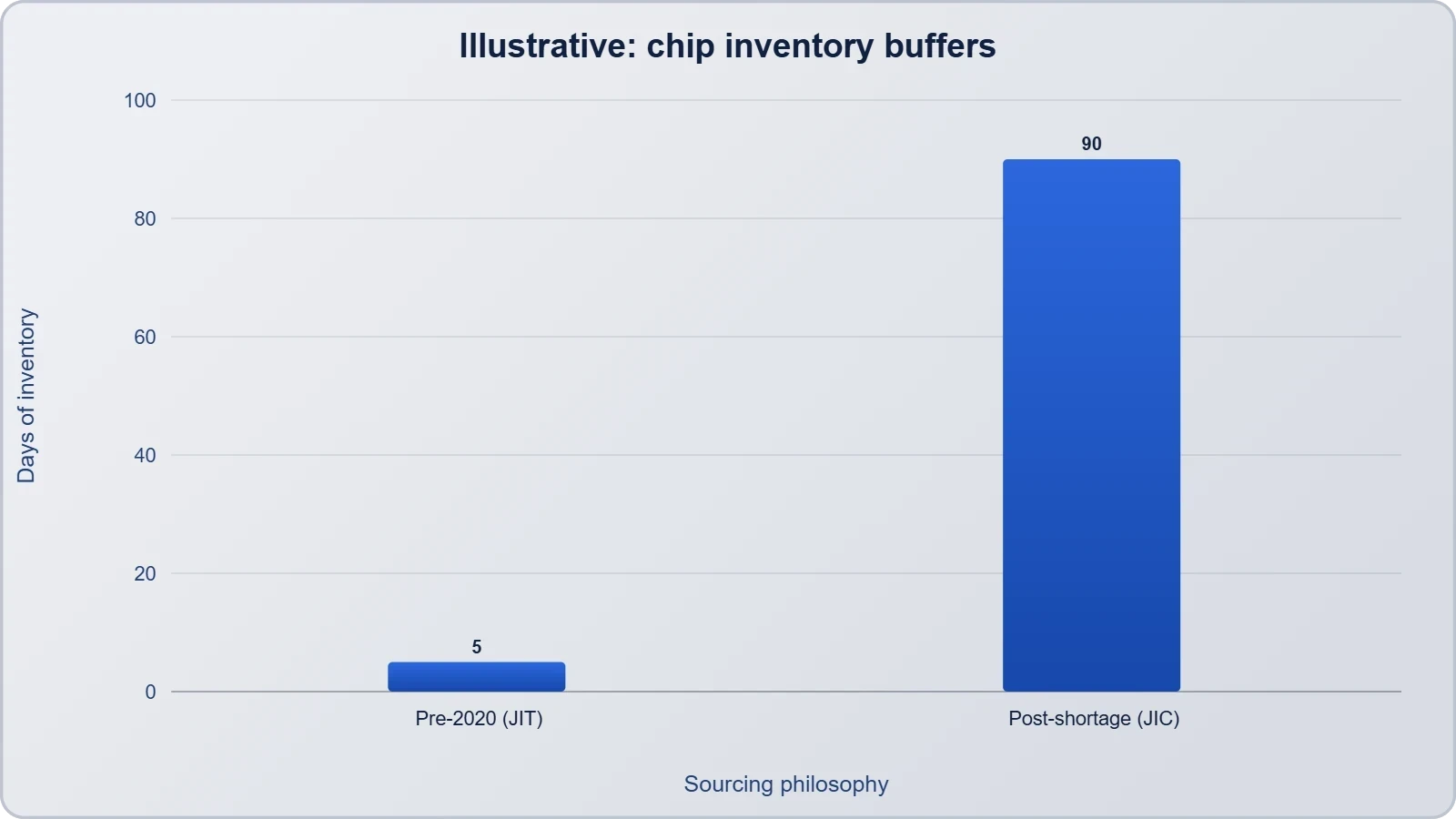
Yet resilience is expensive, and the industry must balance buffer inventory against profitability. Holding excess chips ties up capital and risks obsolescence if vehicle designs change. The optimal strategy is not maximum stockpiling but intelligent diversification: qualifying multiple suppliers, designing for pin-compatibility, and maintaining visibility into sub-tier suppliers. Companies that mastered these disciplines emerged from the crisis stronger; those that did not remain exposed to exactly the kind of disruption the Stellantis reports described.
Geopolitics and the Silicon Supply Map
Semiconductor supply is no longer a purely commercial matter. Export controls, industrial subsidies, and national security considerations have reshaped where chips are designed, fabricated, and packaged. Governments in the United States, Europe, and Asia have committed substantial public funds to onshore capacity, but fabs take years to build and ramp. In the interim, automakers depend on a supply map shaped by diplomacy as much as by economics, and a single policy shift can alter availability for entire vehicle programs.
For investors, this geopolitical dimension adds a layer of risk that traditional automotive analysis did not require. Evaluating an automaker now demands some understanding of foundry capacity, trade restrictions, and regional subsidy regimes. The Stellantis episode, however brief, is a reminder that the company's production outlook is entangled with decisions made in fabrication plants and government ministries far from its assembly lines.
Fiat's Exposure Within the Stellantis Portfolio
Stellantis is a multi-brand conglomerate whose portfolio spans Fiat, Peugeot, Citroën, Opel, Jeep, Ram, Alfa Romeo, and Maserati, each with distinct manufacturing footprints and market positioning. Fiat, historically the group's volume brand in Europe and Latin America, operates on thinner margins than premium marques, which makes production interruptions particularly consequential. A chip shortage affecting Fiat output therefore strikes at the segment least able to absorb cost shocks, even if the absolute financial impact remains modest relative to group revenue.
The brand's production geography adds complexity. Fiat vehicles are assembled across facilities in Italy, Poland, Brazil, and elsewhere, each tied to regional supplier networks and logistics chains. A chip constraint at one plant does not automatically affect another, but shared component sourcing means disruptions can propagate. The reports did not specify which facilities were affected, a gap that leaves analysts to model scenarios rather than quantify outcomes, and that ambiguity itself becomes a source of market anxiety.
Volume Brands and Margin Sensitivity
Volume brands operate on the principle of scale efficiency: modest per-unit margins multiplied across large production runs. When output is interrupted, fixed costs continue while revenue pauses, compressing margins quickly. Fiat's competitive position in price-sensitive markets leaves limited room to pass cost increases to consumers, so production disruptions translate more directly into earnings pressure than they would for a luxury brand with pricing power. This asymmetry explains why investors may react more sharply to Fiat-specific news than to similar reports involving premium marques.
There is also a strategic dimension. Stellantis has invested heavily in electrifying its European lineup, and Fiat's transition to electric models depends on a new generation of power electronics and battery management chips. A shortage affecting these components could delay the brand's electrification roadmap, not merely its current output. The market's reaction may therefore reflect concern about future product cadence as much as present production losses.
Supply Chain Concentration Risks
Automotive supply chains are characterized by deep tiering: Tier 1 suppliers deliver modules, Tier 2 suppliers provide components, and Tier 3 suppliers furnish raw materials and semiconductors. Visibility often fades beyond the first tier, which means an automaker may not know its true exposure until a disruption occurs. The chip shortage exposed this opacity dramatically, with manufacturers discovering that critical components traced back to a single fab or a single packaging facility thousands of miles away.
Stellantis, like its peers, has since invested in supply chain mapping and dual-sourcing arrangements, but concentration risk cannot be eliminated entirely. Leading-edge semiconductor fabrication is among the most concentrated industries on earth, with a handful of foundries serving global demand. When reports of disruption surface, the rational assumption is that the constraint may be structural rather than incidental, and markets price accordingly.
We Also Published
- 01
- 02
- 03
- 04
Information Gaps and the Discipline of Verification
The most instructive aspect of the Stellantis episode may be what was missing. The reports did not specify duration, volume, facility, or component type, and the company did not confirm them. In a well-functioning market, such thin information should produce a muted reaction; in practice, it produced a decline. This gap between information quality and price movement is a recurring feature of financial markets, and it offers a lesson in the discipline of verification that separates disciplined investors from reactive ones.
Verification requires patience and access. Analysts can cross-reference supplier disclosures, shipping data, and regional production statistics to estimate whether a disruption is real and material. They can examine the company's historical disclosure patterns to gauge how quickly confirmation typically arrives. They can also assess the credibility of the reporting outlet and the specificity of its sourcing. None of these steps eliminates uncertainty, but together they convert a vague headline into a probabilistic assessment rather than an emotional trigger.
Reading Between the Lines of Corporate Silence
Corporate silence is not necessarily concealment. Public companies operate under disclosure regulations that require material information to be released through approved channels, and premature comment on unverified reports can create legal and reputational risk. Stellantis's decision not to confirm the reports may reflect caution, ongoing internal assessment, or a judgment that the disruption is not material enough to warrant disclosure. Investors who interpret silence as guilt often misread the incentives that govern corporate communication.
That said, silence has costs. It leaves the narrative to others and allows speculation to harden into conventional wisdom. Companies that communicate proactively during disruptions—even to say that operations are normal or that assessments are underway—tend to experience less volatility than those that stay quiet. The lesson for corporate strategy is that information management is itself a form of risk management, particularly when supply chains are fragile and markets are primed for bad news.
Building an Analytical Framework for Supply News
A disciplined framework for evaluating supply-chain headlines begins with materiality: does the reported disruption affect a product line large enough to move group earnings? It then considers duration: is the constraint likely to resolve in weeks or persist for quarters? Next comes verification: are there corroborating signals from suppliers, logistics data, or regulatory filings? Finally, it weighs context: is the company already priced for adversity, or is the news a genuine surprise? Applying these four filters consistently prevents overreaction to noise and underreaction to genuine risk.
Such a framework also helps distinguish between idiosyncratic and systemic events. A single-plant disruption is idiosyncratic; a foundry outage affecting multiple automakers is systemic. The Stellantis reports sit somewhere in between, which is precisely why they commanded attention. Investors who can classify disruptions accurately are better positioned to act on them, whether by adjusting positions, hedging exposure, or simply waiting for clarity.
Strategic Lessons for Manufacturers and Investors
The Stellantis episode offers lessons that extend well beyond a single trading session. For manufacturers, the imperative is to treat semiconductor supply as a strategic function rather than a procurement detail, embedding chip availability into product planning, capital allocation, and risk management. For investors, the imperative is to incorporate supply-chain resilience into valuation frameworks, recognizing that operational fragility can erase earnings visibility even when demand remains strong. Both lessons point toward a more sophisticated understanding of what makes an automaker competitive in an era defined by software and silicon.
There is also a governance dimension. Boards increasingly expect management to demonstrate supply-chain transparency, scenario planning, and contingency protocols. Companies that can articulate their chip strategy clearly tend to earn a valuation premium, while those that cannot are penalized when disruptions occur. The market is gradually learning to price resilience, and the Stellantis reports provided another data point in that education.
Resilience as a Competitive Advantage
In industries where products are increasingly similar, operational reliability becomes a differentiator. An automaker that can deliver vehicles on schedule during a component shortage gains market share from competitors that cannot, and it strengthens dealer relationships and customer loyalty in the process. Resilience is therefore not merely defensive; it is a source of commercial advantage. The companies that invested in dual sourcing, buffer inventory, and supplier partnerships after the pandemic are now better positioned to weather the next disruption, whatever form it takes.
Resilience also affects capital allocation. Plants that can flex between models, platforms designed for component substitution, and supplier agreements that prioritize allocation during scarcity all require upfront investment. The return on that investment is realized during crises, which makes it easy to underfund in calm periods. The discipline lies in maintaining those capabilities even when the immediate pressure to cut costs is strong.
What Investors Should Monitor Going Forward
Investors tracking Stellantis and its peers should monitor several indicators: monthly production data by region, supplier earnings commentary, semiconductor lead times, and the company's own disclosure cadence. They should also watch for signs of broader industry stress, such as coordinated production cuts or emergency allocation agreements, which would suggest a systemic rather than idiosyncratic disruption. Finally, they should assess whether the company's electrification timeline remains intact, since chip constraints often hit new platforms hardest.
The most valuable habit, however, is patience. Supply-chain disruptions are rarely resolved in a single news cycle, and the information environment around them is noisy. Investors who wait for confirmation, weigh materiality, and avoid reacting to headlines tend to make better decisions than those who trade on the first report. The Stellantis session is a case study in why that discipline matters.
The Wider Context: Autos, Silicon, and Industrial Policy
The Stellantis reports arrived at a moment when industrial policy across major economies is being rewritten around semiconductor sovereignty. The United States, the European Union, Japan, and India have all launched incentive programs to expand domestic chip fabrication and packaging, motivated by both economic and security concerns. For automakers, these programs promise long-term supply stability but create short-term complexity, as new fabs take years to come online and supply chains reconfigure around subsidized capacity.
This policy environment also shapes competitive dynamics. Automakers with strong government relationships and domestic manufacturing footprints may secure preferential access to subsidized chips, while others rely on global markets. The result is a subtle but significant shift in the determinants of competitiveness, away from pure manufacturing efficiency and toward supply-chain diplomacy. Understanding this shift is essential for anyone analyzing the sector over a multi-year horizon.
Electrification and the Chip Intensity Curve
Electric vehicles are substantially more chip-intensive than internal combustion models, requiring power electronics, battery management systems, and advanced computing for range optimization and charging. As Stellantis and its peers accelerate electrification, their exposure to semiconductor supply grows rather than shrinks. This means that chip shortages will remain a recurring risk even after current constraints ease, and that supply-chain strategy must be designed for a more silicon-dependent future.
The chip intensity curve also affects cost structures. Semiconductors represent a rising share of vehicle bill-of-materials, which changes the economics of production and pricing. Automakers must therefore negotiate component costs with the same rigor they apply to steel or aluminum, and they must plan for technology transitions that could render current chip designs obsolete. The companies that manage this transition well will enjoy both cost and reliability advantages.
Implications for Global Supply Chain Design
The longer-term implication is a redesign of global supply chains around resilience rather than pure efficiency. Regionalization, dual sourcing, and strategic inventory are becoming standard practice, even at the cost of higher working capital and slightly elevated unit costs. This shift represents a fundamental change from the efficiency-maximizing paradigm that dominated manufacturing for three decades, and it will reshape supplier relationships, plant locations, and capital allocation across the industry.
For Stellantis specifically, the redesign involves balancing its European and North American footprints, diversifying chip suppliers, and investing in software-defined vehicle architectures that can accommodate component variability. These are multi-year programs with uncertain payoffs, but they address the root cause of the vulnerability that the November reports exposed. The market will watch closely to see whether such investments translate into measurable resilience.
Conclusion: Reading the Signal Beneath the Headline
The Stellantis share decline of November 3, 2026, is best understood not as a verdict on the company but as a signal about the environment in which it operates. A report of chip-related disruption to Fiat production, unconfirmed and unspecified, was sufficient to move the stock because investors have learned that semiconductor supply is a structural vulnerability rather than a temporary inconvenience. The episode captures the intersection of manufacturing complexity, information asymmetry, and market psychology that defines modern equity investing in the automotive sector.
For readers seeking practical takeaways, three stand out. First, treat unconfirmed supply reports as prompts for analysis rather than triggers for action, applying filters of materiality, duration, verification, and context. Second, recognize that resilience has become a competitive variable, and evaluate automakers on their supply-chain strategy alongside their product lineup. Third, appreciate that industrial policy and geopolitics now shape chip availability, which means automotive analysis requires a broader lens than traditional financial metrics alone can provide.
The deeper message is about how markets process uncertainty. Prices are not statements of fact; they are aggregations of expectation, fear, and incomplete information. When a headline about chips and Fiat production moves a global automaker's valuation, it reveals what investors already believe about fragility. The disciplined response is neither to dismiss the signal nor to overreact to it, but to investigate, contextualize, and wait for confirmation. That approach serves long-term investors far better than reflexive trading, and it turns a single-session decline into a durable lesson about how modern industry actually works.
From our network :
- University Language Proficiency Exams: Why Institutional Tests Demand Different Preparation Than IELTS and TOEFLDiscover why university-specific language proficiency examinations differ fundamentally from IELTS and TOEFL, and learn strategic preparation approaches for institutional assessment success.
- The Final Descent: How ESA Retired the Legendary Cluster Constellation After 24 Years of Space Weather ScienceAfter 24 years mapping Earth’s magnetosphere, ESA’s Cluster mission concluded with a precisely controlled reentry over the South Pacific. This analysis explores the scientific legacy, engineering decisions, and debris mitigation principles behind one of space exploration’s most responsible retirements.
- Committed Mediterranean Precipitation Decline: Why Emissions Cuts Alone Cannot Restore Winter RainsNew NOAA research reveals that Mediterranean winter rains may decline irreversibly even with emissions cuts. Explore the science of committed climate change and regional impacts.
- How AI Agents Will Change the Way We Manage Personal FinancesExplore how AI agents are transforming personal finance through automated budgeting, bill payment, and investment management, while examining the critical security protocols and governance frameworks required for safe deployment.
- CISA’s Ten-Advisory Wave: Why Generic Patching Fails in OT and How to Build Product-Specific PlaybooksCISA released ten ICS advisories in one week, exposing critical infrastructure risks. Generic patching fails in OT. Learn to build product-specific remediation playbooks.
- The Hidden Cost of AI Convenience: Why Over-Permissioned Agents Are a Security Time BombDiscover why AI agents with excessive permissions create dangerous single points of failure, and learn how implementing least privilege principles can protect your organization from exploitation.
- Live Online English Classes for Kids: Do They Actually Reduce Anxiety?A ten-week study reveals that synchronous online English classes can significantly reduce child language anxiety while improving listening and reading skills. Discover what makes these programs effective and how parents can select the right one.
- Forbidden Matrix Patterns and Visible Lattice Points: A Geometric DictionaryExplore how multidimensional 0–1 matrices encode geometric truths, linking forbidden patterns to visible lattice points and hypergraph theory, with applications in combinatorics and computational geometry.
- Mobile Learning and VR in English: What Global Evidence Reveals About Effective Language TechnologyA systematic review across 14 countries reveals which language-learning technologies genuinely work. Mobile learning, AI, and VR show measurable benefits when pedagogically integrated. This evidence-based guide helps educators and learners select technology that delivers real return on investment.
RESOURCES
- Resources will be updated soon.
- 01
- 02
- 03
- 04
- 05
- 06
- 07
- 08
0 Comments