South Carolina's Senate contest in the 2026 midterms delivered a result that few political forecasters would have placed on their boards a year earlier: Democrat Annie Andrews, a former paediatrician, defeated Republican Darline Graham, the appointed incumbent and sister of the late Senator Lindsey Graham. The outcome handed Democrats their first Senate victory in the Palmetto State in twenty-eight years, a span stretching back to 1998. For a party that had watched South Carolina drift steadily into deep-red territory, the win represents both a symbolic breakthrough and a practical gain in a chamber where single seats decide committee control and judicial confirmations.
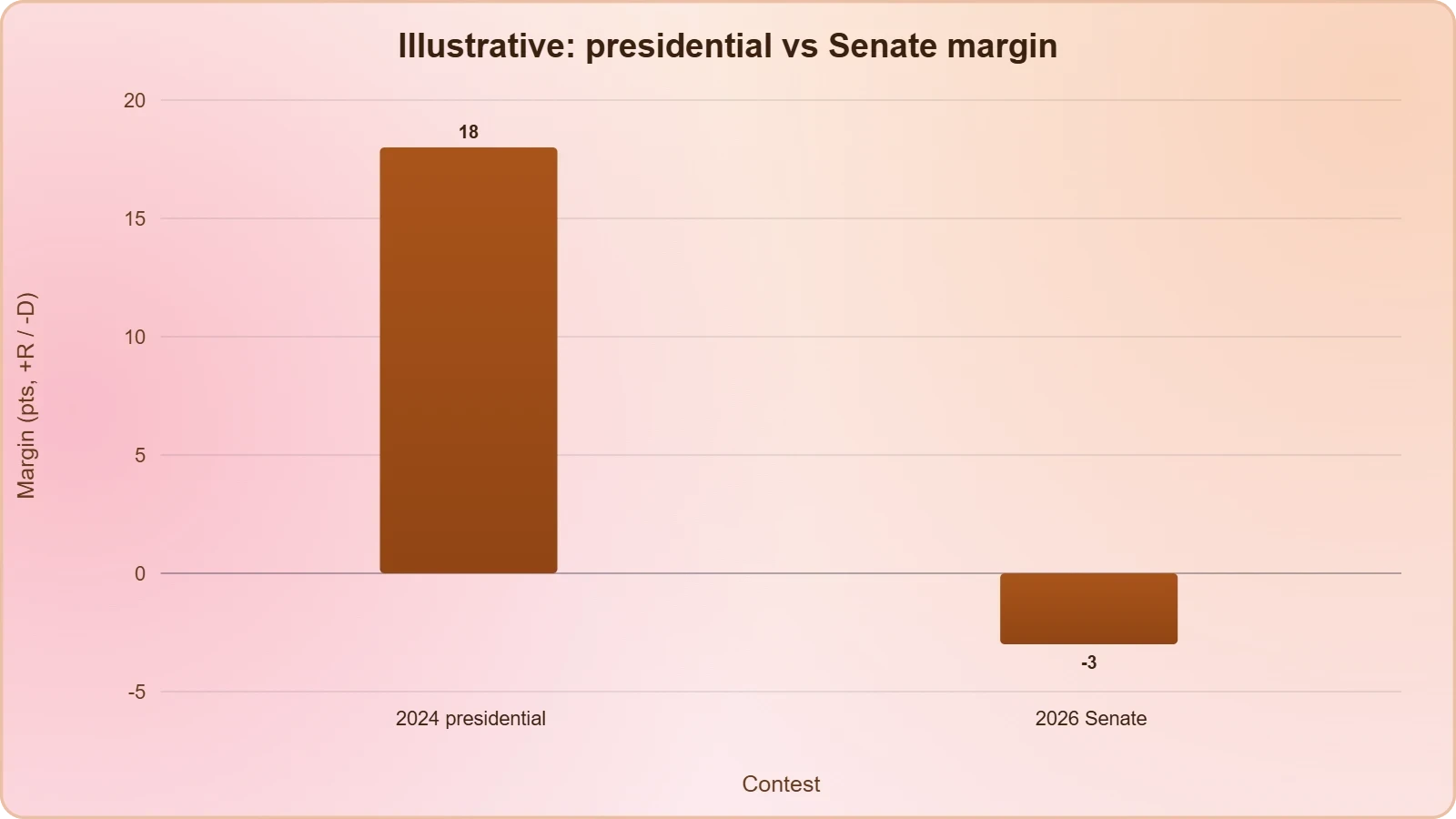
The race carried an unusual dynastic dimension. Darline Graham entered the Senate in July through appointment following the sudden death of her brother, who had represented South Carolina since 2002 and built a reputation as one of Washington's most influential voices on foreign policy. President Donald Trump endorsed her appointment, and the state's Republican tilt—he carried South Carolina by eighteen points in 2024—suggested a comfortable hold. Instead, Graham's political inexperience became a liability. She conceded during the primary that she was "not that informed on national security," and in a debate on the US stance toward Taiwan she acknowledged the subject lay outside her expertise while affirming support for the military.
Those admissions proved costly in a state with a large military footprint and a tradition of electing senators who speak with authority on defence. Andrews, by contrast, campaigned as a clinician accustomed to evidence, triage and hard decisions, and she converted that professional identity into a credibility argument that crossed party lines. The BBC's coverage, drawing on projections from CBS, framed the result within broader Democratic gains across the midterm map, suggesting a possible reshaping of the electoral landscape rather than an isolated upset. The contest therefore functions as a case study in how candidate quality, dynastic succession and national security fluency interact under conditions of partisan advantage.
On This Page
TL;DR Democrat Annie Andrews, a former paediatrician, won South Carolina's US Senate seat in the 2026 midterms, defeating Republican Darline Graham, who had been appointed in July after the death of her brother, Senator Lindsey Graham. The victory is the party's first Senate win in the state in 28 years, despite Donald Trump carrying South Carolina by 18 points in 2024. Graham's admission that she was "not that informed on national security" and her uncertain debate answer on Taiwan became defining vulnerabilities. The result forms part of broader Democratic midterm gains and raises questions about dynastic appointments, candidate preparedness and the durability of partisan lean in a shifting political map.
The Anatomy of an Unlikely Senate Flip
Senate flips rarely emerge from a single cause, and the South Carolina result is best understood as the convergence of three forces: an appointed incumbent with limited political seasoning, a challenger with a distinctive professional biography, and a national environment in which Democratic momentum translated into gains across multiple states. Annie Andrews did not inherit a favourable map; she created one by making the election a referendum on competence rather than party label. The twenty-eight-year gap since the last Democratic Senate victory in the state underscores how far outside conventional expectations the outcome sits, and it explains why the BBC and its US partner CBS treated the projection as a signal of possible structural change rather than a local anomaly.
The Challenger's Professional Credibility
Andrews built her campaign around the vocabulary of medicine—diagnosis, evidence, accountability—and used it to frame public policy as a series of problems requiring disciplined analysis rather than ideological assertion. In a state where health care access, rural hospital closures and maternal mortality have become pressing concerns, a paediatrician's voice carried unusual resonance. Her messaging avoided the abstraction that often defines Senate races and instead emphasised concrete outcomes: children's health, family costs, and the practical consequences of federal decisions on South Carolina communities. That framing allowed her to appeal to independents and disaffected Republicans without abandoning core Democratic positions, a balance that proved decisive in suburban and exurban counties where margins are won.
The credibility argument gained force because her opponent's weaknesses were of the same category. Where Andrews spoke from professional experience, Graham spoke from appointment and association. Voters who might have accepted a Graham candidacy on name recognition alone were asked to weigh a newcomer against a clinician with a clear command of her brief. The contrast was sharpened by the debate exchange on Taiwan, which circulated widely and crystallised the question of whether the state would send a senator equipped to engage on the issues that dominate the chamber's calendar. In that sense, the election turned on a simple test of readiness that Andrews passed more convincingly.
The Burden of an Appointed Incumbent
Appointment to a Senate seat confers incumbency without the legitimacy of a statewide campaign, and history suggests that appointees often struggle to convert institutional advantage into electoral mandate. Darline Graham inherited her brother's seat in July and with it an organisation, a donor network and a presidential endorsement, yet she also inherited the obligation to defend a record she had not built and a profile she had not established. Her primary concession that she was "not that informed on national security" was an unusual admission for any candidate, let alone one seeking a full term in a state whose economy and identity are intertwined with military installations and defence contracting.
The dynastic dimension cut both ways. Lindsey Graham's twenty-plus years in the Senate and his prominence on foreign policy gave the family name weight, but they also invited comparison. Voters who had supported the late senator for his fluency on international affairs were asked to accept a successor who openly disclaimed expertise in precisely that domain. President Trump's backing reinforced partisan loyalty but could not manufacture the personal authority that the seat's previous occupant had accumulated over two decades. The result suggests that name recognition and presidential endorsement are insufficient substitutes for demonstrated competence when the office itself demands foreign policy literacy.
National Security Fluency as an Electoral Test
Foreign policy rarely decides Senate races, but it can expose a candidate's preparation in ways that voters intuitively understand. The debate question on Taiwan placed Darline Graham in precisely that position: asked to articulate the American stance toward a flashpoint in US-China relations, she stated that national security was not her area of expertise while affirming support for the military. The answer was honest, and honesty has electoral value, but it also confirmed a gap that her opponent's campaign had already begun to exploit. In a state where defence installations and military families form a substantial constituency, the exchange framed the choice as one between a candidate still learning the brief and one who had spent a career making consequential judgments under pressure.
Why the Taiwan Exchange Mattered
Taiwan sits at the centre of American strategic planning in the Indo-Pacific, and senators are routinely called upon to vote on arms sales, military exercises and diplomatic signalling. A candidate who cannot locate the issue within a coherent framework signals that she will rely on staff and committee guidance rather than personal conviction. That is not disqualifying in itself—many senators specialise elsewhere—but it becomes salient when the seat's previous occupant was defined by exactly that expertise. Lindsey Graham's reputation as an advocate of US military intervention abroad set a benchmark against which his sister's candidacy was inevitably measured, and the debate answer made the comparison unavoidable.
The episode also illustrates how quickly a single exchange can travel in modern campaigns. Clips circulate within hours, commentary consolidates around a narrative, and the framing hardens before the candidate has an opportunity to recover. Graham's concession in the primary had already established a pattern, so the debate answer read as confirmation rather than aberration. Andrews's team did not need to invent an attack; it needed only to amplify a contrast the voters could see for themselves. In that sense, the national security question functioned less as a policy dispute than as a proxy for the broader competence argument that defined the race.
The Military Footprint of South Carolina
South Carolina hosts major military installations and a defence-industrial base that ties thousands of households to federal decisions on basing, procurement and deployment. Senators from such states are expected to navigate appropriations, committee assignments and strategic doctrine with fluency, because the economic consequences of federal policy are felt locally. A candidate who disclaims national security expertise therefore raises a practical question for voters: who will advocate for the state's bases and contractors when the relevant votes arrive? Andrews addressed that question by framing her candidacy around preparation and evidence, positioning herself as someone who would do the homework rather than defer to advisers on matters that directly affect her constituents' livelihoods.
The broader lesson concerns the relationship between professional background and legislative function. A paediatrician's training involves synthesising incomplete information, weighing risk and communicating decisions to anxious families—skills that translate plausibly to oversight and appropriations work. Voters appear willing to accept that translation when the alternative is an appointee who openly acknowledges gaps in the most visible domain of the office. The result suggests that competence, however defined, remains a currency in Senate races even when partisan lean strongly favours one party, and that candidates who cannot demonstrate it invite comparisons they may not survive.
Dynasty, Appointment and the Limits of Name Recognition
American politics has a long familiarity with dynastic succession, from the Kennedys and Bushes to the Udalls and Romneys, but the mechanism usually involves an electoral mandate earned over time rather than an appointment conferred in grief. Darline Graham's path to the Senate was atypical: she assumed office in July following her brother's sudden death, backed by a presidential endorsement and the assumption that South Carolina's partisan lean would carry her through. That assumption underestimated the degree to which voters distinguish between a family name and a personal record. The 2026 result suggests that appointment can be a liability when it substitutes for the campaign that would otherwise have built a public case.
When Succession Becomes a Vulnerability
Lindsey Graham's two decades in the Senate created a distinctive profile: an influential foreign policy voice, a frequent advocate of US military intervention, and a senator whose name carried weight in national debates. His sister entered that shadow without the committee seniority, the relationships or the accumulated expertise that had made him consequential. Voters who admired the late senator were asked to transfer their loyalty to a successor whose qualifications were, by her own account, incomplete in the areas that had defined his career. The comparison was not merely unfair; it was structurally inevitable, and it converted a family asset into an electoral burden that no endorsement could offset.
There is a broader institutional question here about how vacancies are filled. Appointment mechanisms vary by state, but the common thread is that they prioritise continuity and party control over demonstrated electoral viability. When an appointee faces voters for the first time in a competitive environment, the absence of a campaign record becomes visible. Graham's primary concession about national security and her debate performance were not gaffes in the ordinary sense; they were the natural expression of a candidate who had not been tested. The election outcome suggests that voters are willing to withhold a seat from a party that treats succession as sufficient qualification.
The Precedent for Future Appointments
Governors who fill Senate vacancies now have a fresh data point to consider. Appointing a placeholder who will not seek a full term is one strategy; appointing a successor expected to hold the seat is another, and it carries risks that the South Carolina result makes plain. The candidate must be prepared not only to inherit an office but to earn it, which means building a public profile, demonstrating command of the issues and surviving the scrutiny that a campaign imposes. Parties that skip those steps may find that a favourable partisan environment cannot compensate for a candidate who appears unfinished when the spotlight arrives.
The dynastic dimension also invites reflection on how political families transmit advantage. Name recognition opens doors and attracts donors, but it also raises expectations that successors must meet on their own terms. Where a family member has built a distinctive reputation—as Lindsey Graham did on foreign policy—the successor inherits the comparison as much as the constituency. Andrews's victory demonstrates that a challenger with a coherent professional identity can exploit that gap, particularly when the incumbent's own words supply the contrast. The lesson is not that dynasties fail, but that they must be actively earned in each generation rather than assumed.
Reading the Midterm Map: Democratic Gains and Their Meaning
The South Carolina result did not occur in isolation. BBC coverage described broad Democratic gains across the midterm landscape, with the party's performance suggesting a possible reshaping of the political map rather than a single-state surprise. Midterms traditionally punish the party holding the White House, and 2026 appears to have followed that pattern with unusual intensity in states that had seemed safely Republican. The significance of the South Carolina flip lies less in the single seat than in what it reveals about the durability of partisan lean when candidate quality diverges sharply between the parties. A state that delivered an eighteen-point presidential margin four years earlier proved willing to split its ticket when presented with a compelling contrast.
Ticket-Splitting in a Polarised Era
Ticket-splitting was supposed to be a declining phenomenon in an era of negative partisanship and nationalised elections. South Carolina's result complicates that assumption. Voters who supported Donald Trump in 2024 evidently found reasons to support Annie Andrews in 2026, whether because of her professional profile, her opponent's difficulties, or a desire to balance power in Washington. The pattern echoes other cycles in which state-level candidates outperformed their party's presidential nominee, and it suggests that candidate-specific factors retain explanatory power even when national polarisation is high. For strategists, the implication is that resources devoted to recruitment and preparation may yield returns that blanket advertising cannot match.
The mechanics of ticket-splitting deserve attention because they determine which voters are persuadable. Suburban moderates, college-educated women and military-adjacent households are frequently identified as the swing constituencies in states like South Carolina, and each has reasons to weigh competence alongside ideology. Andrews's campaign appears to have targeted these groups with a message centred on practical governance rather than cultural confrontation. If that reading is correct, the result is less a repudiation of conservatism than a rejection of unprepared incumbency, and it carries implications for how both parties approach future races in states where the partisan advantage is real but not unconditional.
What the Result Signals for 2028
Every midterm is read as a preview of the next presidential cycle, and South Carolina's flip will be scrutinised for signals about 2028. A Democratic Senate victory in a state carried by eighteen points at the presidential level suggests that the party's coalition may extend further into the South than recent results implied, particularly when candidates are perceived as competent and their opponents as unfinished. It also raises questions for Republicans about the cost of appointment strategies that prioritise continuity over electoral preparation. The seat now sits with a Democrat who will have two years to build a record before defending it, and her performance in that period will determine whether 2026 proves a durable realignment or a temporary deviation.
Analysts will also watch how the national parties adjust their recruitment. If Andrews's victory is attributed to candidate quality, both parties have incentives to prioritise professionals with credible records over figures whose principal asset is a familiar name. That shift would not eliminate dynastic politics, but it would raise the bar for successors who seek office on inheritance rather than achievement. The broader lesson of the 2026 midterms, as reflected in the South Carolina result, is that voters remain attentive to preparation and competence even amid intense polarisation, and that a favourable map is not a guarantee when the candidate at the top of the ticket cannot make the case.
- 01
- 02
- 03
- 04
We Also Published
Lessons for Parties, Candidates and Voters
The South Carolina Senate race offers a compact case study in modern campaign dynamics, and its lessons extend beyond the state's borders. Candidate preparation matters, particularly in domains that voters associate with the office itself. Appointment is not election, and the gap between the two becomes visible when a newcomer faces a well-prepared challenger. Professional biography can serve as a credibility bridge across party lines when it maps onto the practical concerns of the electorate. And partisan lean, however pronounced, is not a substitute for a persuasive case. These propositions are familiar, but the 2026 result supplies fresh evidence for each of them in a single, closely watched contest.
Recruitment, Preparation and the Cost of Assumption
Parties routinely assume that favourable demographics or presidential margins will carry their candidates across the line. The South Carolina result challenges that assumption directly. Darline Graham's appointment came with structural advantages—incumbency, a donor network, a presidential endorsement—yet those advantages could not compensate for a public profile that appeared incomplete. The lesson for party committees is that recruitment should prioritise candidates who can withstand scrutiny on the full range of Senate responsibilities, including foreign policy and national security. A candidate who must concede ignorance in a debate has already conceded the frame of the race, and recovery from that position is difficult.
For candidates themselves, the case underscores the value of a coherent professional identity. Andrews did not need to reinvent herself as a foreign policy specialist; she needed to demonstrate that she would approach complex questions with the discipline her training had instilled. That posture proved more persuasive than any claim of expertise she could not substantiate. The implication is that authenticity, grounded in genuine experience, outperforms borrowed authority. Voters appear able to distinguish between a candidate who is learning and one who is unprepared, and they reward the former while punishing the latter when the stakes are clear.
What Voters Signalled About Competence
The electorate's behaviour in South Carolina suggests that competence remains a meaningful criterion, even in a polarised environment where partisan identity shapes most political judgments. Voters were presented with a contrast between a candidate who spoke from professional experience and one who acknowledged gaps in a central domain, and a sufficient number chose the former to overcome an eighteen-point presidential deficit. That outcome does not mean ideology was irrelevant; it means that candidate quality can move enough voters to alter outcomes in states where the partisan margin is large but not insurmountable. The signal is relevant to both parties as they plan future cycles.
There is also a cautionary note for analysts who rely on structural models. Forecasts that weight partisan lean heavily would have missed this result, and the miss would have stemmed from insufficient attention to candidate-specific variables. The South Carolina race suggests that models should incorporate measures of candidate preparedness, professional background and public performance, however difficult those are to quantify. Politics retains a human dimension that resists reduction to demographic and historical data, and the 2026 midterms provided a reminder that individual candidates can still reshape the map when the conditions align.
Frequently Asked Questions
Readers encountering the South Carolina result for the first time often have the same set of questions: who won, why it mattered, and what it signals for the future. The answers below consolidate the key facts and the analytical context in a form that is easy to reference. Each response draws on the BBC's reporting and the surrounding political dynamics, and each is framed to distinguish between confirmed facts and reasonable interpretation. Where the record is clear, the answers state it plainly; where analysts are still assessing the implications, the answers indicate the uncertainty rather than overstating the conclusion.
Who won the South Carolina Senate seat?
Democrat Annie Andrews, a former paediatrician, is projected to have won the seat, according to BBC reporting citing its US partner CBS. She defeated Republican Darline Graham, who had been appointed to the seat in July following the sudden death of her brother, Senator Lindsey Graham. The victory is the first Democratic Senate win in South Carolina in twenty-eight years, a milestone that gives the result significance beyond the single seat. The projection was reported as part of the BBC's midterm coverage, which also noted broad Democratic gains nationally and the possibility of a reshaping of the political map.
Why was the result considered significant?
The result overturned expectations shaped by South Carolina's strong Republican lean, including Donald Trump's eighteen-point victory in the state in 2024. It also highlighted the vulnerability of appointed incumbents who have not built an independent electoral record. Graham's admission during the primary that she was "not that informed on national security," and her debate remark that national security was not her area of expertise, became defining moments that reinforced the competence contrast. The combination of a favourable national environment for Democrats and a candidate-specific advantage for Andrews produced an outcome that forecasters had not anticipated, making it a focal point for analysis of the midterms.
What does the result mean for future elections?
The outcome suggests that candidate quality and preparation can outweigh partisan lean when the contrast between contenders is sharp. It also raises questions about how vacancies should be filled and whether appointees should be expected to demonstrate readiness before seeking a full term. For Democrats, the win provides a Senate seat and a foothold in a state that had seemed out of reach; for Republicans, it is a caution against assuming that structural advantages will carry an unprepared candidate. Analysts will watch the new senator's record and the parties' recruitment choices for evidence of whether 2026 marks a durable shift or a temporary deviation.
From our network :
- Live Online English Classes for Kids: Do They Actually Reduce Anxiety?A ten-week study reveals that synchronous online English classes can significantly reduce child language anxiety while improving listening and reading skills. Discover what makes these programs effective and how parents can select the right one.
- The Hidden Cost of AI Convenience: Why Over-Permissioned Agents Are a Security Time BombDiscover why AI agents with excessive permissions create dangerous single points of failure, and learn how implementing least privilege principles can protect your organization from exploitation.
- Committed Mediterranean Precipitation Decline: Why Emissions Cuts Alone Cannot Restore Winter RainsNew NOAA research reveals that Mediterranean winter rains may decline irreversibly even with emissions cuts. Explore the science of committed climate change and regional impacts.
- CISA’s Ten-Advisory Wave: Why Generic Patching Fails in OT and How to Build Product-Specific PlaybooksCISA released ten ICS advisories in one week, exposing critical infrastructure risks. Generic patching fails in OT. Learn to build product-specific remediation playbooks.
- How AI Agents Will Change the Way We Manage Personal FinancesExplore how AI agents are transforming personal finance through automated budgeting, bill payment, and investment management, while examining the critical security protocols and governance frameworks required for safe deployment.
- University Language Proficiency Exams: Why Institutional Tests Demand Different Preparation Than IELTS and TOEFLDiscover why university-specific language proficiency examinations differ fundamentally from IELTS and TOEFL, and learn strategic preparation approaches for institutional assessment success.
- The Final Descent: How ESA Retired the Legendary Cluster Constellation After 24 Years of Space Weather ScienceAfter 24 years mapping Earth’s magnetosphere, ESA’s Cluster mission concluded with a precisely controlled reentry over the South Pacific. This analysis explores the scientific legacy, engineering decisions, and debris mitigation principles behind one of space exploration’s most responsible retirements.
- Forbidden Matrix Patterns and Visible Lattice Points: A Geometric DictionaryExplore how multidimensional 0–1 matrices encode geometric truths, linking forbidden patterns to visible lattice points and hypergraph theory, with applications in combinatorics and computational geometry.
- Mobile Learning and VR in English: What Global Evidence Reveals About Effective Language TechnologyA systematic review across 14 countries reveals which language-learning technologies genuinely work. Mobile learning, AI, and VR show measurable benefits when pedagogically integrated. This evidence-based guide helps educators and learners select technology that delivers real return on investment.
RESOURCES
- Could a Democrat Win the Senate Race in Deep-Red South Carolina?time.com2 days ago ... ... South Carolina, on Oct. 28, 2026. South Carolina Democratic Senate candidate Dr. Annie Andrews speaks at a Get Out…
- Live Results: South Carolina Senate midterm election | PBS Newspbs.org15 hours ago ... Now supporters of Democrat Annie Andrews can envision something that ... Andrews had already been campaigning for more than a…
- Democrat Annie Andrews flips South Carolina Senate seat held by ...theguardian.com2 hours ago ... Andrews ran a campaign on healthcare affordability and beat Darline Graham, sister of Lindsey Graham to win the race.
- South Carolina Senate race: Annie Andrews defeats Darline Grahamnpr.orgDarline Graham, who was appointed to the seat after the death of her brother, longtime Sen. Lindsey Graham. Elections. Democrat Annie Andrews wins South…
- Ex-South Carolina governors endorse Democrat Annie Andrews in ...theguardian.comOct 26, 2026 ... ... South Carolina. Photograph: Win McNamee/Getty Images. US midterm elections 2026 ... Democrat Annie Andrews in Senate race. Republican and…
- Darline Graham loses South Carolina Senate seat held ... - NBC Newsnbcnews.com2 hours ago ... Democrats notched an upset victory in South Carolina's Senate race, NBC News projects, with Annie Andrews toppling Republican Sen.
- Annie Andrews wins South Carolina 2026 Senate election, flipping ...cbsnews.com2 hours ago ... Democrat Annie Andrews won a stunning upset over GOP Sen. Darline Graham, who was running for her late brother Lindsey…
- South Carolina U.S. Senate Election 2026 Live Results - NBC Newsnbcnews.com1 hour ago ... The South Carolina Senate race has shifted 22.16 points toward Democrats compared with the 2024 presidential election. See the county-by-county ...
- Who is Dr. Annie Andrews? The Senate candidate in the spotlight ...19thnews.orgJul 13, 2026 ... ... South Carolina's U.S. Senate race ... Annie Andrews, the Democratic nominee for U.S. Senate in South Carolina ...
- All eyes on Dr. Annie Andrews A new poll of South Carolina voters ...facebook.comJul 29, 2026 ... Annie Andrews to represent the democratic party in the Senate race. She is a common-sense candidate who is ready to…
- Election Night Reporting - SOE Softwareenr-scvotes.orgJun 12, 2026 ... Skip to main content. State of South Carolina. State of South Carolina. 2026 ... Annie Andrews. 226,075(61.53%). 61.53%. DEM. Brandon…
- Midterm election results: Live updates for key races across the U.S.abc7news.com2 hours ago ... Democratic candidate Annie Andrews will win the election for Senate in South Carolina ... 2026 in Myrtle Beach, South Carolina.…
- ECU Poll Finds Graham Leading Andrews by Four Points - Reportablesurveyresearch-ecu.reportablenews.com6 days ago ... ... South Carolina's U.S. Senate race was once widely expected to be a Republican win. ... 2026 general election. The…
- Annie Andrews projected to win U.S. Senate race, flipping South ...foxcarolina.com2 hours ago ... The Associated Press projects Democratic nominee Dr. Annie Andrews has won the special election for the U.S. Senate in South…
- Senate Democrats' top super PAC spends in South Carolina for the ...politico.com5 days ago ... Senate Majority PAC is running digital ads in support of Democrat Annie Andrews in her race against GOP Sen. Darline…
- 01
- 02
- 03
- 04
- 05
- 06
- 07
- 08
0 Comments