The 2026 United States midterm elections arrived as something considerably more consequential than a routine calendar event. Every two years, American voters render a scattered, state-by-state verdict on the sitting president's party, and the balloting on November 3, 2026, produced a verdict that resisted easy summary. Control of Congress hung in the balance across a handful of unresolved races, Republicans consolidated gains in the House of Representatives, and Democrats defied several pre-election forecasts by holding or flipping districts that analysts had written off. The picture that emerged was not a wave but a mosaic — uneven, contested, and still being assembled as officials counted absentee and provisional ballots in the days that followed.
What makes this cycle instructive is the way it compressed several distinct national arguments into a single ballot. Inflation and household costs dominated kitchen-table conversations, abortion access mobilized suburban voters, and the health of democratic institutions itself became an explicit campaign theme in races up and down the ticket. High turnout across many jurisdictions confirmed that the electorate was engaged rather than exhausted. Meanwhile, governor's races in pivotal states carried their own weight, determining the direction of policy on education, healthcare, and voting rights for years to come. The results, still settling as this analysis was written, will shape the legislative agenda and constrain or empower the president's ability to govern through 2028.
This examination unpacks the meaning beneath the headline numbers. It traces how divided government actually functions, why the president's party historically bleeds seats in midterms, and where the 2026 results departed from that pattern. It also weighs the mechanics of vote counting, the likelihood of recounts and legal challenges, and the state-level consequences that rarely make national headlines but touch citizens most directly. Readers seeking a clear-eyed reading of what the midterms signal — and what they do not — will find the structural analysis, comparative data, and interpretive context assembled below.
On This Page
TL;DR The 2026 US midterm elections delivered a divided verdict rather than a decisive wave. Republicans gained ground in the House of Representatives, Senate control remained too close to call in several states, and Democrats outperformed many forecasts despite the historical tendency of the president's party to lose seats. Turnout was high, with inflation, abortion, and democracy dominating campaign messaging and ballot measures. Governor's races shifted state-level policy landscapes, and lingering recounts and legal challenges mean the final balance of power will take days or weeks to confirm. The outcome constrains the president's legislative room to maneuver and sets the terms of political combat heading into 2028.
The Structural Meaning of a Midterm Verdict
Midterm elections occupy a peculiar place in American constitutional design. They are the only regular national moment when the entire House, roughly a third of the Senate, and most governorships face voters simultaneously, yet they attract far less attention than presidential contests. Their function is corrective: they allow the electorate to adjust the balance of power without waiting four years. When a president's party loses ground, as it usually does, the result is divided government — a configuration that forces negotiation, frustrates sweeping legislation, and shifts scrutiny toward executive action and state-level policymaking. Understanding 2026 requires seeing it through this structural lens rather than as a simple scoreboard.
The Historical Pattern of Seat Losses
Since the Second World War, the president's party has lost House seats in nearly every midterm cycle, with only rare exceptions such as 1998 and 2002. Political scientists attribute this to a phenomenon often called surge and decline: the coalition that turns out enthusiastically for a presidential candidate tends to demobilize two years later, while the opposition, newly motivated by grievance, votes at higher rates. The 2026 cycle tested this rule. Democrats performed better than many models predicted, suggesting that the traditional penalty was softened by candidate quality, issue salience, and unusually high engagement on both sides. Republicans nonetheless made net gains in the House, preserving the broad historical pattern even as its magnitude fell short of expectations.
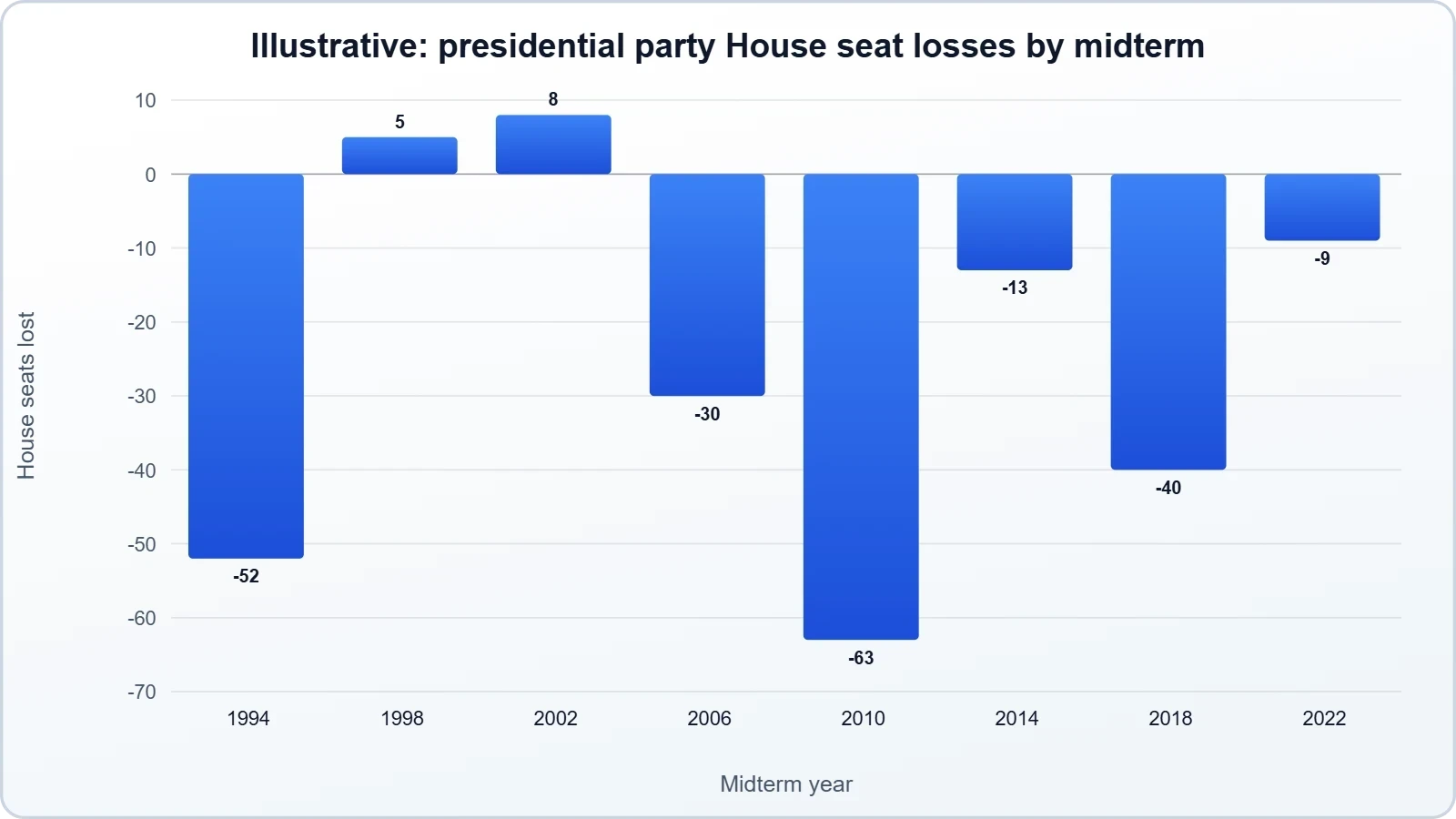
The nuance matters because it reframes how the results should be read. A party that loses fewer seats than forecast can credibly claim a moral victory, while a party that gains power but underperforms its own projections faces internal recrimination. Both narratives were audible within hours of the first returns. The underlying lesson is that midterm outcomes are shaped less by a single national mood than by the aggregation of hundreds of local contests, each with its own candidate, district composition, and turnout dynamics. Analysts who reduce the cycle to one number miss the granular reality that determines who actually governs.
Divided Government as a Governing Reality
When control of Congress is split or margins are razor-thin, the practical consequences ripple through every branch of policy. A president facing an opposition-held chamber cannot rely on party-line votes for major legislation; instead, the toolkit narrows to executive orders, agency rulemaking, and foreign policy, all of which carry legal and political limits. Budget negotiations become brinkmanship, judicial confirmations slow or accelerate depending on which party holds the Senate, and oversight investigations become a primary weapon of the opposition. The 2026 results, with the House in Republican hands and the Senate unresolved, place the country squarely in this constrained mode for the next two years.
Divided government is not merely gridlock, however. It can produce negotiated compromises on issues where both parties face electoral pressure to deliver, such as infrastructure, defense authorization, or targeted tax relief. It also pushes contentious questions to the states, which is precisely what happened with ballot measures on abortion and voting rules in 2026. The net effect is a diffusion of policymaking authority away from Washington and toward governors and state legislatures — a shift with profound implications for citizens whose rights and services vary dramatically depending on where they live.
We Also Published
Control of Congress: The Unresolved Arithmetic
The most consequential uncertainty emerging from November 3 was arithmetic rather than ideology. In the House, Republicans made gains sufficient to claim a working majority, though the precise margin remained fluid as late-counted ballots arrived from urban precincts and military and overseas voters. In the Senate, several races were simply too close to call, with margins inside the range that triggers automatic recounts under state law. Because the Senate confirms judges and ratifies treaties, its composition carries outsized weight relative to its hundred members. A single seat, in other words, could determine whether the president's judicial legacy advances or stalls for two full years.
House Gains and the Geography of the Majority
Republican House gains clustered in suburban and exurban districts where cost-of-living pressures outweighed other concerns, while Democrats held or flipped seats in areas where abortion access and democratic norms ranked higher in voter priorities. This geographic split reflects a broader sorting of the American electorate along educational and cultural lines that has accelerated over the past decade. The result is a chamber whose majority depends on a relatively small number of swing districts, each of which will be contested ferociously again in 2028. Members from those districts face a permanent campaign posture, which shapes how they legislate — cautiously, with an eye toward the next election rather than the next generation.
The narrowness of the majority also empowers individual lawmakers and factions within the conference. A handful of dissenting members can block legislation, extract concessions, or force leadership votes, a dynamic that has become familiar in recent Congresses. For the president, this means that even routine governance — funding the government, raising the debt ceiling, confirming nominees — requires constant negotiation with legislators who answer to very different constituencies. The House majority, in short, is real but fragile, and its fragility will define the legislative tempo of the coming session.
Senate Races and the Recount Threshold
Senate contests in several states fell within margins that state statutes require to be recounted, a mechanical process that can take weeks and occasionally months. These recounts are not signs of dysfunction; they are routine safeguards designed to ensure accuracy when the margin of error in tabulation exceeds the margin of victory. Election officials in the affected states reported orderly processes, with observers from both parties present at counting centers. The practical effect, however, is that the Senate's majority — and therefore control of committees, the confirmation calendar, and the legislative floor — may remain formally undetermined well into the winter.
Legal challenges add a second layer of uncertainty. Campaigns may contest ballot eligibility, challenge provisional ballot rulings, or seek court orders on counting procedures. Historically, most such challenges resolve without altering outcomes, but the 2000 presidential recount demonstrated that the tail can wag the dog. The 2026 cycle appears less litigious than some feared, yet the possibility of litigation in one or two decisive races means that the final Senate composition could be decided by judges rather than voters. That prospect, however remote, colors every strategic calculation in Washington.
Turnout, Issues, and the Shape of the Electorate
High turnout was among the most unambiguous facts of the 2026 cycle. In many jurisdictions, participation exceeded recent midterm averages, a signal that voters on both sides perceived the stakes as unusually high. That intensity cuts against the classic midterm model, in which the opposition dominates because the president's coalition stays home. When both bases turn out, the result tends toward a close, divided outcome rather than a wave — precisely the pattern that materialized. The electorate that showed up was also more polarized in its information sources and more skeptical of institutions than in previous cycles, a backdrop that shaped how campaigns framed their closing arguments.
Inflation, Abortion, and Democracy as Ballot Drivers
Three issues dominated the airwaves and the exit polling. Inflation and the cost of living ranked first for a plurality of voters, particularly in suburban districts where mortgage rates and grocery prices weighed heavily on household budgets. Abortion access mobilized a durable bloc of voters, especially women under fifty, and appeared to drive Democratic overperformance relative to forecasts. Democracy itself — the integrity of elections, the rule of law, and the peaceful transfer of power — surfaced as a motivating concern for a substantial share of the electorate, cutting across party lines in ways that complicate simple partisan mapping. These three currents did not align neatly, which is why the outcome resisted a single narrative.
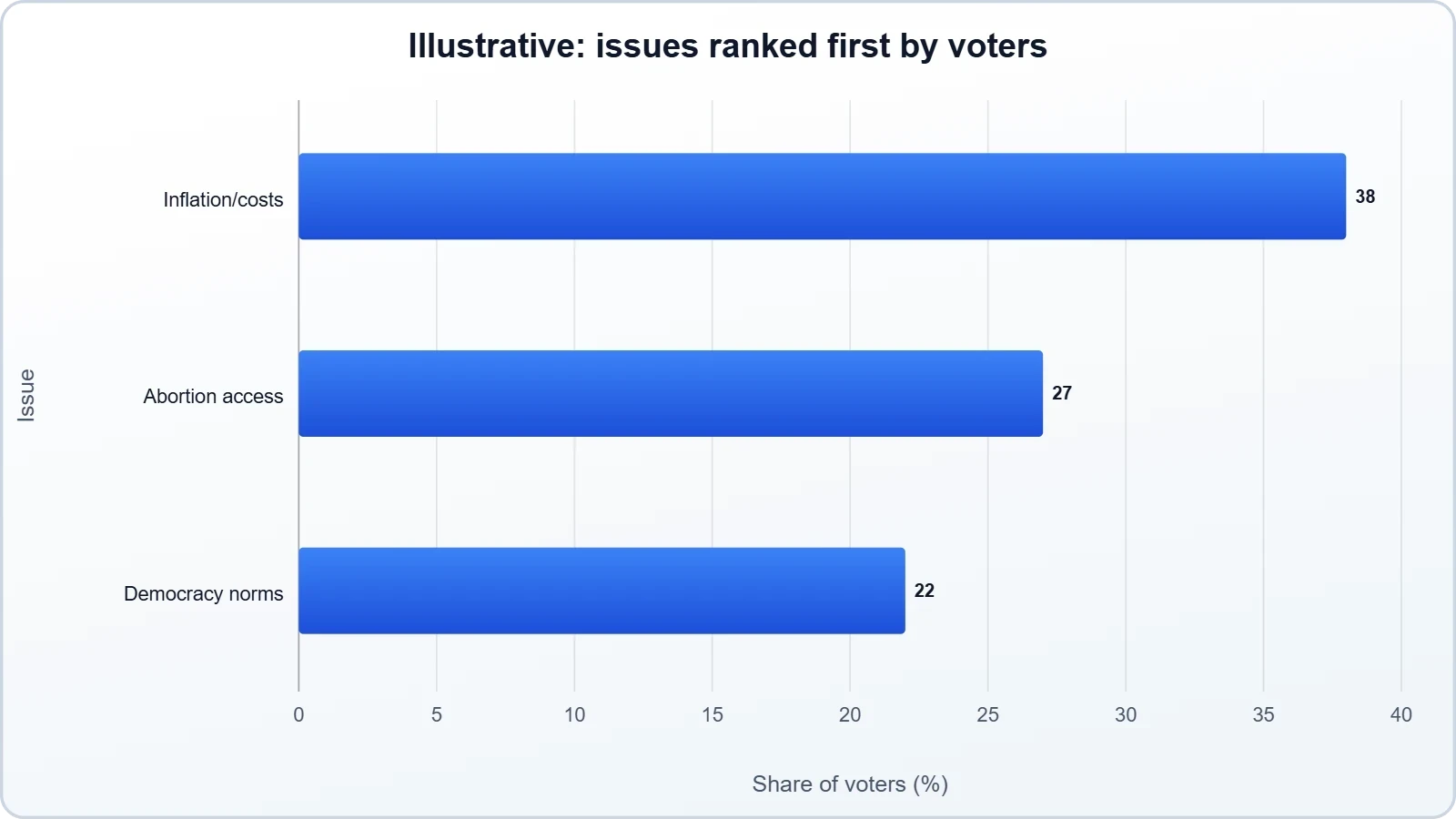
The interplay of these issues explains much of the cycle's texture. A voter worried about grocery prices might still prioritize democratic norms; a voter energized by abortion rights might split a ticket over taxes. Campaigns that understood this complexity tailored messages district by district, while those that relied on national themes struggled. The lesson for strategists is that midterm electorates are coalitional rather than monolithic, and that issue salience varies sharply by geography. The 2026 results reward granular reading and punish sweeping generalization, a point that will shape how both parties prepare for 2028.
Ballot Measures as Parallel Policy Votes
Beyond candidate races, several states placed consequential questions directly before voters. Measures touching abortion access, voting procedures, and election administration appeared on ballots across the country, and their outcomes will shape state law regardless of who controls Congress. This parallel track of direct democracy has grown in importance as federal action has stalled, allowing citizens to legislate on questions their representatives avoid. The measures also function as turnout drivers, drawing to the polls voters who might otherwise skip a midterm, and their presence on the ballot can influence down-ballot races in subtle but measurable ways.
The strategic implications are considerable. When a ballot measure energizes a particular constituency, candidates in the same election often benefit from the heightened participation. Conversely, poorly worded or confusingly framed measures can depress turnout or produce results that courts later overturn. The 2026 measures will likely generate litigation and legislative follow-up in several states, extending their influence well beyond election night. For observers of American federalism, these state-level votes are where the most durable policy changes of the cycle will be found.
- 01
- 02
- 03
- 04
Governorships and the State-Level Consequences
While Washington commanded the headlines, the governor's races decided on November 3 may prove more consequential for daily life. Governors shape education curricula and funding, Medicaid expansion and healthcare delivery, voting procedures, and the administration of elections themselves. Both parties won key states, producing a patchwork of policy regimes that will diverge sharply over the next four years. For citizens, this means that rights and services increasingly depend on state lines — a reality that has been building for a decade and that the 2026 results accelerate. The federal government's constrained posture only amplifies the importance of these state-level outcomes.
Policy Divergence Across State Lines
The divergence is most visible in three domains. On education, states are split between those expanding school choice and those investing in public systems, with curriculum battles over history and science continuing to intensify. On healthcare, the gap between expansion and non-expansion states affects millions of residents' access to coverage and shapes rural hospital viability. On voting rights, states have moved in opposite directions on identification requirements, early voting windows, and mail ballot rules, creating a landscape in which the mechanics of participation vary dramatically depending on zip code. These differences are not abstract; they determine outcomes in the next election as surely as any campaign does.
This patchwork also creates pressure for federal intervention, which in turn fuels the very polarization that produced the divergence. When states adopt sharply different policies, national parties face incentives to nationalize the conflict, and voters begin to sort themselves geographically along policy preferences. The result is a feedback loop that makes compromise harder and state-level stakes higher with each cycle. The 2026 governor's races, in this light, are not a sideshow to congressional results but a parallel arena in which the country's policy future is being written, state by state, election by election.
Election Administration and Public Trust
Election officials across the country reported largely smooth operations, a fact worth emphasizing given the intense scrutiny of recent years. Long lines and isolated technical failures occurred, as they always do, but there was no evidence of systemic disruption. This operational competence matters because public trust in elections depends heavily on the visible professionalism of the people who run them. When officials from both parties certify results and describe orderly processes, they reinforce the norm that losing is legitimate — a norm that has come under strain and that the 2026 cycle, so far, has largely upheld.
Trust, however, is fragile and unevenly distributed. Partisan messaging that preemptively questions results can erode confidence even when the process is sound, and the recount and litigation phase is precisely when such messaging intensifies. The coming weeks will test whether candidates and parties accept outcomes they dislike, a test with implications far beyond any single race. The health of American democracy depends less on any particular result than on the shared willingness to accept results as binding — a disposition that election administrators can support but cannot supply on their own.
Counting, Recounts, and the Path to Certification
The days after an election are governed by administrative procedure rather than political drama, though the two often blur. County officials must process absentee ballots postmarked by election day, verify provisional ballots cast by voters whose eligibility required confirmation, and reconcile totals before transmitting results to the state. These steps take time, and their duration varies by jurisdiction depending on statutory deadlines and staffing capacity. The apparent delay is not evidence of irregularity; it is the ordinary machinery of accurate tabulation. Understanding this process is essential to interpreting the steady stream of partial returns that dominate coverage in the immediate aftermath.
How Recounts and Legal Challenges Work
Recounts are triggered by statutory thresholds, typically when the margin falls below a specified percentage of votes cast. They may be automatic or available upon request, and they range from machine recounts to full hand counts depending on state law. Legal challenges are a separate track, addressing questions of ballot eligibility, procedure, or constitutional interpretation. Both processes are adversarial by design, with representatives from each campaign observing and contesting at each stage. Historically, recounts change outcomes only in extraordinarily close races, but their existence provides a safety valve that reinforces confidence in the final result when it is certified.
The timeline for certification varies widely. Some states certify within days; others take weeks, particularly when military and overseas ballots are involved. Once certified, results can still be challenged in court, but the burden of proof shifts and the presumption of regularity favors the certified outcome. For the 2026 cycle, the practical question is whether the Senate's composition will be settled before the new Congress convenes, or whether a contested seat leaves the chamber temporarily at reduced strength. Either scenario is manageable, but each carries distinct political and procedural consequences that strategists in both parties are already gaming out.
What the Final Numbers Will and Will Not Tell Us
When the last ballot is counted, the final numbers will confirm who holds power but not necessarily why. Aggregate totals obscure the district-level dynamics, turnout differentials, and issue salience that actually determined outcomes. Analysts will spend months dissecting precinct data, comparing it with voter files and survey research, to construct a more accurate account. That work matters because it shapes how parties allocate resources and craft messages in 2028. The headline result is a snapshot; the underlying data is a map, and the map is what strategists will use to navigate the next cycle.
It is also worth remembering what elections cannot settle. A vote determines who governs, not whether the arguments advanced during the campaign were correct. The deep disagreements over inflation policy, abortion, and democratic norms will persist regardless of who wins a particular seat, because they reflect genuine differences in values and priorities among the electorate. The midterms register those differences; they do not resolve them. The most useful reading of 2026 is therefore neither triumphalist nor despairing, but attentive to the durable structure of a closely divided nation and the institutions through which it manages its divisions.
Implications for the President's Agenda and 2028
The most immediate consequence of the 2026 results is the narrowing of the president's legislative options. With the House in Republican hands and the Senate unresolved, any ambitious domestic program faces steep odds. The administration's remaining levers are executive action, agency rulemaking, and foreign policy, each of which carries legal vulnerability and political cost. This is the familiar condition of divided government, and it tends to produce a shift in emphasis from legislation to administration — a shift that can be effective but is inherently less durable, since rules can be reversed by the next administration and orders can be challenged in court.
Legislative Gridlock and Executive Action
Gridlock does not mean inactivity. Presidents facing opposition chambers typically pursue goals through regulation, appointments, and the bully pulpit, while Congress responds with oversight, subpoenas, and appropriations leverage. The result is a kind of adversarial equilibrium in which each branch tests the limits of its authority. The 2026 configuration will likely produce intense fights over spending, investigations into executive agencies, and confirmation battles over judicial nominees. For citizens, the practical effect is that major policy change becomes harder to achieve and easier to reverse, which raises the stakes of every subsequent election and reinforces the cycle of polarization.
There is also a strategic dimension. Presidents often use the midterm aftermath to recalibrate their messaging and personnel, positioning for the next presidential cycle. A president whose party outperformed expectations can claim momentum; one whose party underperformed faces internal pressure and potential primary challenges. The 2026 results, mixed as they are, give both sides material for their preferred narratives. How the White House reads the outcome — as vindication, warning, or both — will shape its posture for the remainder of the term and set the terms of the 2028 contest.
Reading the Cycle as a 2028 Preview
Midterms are imperfect predictors of presidential elections, but they reveal the contours of the coalitions that will contest them. The 2026 results suggest a closely divided electorate in which neither party commands a durable majority, and in which turnout, candidate quality, and issue salience determine outcomes at the margins. Suburban voters remain pivotal, and the parties' competing appeals on costs, rights, and democratic norms will structure the next campaign. The states that decided close Senate and governor's races in 2026 will almost certainly decide the presidency in 2028, making their demographic and economic trajectories central to national strategy.
The deeper signal is institutional. A cycle in which high turnout produced a divided result, in which officials administered the vote professionally, and in which recounts proceeded according to law is, in its way, a reaffirmation of the system's capacity to absorb intense conflict. That capacity is not automatic; it depends on the forbearance of losers and the restraint of winners. The 2026 midterms tested both, and the early evidence suggests the institutions held. Whether that holds through the recount phase and into the next cycle is the question that will define American politics for years to come.
From our network :
- Forbidden Matrix Patterns and Visible Lattice Points: A Geometric DictionaryExplore how multidimensional 0–1 matrices encode geometric truths, linking forbidden patterns to visible lattice points and hypergraph theory, with applications in combinatorics and computational geometry.
- How AI Agents Will Change the Way We Manage Personal FinancesExplore how AI agents are transforming personal finance through automated budgeting, bill payment, and investment management, while examining the critical security protocols and governance frameworks required for safe deployment.
- Committed Mediterranean Precipitation Decline: Why Emissions Cuts Alone Cannot Restore Winter RainsNew NOAA research reveals that Mediterranean winter rains may decline irreversibly even with emissions cuts. Explore the science of committed climate change and regional impacts.
- Live Online English Classes for Kids: Do They Actually Reduce Anxiety?A ten-week study reveals that synchronous online English classes can significantly reduce child language anxiety while improving listening and reading skills. Discover what makes these programs effective and how parents can select the right one.
- Mobile Learning and VR in English: What Global Evidence Reveals About Effective Language TechnologyA systematic review across 14 countries reveals which language-learning technologies genuinely work. Mobile learning, AI, and VR show measurable benefits when pedagogically integrated. This evidence-based guide helps educators and learners select technology that delivers real return on investment.
- CISA’s Ten-Advisory Wave: Why Generic Patching Fails in OT and How to Build Product-Specific PlaybooksCISA released ten ICS advisories in one week, exposing critical infrastructure risks. Generic patching fails in OT. Learn to build product-specific remediation playbooks.
- The Final Descent: How ESA Retired the Legendary Cluster Constellation After 24 Years of Space Weather ScienceAfter 24 years mapping Earth’s magnetosphere, ESA’s Cluster mission concluded with a precisely controlled reentry over the South Pacific. This analysis explores the scientific legacy, engineering decisions, and debris mitigation principles behind one of space exploration’s most responsible retirements.
- The Hidden Cost of AI Convenience: Why Over-Permissioned Agents Are a Security Time BombDiscover why AI agents with excessive permissions create dangerous single points of failure, and learn how implementing least privilege principles can protect your organization from exploitation.
- University Language Proficiency Exams: Why Institutional Tests Demand Different Preparation Than IELTS and TOEFLDiscover why university-specific language proficiency examinations differ fundamentally from IELTS and TOEFL, and learn strategic preparation approaches for institutional assessment success.
RESOURCES
- What history tells us about the 2026 midterm elections | Brookingsbrookings.eduAug 28, 2025 ... Of the 32 seats won by five to 9.99 points, Democrats hold 24, Republicans, just eight. Even so, a swing…
- Cook Political Report | Non-Partisan Political Analysis for US ...cookpolitical.comOctober 29, 2026. Voters cast ballots at a polling place during the 2026 election. Members Only. 2026 Is the 'Back to the Future' Midterm.…
- 2026 Midterm Elections Scenario Analysis: Control of Congressbhfs.comThe November midterm elections are rapidly approaching, with the uncertain control of the House and Senate that could have wide-ranging impacts.
- The Terrorism Threat to the 2026 Midterm Elections - CSIScsis.orgSep 29, 2026 ... ... U.S. Terrorism Incidents Dataset.1 The analysis first identifies terrorist attacks and plots directly connected to U.S. elections over the ...
- Exposing and Disrupting Federal Attempts to Interfere in the 2026 ...democracyforward.orgOct 9, 2026 ... ... 2026 Midterm Elections. How the Trump-Vance ... elections, with significant implications for the midterms and American democracy.
- 2026 Special Elections & Swing Analysis - MultiStatemultistate.usEvery 2026 state legislative special election plus our swing analysis: how Democrats are overperforming the 2024 presidential baseline, with 2018 historical ...
- What you need to know about the 2026 US midterm elections | Reutersreuters.comOct 23, 2026 ... Early voting has been underway for weeks ahead of the November 3, 2026, midterm elections, when US voters will elect…
- 2026 Early Voting - UF Election Lab - University of Floridaelection.lab.ufl.edu2 hours ago ... Midterm Elections. 2022 General. If you want to show your appreciation ... Toss-up U.S. House districts with mail-ballot party ...
- 2026 Governor Elections - MultiStatemultistate.usRace ratings, candidates, and key contests for all 36 gubernatorial races. Expand any race for MultiState's analysis. Pre-election view. The ratings and race ...
- PBS News: News, Analysis, Top Headlines, Live Coveragepbs.orgDemocrat Jamie Ager flips U.S. House seat in North Carolina. By Associated Press. 2026 US midterm elections · Politics Nov 03. JB ...
- Just Security 2026 Midterm Election Analysis and Commentaryjustsecurity.org2 days ago ... This collection brings together analysis of the legal and policy issues surrounding the 2026 U.S. midterm elections published on Just ...
- 2026 midterm election FAQs - Protect Democracyprotectdemocracy.orgOct 23, 2026 ... Can President Trump legally “nationalize” our elections? No. The U.S. Constitution explicitly gives states the authority to determine the “Times ...
- ElectIt - Gary Kinggking.harvard.edu1 day ago ... This page presents our forecasts for all US House and Senate seats in the 11/3/2026 election. ... midterm, using only…
- As the 2026 Midterms Approach, Economy Is Front and Centerpewresearch.orgU.S. Elections & Voters. > Election 2026. Report. |. July 23, 2026. As the 2026 Midterms Approach, Economy Is Front and Center. Democratic candidates…
- The Trump Administration Is Interfering in the 2026 Midterm ...americanprogress.orgAug 12, 2026 ... Seen in this light, the 15 election subversion tactics analyzed in ... U.S. elections. Nor should House Speaker Mike Johnson's…
- 01
- 02
- 03
- 04
- 05
- 06
- 07
- 08
0 Comments