
Winter energy bills have become one of the most closely watched household expenses across the United Kingdom, and the Cold Weather Payment stands as one of the few automatic protections built into the welfare system for the coldest stretches of the year. Unlike a standard benefit that requires a fresh application, this scheme operates quietly in the background, triggered by temperature readings rather than paperwork. For millions of households balancing fixed incomes against volatile heating costs, understanding how the payment works, who receives it, and when it lands is genuinely consequential. The scheme reflects a simple principle: when the mercury drops far enough for long enough, the state steps in to offset the additional cost of keeping a home warm.
The mechanics matter because the payment is not universal, and it is not automatic for everyone who feels the cold. It is tied to specific qualifying benefits, to specific regions, and to a meteorological threshold measured across seven consecutive days. England, Wales, and Northern Ireland operate under the scheme, while Scotland has replaced it with a distinct annual payment delivered through Social Security Scotland. That divergence alone creates confusion, particularly for families near borders or for readers who encounter headlines written for one nation and assume they apply across the whole country. Clarity about geography, eligibility, and timing is therefore the foundation of any useful discussion of this support.
This analysis examines the Cold Weather Payment from every practical angle: the precise temperature trigger, the benefits that unlock eligibility, the amount paid per cold spell, how and when money arrives, and the common misconceptions that leave eligible households without help they are owed. It also considers the wider context of winter fuel support, the strain on advice services during cold snaps, and the practical steps a household can take if a payment fails to appear. The goal is not merely to restate a government leaflet but to explain the reasoning behind the rules and the real-world consequences of how they are applied.
On This Page
- The Temperature Trigger That Activates Cold Weather Payments
- Who Qualifies: The Benefit Gateway to Heating Support
- Payment Amounts, Timing, and What Recipients Actually Receive
- Regional Divergence: England, Wales, Northern Ireland, and Scotland
- Common Misconceptions and Practical Steps for Households
- The Wider Context: Energy Costs, Vulnerability, and Policy Design
TL;DR The Cold Weather Payment is a government scheme in England, Wales, and Northern Ireland that pays a fixed sum for each seven-day period of very cold weather, provided the household receives one of several qualifying benefits. Payments are triggered automatically when the average temperature in a household's postcode area is recorded as, or forecast to be, 0°C or below across seven consecutive days. Eligible recipients receive the money without applying, typically within fourteen working days, and the payment is tax-free and does not affect other benefits. Scotland operates a separate annual winter heating payment instead. Understanding the temperature trigger, the qualifying benefit list, and the postcode-based measurement system is essential for anyone who may be owed this support during a cold spell.
The Temperature Trigger That Activates Cold Weather Payments
At the heart of the scheme sits a meteorological rule that is deceptively simple and frequently misunderstood. A Cold Weather Payment becomes payable when the average temperature at a designated weather station, measured or forecast across seven consecutive days, is recorded at or below 0°C. The measurement is not taken from a household's own thermometer but from the official station assigned to that postcode area, which means neighbours a few miles apart can, in rare cases, fall on different sides of the threshold. This design ensures consistency and removes the need for individual claims, but it also means the payment is a matter of geography as much as personal circumstance.
The seven-day window is the critical detail. A single bitterly cold night does not trigger a payment, nor does a brief frost followed by milder air. The scheme rewards sustained cold, because sustained cold is what drives heating systems to run continuously and bills to climb. Once a qualifying cold spell is confirmed, the payment covers that seven-day period, and a prolonged freeze lasting fourteen days can generate two separate payments. The logic is cumulative: each qualifying week is treated as its own unit of need, and the support scales accordingly rather than capping at a single lump sum for the whole winter.
How the Postcode and Weather Station System Works
The Department for Work and Pensions maintains a mapping of postcodes to weather stations, and this mapping determines which temperature readings apply to which households. When forecasters expect an average of 0°C or lower over the coming week, the system can trigger payments in advance, allowing money to reach accounts before the coldest days arrive rather than weeks afterward. This forecasting element is often overlooked, yet it is what makes the scheme responsive rather than merely retrospective. Households can check their eligibility and see whether a payment has been triggered for their area using the government's online postcode checker, which updates as cold spells are confirmed.
Because the trigger is based on averages rather than minimums, a week of daytime temperatures around 3°C paired with sub-zero nights may or may not qualify depending on how the daily figures balance out. This nuance explains why two households in adjacent regions can experience similar discomfort yet only one receives a payment. The station-based approach is a pragmatic compromise between accuracy and administrative simplicity, and it is worth understanding precisely because it shapes expectations. A household that knows its assigned station and monitors forecasts can anticipate payments with reasonable confidence rather than waiting anxiously for a bank statement to reveal whether help is coming.
The Difference Between Recorded and Forecast Cold
Payments can be triggered either by recorded temperatures or by forecasts issued by the Met Office, and this dual mechanism has practical implications. A forecast-triggered payment may arrive before the cold spell has fully materialised, which is precisely the point: heating costs are incurred during the cold, not after it. Occasionally a forecast triggers a payment and the actual weather turns milder than predicted, but the payment is not clawed back. Conversely, a spell that turns colder than forecast after the window closes is assessed on recorded data. The system is deliberately generous in this respect, prioritising timely support over perfect meteorological accuracy.
This design also explains why the scheme is administered automatically. Requiring households to apply after each cold snap would create delay, stigma, and administrative burden, and would likely leave the most vulnerable claimants without help. By tying payments to objective weather data and existing benefit records, the government removes the need for individual action almost entirely. The only action required of a household is to be receiving a qualifying benefit and to ensure their details are current. Everything else, from temperature monitoring to payment issuance, happens without the claimant lifting a finger, which is a rare and welcome feature in means-tested support.
Who Qualifies: The Benefit Gateway to Heating Support
Eligibility for the Cold Weather Payment is channelled through the benefit system rather than assessed on income directly. A household must be receiving one of a defined set of means-tested or disability-related benefits during the qualifying cold spell, and the payment then follows automatically. The qualifying list includes Pension Credit, Income Support, income-based Jobseeker's Allowance, income-related Employment and Support Allowance, Universal Credit, and certain disability benefits such as Personal Independence Payment and Disability Living Allowance when combined with other criteria. The precise combination matters, and the rules contain nuances that trip up even experienced advisers.
The scheme's reliance on existing benefit records is both its strength and its limitation. It is efficient, because no separate claim is needed, but it is exclusionary, because households just above the benefit threshold receive nothing regardless of how cold their home becomes. This is a deliberate policy choice: the payment is framed as additional support for those already receiving means-tested help, not as universal winter relief. Critics argue the cliff-edge nature of the design leaves working households on modest incomes exposed, while defenders point to the administrative simplicity and the absence of any application burden on the most vulnerable claimants.
The Full List of Qualifying Benefits
The qualifying benefits span working-age and pensioner support, and each carries its own conditions. Pension Credit is the most straightforward route for older households, and it is also the benefit most frequently under-claimed, meaning many eligible pensioners miss out on both the credit itself and the cold weather payments that flow from it. Universal Credit claimants qualify, though the payment is separate from the standard award and does not reduce it. Income-based Jobseeker's Allowance and income-related Employment and Support Allowance qualify, while their contribution-based equivalents generally do not, a distinction that confuses many claimants who assume the benefit name alone determines eligibility.
Disability benefits enter the picture through a supporting condition. Receiving Personal Independence Payment, Disability Living Allowance, Attendance Allowance, or Severe Disablement Allowance can qualify a household when combined with another qualifying benefit or with a child element. The logic is that disability often brings higher heating needs, whether through reduced mobility, medical equipment, or extended time at home. The interaction between these benefits is intricate, and the government's own guidance recommends checking the full criteria or contacting an advice service rather than relying on a simplified summary. For households with multiple benefit streams, professional advice can be the difference between receiving support and missing it entirely.
Universal Credit and the Mixed Household Rules
Universal Credit has simplified many parts of the welfare system but has introduced its own wrinkles into cold weather support. Claimants on Universal Credit qualify for the payment, but the assessment is based on the household's circumstances during the qualifying week, and changes in employment or earnings can affect the underlying award even if the cold weather payment itself is unaffected. The payment is not treated as income for Universal Credit purposes, so it does not reduce the standard allowance. This separation is important: the cold weather payment is designed to be additive, a genuine top-up rather than a substitution for existing support.
Households containing a mix of benefit types require particular care. Where one member receives a qualifying disability benefit and another receives a means-tested benefit, the household may qualify even if neither individual would qualify alone. Conversely, a household where the qualifying benefit has recently ceased, perhaps because of a move into work, may lose eligibility even though the cold spell arrives shortly afterward. Timing is everything, and the relevant date is the qualifying week itself rather than the date the payment is issued. Claimants who report changes promptly and keep their records current are best positioned to receive what they are owed.
Payment Amounts, Timing, and What Recipients Actually Receive
Each qualifying cold spell generates a fixed payment of £25 for every seven-day period, a figure that has remained stable for well over a decade. The amount is deliberately modest and formulaic: it is not calibrated to actual consumption, household size, or fuel prices, but functions as a standardised contribution toward the extra cost of heating during severe cold. A household experiencing three separate qualifying spells across a winter would receive £75 in total, paid in instalments as each spell is confirmed. The predictability of the amount is part of the scheme's appeal, even if the sum itself is widely regarded as insufficient to cover a full week of additional heating.
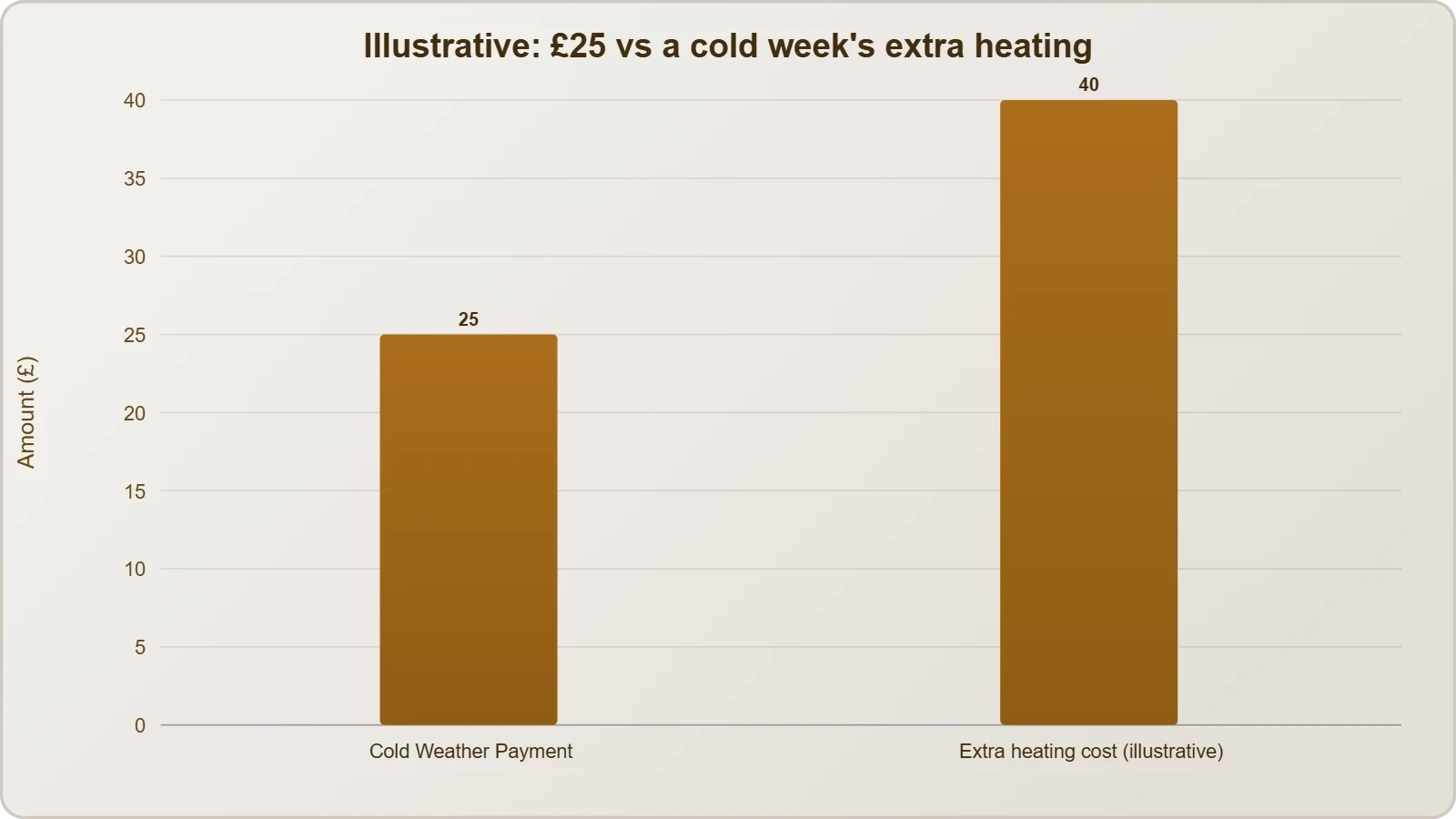
Timing is where the scheme earns much of its practical value. Payments are typically issued within fourteen working days of the trigger, and because forecasts can activate the mechanism, money sometimes arrives before the coldest weather has even landed. The payment is made automatically into the same account that receives the underlying benefit, with no separate application, no forms, and no interview. It is tax-free, does not count toward the benefit cap, and does not reduce other awards. For a household already stretched by winter bills, the arrival of an unexpected £25 can be the difference between running the heating through a cold snap and rationing it.
Why the Fixed Sum Attracts Criticism
The £25 figure has been frozen for years, and inflation has steadily eroded its real value. Energy analysts note that a week of sustained sub-zero temperatures can add considerably more than £25 to a typical household's gas and electricity bill, particularly for older homes with poor insulation or for households relying on more expensive heating methods. The mismatch between the payment and the actual cost of cold weather is the scheme's most persistent criticism. Campaigners argue that the amount should be indexed or linked to energy prices, while officials defend the fixed sum as simple to administer and predictable for budgeting purposes.
There is also a distributional argument. Because the payment is triggered by weather rather than need, a household in a well-insulated home in a cold region may receive more than a poorly insulated household in a milder region, even though the latter faces higher relative costs. The scheme is a blunt instrument, and its defenders acknowledge as much. Its virtue lies in speed and universality within the eligible group: no assessment of individual bills, no means-testing beyond the benefit gateway, and no delay while paperwork is processed. For a policy designed to respond within days to a weather event, bluntness may be an acceptable price for reliability.
How and When the Money Arrives
Payments are routed through the benefit delivery system, which means the money appears in the claimant's usual payment account rather than arriving as a separate cheque or voucher. Claimants on Universal Credit will see it as a distinct credit, while those on legacy benefits receive it through the same channel as their regular payment. The fourteen-working-day window is a guideline rather than a guarantee, and delays can occur during widespread cold spells when the volume of triggered payments is high. Households that believe a payment is overdue should first check the postcode checker, then contact the relevant benefit office or an advice agency if the discrepancy persists.
Record-keeping matters here. Because the payment is automatic, claimants sometimes fail to notice whether it has arrived, particularly if it is absorbed into a busy account. Keeping a simple note of cold spells in the local area and comparing them against bank statements is a practical habit. If a payment appears to be missing, the remedy is straightforward: contact the office administering the underlying benefit, quote the postcode and the dates of the cold spell, and ask for a check. Errors are rare but not unknown, and the burden of catching them falls on the claimant, which makes vigilance worthwhile.
We Also Published
Regional Divergence: England, Wales, Northern Ireland, and Scotland
The Cold Weather Payment applies in England, Wales, and Northern Ireland, but not in Scotland, which has taken a different path since devolution of social security powers. Scotland replaced the scheme with the Winter Heating Payment, an annual payment made regardless of temperature, designed to reach a similar group of low-income households without waiting for the weather to cooperate. This divergence is more than administrative trivia: it means a household in Carlisle and a household in Gretna Green, a few miles apart, face entirely different mechanisms, timings, and amounts. Understanding which scheme applies is the first step for any household seeking winter support.
Within England, Wales, and Northern Ireland, the scheme operates uniformly in terms of trigger and amount, but the practical experience varies with climate. Northern Ireland, being generally colder and windier in winter, sees more frequent triggers than southern England, while coastal Wales may experience fewer qualifying spells than inland areas at elevation. These geographic patterns mean the scheme's value to a household depends substantially on where they live, a feature that is both logical, since cold weather drives the need, and inequitable, since two households with identical incomes may receive very different levels of support over a winter.
The Scottish Alternative Explained
Scotland's Winter Heating Payment is paid once a year to eligible households, with the amount set annually and the eligibility criteria broadly mirroring the benefits that qualify for the Cold Weather Payment south of the border. The rationale for the change was that the temperature-triggered model produced unpredictable and geographically uneven support, leaving some cold households without help in mild winters while rewarding others in cold ones. A flat annual payment is easier to budget around and reaches everyone eligible regardless of local weather. The trade-off is that it no longer responds to the severity of any particular winter, so a household facing an unusually harsh season receives no additional help.
For households near the border, or for anyone moving between nations, the practical advice is to confirm which scheme applies based on address rather than assumption. The Scottish payment is administered by Social Security Scotland, while the Cold Weather Payment is handled by the Department for Work and Pensions and, in Northern Ireland, by the relevant devolved authority. Confusion between the two is common in media coverage, which often reports on one scheme while readers assume it applies to them. Checking the administering body is a reliable way to determine which set of rules governs a particular household.
Northern Ireland and the Devolved Administration
Northern Ireland operates its own version of the Cold Weather Payment through the Department for Communities, with rules that closely mirror the England and Wales scheme but are administered separately. The temperature trigger, the £25 amount, and the qualifying benefits are aligned, so a reader familiar with the mainland scheme will recognise the structure. The difference lies in the delivery machinery and in the advice infrastructure: Northern Ireland has its own network of advice agencies and its own government helplines, and claimants should direct queries there rather than to mainland offices. Cross-border confusion is common and easily resolved by checking the postcode against the correct authority's checker.
The devolved landscape also affects how policy evolves. Because Scotland controls its own winter support, it can adjust amounts and eligibility independently, and future changes may widen the gap between the schemes. Households in England, Wales, and Northern Ireland remain subject to decisions made at Westminster, where the £25 figure and the benefit gateway are set. For anyone tracking the adequacy of winter support, the four-nation comparison is instructive: it reveals that the same underlying problem, cold homes and rising heating costs, can be addressed through quite different policy instruments, each with its own strengths and blind spots.
Common Misconceptions and Practical Steps for Households
Misinformation about the Cold Weather Payment spreads quickly during cold snaps, and several persistent myths cause eligible households to miss out or ineligible households to wait for money that will never arrive. One common error is the belief that the payment must be claimed, which leads people to search for forms that do not exist. Another is the assumption that any freezing night triggers a payment, when in fact the seven-day average rule is far stricter. A third is confusion with the Winter Fuel Payment, a separate and much larger annual sum paid to older households regardless of temperature. Untangling these threads is essential for anyone trying to work out what they are actually owed.
The practical steps are straightforward once the rules are clear. First, confirm which scheme applies to your address. Second, check whether you receive a qualifying benefit and whether any supporting conditions are met. Third, use the official postcode checker during cold spells to see whether a payment has been triggered in your area. Fourth, keep an eye on bank statements for the £25 credit and follow up if it does not appear within the expected window. Fifth, if circumstances change, such as a benefit award ending or a move, report the change promptly so records stay accurate. These five steps cover the vast majority of situations and take only a few minutes to complete.
Cold Weather Payment Versus Winter Fuel Payment
The two schemes are frequently conflated, yet they differ in almost every respect. The Winter Fuel Payment is an annual, tax-free sum paid to people over pension age, historically universal but now means-tested following recent policy changes, and it is not linked to temperature at all. The Cold Weather Payment is smaller, paid per cold spell, and available to a broader working-age group receiving means-tested benefits. A pensioner household may receive both, while a working-age Universal Credit household may receive only the Cold Weather Payment. Understanding the distinction prevents both false expectations and missed entitlements, and it clarifies which office to contact when something goes wrong.
Recent changes to the Winter Fuel Payment have made the distinction more consequential. As eligibility for the annual payment has narrowed, the Cold Weather Payment has become relatively more important for households that lost access to the larger sum. Advice agencies report increased queries from pensioners uncertain about what they can still claim, and the temperature-triggered payment is often the answer for those on Pension Credit. The interaction between the two schemes is a useful case study in how winter support is layered, with different instruments targeting different groups through different mechanisms, and how changes to one layer ripple through the others.
What to Do If a Payment Does Not Arrive
When a payment appears to be missing, the first step is verification rather than alarm. Check the postcode tool to confirm that a cold spell was recorded for the area and the dates involved, then review bank statements carefully, since the credit may be labelled in a way that is easy to overlook. If the trigger is confirmed and the payment is absent after fourteen working days, contact the office administering the underlying benefit. Have the postcode, the dates of the cold spell, and the benefit reference to hand. Most queries are resolved quickly, and errors, while uncommon, are usually straightforward administrative slips rather than disputes about entitlement.
For households facing persistent problems, independent advice agencies offer free support. Citizens Advice, local welfare rights services, and national helplines can review eligibility, chase missing payments, and identify other support that may be available, including help from energy suppliers and local authority hardship funds. The cold weather payment is rarely the only source of winter help, and a broader benefits check often reveals additional entitlements. The most important message is that help exists and is designed to be automatic, but the system still depends on claimants keeping their details current and speaking up when something goes wrong.
The Wider Context: Energy Costs, Vulnerability, and Policy Design
The Cold Weather Payment sits within a broader architecture of winter support that includes the Winter Fuel Payment, the Warm Home Discount, cold weather payments made by energy suppliers under the Warm Home Discount scheme, and local authority hardship funds. Each instrument targets a slightly different group and operates on a different logic, and together they form a patchwork rather than a coherent system. Understanding the patchwork matters because households often qualify for more than one form of help, and advice agencies routinely find that a single query about cold weather payments uncovers several unclaimed entitlements. The scheme is best understood as one entry point into a wider support landscape.
Energy costs have risen sharply in recent years, and the fixed £25 payment has become proportionally smaller against typical winter bills. This erosion has prompted debate about whether the scheme should be uprated, indexed to energy prices, or replaced with a more generous automatic mechanism. The policy challenge is familiar: targeted support is cheaper but leaves gaps, while universal support is simpler but expensive. The Cold Weather Payment occupies a middle position, targeted through the benefit system but triggered by objective weather data, and its design reflects a series of compromises between accuracy, timeliness, and cost that are worth examining rather than dismissing.
Vulnerability, Health, and the Cost of Cold Homes
The health consequences of cold homes are well documented. Prolonged exposure to low indoor temperatures is associated with respiratory illness, cardiovascular strain, and worsened mental health, and the burden falls disproportionately on older people, young children, and those with existing health conditions. The Cold Weather Payment is, in this light, a public health instrument as much as a financial one. By helping households keep the heating on during severe cold, it reduces the risk of crisis presentations at hospitals and GP surgeries. The £25 sum may look modest against a fuel bill, but its preventive value is measured against far larger costs elsewhere in the system.
Fuel poverty organisations argue that the payment's design could be sharpened. Linking the amount to actual energy prices, extending eligibility to households just above the benefit threshold, and improving take-up of Pension Credit are among the most frequently proposed reforms. Each has trade-offs, and none is straightforward to implement within existing delivery systems. What unites the proposals is a recognition that the current scheme, while valuable, is a blunt tool aimed at a precise problem. The debate over its future is really a debate about how generously and how intelligently the state should respond to the health risks of cold housing.
How Households Can Maximise Available Support
Beyond the Cold Weather Payment, several avenues of help are worth exploring. The Warm Home Discount provides a one-off credit on electricity bills for eligible households, and energy suppliers offer their own hardship funds and payment plans. Local authorities administer discretionary housing payments and welfare assistance schemes that can cover heating costs in a crisis. Charities such as National Energy Action and Age UK provide advice tailored to specific circumstances. A benefits check, available free from Citizens Advice and other agencies, often reveals entitlements that a household did not know existed, and the cumulative value can far exceed the cold weather payment alone.
The most effective approach is proactive rather than reactive. Households should review their benefit entitlements annually, keep their contact details current with the relevant offices, and check the postcode tool during cold spells rather than waiting for a payment that may never come. Energy efficiency measures, from draught-proofing to loft insulation, reduce bills regardless of the weather and are often available through supplier obligation schemes or local authority grants. The Cold Weather Payment is a safety net, not a solution to high heating costs, and the households that fare best are those that combine it with the wider range of support and efficiency measures available to them.
From our network :
- The Hidden Cost of AI Convenience: Why Over-Permissioned Agents Are a Security Time BombDiscover why AI agents with excessive permissions create dangerous single points of failure, and learn how implementing least privilege principles can protect your organization from exploitation.
- CISA’s Ten-Advisory Wave: Why Generic Patching Fails in OT and How to Build Product-Specific PlaybooksCISA released ten ICS advisories in one week, exposing critical infrastructure risks. Generic patching fails in OT. Learn to build product-specific remediation playbooks.
- University Language Proficiency Exams: Why Institutional Tests Demand Different Preparation Than IELTS and TOEFLDiscover why university-specific language proficiency examinations differ fundamentally from IELTS and TOEFL, and learn strategic preparation approaches for institutional assessment success.
- Mobile Learning and VR in English: What Global Evidence Reveals About Effective Language TechnologyA systematic review across 14 countries reveals which language-learning technologies genuinely work. Mobile learning, AI, and VR show measurable benefits when pedagogically integrated. This evidence-based guide helps educators and learners select technology that delivers real return on investment.
- The Final Descent: How ESA Retired the Legendary Cluster Constellation After 24 Years of Space Weather ScienceAfter 24 years mapping Earth’s magnetosphere, ESA’s Cluster mission concluded with a precisely controlled reentry over the South Pacific. This analysis explores the scientific legacy, engineering decisions, and debris mitigation principles behind one of space exploration’s most responsible retirements.
- How AI Agents Will Change the Way We Manage Personal FinancesExplore how AI agents are transforming personal finance through automated budgeting, bill payment, and investment management, while examining the critical security protocols and governance frameworks required for safe deployment.
- Committed Mediterranean Precipitation Decline: Why Emissions Cuts Alone Cannot Restore Winter RainsNew NOAA research reveals that Mediterranean winter rains may decline irreversibly even with emissions cuts. Explore the science of committed climate change and regional impacts.
- Live Online English Classes for Kids: Do They Actually Reduce Anxiety?A ten-week study reveals that synchronous online English classes can significantly reduce child language anxiety while improving listening and reading skills. Discover what makes these programs effective and how parents can select the right one.
- Forbidden Matrix Patterns and Visible Lattice Points: A Geometric DictionaryExplore how multidimensional 0–1 matrices encode geometric truths, linking forbidden patterns to visible lattice points and hypergraph theory, with applications in combinatorics and computational geometry.
RESOURCES
- Cold Weather Payment: Overview - GOV.UKgov.ukYou may get Cold Weather Payments if you're getting certain benefits or Support for Mortgage Interest. If you're eligible, you'll get these payments ...
- Low Income Winter Heating Assistance (LIWHA): consultationgov.scotDec 1, 2021 ... As we intend to remove the weather dependency of this benefit when we introduce LIWHA we will need to be…
- Winter Fuel Payment: Eligibility - GOV.UKgov.ukwere visiting England, Wales or Northern Ireland on 21 to 27 September 2026 (the 'qualifying week'), but usually live somewhere else ... Cold Weather…
- You may get Cold Weather Payments if you get certain benefits ...facebook.comDec 16, 2025 ... You may get Cold Weather Payments if you get certain benefits. ❄️ If you're eligible, you'll get £25 automatically for…
- Qualifying benefits - Winter Heating Payment - mygov.scotmygov.scotFeb 20, 2026 ... Social Security Scotland use qualifying data to decide if you're eligible for Winter Heating Payment.
- What are cold weather payments and who can get them? - BBCbbc.com3 hours ago ... To qualify, you must live in England, Wales or Northern Ireland. Payments are not age-related but you must already be…
- Temporary Assistance | OTDAotda.ny.gov... requirements to receive FA benefits. As a further condition of FA ... You do not have fuel for heating in the cold weather…
- Benefits Eligibility - Virginia Employment Commissionvec.virginia.govWeekly eligibility requirements. Monetary qualification. In a separate mailing you will receive your Statement of Wages and Potential Benefit Entitlement.
- Eligibility Information | Department of Labor and Industrypa.govHowever, your maximum benefit amount may not exceed 26 times your weekly benefit rate. You are not eligible to receive benefits if you have…
- Korean War Veterans - Veterans Benefits Administrationbenefits.va.govMar 26, 2026 ... VA Benefits. Korean War Veterans may be eligible for a wide-variety of benefits available to all U.S. military Veterans. VA…
- Financial help in cold weather | Independent Ageindependentage.orgAm I eligible? You can only get this benefit if you live in England or Wales. Cold Weather Payments are made if the average…
- Changes to Winter Fuel Payment eligibility in 2024/25 rules in 2024/25commonslibrary.parliament.ukMar 7, 2025 ... On 20 August 2024, the DWP announced a 'Pension Credit awareness drive' to encourage eligible households not receiving the benefit…
- Winter Heating Payment - Social Security Scotlandsocialsecurity.gov.scotEligibility is the same as Cold Weather Payment. People must get and meet specific requirements of a qualifying benefit on at least 1 day…
- Assignment Incentive Pay to be authorized for Airmen, Guardians ...af.milApr 2, 2024 ... Cold Weather Assignment Incentive Pay is a single lump sum payment ... qualify an area as a cold-weather location. “We…
- Who is entitled to cold weather payments? - MoneyHelpermoneyhelper.org.uk... qualify for Cold Weather Payments if they get certain benefits. If in doubt check with Jobcentre Plus or your pension centre to see…
- 01
- 02
- 03
- 04
- 05
- 06
- 07
- 08
0 Comments