When António Guterres stepped to the podium at COP31, he carried with him the accumulated weight of nearly a decade of climate diplomacy and the unmistakable frustration of a departing steward watching his warnings go unheeded. The United Nations Secretary-General did not arrive with new data or novel frameworks; instead, he arrived with a blunt moral demand: that nations move from the language of aspiration to the discipline of actual phase-out. His framing was deliberate and unusually direct, casting fossil fuels not as a fuel source to be managed but as an addiction to be broken, a dependency that has shaped economies, politics, and the very architecture of modern life.
The summit itself, hosted in Turkey, unfolded against a backdrop of intensifying global weather extremes and a widening gap between pledged ambition and measurable action. Guterres used one of his final climate speeches to sharpen a distinction that has quietly defined the last several COP cycles: the difference between suggesting a transition and executing one. His remark that the fossil fuel industry possesses lobbying power unlike the dinosaurs, which he noted became extinct without such influence, was more than a quip. It was a pointed observation about how organized commercial interest can delay the very extinction of a harmful industry that science has long marked for retirement.
What makes this intervention significant is its timing and its tone. A departing Secretary-General is freed from the diplomatic caution that constrains sitting officials, and Guterres leaned into that freedom with a wordplay that will likely outlast the summit itself: it is "make or bake time." The phrase compresses an entire policy argument into three syllables, invoking both the urgency of manufacturing a new energy economy and the literal heat that is already baking the planet. This analysis unpacks the substance behind the rhetoric, the structural obstacles to phase-out, and what the COP31 moment reveals about the state of global climate governance.
On This Page
TL;DR At COP31, UN Secretary-General António Guterres demanded that nations accelerate the phase-out of fossil fuels rather than merely gesture toward it, describing the world's dependence on coal, oil, and gas as an addiction. He contrasted the lobbying power of the fossil fuel industry with the extinction of the dinosaurs, arguing that deliberate political action is the only force capable of overcoming organized commercial resistance. His "make or bake time" wordplay framed the choice as one between building a new energy economy and suffering the consequences of inaction. The speech reflects a broader tension in climate diplomacy between voluntary pledges and enforceable transition, and it signals that the moral authority of the UN is being deployed to pressure governments and industry alike as the window for meaningful action narrows.
The Rhetorical Architecture of a Departing Secretary-General
Guterres has spent his tenure refining a particular register of climate communication, one that blends scientific authority with moral urgency and occasional flashes of dark humor. At COP31, that register reached its sharpest pitch. The dinosaur comparison was not casual comedy; it was a carefully constructed analogy designed to expose a paradox. Dinosaurs, he observed, went extinct without the benefit of lobbyists, public relations firms, or trade associations. Fossil fuel companies, by contrast, possess all of these and have used them to slow, dilute, and delay the transition that physics demands. The analogy works because it reframes the debate from one about energy economics to one about political power.
This rhetorical strategy matters because climate summits are, at their core, exercises in collective persuasion. The Secretary-General cannot legislate, tax, or regulate. What he commands is a platform and the credibility that comes from representing nearly two hundred member states. By naming the lobbying power of the fossil fuel industry explicitly, Guterres shifted the conversation from abstract emissions targets to the concrete mechanisms that prevent those targets from being met. His language invited delegates and the public alike to ask a sharper question: if the science is settled and the technology exists, what exactly is standing in the way?
The Weight of a Final Speech
There is a well-documented phenomenon in diplomacy whereby departing officials speak with greater candor than they could while their tenure remained open-ended. Guterres, nearing the end of his term, appears to have embraced this liberation. His characterization of fossil fuel reliance as an addiction carries clinical connotations: addiction implies denial, enabling behavior, and the need for intervention rather than gentle encouragement. This framing implicitly criticizes the voluntary, pledge-based architecture of the Paris Agreement and its successors, suggesting that asking nations to self-regulate their carbon habits has produced rhetoric outpacing results.
The phrase "make or bake time" deserves particular attention as a piece of political communication. It plays on the familiar idiom "make or break," substituting "bake" to evoke the literal thermal consequences of inaction. In doing so, Guterres fused the language of manufacturing and industrial opportunity with the language of climate damage. The double meaning is elegant: nations can make a new energy economy, or they can be baked by the one they refuse to leave behind. Such compression is characteristic of effective political speech, which must travel far beyond the room in which it is delivered.
Why Wordplay Carries Policy Weight
Critics sometimes dismiss rhetorical flourishes as substitutes for substance, but in the climate arena, framing shapes funding, regulation, and public tolerance for transition costs. When a UN Secretary-General describes fossil fuels as an addiction rather than a resource, he legitimizes policies that might otherwise seem punitive, such as subsidy removal, carbon pricing, and moratoria on new extraction. Language sets the boundaries of what governments believe they can defend politically. The "make or bake" formulation gives ministers a memorable phrase to carry into domestic debates, where the abstract language of decarbonization often fails to resonate.
Moreover, the speech functioned as an implicit endorsement of the phase-out coalition, a bloc of nations and civil society groups that has pushed for explicit language committing parties to end fossil fuel production rather than merely reduce emissions. By stating plainly that phase-out "will not happen without deliberate action," Guterres aligned the moral authority of his office with that coalition. The statement is unremarkable as physics but consequential as politics, because it frames inaction as a choice rather than an inevitability.
We Also Published
The Gap Between Suggestion and Phase-Out
The central substantive claim in Guterres's address was that the case for fossil fuels is weakening, yet their phase-out will not occur without deliberate action. This is a statement about political economy rather than geology or engineering. Renewable energy costs have fallen dramatically over the past decade, and in many markets new solar and wind capacity is now cheaper than new fossil generation. The economic case for transition has strengthened considerably. What has not strengthened at the same pace is the political will to retire existing assets, dismantle subsidies, and manage the social consequences of decline.
Phase-out is difficult precisely because it is not a single decision but thousands of them, distributed across ministries, utilities, banks, and households. A government can announce a target while continuing to approve new exploration licenses, and both facts can coexist within the same administration. This is the gap that Guterres was pointing toward. Suggestion operates at the level of communiqués and summit declarations; phase-out operates at the level of permitting, procurement, and balance sheets. The distance between the two is where the climate battle is actually fought, and it is a distance measured in institutional inertia rather than scientific uncertainty.
The Lobbying Asymmetry
The Secretary-General's dinosaur remark drew attention to an asymmetry that scholars of climate governance have documented extensively: the concentrated benefits of fossil fuel production accrue to a relatively small set of firms and regions, while the diffuse costs of climate change are spread across the entire global population. Concentrated interests organize, lobby, and finance campaigns; diffuse interests vote, but rarely with the same intensity. This asymmetry explains why ambitious targets are often announced with fanfare and then quietly undermined through exemptions, loopholes, and delayed implementation timelines.
Guterres's intervention can be read as an attempt to rebalance this asymmetry by lending the moral weight of the United Nations to the diffuse majority. By naming lobbying power directly, he made visible a mechanism that usually operates in the background of climate negotiations. The comparison to dinosaurs also carries an implicit reassurance: extinction, however resisted, remains the eventual fate of industries that cannot adapt to changed conditions. The question the speech poses is whether that extinction will be managed deliberately or allowed to drag the broader economy into crisis alongside it.
Voluntary Pledges Versus Enforceable Transition
The architecture of international climate governance rests on nationally determined contributions, a system built on voluntary ambition rather than binding obligation. This design was a political necessity, enabling broad participation at the cost of enforceability. Guterres's call for deliberate action implicitly critiques this architecture without proposing to replace it. His argument is that voluntary systems require constant pressure to function, and that pressure must come from leaders willing to name the obstacles plainly. In this reading, the Secretary-General's role is not to legislate but to keep the moral ledger balanced.
The distinction between suggesting and phasing out also maps onto a broader debate about the role of fossil fuel companies themselves. Some argue for engagement, encouraging majors to diversify into renewables and manage a gradual decline. Others argue that engagement is a delaying tactic and that only mandated production cuts can deliver the required reductions. Guterres's language leaned toward the latter position, framing the industry as an obstacle to be overcome rather than a partner to be accommodated. That framing will resonate with phase-out advocates and unsettle governments that prefer consensus language.
The Economics of a Weakening Case
Guterres's assertion that the case for fossil fuels is weakening rests on a foundation of shifting economics that has accelerated faster than most forecasters anticipated. The levelized cost of electricity from solar photovoltaics has fallen by roughly ninety percent over the past decade, and onshore wind has followed a similar trajectory. Battery storage costs have declined sharply as well, addressing the intermittency objection that long served as the industry's strongest technical argument. These trends do not eliminate fossil fuels overnight, but they fundamentally alter the terms of the debate.
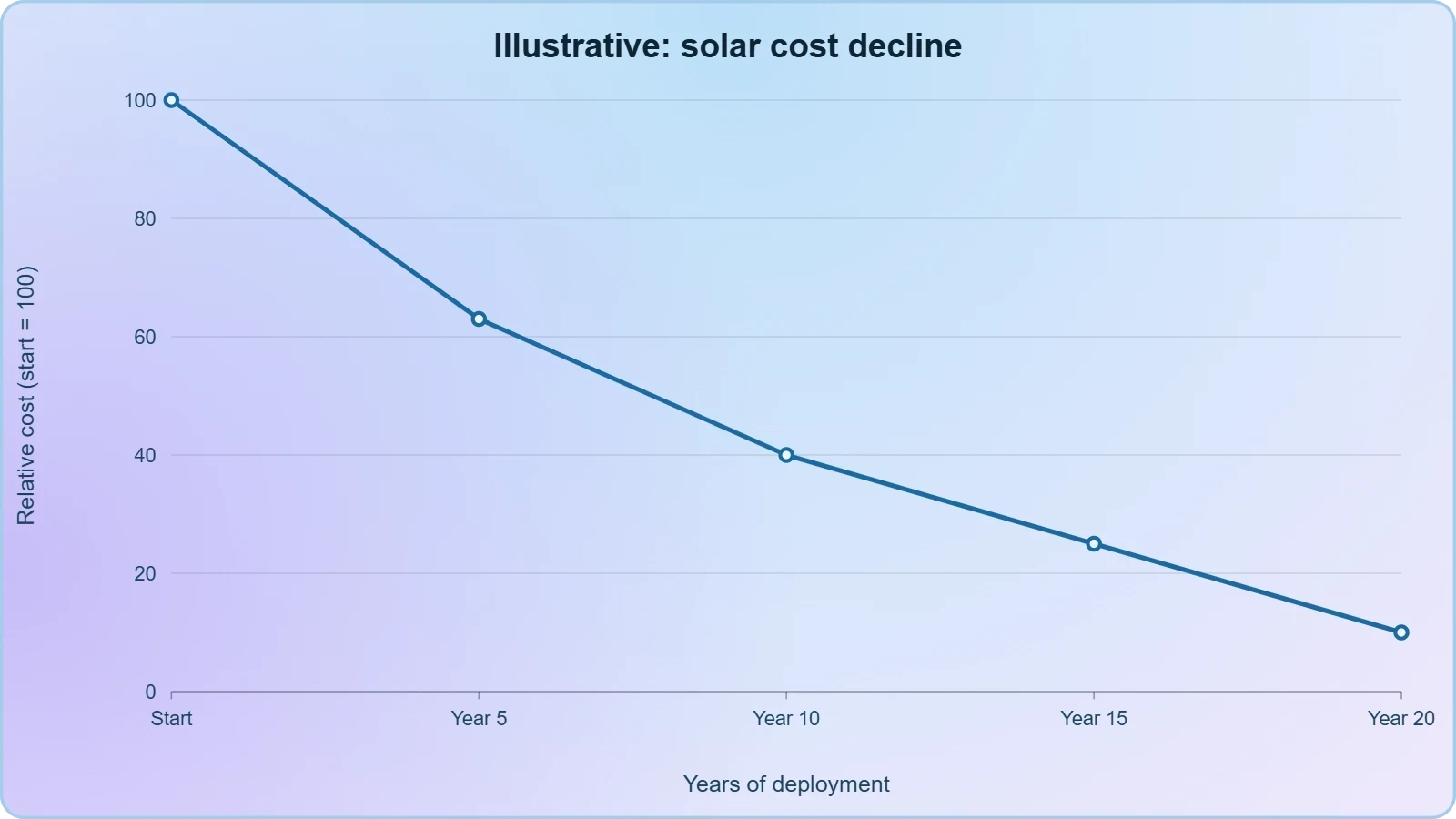
Yet weakening economics do not automatically produce phase-out, because incumbent industries enjoy advantages that are not captured in cost curves. Existing plants are already built, their capital costs sunk, and their grid connections secured. They benefit from subsidies, tax treatment, and regulatory frameworks designed in an earlier era. They also benefit from the political relationships that Guterres highlighted. The economics may be shifting, but the institutional arrangements that govern energy systems change more slowly, which is precisely why the Secretary-General insisted that deliberate action is required.
Stranded Assets and Financial Exposure
The financial sector has begun to internalize the phase-out logic, albeit unevenly. Banks, insurers, and asset managers face growing pressure to disclose climate exposure and to account for the possibility that fossil fuel reserves may become stranded assets, uneconomic to extract before the end of their projected productive lives. Central banks have incorporated climate risk into financial stability assessments. These developments represent a quiet but significant shift: the case for fossil fuels is weakening not only in engineering terms but in the language of risk management and fiduciary duty.
This financial dimension gives Guterres's speech a practical edge beyond its moral appeal. When he speaks of addiction, he is describing a dependency that extends into pension funds, sovereign wealth portfolios, and household savings. Breaking that dependency requires not only political courage but financial plumbing: disclosure standards, capital requirements, and investment mandates that align fiduciary obligations with climate reality. The transition is therefore as much an accounting project as an engineering one, and the institutions that govern capital allocation are increasingly central to the phase-out debate.
Energy Security and the Transition Dilemma
Opponents of rapid phase-out frequently invoke energy security, arguing that fossil fuels provide reliable baseload power and protect nations from geopolitical shocks. The argument has genuine force, particularly for economies with limited renewable resources or fragile grids. Yet the same argument increasingly cuts the other way, as import-dependent nations discover that fossil fuel reliance exposes them to price volatility and supply disruption. The 2022 energy crisis demonstrated how quickly dependence on imported gas can become a strategic vulnerability, strengthening the case for domestic renewables.
Guterres's framing implicitly addresses this dilemma by presenting phase-out as a matter of deliberate design rather than abrupt withdrawal. The addiction metaphor suggests a managed recovery: substitute the harmful dependency with healthier alternatives, build supporting infrastructure, and address the social costs of withdrawal. This is a more sophisticated argument than simple abolition, and it acknowledges that transition requires planning, investment, and political patience. The question is whether the international system possesses the institutional capacity to manage such a recovery at the speed the science demands.
- 01
- 02
- 03
- 04
COP31 in the Longer Arc of Climate Diplomacy
Every COP is both a discrete event and a node in a longer narrative, and COP31 will likely be remembered less for any single agreement than for the tone of its closing arguments. Guterres's speech belongs to a tradition of farewell interventions that seek to define the terms of debate for successors. His emphasis on phase-out rather than emissions reduction reflects a shift in the diplomatic lexicon that has been building for several years, as civil society and vulnerable nations have pressed for explicit language targeting the production of fossil fuels rather than only their combustion.
The summit's location in Turkey also carried symbolic weight, placing the negotiations in a country that sits at the crossroads of energy transit routes between producing regions and consuming markets. Such geography inevitably shapes the politics of any climate gathering, reminding delegates that energy systems are embedded in trade relationships, security alliances, and development pathways. The Secretary-General's remarks can be read as an attempt to lift the conversation above these particularities toward the universal physics of cumulative emissions and the finite carbon budget.
The Moral Authority of the United Nations
The UN Secretary-General possesses no enforcement power, no budget of consequence, and no ability to compel compliance. What the office holds is moral authority, a resource that is difficult to measure but not negligible. When deployed effectively, it can shift the terms of legitimate debate, making certain positions easier to defend and others harder to maintain. Guterres has used this authority consistently on climate, and his final speeches represent an attempt to bank that authority in the institutions and movements that will carry the argument forward.
Whether moral authority translates into material change depends on the receptivity of the audiences it reaches. Governments facing domestic political constraints may acknowledge the Secretary-General's framing while continuing to approve new fossil infrastructure. Investors may incorporate his warnings into risk models without divesting. The value of the speech lies less in immediate policy change than in the slow accretion of legitimacy for phase-out positions. Over time, such accretion can alter what is politically thinkable, and that is often the precondition for legislative action.
What Comes After the Farewell
The departure of a Secretary-General inevitably raises questions about continuity. Climate diplomacy has benefited from Guterres's sustained attention, and his successor will inherit both the institutional momentum he built and the unresolved tensions he named. The phase-out coalition will need to find new champions within the UN system and among member states. The lobbying asymmetry he highlighted will persist regardless of who occupies the office, because it is structural rather than personal, rooted in the organization of economic interests rather than the preferences of any individual diplomat.
For observers of climate governance, the COP31 moment offers a useful case study in how international institutions exercise influence without formal power. The Secretary-General's speech did not change any nation's emissions trajectory on the day it was delivered. But it articulated a framework, addiction and recovery, that may prove durable in future negotiations. Frameworks matter because they determine which policies appear reasonable, which arguments appear self-serving, and which futures appear achievable. In that sense, the farewell address was less an ending than an attempt to set the terms for what follows.
Reading the Signal for Investors and Policymakers
For those who allocate capital or design regulation, the COP31 address offers a signal worth decoding. The Secretary-General's language suggests that the moral and political pressure on fossil fuel incumbents will continue to intensify, even as the pace of actual phase-out remains uneven across jurisdictions. Investors should read this as a continuation of the trend toward climate-aware capital allocation, with growing scrutiny of transition plans, reserve valuations, and lobbying disclosures. The speech does not change fundamentals, but it reinforces the direction of travel in norms and expectations.
Policymakers face a more complicated calculus. The call for deliberate action arrives at a moment when many governments are balancing climate ambition against affordability and security concerns. Guterres's framing provides rhetorical cover for tougher measures, but it does not resolve the distributional questions that make phase-out politically difficult. The speech is best understood as an attempt to raise the cost of inaction in the court of public opinion, leaving the detailed work of policy design to those who hold the levers of implementation.
Transition Risk and Opportunity
The distinction between risk and opportunity in the energy transition is largely a matter of time horizon and portfolio positioning. Assets tied to long-lived fossil infrastructure face mounting obsolescence risk as renewable alternatives improve and policy tightens. Conversely, firms and regions that invest early in grid modernization, storage, and industrial decarbonization may capture durable advantages. Guterres's remarks, by emphasizing the weakening case for incumbency, implicitly favor the latter positioning without offering specific investment guidance.
This is characteristic of UN interventions, which set direction without prescribing instruments. The practical translation occurs in national capitals and corporate boardrooms, where the Secretary-General's moral framing is weighed against narrower considerations of cost, competitiveness, and political survival. The value of the COP31 speech lies in its contribution to that weighing process, adding a authoritative voice to the case that delay is itself a choice with consequences. Over time, such voices shape the background assumptions against which decisions are made.
The Limits of Exhortation
It is important to be clear-eyed about what a speech can and cannot accomplish. Guterres's address will not retire a single power plant or cancel a single exploration license. Its influence operates through the slower channels of norm diffusion, agenda setting, and public expectation. These channels matter, but they are not substitutes for the institutional mechanisms that actually govern energy systems. The gap between exhortation and implementation is precisely the gap the Secretary-General identified, and his speech is best read as an attempt to narrow it by making the obstacles visible.
The ultimate test of the COP31 moment will be whether the phase-out language it amplified translates into binding commitments in subsequent negotiations. History suggests that such translation is slow and contested, proceeding through incremental shifts in what governments are willing to accept as legitimate. The farewell address of a departing Secretary-General is unlikely to be remembered as a turning point, but it may be remembered as a marker of how far the mainstream had moved, and how much further the physics still requires.
Conclusion: The Measure of a Farewell
The COP31 address will be judged by history less for its wit than for its diagnosis. Guterres identified with unusual clarity the central paradox of contemporary climate politics: the scientific and economic case for transition has never been stronger, yet the political mechanisms required to execute it remain captive to the interests it threatens. His dinosaur analogy and addiction framing were not ornaments but instruments, designed to make that paradox legible to audiences beyond the negotiating halls. Whether they succeed depends on forces far beyond any single speech.
What remains after the applause fades is a set of questions that will define the next decade of climate governance. Can voluntary frameworks be made to deliver mandatory outcomes? Can the lobbying asymmetry be rebalanced through transparency and democratic pressure? Can the financial system be aligned with the physics of the carbon budget? Guterres offered no blueprint, but he sharpened the questions and lent them the authority of his office. In the long arc of climate diplomacy, that may prove a more durable contribution than any communiqué.
From our network :
- The Hidden Cost of AI Convenience: Why Over-Permissioned Agents Are a Security Time BombDiscover why AI agents with excessive permissions create dangerous single points of failure, and learn how implementing least privilege principles can protect your organization from exploitation.
- Live Online English Classes for Kids: Do They Actually Reduce Anxiety?A ten-week study reveals that synchronous online English classes can significantly reduce child language anxiety while improving listening and reading skills. Discover what makes these programs effective and how parents can select the right one.
- Forbidden Matrix Patterns and Visible Lattice Points: A Geometric DictionaryExplore how multidimensional 0–1 matrices encode geometric truths, linking forbidden patterns to visible lattice points and hypergraph theory, with applications in combinatorics and computational geometry.
- CISA’s Ten-Advisory Wave: Why Generic Patching Fails in OT and How to Build Product-Specific PlaybooksCISA released ten ICS advisories in one week, exposing critical infrastructure risks. Generic patching fails in OT. Learn to build product-specific remediation playbooks.
- Committed Mediterranean Precipitation Decline: Why Emissions Cuts Alone Cannot Restore Winter RainsNew NOAA research reveals that Mediterranean winter rains may decline irreversibly even with emissions cuts. Explore the science of committed climate change and regional impacts.
- University Language Proficiency Exams: Why Institutional Tests Demand Different Preparation Than IELTS and TOEFLDiscover why university-specific language proficiency examinations differ fundamentally from IELTS and TOEFL, and learn strategic preparation approaches for institutional assessment success.
- How AI Agents Will Change the Way We Manage Personal FinancesExplore how AI agents are transforming personal finance through automated budgeting, bill payment, and investment management, while examining the critical security protocols and governance frameworks required for safe deployment.
- Mobile Learning and VR in English: What Global Evidence Reveals About Effective Language TechnologyA systematic review across 14 countries reveals which language-learning technologies genuinely work. Mobile learning, AI, and VR show measurable benefits when pedagogically integrated. This evidence-based guide helps educators and learners select technology that delivers real return on investment.
- The Final Descent: How ESA Retired the Legendary Cluster Constellation After 24 Years of Space Weather ScienceAfter 24 years mapping Earth’s magnetosphere, ESA’s Cluster mission concluded with a precisely controlled reentry over the South Pacific. This analysis explores the scientific legacy, engineering decisions, and debris mitigation principles behind one of space exploration’s most responsible retirements.
RESOURCES
- Guterres Urges Faster Shift to Renewable Energy at COP31 UN ...facebook.com1 day ago ... ... phasing out fossil fuels, and ensuring equitable access to finance for sustainable solutions. Guterres' call to action resonates powerfully ...
- COP31: World leaders must break fossil fuels' grip on climate policyamnesty.org4 days ago ... and begin reforming the way UN climate governance works. Governments must accelerate a full, fast, fair and funded fossil fuel…
- UN chief urges countries to adopt fossil fuel transition plans with ...climatechangenews.comSep 22, 2026 ... The head of the United Nations has called on all countries to deliver plans for phasing out their production and…
- COP31: Environment MEPs urge faster fossil fuel phase-out and ...theclimatewatch.comOct 1, 2026 ... The draft resolution on Parliament's priorities for the 9-20 November UN Climate Change Conference (COP31), to be held in Antalya,…
- UN chief urges governments to stop propping up polluting fossil fuelseuronews.comOct 16, 2026 ... EU finance ministers earlier this month called for a phaseout of fossil fuel subsidies at the COP31 climate negotiations taking…
- STATEMENT: UN Secretary-General's Climate Summit Calls for ...wri.orgSep 23, 2026 ... STATEMENT: UN Secretary-General's Climate Summit Calls for Faster, Fairer Climate Action ... phase out fossil fuels by 2045. Following is…
- UN Chief Calls for Immediate Global Action to Phase Out Coalunfccc.intMar 2, 2021 ... ... fossil fuel from its power sectors. The International Energy Agency has found that the cost of building new solar…
- Nestle, Volvo among 130 companies urging COP28 agreement to ...reuters.comOct 23, 2023 ... , Mahindra Group and Volvo Cars are urging political leaders to agree a timeline at the upcoming U.N. climate summit…
- Fossil Fuel Treatyfossilfueltreaty.orgTHE GLOBAL PLAN FOR A JUST TRANSITION TO PHASE OUT FOSSIL FUELS. Building momentum to phase out fossil fuels: fair, fast and forever. The…
- OPEC head to OPEC+: reject COP28 language on fossil fuel phase ...reuters.comDec 8, 2023 ... OPEC Secretary General Haitham Al Ghais has urged OPEC+ members to reject proposals for any text under negotiation at the…
- Climate crisis: UN chief lays out solutions blueprint for clean energy ...news.un.orgJun 23, 2026 ... Guterres said, in a call for political leadership to push through global change akin to that required to phase out…
- Have courage to create fossil fuel phaseout roadmap at Cop30 ...theguardian.comNov 16, 2025 ... Brazil's environment minister, Marina Silva, has urged all countries to have the courage to address the need for a fossil…
- International Cooperation: Promoting Global Climate Leadershipclimaterealityproject.org... fossil fuels by developing roadmaps for phasing out dirty energy. ... urge them to keep all fossil fuel lobbyists out of COP 31…
- 'Now is the hour': Labor urged to speed up fossil fuel phase-out to ...theguardian.comNov 23, 2025 ... The Albanese government is being urged to explain how it will drive a fossil fuel phase-out, after it joined dozens…
- COP30: Not enough on fossil fuels and forests, but promising steps ...cleanairfund.orgNov 22, 2025 ... We urge ambitious countries to move forward together on a full, fair and fast fossil fuel phaseout. ... Countries should…
- 01
- 02
- 03
- 04
- 05
- 06
- 07
- 08
0 Comments