On 11 November 2026, Iran's Foreign Ministry issued a formal declaration classifying the Argentine navy and air force as "terrorist organizations," a move explicitly framed as reciprocal retaliation for Buenos Aires' designation of the Islamic Revolutionary Guard Corps (IRGC) as a terrorist entity earlier that April. The announcement, carried by Deutsche Welle and other international outlets, represents one of the more unusual diplomatic escalations in recent Latin American–Middle Eastern relations: a state designating another state's conventional military branches as terrorist bodies, rather than targeting a non-state militia or irregular force. The language of the statement was deliberately legalistic, invoking the principle of reciprocity as its justification and warning that Argentina's government would bear responsibility for "all consequences" arising from the matter.
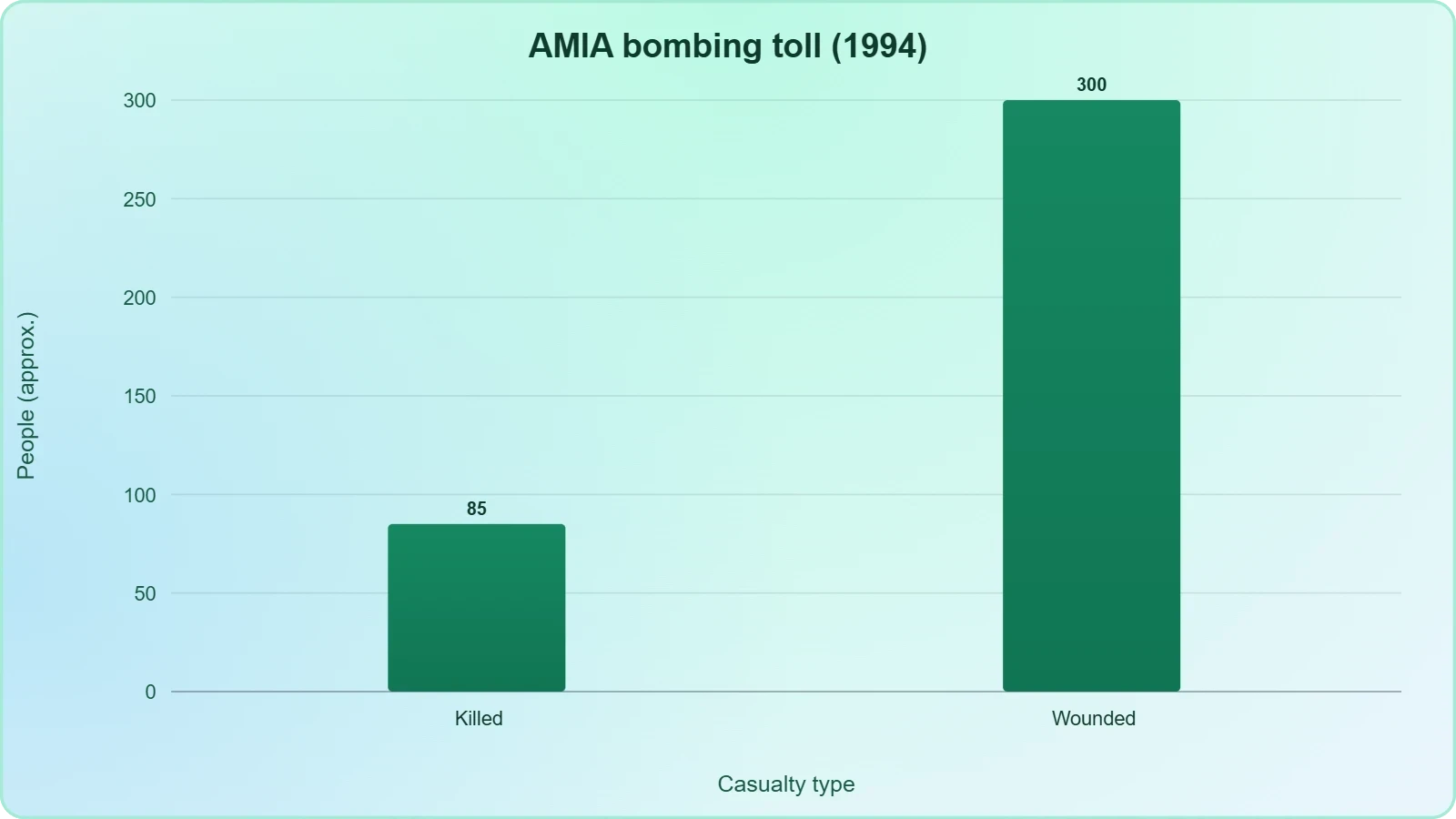
The dispute traces back to Argentina's decision to proscribe the IRGC over its alleged support for Hezbollah, the Lebanon-based militant movement that Buenos Aires holds responsible for the 1994 bombing of the AMIA Jewish community center, an attack that killed 85 people and remains the deadliest terrorist incident in Argentine history. Iran's response draws on a 2019 domestic law permitting retaliatory measures against any state that designates its military as a terrorist group, giving Tehran a ready legal architecture for symmetric counter-designation. Notably, the Iranian statement pointedly omitted Argentina's army from its list, a selective targeting that analysts read as calibrated rather than indiscriminate.
What follows examines the legal logic, historical grievances, and geopolitical consequences embedded in this exchange, from the IRGC's dual identity as both an elite fighting force and a vast economic conglomerate to the widening rift between Western and non-Western interpretations of counterterrorism designation. The episode also illuminates how the AMIA bombing continues to shape Argentine foreign policy three decades later, and why the principle of reciprocity has become an increasingly common instrument in interstate disputes.
On This Page
TL;DR Iran's Foreign Ministry declared Argentina's navy and air force terrorist organizations in November 2026, retaliating against Argentina's April designation of the IRGC over its alleged backing of Hezbollah and the 1994 AMIA bombing. The move invokes a 2019 Iranian law authorizing reciprocal measures and deliberately excludes Argentina's army. The exchange highlights the IRGC's contested status—designated terrorist by the US, EU, UK, and others, yet a constitutional pillar of the Iranian state—and signals how counterterrorism designations have become instruments of diplomatic coercion rather than purely legal judgments.
The Anatomy of a Reciprocal Designation
The Iranian declaration is best understood as a carefully staged act of diplomatic signaling rather than a practical security measure. By labeling Argentina's navy and air force as terrorist organizations, Tehran is not claiming that Argentine naval vessels or aircraft have conducted terrorist operations; it is instead deploying the vocabulary of counterterrorism as a mirror, reflecting back the stigma that Buenos Aires applied to the IRGC. This rhetorical symmetry carries real legal weight under Iran's 2019 statute, which empowers the government to take retaliatory measures against states that designate Iranian military institutions as terrorist entities. The statement's warning about consequences was left deliberately vague, preserving escalation options without committing to specific reprisals.
The Legal Architecture Behind the 2019 Iranian Law
Iran's 2019 law on reciprocal designation emerged in response to the United States' April 2019 decision to designate the IRGC as a Foreign Terrorist Organization—the first time Washington had applied that label to a branch of another nation's armed forces. The Iranian statute created a domestic legal basis for designating foreign military and security bodies in return, transforming counterterrorism listing from a one-way Western instrument into a two-way diplomatic weapon. Legal scholars note that such reciprocal designations operate in a gray zone of international law: they are valid under the designating state's domestic statutes but carry little standing in multilateral forums, where terrorist listings are typically the province of the UN Security Council's 1267 Committee.
The practical effect of these tit-for-tat designations is less about law enforcement than about narrative control. When Iran labels Argentina's navy and air force terrorist organizations, it signals to domestic audiences and regional allies that Tehran will not absorb Western designations passively. It also complicates any future Argentine or Western legal action against Iranian entities, since Tehran can now point to its own listing regime as evidence of politicized targeting. The reciprocity principle, in this reading, functions as a reputational shield rather than a genuine threat assessment.
Why Argentina's Army Was Spared
The conspicuous omission of Argentina's army from the Iranian statement has drawn analytical attention. Iran's Foreign Ministry named the navy and air force but said nothing about the land forces, a selectivity that suggests deliberate calibration. One interpretation holds that Tehran wished to avoid the appearance of declaring wholesale hostility toward the Argentine state, preserving a channel for future dialogue. Another reading focuses on symbolism: the navy and air force are the branches most associated with Argentina's participation in Western-aligned maritime and aerial operations, making them more convenient targets for rhetorical retaliation than the army, which carries a different historical baggage tied to domestic politics.
Whatever the motive, the selective listing underscores that these designations are political instruments rather than security assessments. A genuine terrorist designation would rest on evidence of specific conduct, not on the institutional identity of a conventional military branch. By excluding the army, Iran left itself room to claim restraint while still delivering a sharp diplomatic rebuke—a pattern consistent with Tehran's broader practice of calibrated escalation in disputes with Western-aligned governments.
We Also Published
The IRGC: A State Within a State
Understanding why the IRGC's designation provokes such intense reactions requires appreciating what the organization actually is. Established at the close of Iran's 1979 Islamic Revolution, the Corps began as an elite armed force charged with protecting the newly formed Shiite clerical regime from internal and external threats. Over more than four decades, it has evolved into something far more expansive: a parallel military with its own navy, air force, and intelligence apparatus, a sprawling economic conglomerate controlling construction, energy, and telecommunications assets, and a political actor of decisive influence in Iranian domestic affairs. The IRGC answers directly to the Supreme Leader rather than to the elected president, placing it outside the ordinary chain of civilian command.
From Revolutionary Guard to Economic Powerhouse
The IRGC's economic footprint is vast and often opaque. Through entities such as the Khatam al-Anbiya Construction Headquarters, the Corps has secured billions of dollars in infrastructure, oil, and gas contracts, particularly during periods when international sanctions deterred foreign competitors. This economic role makes designating the IRGC as a terrorist organization a far-reaching act: it potentially exposes any company or bank transacting with IRGC-linked firms to secondary sanctions and legal jeopardy. For Argentina, designating the IRGC was therefore not merely a symbolic gesture about Hezbollah but a statement aligning Buenos Aires with the Western financial architecture that treats the Corps as a pariah institution.
Critics of broad IRGC designations argue that the organization's entanglement with the Iranian state makes it impossible to isolate the "terrorist" component from the legitimate governing apparatus. When the United States designated the IRGC in 2019, it carved out exceptions for certain humanitarian and governmental transactions, acknowledging that the Corps is embedded in Iran's constitutional order. Iran's reciprocal designations exploit this ambiguity, arguing that if the IRGC is the state, then designating it is an act of hostility against the Iranian nation itself—a framing designed to delegitimize Western listings.
The AMIA Bombing and Argentina's Long Memory
Argentina's decision to designate the IRGC cannot be separated from the unresolved trauma of the AMIA bombing. On 18 July 1994, a truck bomb destroyed the Argentine Israelite Mutual Association building in Buenos Aires, killing 85 people and wounding hundreds more. Argentine prosecutors and international investigators have long alleged that Hezbollah carried out the attack with Iranian logistical support, though Tehran has consistently denied involvement. The case has been marked by decades of frustrated investigations, including the 2015 death of prosecutor Alberto Nisman, who had accused then-president Cristina Fernández de Kirchner of covering up Iranian involvement—a charge her government rejected.
For Argentine policymakers, designating the IRGC was a way to reaffirm a national commitment to accountability that has survived multiple changes of government. It also served a diplomatic purpose: aligning Argentina with the United States, the European Union, and the United Kingdom, all of which classify the IRGC as a terrorist organization. The designation thus carried dual significance—a moral statement about AMIA and a strategic alignment with Western powers at a time of shifting global alliances.
Reciprocity as a Diplomatic Weapon
The principle of reciprocity invoked by Iran's Foreign Ministry is an old concept in international law, traditionally associated with the mutual exchange of privileges and obligations between states. In the context of counterterrorism designations, however, reciprocity has acquired a sharper edge. When one state labels another's military as terrorist, the targeted state can respond in kind, creating a spiral in which the terrorist label loses its specificity and becomes a generic marker of political hostility. Iran's 2019 law institutionalized this logic, and the November 2026 declaration against Argentina's navy and air force is its most prominent application to date against a Latin American state.
The Erosion of the Terrorist Label
Scholars of international security have warned that reciprocal designations dilute the analytical value of terrorist listings. If any military branch can be labeled terrorist in response to a political disagreement, the designation ceases to convey information about actual conduct and becomes instead a diplomatic insult dressed in legal language. This erosion matters because genuine counterterrorism cooperation depends on shared, evidence-based lists. When designations become retaliatory, they complicate extradition requests, asset freezes, and intelligence-sharing arrangements, since each side can question the political motives behind the other's listings.
The Argentina–Iran exchange illustrates this dynamic vividly. Argentina's designation of the IRGC rested on specific allegations of Hezbollah support tied to the AMIA bombing, a case with a documented investigative record. Iran's counter-designation of Argentina's navy and air force rests on no comparable evidentiary foundation; it is explicitly framed as reciprocity, not as an assessment of Argentine conduct. The asymmetry in evidentiary grounding is precisely what critics of reciprocal designation regimes point to when arguing that the practice undermines the credibility of counterterrorism law.
Precedents and Parallels
Iran is not alone in using reciprocal designation as a diplomatic tool. Russia has designated various Western-linked organizations, and several states have passed laws allowing mirror-image responses to foreign sanctions and listings. The pattern reflects a broader fragmentation of the post-Cold War security consensus, in which the power to label an entity as terrorist is increasingly contested. For middle powers like Argentina, the lesson is that aligning with Western designation regimes carries costs: it invites retaliation from targeted states and can draw a country into disputes far from its immediate neighborhood.
The Argentine case also highlights the role of domestic politics. Designating the IRGC was popular with segments of the Argentine public and with the country's Jewish community, which has long demanded accountability for AMIA. But it also exposed Argentina to Iranian countermeasures at a time of economic vulnerability. The Iranian statement's warning about "all consequences" was calibrated to remind Buenos Aires that diplomatic gestures have material costs, whether through trade disruptions, visa restrictions, or other retaliatory measures permitted under the 2019 law.
- 01
- 02
- 03
- 04
Geopolitical Ripples Across Regions
The Argentina–Iran designation dispute resonates well beyond the two capitals involved. It arrives at a moment of heightened global polarization, when the vocabulary of terrorism is being deployed across multiple theaters—from the Middle East to Eastern Europe to Latin America—as an instrument of statecraft. For Iran, the move against Argentina signals to other states considering similar designations that Tehran will respond in kind, a deterrent message aimed at governments weighing alignment with Western listing regimes. For Argentina, the episode tests the durability of a foreign policy consensus built around accountability for AMIA and alignment with Western powers.
Implications for Latin America and the Global South
Latin American governments have historically maintained diverse relationships with Iran, and the Argentine designation may complicate regional diplomacy. Countries with closer ties to Tehran, including some in the Bolivarian alliance, may view Argentina's move as unnecessarily provocative, while others aligned with Washington will see it as a principled stand. The dispute also intersects with broader questions about how Global South states navigate between Western and non-Western blocs, particularly as sanctions and designation regimes proliferate. Argentina's experience offers a cautionary tale about the costs of using counterterrorism listings as instruments of alignment.
For Iran, the counter-designation reinforces its longstanding strategy of treating Western terrorist listings as political rather than legal acts. By responding in kind, Tehran seeks to normalize the idea that designations are reversible diplomatic currency, not objective assessments. This framing has found some traction among non-Western legal scholars who argue that the post-9/11 proliferation of terrorist lists has created a parallel legal order lacking due process and multilateral oversight. The Argentina case gives that critique a concrete example to cite.
Economic and Security Consequences
The practical consequences of the exchange are likely to be modest in the short term but potentially significant over time. Argentina and Iran have limited direct trade, so economic retaliation has a narrow surface. However, the designations could affect financial institutions that handle transactions involving Argentine military entities or Iranian-linked firms, creating compliance headaches for banks operating in both jurisdictions. Security cooperation, already minimal, is unlikely to be affected directly, but the exchange adds another layer of mistrust to a relationship already burdened by the unresolved AMIA case.
Over the longer term, the precedent matters more than the immediate impact. If reciprocal designations become routine, the international legal architecture around terrorism will fragment further, with each bloc maintaining its own lists and rejecting the legitimacy of others. That outcome would complicate multilateral counterterrorism efforts and make it harder to coordinate responses to genuine threats. The Argentina–Iran exchange is a small but telling data point in that broader trajectory.
Reading the Signal: What Tehran and Buenos Aires Want
Beneath the legal language, both governments are pursuing identifiable political objectives. Iran's declaration serves domestic legitimation purposes, demonstrating to hardline constituencies that the Islamic Republic defends its military institutions against foreign stigmatization. It also signals to regional allies that Tehran remains willing to confront Western-aligned states, even far from its immediate neighborhood. For Argentina, the April designation of the IRGC was a way to honor AMIA victims, satisfy domestic constituencies, and align with Western powers—objectives that remain intact despite Iran's counter-move. Neither side appears to seek escalation beyond the symbolic register.
Domestic Audiences and Symbolic Politics
The timing and framing of both designations suggest careful attention to domestic reception. Iran's Foreign Ministry statement was issued on a Wednesday, a common day for diplomatic announcements, and emphasized the reciprocity principle to preempt accusations of unprovoked aggression. Argentina's April designation was similarly timed to maximize domestic political benefit, reinforcing the government's commitment to AMIA accountability. In both cases, the designations function as signals to domestic audiences as much as to foreign governments, a reminder that counterterrorism policy is never purely technical.
Symbolic politics also shapes how the designations are received internationally. Iran's move was reported by Deutsche Welle and other outlets as a notable escalation, drawing attention to the unusual step of labeling a conventional military branch as terrorist. That media framing itself becomes part of the political dynamic, amplifying the signal beyond the diplomatic channel. For both governments, the visibility of the exchange may matter more than its substantive consequences, since each can claim to have stood firm against external pressure.
Prospects for De-escalation
Prospects for de-escalation depend largely on whether either side sees value in reversing course. Argentina is unlikely to rescind its IRGC designation given the domestic consensus around AMIA, while Iran has little incentive to withdraw a counter-designation that costs it little and signals resolve. A face-saving formula might involve quiet diplomatic assurances or a mutual understanding that the designations are symbolic rather than operational, but no such mechanism is currently visible. The dispute is therefore likely to persist as a low-level irritant in bilateral relations, flaring occasionally when either side finds it useful.
The broader lesson is that counterterrorism designations have become embedded in the toolkit of geopolitical competition, and states should expect reciprocal responses when they use them. For Argentina, the experience may prompt reflection on the costs of alignment; for Iran, it reinforces a strategy of treating Western listings as reversible political acts. For the international system, the exchange adds another data point suggesting that the post-9/11 consensus on terrorist designation is fraying, replaced by a patchwork of competing lists and reciprocal retaliation.
Conclusion: A Precedent With Long Shadows
The Iranian designation of Argentina's navy and air force as terrorist organizations is, on its face, a narrow diplomatic maneuver. Yet it carries outsized significance as a precedent for how states use counterterrorism law as an instrument of reciprocal pressure. By invoking its 2019 statute and framing the move as a mirror response to Argentina's IRGC designation, Tehran has demonstrated that the terrorist label can travel in both directions. The selective omission of Argentina's army adds a layer of calculated restraint, signaling that Iran seeks to make a point without closing every door.
For Argentina, the episode is a reminder that foreign policy choices carry costs, even when those choices are grounded in deeply held national commitments like accountability for the AMIA bombing. The designation of the IRGC was morally and politically significant, but it also invited retaliation from a state with a legal framework designed for exactly this purpose. How Buenos Aires manages the aftermath—whether through quiet diplomacy, multilateral engagement, or simply absorbing the symbolic blow—will shape the longer-term trajectory of its relationship with Tehran.
More broadly, the exchange contributes to a growing body of evidence that the international legal order around terrorism is fragmenting. When designations become reciprocal weapons, the shared vocabulary that once enabled cooperation erodes, replaced by competing lists and mutual accusations. The Argentina–Iran case is unlikely to be the last of its kind; it may instead become a template for other states seeking to respond in kind to Western-aligned listings. Understanding this dynamic is essential for anyone tracking the future of counterterrorism law and the geopolitics of designation.
From our network :
- Forbidden Matrix Patterns and Visible Lattice Points: A Geometric DictionaryExplore how multidimensional 0–1 matrices encode geometric truths, linking forbidden patterns to visible lattice points and hypergraph theory, with applications in combinatorics and computational geometry.
- Mobile Learning and VR in English: What Global Evidence Reveals About Effective Language TechnologyA systematic review across 14 countries reveals which language-learning technologies genuinely work. Mobile learning, AI, and VR show measurable benefits when pedagogically integrated. This evidence-based guide helps educators and learners select technology that delivers real return on investment.
- CISA’s Ten-Advisory Wave: Why Generic Patching Fails in OT and How to Build Product-Specific PlaybooksCISA released ten ICS advisories in one week, exposing critical infrastructure risks. Generic patching fails in OT. Learn to build product-specific remediation playbooks.
- Live Online English Classes for Kids: Do They Actually Reduce Anxiety?A ten-week study reveals that synchronous online English classes can significantly reduce child language anxiety while improving listening and reading skills. Discover what makes these programs effective and how parents can select the right one.
- The Final Descent: How ESA Retired the Legendary Cluster Constellation After 24 Years of Space Weather ScienceAfter 24 years mapping Earth’s magnetosphere, ESA’s Cluster mission concluded with a precisely controlled reentry over the South Pacific. This analysis explores the scientific legacy, engineering decisions, and debris mitigation principles behind one of space exploration’s most responsible retirements.
- Committed Mediterranean Precipitation Decline: Why Emissions Cuts Alone Cannot Restore Winter RainsNew NOAA research reveals that Mediterranean winter rains may decline irreversibly even with emissions cuts. Explore the science of committed climate change and regional impacts.
- How AI Agents Will Change the Way We Manage Personal FinancesExplore how AI agents are transforming personal finance through automated budgeting, bill payment, and investment management, while examining the critical security protocols and governance frameworks required for safe deployment.
- University Language Proficiency Exams: Why Institutional Tests Demand Different Preparation Than IELTS and TOEFLDiscover why university-specific language proficiency examinations differ fundamentally from IELTS and TOEFL, and learn strategic preparation approaches for institutional assessment success.
- The Hidden Cost of AI Convenience: Why Over-Permissioned Agents Are a Security Time BombDiscover why AI agents with excessive permissions create dangerous single points of failure, and learn how implementing least privilege principles can protect your organization from exploitation.
RESOURCES
- Argentina designates Iran's IRGC a terrorist organization, aligning ...reuters.comMar 31, 2026 ... BUENOS AIRES, March 31 (Reuters) - Argentina has designated Iran's Islamic Revolutionary Guard Corps (IRGC) as a terrorist organization, ...
- Argentina expels Iranian diplomat after listing IRGC as 'terrorist ...al-monitor.comApr 3, 2026 ... On Tuesday, Argentina designated Iran's Islamic Revolutionary Guard Corps as a terrorist organization, citing its alleged role in backing ...
- Iran designates Argentina's navy and air force as 'terrorist ... - Reutersreuters.com10 hours ago ... Argentina had designated Iran's Islamic Revolutionary Guard Corps (IRGC) as a terrorist organization, following a push from US President ...
- Islamic Revolutionary Guard Corps - Wikipediaen.wikipedia.orgIt operates a media arm, known as "Sepah News" within Iran. Currently, the IRGC is designated as a terrorist organization by Albania, Argentina, ...
- Argentina designates Iran's Revolutionary Guards as a terrorist ...iranintl.comApr 1, 2026 ... “The National Government has declared the Islamic Revolutionary Guard Corps (IRGC) a terrorist organization,” the statement said. Argentina tied ...
- Argentina Targets IRGC's Quds Force With Terror Designation and ...themedialine.orgJan 18, 2026 ... Argentine President Javier Milei has moved to designate the IRGC Quds Force—Iran's overseas operations arm—as a terrorist organization ...
- Designation of the Islamic Revolutionary Guard Corps2017-2021.state.govApr 8, 2019 ... The IRGC FTO designation highlights that Iran is an outlaw regime that uses terrorism as a key tool of statecraft…
- Iran-related Designations and Updates; Counter Terrorism ...ofac.treasury.govOct 16, 2018 ... ... [IRGC] [IRAN-HR]. -to- BASIJ RESISTANCE FORCE (a.k.a. BASEEJ; a.k.a. ... 18, Iranian Building, 14th Alley, Ahmad Qassir Street, Argentina…
- Tehran has designated Argentina's navy and air force as “terrorist ...facebook.com10 hours ago ... Argentina has officially designated Iran's Islamic Revolutionary Guard Corps (IRGC) as a terrorist organization—marking a major geopolitical ...
- Argentina expels Iranian diplomat amid rift over blacklisting IRGCaljazeera.comApr 2, 2026 ... ... Argentina after it labeled IRGC as 'terror' group ... Israel had praised Buenos Aires's designation of the IRGC as…
- Iran designates Argentina's navy and air force as ... - Facebookfacebook.com9 hours ago ... Argentina Labels Iran's IRGC a Terror Group. Argentina has officially designated Iran's Islamic Revolutionary Guard Corps (IRGC) as a terrorist ...
- What is Iran's Islamic Revolutionary Guard Corps and Why is it ...ajc.orgJul 13, 2026 ... The EU's 2026 terrorist designation of the IRGC is a major milestone ... Argentina, and Australia have designated Hezbollah a…
- Iran classes Argentina navy, air force as 'terrorist organizations'dw.com5 hours ago ... ... Argentina's navy and air force as "terrorist organizations." In early April, Argentina designated Iran's Islamic Revolutionary Guard Corps (IRGC) ...
- Justice Department Seeks Seizure of Boeing 747 Cargo Plane ...justice.govAug 2, 2022 ... ... Iranian airline affiliated with the Islamic Revolutionary Guard Corp-Qods Force (IRGC-QF), a designated terrorist organization, and Empresa ...
- Iran Designates Argentine Navy, Air Force as Terrorist Organizationstasnimnews.ir10 hours ago ... ... designate the IRGC as a terrorist organization shall be subject to reciprocal measures. Accordingly, Iran considers Argentina's Navy and…
- 01
- 02
- 03
- 04
- 05
- 06
- 07
- 08
0 Comments