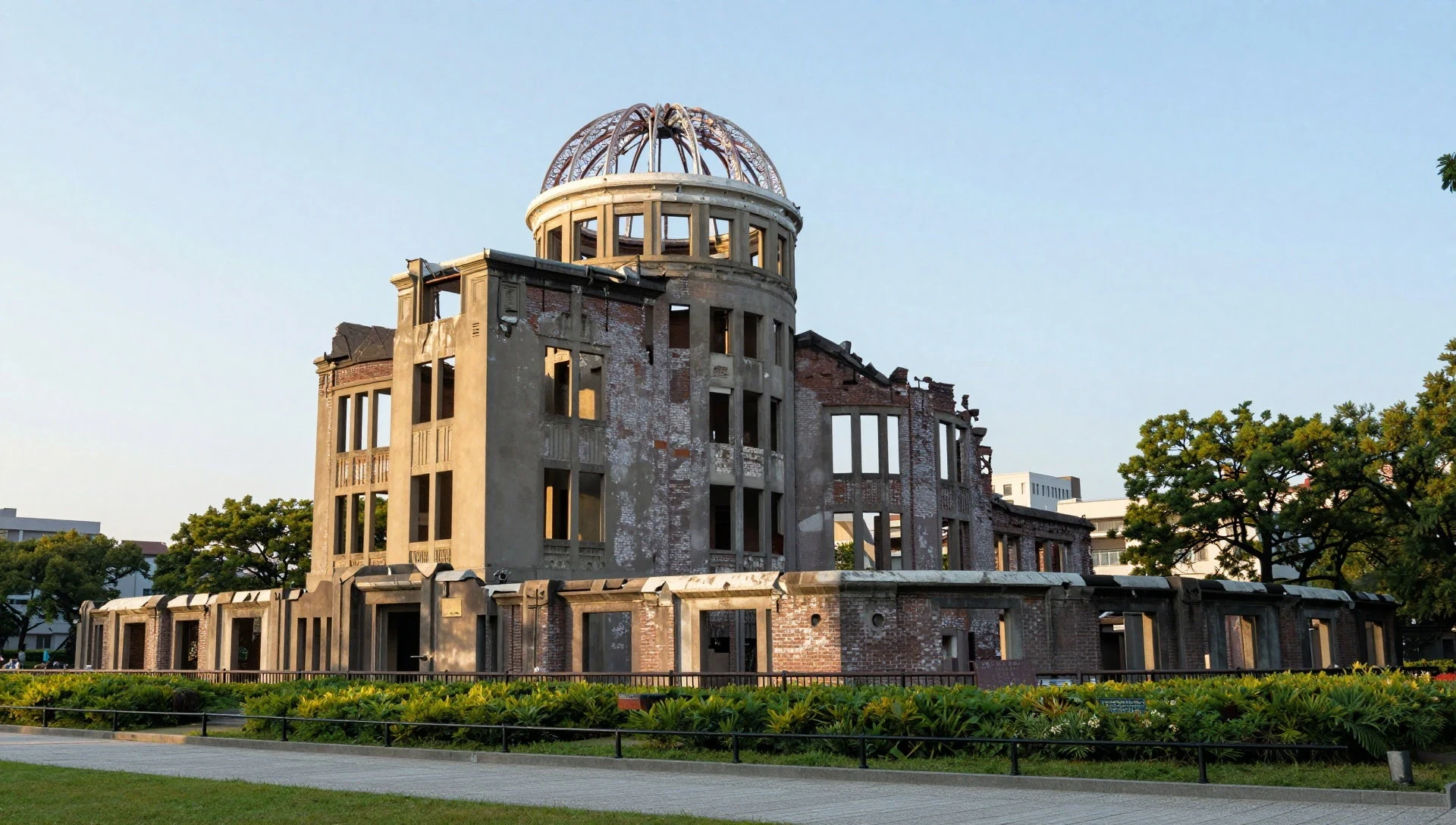
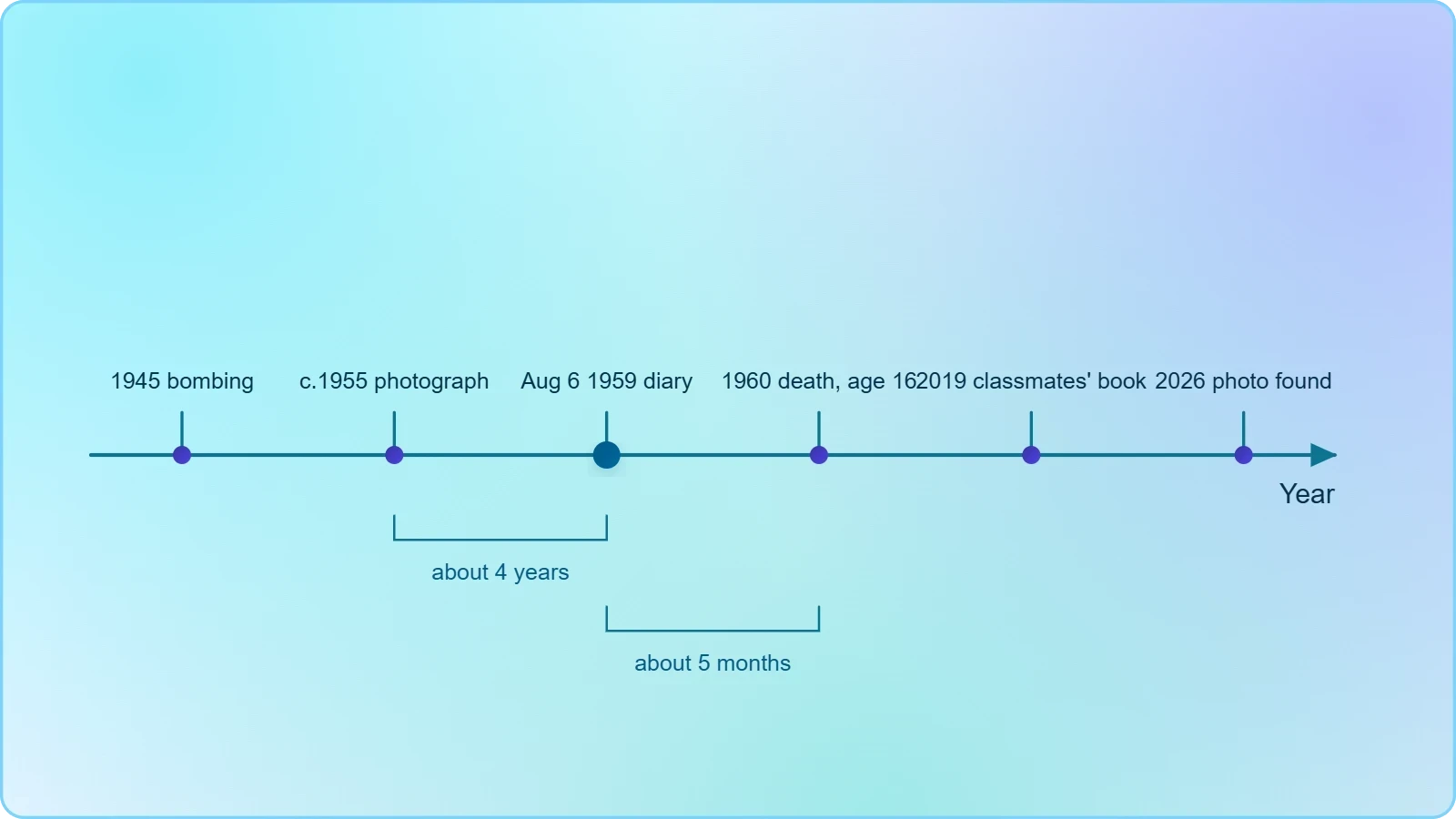
In the autumn of 2026, as the Atomic Bomb Dome in Hiroshima marked thirty years since its inscription as a UNESCO World Heritage Site, a quiet discovery surfaced that reframed how the world understands the building's survival. A previously unknown photograph emerged of Kajiyama Hiroko, a hibakusha whose teenage diary helped turn public opinion against demolishing the ruined Industrial Promotion Hall. The image, apparently captured around 1955 in Fuchu Town, shows a young girl standing among friends and sisters, smiling in a way that gives no hint of the radiation already working inside her body. She was one year old and roughly 1.3 kilometers from ground zero when the bomb fell on August 6, 1945, and she died of acute leukemia at sixteen.
What makes this photograph more than a family keepsake is the chain of civic action it illuminates. In the late 1950s, Hiroshima was divided over whether the skeletal dome should be preserved or cleared away as a hazard and a painful reminder. Kajiyama's diary entry of August 6, 1959, written about eight months before her death, asked whether the building would remain as a warning to the world about the fearsomeness of atomic weapons. A peace group read those words aloud at a preservation rally, and the sentiment spread far beyond the room. The dome survived, and the diary became a founding document of memory rather than a private grief.
The story also belongs to the people who outlived her. Shintaku Kumie, seventy-nine, remembered Kajiyama as unfailingly kind, and expressed regret that her friend died of an atomic bomb-related illness while hoping the world will come to know her. Former classmates published a book about her in 2019 and now intend to add the new photograph and further material. Terada Masahiro, eighty-three, framed the larger lesson plainly: visitors should not stop at the dome itself but should learn about the events that led to its preservation. That is the analytical heart of this account, and it is where the following sections begin.
On This Page
TL;DR A newly discovered photograph of Kajiyama Hiroko, a Hiroshima survivor who died of acute leukemia at sixteen, has surfaced as the Atomic Bomb Dome marks thirty years as a UNESCO World Heritage Site. Her 1959 diary entry about the Industrial Promotion Hall was read aloud by a peace group and helped galvanize the campaign that saved the structure from demolition. The find, showing her around 1955 with friends and sisters in Fuchu Town, has prompted her former classmates to expand a 2019 book about her life. The episode illustrates how individual testimony, civic organizing, and archival recovery combine to shape public memory and heritage preservation.
The Human Testimony Behind a World Heritage Site
Heritage sites are usually explained through architecture, engineering, and international conventions, yet the Atomic Bomb Dome owes its continued existence to something far more fragile: a teenager's written question. Kajiyama Hiroko was not a planner, a politician, or a preservation architect. She was a survivor of catastrophic radiation exposure who, knowing her own prognosis, chose to record what the ruined building meant to her. That single act of documentation entered public debate at precisely the moment when the outcome was undecided, and it shifted the terms of the argument from cost and safety to obligation and warning.
The Diary Entry That Changed a Debate
The entry dated August 6, 1959, was composed fourteen years after the bombing and roughly eight months before Kajiyama's death. In it she reflected on the Industrial Promotion Hall, the structure whose iron skeleton would later be known worldwide as the Atomic Bomb Dome, and wondered whether the painful reminder would always stand to tell the world how fearsome atomic bombs are. The phrasing matters because it does not ask for pity. It asks for permanence of memory, treating the ruin as an instrument of instruction rather than a monument to suffering, and that framing proved persuasive to audiences who might have resisted a purely emotional appeal.
At the time, Hiroshima's civic conversation included serious proposals to dismantle the building, which was deteriorating and widely regarded by some residents as a distressing daily sight. Preservation was not the obvious choice; it required money, engineering, and political will. When a Hiroshima peace group read Kajiyama's words aloud at an event organized to save the dome, the argument acquired a human voice that could not easily be dismissed. Her question reframed demolition as an act of forgetting, and the campaign gathered momentum from there.
Why a Single Voice Carried So Far
The persuasive power of testimony rests on specificity. Abstract arguments about historical value can be debated indefinitely, but a named sixteen-year-old describing her own exposure and asking a direct question compresses the entire moral case into a sentence. Scholars of collective memory have long observed that public remembrance consolidates around concrete, identifiable individuals rather than statistics, and the Hiroshima preservation campaign is a textbook instance. Kajiyama gave the campaign a face before anyone had a photograph to circulate, which makes the later discovery of her image symbolically significant rather than merely sentimental.
Her death at sixteen also placed the dome's meaning in an intergenerational frame. The building would outlive her by decades, and every year it stands extends the reach of a message she could not deliver in person. That asymmetry, between a short life and a long-lasting structure, is precisely what the preservation campaign asked the public to weigh. The dome became, in effect, the continuation of a testimony that illness cut short, and the thirty-year World Heritage anniversary in 2026 gives that continuity a formal, global recognition it did not have when she wrote.
The Preservation Campaign and the Politics of Memory
Preserving a ruin is never a neutral act. It requires a community to decide that a structure associated with trauma should remain visible rather than be replaced by something useful or consoling. In Hiroshima, that decision was contested for years, and the arguments on both sides were reasonable. Opponents emphasized physical danger, urban renewal, and the daily distress the skeleton caused survivors. Supporters argued that erasure would spare feelings at the cost of forgetting. Kajiyama's diary entered that dispute as evidence of what survivors themselves wanted, and that provenance gave the preservation campaign an authority no outside advocate could claim.
From Local Dispute to Global Heritage
The campaign's success eventually carried the dome beyond Hiroshima's municipal politics and into international heritage frameworks. UNESCO inscription in 1996 formalized what the preservation movement had asserted decades earlier: that the structure's value lies not in its architecture but in its evidentiary function. The thirty-year anniversary observed in 2026 therefore marks two things at once, the maturity of a global designation and the durability of a local argument won by ordinary residents. The newly found photograph arrives at that anniversary as a reminder that the designation rests on named people rather than abstract principles.
Heritage listing also changes the obligations attached to a site. Conservation standards, interpretive materials, and visitor expectations all become subject to scrutiny, and the story told to tourists must be accurate enough to withstand scholarly review. In that context, the emphasis placed by Terada Masahiro on learning about the events that led to preservation is not a minor request. It is a call for interpretation that includes the human advocacy behind the designation, not merely the catastrophe that created the ruin.
What the Dome Communicates to Later Generations
For visitors born decades after 1945, the dome functions as a physical argument that photographs and textbooks cannot fully replicate. Standing beneath the exposed steel ribs produces a spatial encounter with destruction that no statistic conveys, and that encounter is precisely what Kajiyama asked the building to provide. The risk, however, is that awe replaces understanding. A ruin can become a backdrop for reflection without transmitting the specific civic history that kept it standing, which is why the recovery of her photograph and the planned expansion of the classmates' book carry interpretive weight.
Memory transmission is an active process, not a passive inheritance. Each generation must be given the documents, images, and narratives that allow it to reconstruct why a decision was made. The 2019 book by Kajiyama's former classmates was one such instrument; the addition of the newly found photograph and further information extends its evidentiary base. In this sense the dome's survival and the survival of her story are the same project, sustained by the same small group of people who refuse to let the record thin out.
We Also Published
Reading the New Photograph as Historical Evidence
Photographs of hibakusha are often treated as illustrations, but they function as evidence with their own rules of interpretation. The image found in 2026, apparently taken around 1955 in Fuchu Town, Hiroshima Prefecture, shows Kajiyama with younger friends and sisters. Before this discovery she had been identified in only a few other photographs, which means the visual record of her life was thin and largely dependent on textual description. A new image does not merely decorate the story; it establishes her presence in a specific place at a specific time, anchoring the narrative in verifiable circumstance.
What the Image Adds to the Written Record
The photograph dates to roughly four years before the diary entry and about five before her death, placing her in a period of ordinary adolescence that the historical record otherwise compresses into illness and advocacy. Seeing her among younger companions and siblings restores a social dimension that testimony alone cannot supply. It also corroborates the recollections of Shintaku Kumie, who described her as consistently kind, by showing her in a group where she appears as an older figure to younger children. Such details matter to historians because they test whether remembered character traits align with documented context.
Provenance questions will inevitably follow any newly surfaced image. Researchers will want to establish the photographer, the occasion, and the chain of custody before the photograph is treated as definitive. The reported location and approximate date provide a starting framework, and comparison with the few known images of Kajiyama can support identification. None of this diminishes the find; it simply reflects the standard by which archival material earns trust. The classmates' plan to incorporate the photograph into an expanded edition of their 2019 book is itself a form of peer review within a community that knew her.
Archival Recovery and the Work of Memory
Discoveries like this one rarely happen by accident. They emerge from sustained attention by families, local groups, and amateur historians who keep looking through albums and municipal records long after official commemorations have concluded. The recovery of Kajiyama's photograph belongs to that quieter tradition of archival labor, which operates outside the spotlight of anniversaries and international designations. Its value compounds over time, because each recovered document makes the next reconstruction easier and raises the standard of evidence for future accounts.
There is also a corrective dimension. Public memory tends to flatten survivors into symbols, and symbols resist the ordinary detail that makes them believable. A photograph of a girl standing with friends in a provincial town in the mid-1950s restores the ordinariness that the bombing interrupted. That ordinariness is the strongest possible argument against nuclear weapons, because it shows what was taken rather than merely asserting that something was taken. Kajiyama's diary supplied the moral question; the photograph supplies the life that made the question urgent.
- 01
- 02
- 03
- 04
The Survivors Who Kept the Story Alive
Anniversary coverage tends to center the dead, yet this account is carried by the living. Shintaku Kumie, seventy-nine, and Terada Masahiro, eighty-three, are childhood friends of Kajiyama who have now spent decades ensuring that her brief life is remembered accurately. Their testimony supplies the texture that documents cannot, including the simple observation that she was always kind. More importantly, they have converted private memory into public infrastructure through the 2019 book and the planned expansion that will incorporate the new photograph. That is a deliberate act of stewardship, and it deserves recognition alongside the preservation of the building itself.
Friendship as a Form of Stewardship
Stewardship of memory is usually discussed in institutional terms, but the most durable work is often done by small groups with personal stakes. Kajiyama's classmates did not wait for a museum or a government body to take up her story; they published a book themselves and now intend to revise it as new material emerges. Shintaku's expressed hope that many people will come to know her friend is a modest ambition with large consequences, because recognition at scale depends on exactly this kind of persistent, unglamorous advocacy by people who knew the subject personally.
There is also an emotional honesty in these recollections that official narratives often lack. Shintaku's regret that her friend died of an atomic bomb-related illness is stated plainly, without rhetorical inflation, and that plainness carries conviction. Terada's request that visitors learn about the events leading to preservation extends the same ethic to the public. Together they model a form of remembrance that is neither sentimental nor abstract, but specific about what was lost and deliberate about what should be taught.
Lessons for Contemporary Heritage Interpretation
Heritage professionals increasingly recognize that sites of conscience require layered interpretation. A structure alone cannot explain the decisions that preserved it, and visitors who encounter only the ruin may leave with awe but without understanding. The Hiroshima case suggests a practical model: pair the physical site with the documents and people who secured its future, and make the civic campaign part of the exhibit rather than an appendix. Kajiyama's diary, the preservation rally, and the classmates' book together form a narrative that can be taught in sequence, and the new photograph strengthens the opening chapter.
This approach also has relevance beyond Japan. Sites associated with atrocity, displacement, and war face similar pressures to sanitize or simplify their stories for tourism. The Hiroshima example argues for resisting that simplification and for treating advocacy history as essential content. When Terada asks visitors to learn what led to preservation, he is articulating a principle that curators elsewhere can adopt: the story of how a site survived is itself part of what the site means, and omitting it leaves the monument half-explained.
Nuclear Memory in an Era of Renewed Anxiety
The timing of this discovery is not incidental to its meaning. Nuclear weapons have returned to the center of international politics, and public discussion of deterrence, testing, and proliferation has grown more urgent than at any point in recent decades. In that climate, a survivor's question about whether the dome would always stand to warn the world acquires renewed force. Kajiyama wrote for a future she would not see, and the current generation is that future. The photograph and the diary together ask whether the warning has been received or merely displayed.
Why Testimony Still Matters to Policy Debates
Policy arguments about nuclear arsenals are conducted in the language of strategy, verification, and credible deterrence. Testimony operates in a different register, describing consequences at the scale of a single body and a single family. Neither register is sufficient alone. Strategy without consequence can become abstract to the point of irresponsibility, while consequence without strategy offers no path to prevention. The Hiroshima record, including Kajiyama's diary, supplies the human accounting that keeps strategic discussion tethered to what is actually at stake when arsenals are expanded or modernized.
There is a measurable dimension to this as well. Survivors of the 1945 bombings are aging, and the number able to speak from direct experience declines each year. That demographic reality makes documents, photographs, and secondhand accounts increasingly important as substitutes for living testimony. The classmates' decision to expand their book is therefore not merely commemorative; it is an investment in the evidentiary infrastructure that will carry the argument once the last hibakusha can no longer speak in person.
The Difference Between Commemoration and Instruction
Commemoration honors the dead, while instruction equips the living. The Atomic Bomb Dome can serve both purposes, but only if interpretation is designed deliberately. A visitor who photographs the ruin and departs has commemorated; a visitor who learns about Kajiyama's diary, the preservation campaign, and the civic choices behind the World Heritage designation has been instructed. Terada's hope that people will learn the events leading to preservation is, in practical terms, a request that the site function as a classroom rather than a backdrop, and that request has implications for signage, tours, and educational programming.
The newly found photograph strengthens the instructional case because it gives a face to a name that previously existed mainly in text. Images are powerful teaching tools, and a picture of a smiling adolescent in a provincial town makes the consequences of nuclear war concrete in a way that casualty figures cannot. If the photograph is incorporated into the expanded book and into interpretive materials at the site, it will extend Kajiyama's reach to audiences who might never read a diary but will pause before a photograph.
What This Discovery Means for Heritage and Public Memory
The broader significance of this account lies in what it reveals about how heritage actually survives. Buildings are preserved by decisions, decisions are made by publics, and publics are moved by stories that are specific enough to be believed. Kajiyama Hiroko's diary supplied such a story at a decisive moment, and the recovery of her photograph renews its force at another decisive moment, thirty years into the dome's World Heritage status. The lesson is structural rather than sentimental: memory requires maintenance, and maintenance requires documents, advocates, and institutions willing to keep the record accurate.
From One Survivor to a Global Warning
It is worth stating plainly what the dome is for. It exists to make the consequences of nuclear war visible in steel and stone, and it does so on behalf of people who can no longer speak. Kajiyama asked whether the painful reminder would always be there to tell the world how fearsome atomic bombs are, and the answer, for now, is yes. But that answer depends on continued care, on interpretation that includes her name, and on visitors who arrive willing to learn rather than merely to look. The photograph makes that dependence visible.
Her former classmates understand this better than most. By planning to add the new image and further information to their 2019 book, they are extending the documentary base on which future interpretation will rest. Shintaku's hope that many people will come to know Kajiyama is, in effect, a hope that the warning will keep working. Terada's request that visitors learn the events leading to preservation is a request that the warning be understood rather than merely encountered. Together they describe a complete theory of remembrance, and it is one that other sites of conscience could adopt.
The Continuing Obligation of Remembrance
Anniversaries create a natural pause for assessment, and the thirtieth year of World Heritage inscription is such a pause. The assessment is mixed but ultimately encouraging. The dome stands, the diary survives, a new photograph has surfaced, and a small group of elderly friends continues to publish and revise the record. Against that, the survivors are aging, the political salience of nuclear weapons is rising, and the risk of interpretive drift toward mere tourism remains real. The obligation of remembrance is therefore neither discharged nor dischargeable; it is renewed with each generation that inherits the story.
What makes this particular case instructive is the modesty of its scale. No grand institution drove the preservation campaign; a peace group read a girl's words aloud, and the words did the rest. No professional historian found the photograph; it surfaced through the kind of patient attention that families and local groups sustain. The lesson for anyone concerned with heritage is that large outcomes often rest on small acts of documentation and advocacy, and that the most valuable contribution a person can make is sometimes simply to keep the record and pass it on.
From our network :
- CISA’s Ten-Advisory Wave: Why Generic Patching Fails in OT and How to Build Product-Specific PlaybooksCISA released ten ICS advisories in one week, exposing critical infrastructure risks. Generic patching fails in OT. Learn to build product-specific remediation playbooks.
- Committed Mediterranean Precipitation Decline: Why Emissions Cuts Alone Cannot Restore Winter RainsNew NOAA research reveals that Mediterranean winter rains may decline irreversibly even with emissions cuts. Explore the science of committed climate change and regional impacts.
- The Hidden Cost of AI Convenience: Why Over-Permissioned Agents Are a Security Time BombDiscover why AI agents with excessive permissions create dangerous single points of failure, and learn how implementing least privilege principles can protect your organization from exploitation.
- Mobile Learning and VR in English: What Global Evidence Reveals About Effective Language TechnologyA systematic review across 14 countries reveals which language-learning technologies genuinely work. Mobile learning, AI, and VR show measurable benefits when pedagogically integrated. This evidence-based guide helps educators and learners select technology that delivers real return on investment.
- Forbidden Matrix Patterns and Visible Lattice Points: A Geometric DictionaryExplore how multidimensional 0–1 matrices encode geometric truths, linking forbidden patterns to visible lattice points and hypergraph theory, with applications in combinatorics and computational geometry.
- Live Online English Classes for Kids: Do They Actually Reduce Anxiety?A ten-week study reveals that synchronous online English classes can significantly reduce child language anxiety while improving listening and reading skills. Discover what makes these programs effective and how parents can select the right one.
- How AI Agents Will Change the Way We Manage Personal FinancesExplore how AI agents are transforming personal finance through automated budgeting, bill payment, and investment management, while examining the critical security protocols and governance frameworks required for safe deployment.
- The Final Descent: How ESA Retired the Legendary Cluster Constellation After 24 Years of Space Weather ScienceAfter 24 years mapping Earth’s magnetosphere, ESA’s Cluster mission concluded with a precisely controlled reentry over the South Pacific. This analysis explores the scientific legacy, engineering decisions, and debris mitigation principles behind one of space exploration’s most responsible retirements.
- University Language Proficiency Exams: Why Institutional Tests Demand Different Preparation Than IELTS and TOEFLDiscover why university-specific language proficiency examinations differ fundamentally from IELTS and TOEFL, and learn strategic preparation approaches for institutional assessment success.
RESOURCES
- Hiroshima Peace Memorial (Genbaku Dome)whc.unesco.orgThrough the efforts of many people, including those of the city of Hiroshima, it has been preserved in the same state as immediately after…
- Hiroshima Peace Memorial - Wikipediaen.wikipedia.orgThe Hiroshima Peace Memorial originally the Hiroshima Prefectural Industrial Promotion Hall, and now commonly called the Genbaku Dome, Atomic Bomb Dome or ...
- The Atomic Bomb Dome | STORY | HIROSHIMA PEACE TOURISMpeace-tourism.comResidents appealed for the preservation of the Dome as a raw example of the sheer destructive power and horror of nuclear weapons, and in…
- Hiroshima Peace Memorial | History, Significance, & Facts - Britannicabritannica.comSep 16, 2026 ... The ruins of the building came to be known as Genbaku dōmu (Atomic Bomb Dome) and have been preserved as…
- Japan's peace initiatives preserving the past for the futureweforum.orgSep 1, 2025 ... ... Dome in Hiroshima, Japan, in memory of the 1945 atomic bomb victims. ... a matter of historical preservation, but…
- So fascinating to be in Hiroshima, Japan and see the famous ...facebook.comOct 12, 2024 ... It's not about fun or food—it's a place to reflect on history and the impact of the atomic bomb in…
- 6-3-3-3 Preservation of the A-bomb Domehpmmuseum.jpThe Hiroshima Peace Memorial Museum collects and displays belongings left by the victims, photos, and other materials that convey the horror of that event, ...
- Contribute to the Preservation of the Atomic Bomb Dome - 広島市city.hiroshima.lg.jp... the atomic bomb in human history, has become more ... the Hiroshima City Atomic Bomb Dome Preservation Project Fund to implement preservation work.
- Hiroshima Dome's Devastating Past Preserved Through Revealing ...japan-forward.comFeb 13, 2025 ... The dome is the skeletal remains of a stone and steel building destroyed by an atomic bomb during World War…
- The Story of the Atomic Bomb Dome|広島市公式ウェブサイトcity.hiroshima.lg.jpA preservation fundraising campaign is launched; Hiroshima residents and people around Japan and the world donate a total of 66 million yen. 1967: The…
- The Re-Making of Hiroshima as Peace Memorial City after the Bombsah.orgMay 12, 2023 ... ... the preservation of its history as the site of the first atomic bomb. ... the memorial park and A-Bomb…
- About the Atomic Bomb Dome | The Official Guide to Hiroshimadive-hiroshima.comOn August 6, 1945, at 8:15 a.m., the first atomic bomb in human history was dropped on Hiroshima. ... ③ What are the challenges…
- The History of Asia: Japan, Vietnam & South Korea - Collette Toursgocollette.comJul 20, 2026 ... Standing before the Atomic Bomb Dome, preserved as it was after the ... Hiroshima bomb survivor and North Korean defector…
- A-Bomb Domepcf.city.hiroshima.jpTo date, the A-bomb Dome has undergone three preservation projects. As a historical witness that conveys the disaster of the first atomic bombing in…
- History and Essential Information to Know Before Visiting the Atomic ...gltjp.comApr 22, 2026 ... ... preservation, and in 1966 the Hiroshima City Council passed a resolution for the permanent preservation of the Atomic Bomb…
- 01
- 02
- 03
- 04
- 05
- 06
- 07
- 08
0 Comments