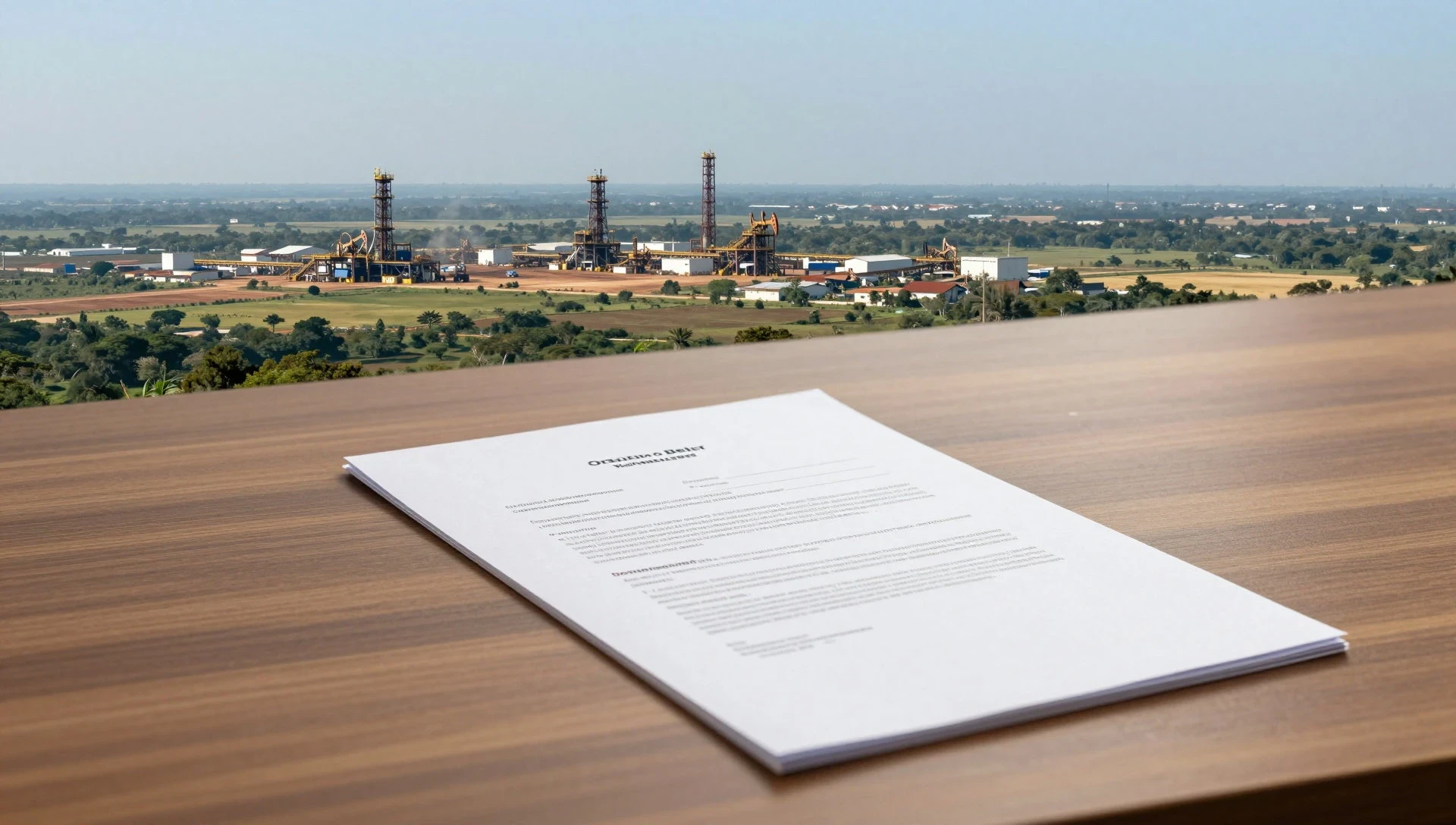
When ExxonMobil walked away from Venezuela in 2007, it left behind nationalized assets, a bitter arbitration docket, and one of the most consequential corporate exits in Latin American energy history. Nearly two decades later, the largest U.S. oil company has signed a memorandum of understanding with the Venezuelan government and its state oil company, PDVSA, to examine potential exploration and production opportunities. The agreement is non-binding by design, a cautious first step rather than a commitment, yet its symbolic weight is considerable: it signals that Caracas is actively courting the very majors it once expelled, and that Washington's largest energy player is at least willing to listen.
The backdrop matters enormously. Venezuela amended its petroleum law this year to attract foreign operators, granting private companies greater operational control within partnerships and reforming the tax and royalty regime that had long deterred investment. Chevron and Continental Resources have already expanded their presence, and ExxonMobil's memorandum places it alongside them in testing the waters. The timing is striking because as recently as earlier this year, ExxonMobil CEO Darren Woods described Venezuela as "uninvestable" during a White House meeting. By last month, his language had softened: progress on fiscal and legal rules and investor protections was real, he suggested, but more work remained.
What follows is a close reading of this agreement, its historical roots, and its strategic implications. The analysis examines the legal architecture Venezuela has rebuilt, the arbitration legacy that still shadows the relationship, the geological prize of the Orinoco Belt, and the regional rivalry with Guyana that complicates any return. It also weighs the methane intensity problem that energy analysts flag and the conditions ExxonMobil has publicly attached to any future capital deployment. The core message is one of conditional re-engagement: a memorandum of understanding is not a contract, and in Venezuela's case, the distance between the two has historically been measured in billions of dollars and years of litigation.
On This Page
TL;DR ExxonMobil has signed a non-binding memorandum of understanding with Venezuela and PDVSA to explore potential oil and gas opportunities, marking a tentative first step after its 2007 exit and years of international arbitration. Venezuela's amended petroleum law offers private operators more control and reformed taxes and royalties, drawing Chevron and Continental Resources back as well. ExxonMobil conditions any investment on stable policies, clear regulation, strong protections, and competitive returns, while analysts point to the Orinoco Belt as the likely target despite high methane intensity. A U.S. court's September 2025 order requiring Venezuela to pay ExxonMobil more than $985 million for past expropriations remains a defining backdrop to the relationship.
The Anatomy of a Non-Binding Memorandum
A memorandum of understanding occupies a peculiar place in international commerce. It is a document that signals intent without creating enforceable obligation, a diplomatic handshake dressed in legal prose. In the oil industry, such instruments are routine precursors to production-sharing agreements, joint ventures, and exploration licenses, allowing both parties to explore technical and commercial fit before committing capital. For ExxonMobil, the memorandum with Venezuela and PDVSA functions as a low-risk probe: it opens channels of communication, permits data exchange, and tests whether Caracas can deliver the institutional stability the company has demanded publicly.
The distinction between a memorandum and a binding contract is not academic in Venezuela's case. The country's history with international oil companies includes contract renegotiations, asset seizures, and protracted arbitration, all of which have taught majors to treat early-stage documents with disciplined skepticism. ExxonMobil's own language reflects this: any future investment, the company stated, would depend on stable policies, clear regulations, strong investment protections, and competitive returns. Those four conditions are effectively a checklist against which Caracas will be measured, and each one carries the weight of past disappointment.
Why the Legal Form Matters
Non-binding instruments preserve optionality. They allow a company to withdraw without penalty if political conditions deteriorate, and they allow a government to claim progress without conceding terms. For Venezuela, the memorandum is a signaling device to other majors and to international creditors, demonstrating that the investment climate is being repaired. For ExxonMobil, it is a hedge: a seat at the table in a country holding the world's largest proven oil reserves, acquired at minimal cost and with no capital at risk until conditions are verified.
The structure also protects ExxonMobil's negotiating position in ongoing arbitration and enforcement proceedings. Engaging commercially while litigation continues is a familiar pattern in resource-rich states emerging from expropriation disputes. The company can pursue recovery of past damages through the courts while simultaneously exploring future profits, treating the two tracks as separate ledgers. That separation is legally clean and strategically useful, allowing dialogue without implying forgiveness of the $985 million judgment ordered in September 2025.
The Conditions ExxonMobil Has Set
Stable policies, clear regulations, strong investment protections, and competitive returns form a compact but demanding framework. Stability implies durability beyond a single administration, a difficult promise in a country whose petroleum law has been rewritten repeatedly. Clear regulation means transparent licensing rounds and predictable fiscal terms. Investment protections evoke bilateral treaties, international arbitration clauses, and OPEC-style stabilization mechanisms. Competitive returns require that Venezuela's take, through taxes and royalties, leave enough margin to justify the risk premium that lenders and shareholders will demand.
Each condition maps onto a specific historical grievance. The 2004 contract renegotiations under Hugo Chávez and the subsequent nationalization of ExxonMobil's assets illustrate the stability problem. The arbitration saga illustrates the protection problem. The reformed petroleum law, which grants private operators more control and adjusts taxes and royalties, addresses the returns problem on paper. Whether paper translates into practice will determine whether the memorandum matures into a binding agreement or joins the archive of stalled intentions.
The Long Shadow of Expropriation
ExxonMobil operated in Venezuela for much of the twentieth century, building infrastructure, training workforces, and extracting crude from fields that helped define the modern oil industry. That relationship soured decisively beginning in 2004, when then-President Hugo Chávez renegotiated contracts with international oil companies and ordered the nationalization of ExxonMobil's assets. The company departed in 2007 and has since pursued international arbitration, a legal campaign that culminated in September 2025 when a U.S. court ordered Venezuela to pay ExxonMobil more than $985 million for past expropriations. That judgment is not a footnote; it is the financial baseline against which any new investment must be assessed.
The arbitration record shapes negotiating behavior on both sides. For ExxonMobil, it demonstrates that legal recourse exists and that claims can be enforced through U.S. courts, a form of leverage that strengthens its hand in commercial discussions. For Venezuela, the judgment represents a liability that complicates sovereign financing and signals to other investors that expropriation carries lasting costs. The memorandum does not resolve this legacy, nor is it intended to. It creates a parallel channel through which future cooperation can be explored while the past remains contested in courtrooms.
Arbitration as Negotiating Leverage
International arbitration in the oil sector is slow, expensive, and consequential. Awards can be enforced against sovereign assets in jurisdictions worldwide, and they influence creditworthiness, lending terms, and the willingness of export credit agencies to support trade. Venezuela's outstanding obligations to ExxonMobil and other claimants function as a discount rate applied to any new project: investors demand higher returns to compensate for the risk that history repeats. The memorandum implicitly acknowledges this dynamic by placing commercial exploration alongside unresolved legal claims rather than after their settlement.
For ExxonMobil, the calculus is straightforward. Recovering past damages and securing future profits are complementary objectives, not competing ones. A commercial presence in Venezuela could, over time, create conditions in which settlement becomes more attractive to Caracas, while continued enforcement preserves the company's leverage. This dual-track approach is common among majors operating in countries with contested expropriation histories, and it explains why a non-binding memorandum can coexist comfortably with a nine-figure court judgment.
What Caracas Gains From Re-engagement
Venezuela's incentives are equally clear. Foreign capital and technical expertise are essential to arresting the long decline in oil output, and the amended petroleum law is designed to attract exactly the kind of operator that once left. Chevron and Continental Resources have already expanded their presence, and ExxonMobil's memorandum adds the credibility of the largest U.S. oil company to the reform narrative. Each additional major strengthens Caracas's argument that the investment climate has genuinely changed, which in turn supports negotiations with creditors and multilateral institutions.
The political economy is delicate. Re-engagement with companies once expelled requires domestic justification, and the government must balance nationalist sentiment against the fiscal reality of underinvestment. The reformed law, which grants private operators more control and adjusts taxes and royalties, represents a pragmatic concession. Whether it survives political pressure is an open question, and that uncertainty is precisely what ExxonMobil's condition of "stable policies" is designed to probe. A memorandum allows both sides to test intentions without binding commitments that could later become political liabilities.
The Orinoco Belt and the Methane Question
Energy analysts identify the Orinoco Belt as the most likely target of any renewed ExxonMobil interest. The belt holds some of the largest oil reserves on the planet, and ExxonMobil has worked there before, giving it institutional knowledge that few competitors can match. The crude is heavy, requiring upgrading and dilution, but the scale is transformative for a company seeking long-life assets. For Venezuela, the belt represents the core of its production ambitions, and foreign participation there would signal a genuine reopening rather than a symbolic gesture.
The geological prize comes with an environmental complication that has moved from the margins to the center of investment decisions. A professor who studies the oil industry noted that oil production in the Orinoco Belt has high methane levels, a potent greenhouse gas. Methane intensity is now a material factor in how majors allocate capital, affecting everything from shareholder engagement to access to capital markets. ExxonMobil's public climate commitments and its investors' expectations mean that any Orinoco project would face scrutiny over emissions performance, flaring, and leak detection.
Reserve Scale Versus Emissions Intensity
Heavy oil projects carry inherently higher emissions per barrel than conventional light crude, because extraction, upgrading, and transport require more energy. Methane leakage compounds the problem, since methane traps far more heat than carbon dioxide over short time horizons. For a company operating under investor pressure to reduce Scope 1 and Scope 2 emissions, the Orinoco Belt presents a tension between reserve replacement and climate performance. The memorandum's exploratory nature allows ExxonMobil to assess whether modern technology and operational discipline can narrow that gap before committing capital.
Venezuela's regulatory framework will determine much of the answer. Methane abatement requires equipment upgrades, monitoring systems, and enforcement, all of which depend on clear rules and reliable oversight. The reformed petroleum law's emphasis on private operational control could, in principle, allow operators to impose higher environmental standards than state-run facilities have historically achieved. Whether that potential is realized depends on the same institutional conditions ExxonMobil has identified as prerequisites, which is why the methane question is inseparable from the governance question.
Guyana as Strategic Context
ExxonMobil's large investments in neighboring Guyana provide essential context for any Venezuelan decision. Guyana has become a key emerging player in the international oil industry, with ExxonMobil at the center of its offshore development. The company therefore faces a portfolio question: why accept Venezuelan political risk when Guyanese production is expanding under a more predictable regime? The answer lies in scale, cost, and optionality. Orinoco reserves are vast, and a foothold there could complement rather than replace Guyanese output, provided the risk-adjusted returns clear the company's threshold.
The two countries share a long territorial dispute related to oil rights, which adds a geopolitical layer to commercial calculations. Essequibo, the contested region, has been the subject of renewed tension, and any ExxonMobil presence in Venezuela would sit awkwardly beside its Guyanese operations. The company must manage a diplomatic balancing act, maintaining constructive relations with Georgetown while exploring opportunities in Caracas. That tension is manageable but not trivial, and it reinforces the wisdom of a non-binding memorandum that preserves flexibility on all sides.
We Also Published
Reading the Political Signals
The memorandum arrives at a moment of unusual alignment between commercial and diplomatic interests. Earlier this year, ExxonMobil CEO Darren Woods attended a White House meeting where he described Venezuela as "uninvestable," a blunt assessment that reflected both legal risk and operational dysfunction. Last month, he said progress was being made on fiscal and legal rules and investor protections, but more work was needed. That evolution in language, from categorical rejection to conditional engagement, tracks the Venezuelan petroleum law's reform and the broader easing of U.S. policy toward Caracas.
Political signals in the oil industry are rarely accidental. A CEO's public characterization of a country's investment climate can move sovereign bond spreads, influence competitor behavior, and shape diplomatic conversations. Woods's shift therefore carries weight beyond ExxonMobil's internal planning. It tells Chevron, Continental Resources, and other majors that the largest U.S. player sees a credible path, while the explicit caveats preserve the option to retreat if reforms stall. The memorandum formalizes that posture, converting rhetoric into a documented, if non-binding, engagement.
Washington's Role in the Calculation
U.S. policy toward Venezuela conditions what American companies can legally do. Sanctions frameworks, licensing regimes, and Treasury guidance determine whether ExxonMobil can sign contracts, move equipment, and repatriate profits. The White House meeting and the subsequent softening of CEO language suggest that policy channels are opening, but the pace and scope remain uncertain. Any binding investment would require a stable legal foundation that only Washington and Caracas together can provide, which is why the memorandum's language emphasizes policy stability rather than technical feasibility.
The domestic political dimension is equally significant. Venezuela policy in Washington is contested, and sanctions relief can be reversed. ExxonMobil's caution reflects an awareness that commercial agreements can be rendered inoperable by a change in executive guidance. By keeping the arrangement non-binding, the company protects itself against policy reversal while positioning to move quickly if the opening persists. This is standard risk management in sanctioned or partially sanctioned jurisdictions, and it explains why the memorandum is framed as exploration rather than commitment.
Competitor Moves and First-Mover Dynamics
Chevron's continued presence and Continental Resources' expansion establish a competitive context. In a reopening market, early entrants can secure the best acreage and the most favorable terms, a dynamic that creates pressure on laggards. ExxonMobil's memorandum ensures it is not absent from the conversation, even if it moves slowly. The company's scale and technical capability give it leverage in negotiations, but its history in Venezuela also makes it a politically sensitive partner for Caracas, which must balance the benefits of ExxonMobil's capital against the symbolism of welcoming back a company it once expelled.
First-mover advantages in oil are real but bounded. Geology does not change, and a late entrant with superior technology can still compete for the same reserves. What early entrants gain is information: seismic data, reservoir performance, and relationships with regulators and partners. ExxonMobil's prior experience in the Orinoco Belt gives it a form of institutional memory that partially offsets its late return. The memorandum allows it to refresh that knowledge and assess whether the reformed framework delivers the operational control the new law promises.
- 01
- 02
- 03
- 04
Risk, Return, and the Path to a Binding Deal
The distance between a memorandum and a final investment decision is measured in due diligence, negotiation, and political endurance. ExxonMobil will need to verify reservoir performance, assess infrastructure condition, model fiscal terms under the reformed law, and stress-test political scenarios. Venezuela will need to demonstrate that the new petroleum law is implemented consistently, that contracts are honored, and that arbitration awards are addressed. Neither side has committed to a timetable, and the absence of one is itself informative: both parties prefer to preserve flexibility while conditions clarify.
Competitive returns remain the binding constraint. Oil majors allocate capital across a global portfolio, and Venezuela must compete with Guyana, Brazil, Namibia, and the Permian Basin for the same dollars. The risk-adjusted hurdle rate for a Venezuelan project will be high, reflecting political risk, legal uncertainty, and emissions intensity. For the project to proceed, the fiscal terms must be generous enough to clear that hurdle while still delivering acceptable revenue to Caracas. The reformed tax and royalty regime is the mechanism through which that balance is struck, and its details will determine whether the memorandum leads anywhere.
The Fiscal and Legal Hurdles
Venezuela's amended petroleum law grants private companies more operational control in partnerships and reforms taxes and royalties, but implementation matters more than statute. Licensing rounds, contract templates, dispute resolution clauses, and the reliability of PDVSA as a partner will all be tested. ExxonMobil's history with PDVSA includes the nationalization of assets, so trust must be rebuilt through demonstrated behavior rather than legal text. The company's public conditions, particularly strong investment protections, suggest it will seek international arbitration clauses and stabilization guarantees that insulate it from future legal changes.
The $985 million judgment adds a financial dimension to the negotiation. Venezuela's willingness to settle or restructure that obligation could serve as a confidence-building measure, signaling that past grievances will be addressed. Conversely, continued non-payment would reinforce skepticism about contract durability. ExxonMobil has not linked the memorandum to the judgment publicly, but the two tracks inevitably interact. A comprehensive resolution would strengthen the case for investment; an unresolved judgment would raise the risk premium applied to any new project.
Scenarios for the Years Ahead
Three broad scenarios frame the outlook. In the first, reforms hold, sanctions ease, and the memorandum matures into exploration agreements, with ExxonMobil eventually committing capital to the Orinoco Belt. In the second, political or policy reversals stall progress, and the memorandum expires without a binding follow-on, leaving the arbitration judgment as the dominant legacy. In the third, partial progress occurs: limited technical cooperation and data sharing continue, but major capital remains deferred pending clearer institutional guarantees. The third scenario is arguably the most likely, given the gap between reform on paper and implementation in practice.
Each scenario carries implications beyond ExxonMobil. A successful return would encourage other majors, accelerate Venezuela's production recovery, and reshape Caribbean energy geopolitics. A stalled process would reinforce the country's isolation and complicate its sovereign financing. Partial progress would preserve optionality for all parties while leaving the fundamental questions unresolved. The memorandum's significance lies less in what it commits than in what it reveals: a major oil company is willing to re-engage, conditionally, with a country it once wrote off as uninvestable.
What the Agreement Reveals About Energy Geopolitics
ExxonMobil's memorandum is a small document with large implications. It demonstrates that the global oil industry's assessment of Venezuela is shifting, however cautiously, from categorical avoidance to conditional engagement. That shift reflects changes in Caracas, where the petroleum law has been rewritten to attract foreign capital, and in Washington, where policy toward Venezuela has become more transactional. It also reflects the structural reality that the world's largest reserves cannot remain indefinitely off-limits to the companies best equipped to develop them, especially as demand for long-life assets persists.
The agreement also illustrates how majors manage political risk in an era of sanctions and energy transition. Non-binding instruments, staged commitments, and explicit public conditions allow companies to participate in reopening markets without exposing shareholders to irreversible losses. ExxonMobil's approach, combining a memorandum with continued arbitration enforcement, is a template that other firms may follow in Venezuela and elsewhere. The company is neither embracing nor rejecting the country; it is pricing the risk and preserving the option to act if the price becomes right.
Implications for the Global Oil Map
Venezuela's re-emergence would alter the Western Hemisphere's oil map. Additional barrels from the Orinoco Belt would compete with Guyanese and Brazilian crude, influence OPEC dynamics, and affect refining economics in the U.S. Gulf Coast, where heavy crude is in demand. ExxonMobil's participation would lend technical credibility to Venezuela's production ambitions and could accelerate the rehabilitation of degraded infrastructure. The scale of the reserves means that even modest recovery would be globally significant, though the timeline would be measured in years rather than months.
The energy transition adds a further layer. As majors balance hydrocarbon investment against decarbonization commitments, heavy oil projects with high methane intensity face heightened scrutiny. Venezuela's ability to attract capital will depend partly on whether operators can demonstrate credible emissions management. The professor's observation about methane levels in the Orinoco Belt is therefore not a technical footnote but a commercial variable, one that could tilt investment toward lower-intensity jurisdictions if Venezuelan governance does not support robust environmental performance.
The Verdict on Conditional Re-engagement
The memorandum's core message is that re-engagement is possible but not assured. ExxonMobil has reopened a door it closed in 2007, but it has done so with conditions that Venezuela has not yet fully met. The $985 million judgment, the methane challenge, the Guyana rivalry, and the durability of the petroleum law all remain unresolved. What has changed is the direction of travel: a company that called Venezuela uninvestable is now willing to study the question, and a government that once expelled it is now courting its return.
For observers of energy markets, the agreement is a reminder that political risk is dynamic rather than fixed. Countries can reform, companies can reconsider, and relationships once thought permanently broken can be rebuilt incrementally. The memorandum is not a return; it is an inquiry. But in the oil industry, inquiries sometimes become investments, and investments sometimes reshape the geopolitical landscape. Whether this one does will depend on the same factors ExxonMobil has named: stable policies, clear regulations, strong protections, and competitive returns.
Also Read
- The Third Chengdu-Chongqing Theatre Twin City Festival: Where Regional Ambition Meets the Stage
- China Executes Canadians: A Comedy of Errors and Executions: Navigating the Dragon’s Labyrinth of Justice – Ottawa Condemns the Action
- October Dividend Dates and Market Signals on the Athens Stock Exchange
From our network :
- Live Online English Classes for Kids: Do They Actually Reduce Anxiety?A ten-week study reveals that synchronous online English classes can significantly reduce child language anxiety while improving listening and reading skills. Discover what makes these programs effective and how parents can select the right one.
- How AI Agents Will Change the Way We Manage Personal FinancesExplore how AI agents are transforming personal finance through automated budgeting, bill payment, and investment management, while examining the critical security protocols and governance frameworks required for safe deployment.
- The Final Descent: How ESA Retired the Legendary Cluster Constellation After 24 Years of Space Weather ScienceAfter 24 years mapping Earth’s magnetosphere, ESA’s Cluster mission concluded with a precisely controlled reentry over the South Pacific. This analysis explores the scientific legacy, engineering decisions, and debris mitigation principles behind one of space exploration’s most responsible retirements.
- Committed Mediterranean Precipitation Decline: Why Emissions Cuts Alone Cannot Restore Winter RainsNew NOAA research reveals that Mediterranean winter rains may decline irreversibly even with emissions cuts. Explore the science of committed climate change and regional impacts.
- The Hidden Cost of AI Convenience: Why Over-Permissioned Agents Are a Security Time BombDiscover why AI agents with excessive permissions create dangerous single points of failure, and learn how implementing least privilege principles can protect your organization from exploitation.
- CISA’s Ten-Advisory Wave: Why Generic Patching Fails in OT and How to Build Product-Specific PlaybooksCISA released ten ICS advisories in one week, exposing critical infrastructure risks. Generic patching fails in OT. Learn to build product-specific remediation playbooks.
- University Language Proficiency Exams: Why Institutional Tests Demand Different Preparation Than IELTS and TOEFLDiscover why university-specific language proficiency examinations differ fundamentally from IELTS and TOEFL, and learn strategic preparation approaches for institutional assessment success.
- Mobile Learning and VR in English: What Global Evidence Reveals About Effective Language TechnologyA systematic review across 14 countries reveals which language-learning technologies genuinely work. Mobile learning, AI, and VR show measurable benefits when pedagogically integrated. This evidence-based guide helps educators and learners select technology that delivers real return on investment.
- Forbidden Matrix Patterns and Visible Lattice Points: A Geometric DictionaryExplore how multidimensional 0–1 matrices encode geometric truths, linking forbidden patterns to visible lattice points and hypergraph theory, with applications in combinatorics and computational geometry.
RESOURCES
- Oil giant ExxonMobil left Venezuela years ago. Now it's considering ...houstonpublicmedia.org2 hours ago ... ExxonMobil has signed a memorandum of understanding with the Venezuelan government and its state-owned oil company to explore opportunities ...
- Oil giant ExxonMobil left Venezuela years ago. Now it's ... - NPRnpr.org7 hours ago ... ExxonMobil has signed a memorandum of understanding with the Venezuelan government and its state-owned oil company to explore opportunities ...
- Exxon advances talks to return to Venezuela's Orinoco Belt, sources ...reuters.comSep 16, 2026 ... The logo of American multinational oil and gas corporation ExxonMobil ... oil company PDVSA, among other topics. She loves animals…
- Pdvsa and ExxonMobil sign oil memorandum in Venezuelafacebook.com1 day ago ... Venezuela's state-owned oil company PDVSA and ExxonMobil signed a memorandum of understanding to ensure mutual benefits, economic momentum, ...
- Continental Signs Deal with PDVSA for Venezuelan Oil - LinkedInlinkedin.comSep 20, 2026 ... ... memorandum of understanding to a revitalized Venezuelan oil ... PDVSA to evaluate additional oilfields in the Orinoco Belt and…
- ExxonMobil signs Venezuela MoU but stops short of investment ...bnamericas.com1 day ago ... Houston-based oil company ExxonMobil has signed a memorandum ... PDVSA to take majority control of heavy oil projects in the…
- Crude Oil - Energy News Beatenergynewsbeat.coSep 16, 2026 ... Continental Resources signed a memorandum of understanding with Petróleos de Venezuela (PDVSA) on September 16 to operate and develop the ...
- ExxonMobil signs memorandum with PDVSA to assess oil ...energynews.pro23 hours ago ... ExxonMobil signs memorandum with PDVSA to assess oil opportunities in Venezuela ... Orinoco oil belt, along with areas neighboring the…
- ExxonMobil Opens Door to Venezuela Return With Preliminary ...energynow.com1 day ago ... Reuters reported in September that ExxonMobil had expressed interest in the Petromonagas heavy-oil project in Venezuela's Orinoco Belt, formerly ...
- Chevron speeds ahead in Venezuela while Exxon urges ... - Fortunefortune.comOct 31, 2026 ... ... memorandum of understanding with Venezuelan state oil company PDVSA to develop a major area in the prolific Orinoco Belt.…
- International Oil Majors Flock Back to Venezuela as Chevron Plans ...finance.biggo.comSep 21, 2026 ... ... PDVSA to develop the Ayacucho 2 block in the Orinoco Belt. According to Reuters confirmation, the memorandum was signed…
- ExxonMobil Eyes Return to Venezuela Under Post-US-Bombing ...orinocotribune.com12 hours ago ... She noted the Orinoco Belt's ... Filed under1966 Geneva Agreement Delcy Rodríguez Essequibo ExxonMobil Guyana Oil PDVSA US Imperialism Venezuela ...
- Exxon signs a preliminary agreement with Venezuela's PDVSA to ...mlq.ai1 day ago ... ExxonMobil signed a non-binding memorandum of understanding with Venezuela's state oil company PDVSA on Monday to evaluate upstream oil ...
- Fact Sheet: Arbitration between ExxonMobil and Venezuelavenezuelanalysis.comFeb 18, 2008 ... ... oil interests to the Venezuelan national oil company PDVSA. ... If taking into account the Orinoco Oil Belt, Venezuela…
- Oil giant ExxonMobil left Venezuela years ago. Now it's ... - WEMU.orgwemu.org7 hours ago ... ExxonMobil has signed a memorandum of understanding with the Venezuelan government and its state-owned oil company to explore opportunities ...
- 01
- 02
- 03
- 04
- 05
- 06
- 07
- 08
0 Comments