
Sonia Gandhi's decision to speak publicly about love and loss, in a conversation published by The New York Times, carries a significance that extends well beyond the ordinary rhythms of political journalism. For a figure who has spent decades inside the machinery of Indian public life, the choice to discuss private grief and personal attachment is neither incidental nor decorative. It signals a deliberate recalibration of how a famously reserved leader wishes to be understood, and it invites readers to consider the human being behind the institutional persona. The interview, dated to November 2026, arrives at a moment when the Congress party and the wider opposition landscape are being reassessed, making the timing as revealing as the content itself.
What makes the disclosure notable is the contrast it creates with the established public record. Sonia Gandhi has long been characterised by restraint, a quality that has defined her media posture since she entered politics in the late 1990s. Her rare interviews have tended to be tightly controlled, focused on party affairs, electoral strategy, or constitutional questions. A conversation centred on love and loss therefore represents a departure, one that reframes her legacy around emotional endurance rather than tactical manoeuvring. The New York Times, as the publishing outlet, lends the exchange an international readership and a framing that treats her as a global political figure rather than a domestic operator alone.
This analysis examines the layered meanings embedded in that brief report and the broader context it activates. It considers how personal narrative functions as political communication, why grief has become a legitimate register for public figures, and what the international platform implies about India's place in global media attention. It also weighs the limits of the available information, since the original report offered only a summary rather than extensive quotations. The aim is to read the signal carefully without overstating what the record supports, and to situate a single interview within the longer arc of a remarkable public life.
On This Page
- The Significance of a Rare Public Reflection
- The Choice of The New York Times as a Platform
- Love, Loss, and the Emotional Grammar of Political Dynasties
- Reading the Timing: Politics, Succession, and Public Mood
- Media Ethics and the Reporting of Personal Grief
- What the Interview Reveals About Legacy and Memory
TL;DR Sonia Gandhi's interview with The New York Times, in which she discusses love and loss, marks a meaningful shift in how a reserved political figure presents herself to the world. The conversation moves beyond electoral commentary into the terrain of personal grief, memory, and emotional resilience, using an international platform to reframe her public identity. This analysis explores the political function of personal disclosure, the symbolism of the chosen outlet, and the careful boundaries that still govern what is revealed and what remains withheld. The report is brief, but its implications for how leaders communicate vulnerability are substantial.
The Significance of a Rare Public Reflection
Public figures rarely speak about grief without calculation, and Sonia Gandhi's willingness to do so reflects a considered judgment about what her audience now needs to hear. The interview, as reported, places love and loss at its centre rather than treating them as asides to political questions. That editorial choice matters because it positions her as a witness to personal history rather than merely a participant in partisan contests. For readers accustomed to seeing her through the lens of party politics, the shift invites a different kind of attention, one that foregrounds endurance, memory, and the emotional cost of a life lived in the public eye.
The Contrast With Her Established Public Persona
Her career has been defined by a distinctive form of reticence. She entered politics reluctantly after the assassination of her husband, Rajiv Gandhi, in 1991, and she has consistently guarded her interior life from journalistic scrutiny. Interviews have been infrequent and carefully bounded, usually serving party purposes or addressing constitutional crises. Against that backdrop, a conversation devoted to love and loss reads as a genuine opening rather than a routine media appearance. The restraint that once protected her privacy now gives the disclosure its weight, because words from a reserved person carry more force than confessions from someone habitually voluble.
This contrast also shapes how the interview will be received across India's fragmented media landscape. Supporters may read it as evidence of depth and authenticity, a leader willing to acknowledge the human cost of her family's history. Critics may interpret it as a strategic softening ahead of future political moments. Both readings are plausible, and neither can be dismissed outright. What remains clear is that the interview alters the texture of her public image, adding a register of vulnerability to a profile long dominated by stoicism, and that alteration is difficult to reverse once it has entered the record.
Why Personal Disclosure Resonates in Contemporary Politics
Across democracies, leaders have increasingly discovered that emotional candour can function as a form of credibility. Voters saturated with policy language often respond more readily to accounts of loss, family, and resilience, because such narratives signal shared humanity. Sonia Gandhi's discussion of love and loss fits within this broader pattern, though it arrives late in a long career rather than as an early branding exercise. The effect is to humanise an institution as much as an individual, reminding audiences that political dynasties are also families marked by violence, mourning, and the burden of inheritance.
The resonance is amplified by the specific history her name carries. The Gandhi family's story includes two assassinations, years of security threats, and persistent personal danger, facts that give any discussion of loss an unavoidable gravity. When she speaks of love, readers will inevitably connect it to a marriage cut short and to the protective bonds formed around her children and grandchildren. The interview therefore does not need explicit detail to be powerful; the context supplies the emotional architecture, and her willingness to name the themes at all is sufficient to activate public reflection on sacrifice and survival.
We Also Published
The Choice of The New York Times as a Platform
Where a leader chooses to speak matters as much as what is said, and the selection of The New York Times signals an intent to reach beyond domestic audiences. The newspaper's global readership includes policymakers, diplomats, and analysts who shape international perceptions of India. By granting access to such an outlet, Sonia Gandhi positions her reflections within a conversation about leadership and legacy that transcends electoral cycles. The platform also imposes its own framing conventions, favouring narrative depth and personal texture over the transactional exchanges typical of political briefings, which in turn shapes how the themes of love and loss are presented to readers.
International Media and the Construction of Legacy
Global outlets have long played a role in how national figures are remembered outside their own borders. A profile in a major American newspaper can crystallise a reputation for international audiences, distilling decades of public life into a coherent narrative. For Sonia Gandhi, whose career has been extensively covered abroad, such a platform offers an opportunity to shape that distillation on her own terms. The emphasis on love and loss suggests a desire to be remembered as a person shaped by family and tragedy, not solely as a party president or parliamentary leader whose tenure is measured in seats won and lost.
This legacy-building function is especially relevant given the generational transition underway in Indian politics. As leadership passes to younger figures, including her own children, the elder stateswoman's reflections acquire the quality of testimony. International publication lends that testimony durability, archiving it in a venue that researchers and historians will consult long after the news cycle has moved on. The interview thus functions simultaneously as journalism and as a primary source, a dual status that few domestic appearances can achieve and that explains why the choice of outlet deserves careful attention.
What the Report Leaves Unsaid
The available report is notably sparse, offering a summary rather than extensive quotations or detailed context. It confirms that the interview exists, identifies its themes, and names the publication, but it does not reproduce the specific reflections on love and loss that give the conversation its emotional charge. This brevity is itself instructive. It reminds readers that secondary summaries inevitably flatten complex conversations, and it cautions against drawing firm conclusions about tone, emphasis, or intent from a compressed account. The responsible response is to treat the report as a pointer toward the original interview rather than a substitute for it.
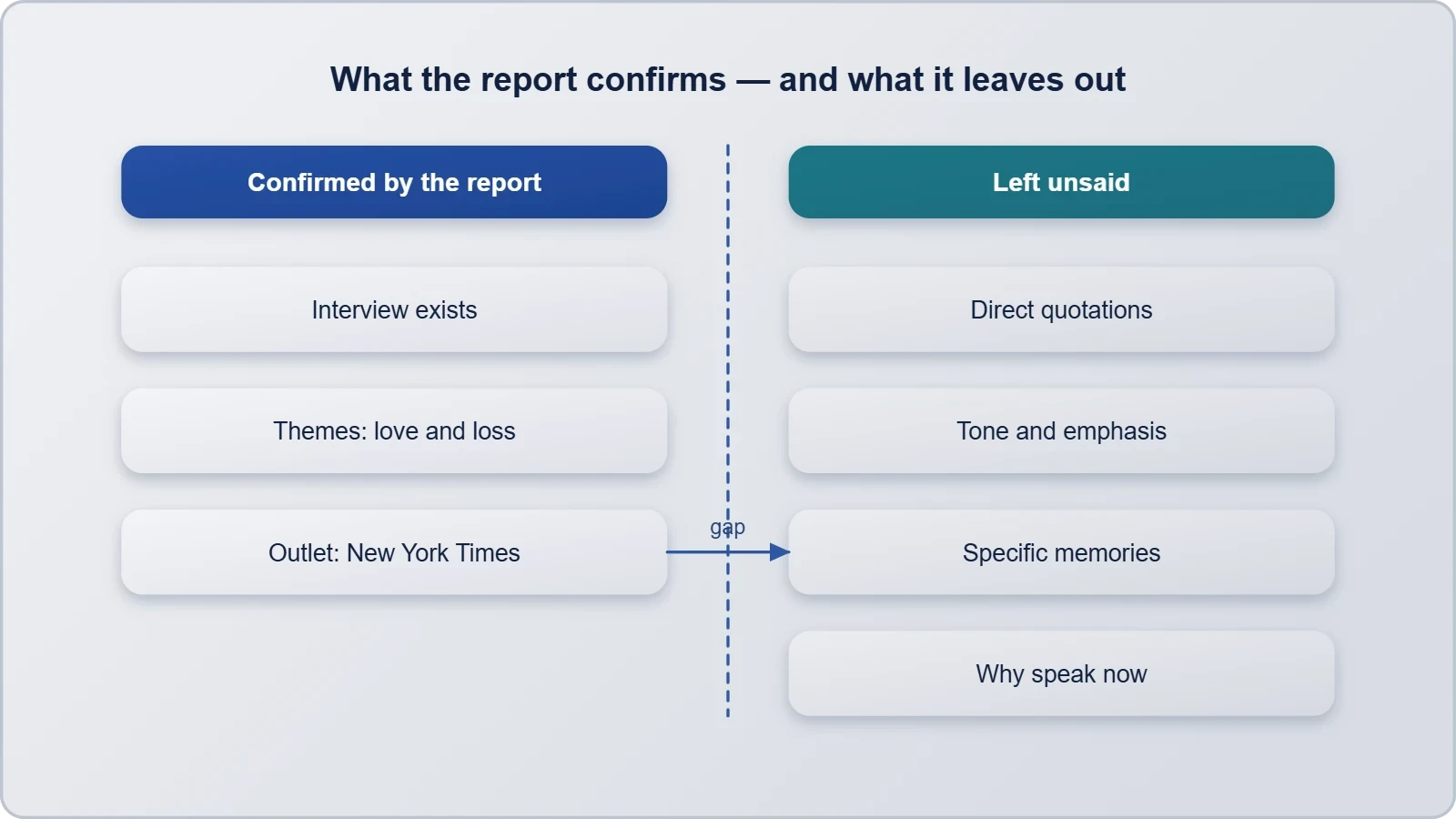
The gaps also highlight how information travels in a fragmented media environment. A single sentence in a wire-style summary can generate commentary far exceeding the substance of the original text, with interpretations multiplying faster than verification. Readers encountering the story through aggregators may never see the full conversation, yet they will form impressions based on the summary alone. Recognising this dynamic encourages a more disciplined approach, one that distinguishes between what is documented and what is inferred, and that resists the temptation to over-read a deliberately brief report.
Love, Loss, and the Emotional Grammar of Political Dynasties
Political dynasties carry an emotional grammar that shapes how their members speak and are heard. In families marked by assassination and sustained threat, love and loss are not abstract themes but organising principles of daily life. Sonia Gandhi's willingness to name them publicly invites reflection on how such families convert private grief into public purpose. The interview, as summarised, does not dwell on specifics, yet the mere articulation of these themes connects her story to a wider human experience of bereavement, one that audiences across cultures recognise and to which they respond with attention and, often, sympathy.
Grief as a Shared Language
Loss is among the few experiences that translate across borders without much mediation. A leader who speaks of love and mourning reaches audiences who may know little about Indian party politics but understand the contours of bereavement intimately. This universality gives the interview a reach that policy discussions rarely achieve. It also creates a risk, since public grief can be read as performance if it appears calculated. The credibility of such disclosure depends on consistency, on whether the emotional register is sustained in other contexts or confined to a single carefully staged appearance.
The shared language of grief also carries political implications. When a figure associated with a powerful dynasty speaks of loss, it can soften perceptions of privilege and remind audiences of the costs borne by those who enter public life. That softening may be welcomed by supporters and viewed sceptically by opponents, but its cultural resonance is difficult to deny. The interview thus operates on two levels at once, addressing individual memory and collective sentiment, and its effectiveness depends on how gracefully it moves between the two without appearing to instrumentalise either.
The Boundaries of Disclosure
Even in a conversation about love and loss, boundaries remain. The report does not indicate how far the discussion ventured into specific family history, and it is reasonable to assume that certain subjects remained off limits. This selectivity is not inconsistency but a form of editorial control, allowing a public figure to acknowledge emotional truth while protecting the privacy of relatives and the dignity of the deceased. The result is a calibrated disclosure, one that offers enough to satisfy curiosity and establish authenticity while withholding the detail that would convert reflection into spectacle.
Such calibration reflects a broader ethic of public communication in which vulnerability is shared without becoming exposure. For a leader of Sonia Gandhi's generation and temperament, this balance is especially delicate, since her privacy has been hard-won and repeatedly threatened. The interview's emphasis on themes rather than particulars may therefore be read as a considered choice, one that honours the emotional weight of her history without surrendering it to the demands of a media culture that rewards revelation over restraint. That restraint, paradoxically, may be what makes the disclosure credible.
- 01
- 02
- 03
- 04
Reading the Timing: Politics, Succession, and Public Mood
Timing is rarely accidental in political communication, and the publication of this interview in late 2026 invites scrutiny of the surrounding context. India's political calendar, the internal dynamics of the Congress party, and the broader debate about generational succession all provide a backdrop against which the conversation acquires additional meaning. A reflective interview can serve multiple purposes at once, offering personal testimony while subtly shaping perceptions of continuity and change within the organisation she has led. The themes of love and loss may therefore be read alongside, rather than instead of, the strategic considerations that accompany any major media appearance.
Succession and the Weight of Inheritance
Discussions of love and loss inevitably raise questions about inheritance, both emotional and political. For a family that has supplied multiple generations of leadership, the transmission of values and responsibility is a persistent theme. An interview that foregrounds personal bonds may implicitly address the question of what is passed down and what is carried forward, even without explicit commentary on succession. Readers attuned to dynastic politics will find in such reflections a subtext about continuity, about the burdens placed on younger family members, and about the emotional costs of a vocation that is often inherited rather than chosen.
The interview also arrives as the party navigates its own transitions, with younger leaders assuming greater visibility and older figures considering their roles. In this environment, a senior stateswoman's reflections on love and loss can function as a gentle framing device, situating present arrangements within a longer story of sacrifice and commitment. Whether or not such framing is intentional, it shapes how audiences interpret the party's evolution, lending emotional depth to what might otherwise appear as routine organisational change and reminding observers that political institutions are sustained by human relationships.
Public Mood and the Appetite for Sincerity
Contemporary audiences display a marked appetite for sincerity, often rewarding leaders who appear to speak without calculation. This appetite coexists with a deep suspicion of staged emotion, creating a narrow path that public figures must navigate. Sonia Gandhi's long record of reticence may serve her well here, since audiences tend to credit candour more readily when it comes from someone not known for performative disclosure. The interview's focus on love and loss thus aligns with a cultural moment that values authenticity, even as it tests whether that authenticity can be sustained beyond a single conversation.
The public mood also varies across audiences. Domestic readers may interpret the interview through the lens of party politics and family legacy, while international readers may encounter it as a human-interest story about endurance and memory. These divergent readings do not contradict one another; they simply reflect the multiple frames through which any prominent figure is understood. The interview's durability will depend on whether it enriches both frames, offering domestic audiences a deeper sense of purpose and international audiences a compelling account of a life marked by both privilege and profound loss.
Media Ethics and the Reporting of Personal Grief
The reporting of personal grief raises ethical questions that deserve careful attention. When a public figure discusses love and loss, journalists must balance the public's interest in understanding its leaders against the individual's right to privacy and dignity. The summary under consideration illustrates the tension well, offering just enough detail to inform readers while declining to speculate about matters the original interview may have addressed in confidence. This restraint is commendable, though it also leaves audiences with an incomplete picture, highlighting the inherent difficulty of reporting on emotional subjects without either sensationalising them or reducing them to bare facts.
Verification and the Limits of Summary
Verification remains the cornerstone of responsible reporting, and summaries that omit direct quotations place a premium on trust in the original outlet. Readers encountering the story second-hand cannot independently assess tone, emphasis, or context, which makes the reputation of the publishing newspaper a crucial guarantor of accuracy. The New York Times carries substantial institutional credibility, and its involvement lends the report a reliability that anonymous aggregation cannot match. Even so, the gap between a full interview and a compressed summary is where misunderstanding flourishes, and ethical reporting requires acknowledging that gap rather than papering over it.
The limits of summary also affect how the subject is portrayed. A conversation spanning many topics may be reduced to a single theme, and that reduction can distort the overall balance of the exchange. In this case, the emphasis on love and loss may reflect the original interview's structure, or it may reflect the summariser's judgment about what is most newsworthy. Without access to the full text, readers cannot know, and responsible commentary should therefore avoid asserting what the interview did or did not cover beyond what the report explicitly states.
Dignity, Privacy, and the Public Interest
Public interest does not automatically override personal dignity, and the reporting of grief requires particular care. Families that have endured violence and loss are entitled to protection from gratuitous scrutiny, even when their members occupy prominent positions. The summary's refusal to elaborate on specifics may therefore be read as an ethical choice, one that respects the boundaries the interview itself may have established. This approach contrasts with more intrusive styles of coverage that treat emotional detail as a commodity, and it suggests a model of reporting in which restraint is understood as a form of respect rather than a failure of completeness.
Privacy, moreover, is not a simple binary. A public figure may choose to discuss certain aspects of personal experience while withholding others, and ethical reporting honours those choices rather than circumventing them. The themes of love and loss can be addressed meaningfully without disclosing intimate particulars, and audiences are capable of engaging with emotional truth at that level of abstraction. Recognising this capacity encourages a form of journalism that informs without exploiting, and it affirms that the most respectful coverage is often the most durable, because it preserves the trust on which future disclosures depend.
What the Interview Reveals About Legacy and Memory
Legacy is rarely settled in a single conversation, but interviews of this kind contribute to its gradual formation. By choosing to discuss love and loss, Sonia Gandhi adds a dimension to a public record that has often been dominated by political events and institutional roles. The themes she raises invite audiences to consider her life as a whole, encompassing marriage, motherhood, widowhood, and the unexpected assumption of leadership. This holistic framing does not erase political controversy, but it situates it within a human story that is more complex and more sympathetic than partisan accounts typically allow.
The Personal as Historical Record
Personal testimony has long served as a valuable supplement to official histories, capturing the emotional and domestic dimensions that institutional records omit. An interview of this sort becomes part of that informal archive, preserving reflections that might otherwise remain private. For future historians, such material offers insight into how a prominent figure understood her own experience, including the interplay between public duty and private grief. The value lies not in revelation for its own sake but in the texture it adds to the historical record, allowing later readers to encounter a leader as a person shaped by circumstance and feeling.
The interview also contributes to a broader cultural conversation about how nations remember their political families. India's relationship with the Nehru-Gandhi dynasty is complex, encompassing admiration, criticism, and a persistent fascination with its sacrifices. Reflections on love and loss feed that conversation, offering a human counterpoint to the often polarised debates about dynasty and merit. Whether such contributions clarify or complicate public understanding depends on how they are received, but their presence in the record ensures that the emotional history of political life is not entirely eclipsed by analysis of strategy and power.
Enduring Questions and Open Threads
Several questions remain open, and their persistence is part of what makes the interview significant. How far did the conversation venture into specific memories? What prompted the decision to speak now, and to this outlet? Will the themes of love and loss inform future public statements, or was this a singular reflection? These questions cannot be answered from the available summary, and speculation would exceed the evidence. What can be said is that the interview has opened a door, and the way it is followed will determine whether the disclosure becomes a lasting element of her public identity or a brief departure from established form.
The open threads also invite a broader reflection on how publics engage with leaders' emotional lives. Audiences are not passive recipients of such disclosures; they interpret, debate, and remember them in ways that shape political culture over time. An interview about love and loss may thus have effects that extend well beyond its immediate reception, influencing how future leaders approach the question of vulnerability and how citizens evaluate the authenticity of those who govern. The conversation, brief as its summary may be, participates in that longer negotiation between private feeling and public expectation.
The interview, as reported, ultimately functions as an invitation rather than a conclusion. It asks audiences to consider a long public life through the lens of love and loss, and in doing so it reminds us that political figures are also people whose choices are shaped by affection, bereavement, and memory. Whether or not one agrees with her politics, the willingness to speak in these terms adds a layer to the historical record that partisan commentary rarely supplies. The full conversation, available through the original publication, will determine how far that invitation is accepted and how enduring its effects prove to be.
From our network :
- Live Online English Classes for Kids: Do They Actually Reduce Anxiety?A ten-week study reveals that synchronous online English classes can significantly reduce child language anxiety while improving listening and reading skills. Discover what makes these programs effective and how parents can select the right one.
- Committed Mediterranean Precipitation Decline: Why Emissions Cuts Alone Cannot Restore Winter RainsNew NOAA research reveals that Mediterranean winter rains may decline irreversibly even with emissions cuts. Explore the science of committed climate change and regional impacts.
- How AI Agents Will Change the Way We Manage Personal FinancesExplore how AI agents are transforming personal finance through automated budgeting, bill payment, and investment management, while examining the critical security protocols and governance frameworks required for safe deployment.
- University Language Proficiency Exams: Why Institutional Tests Demand Different Preparation Than IELTS and TOEFLDiscover why university-specific language proficiency examinations differ fundamentally from IELTS and TOEFL, and learn strategic preparation approaches for institutional assessment success.
- Mobile Learning and VR in English: What Global Evidence Reveals About Effective Language TechnologyA systematic review across 14 countries reveals which language-learning technologies genuinely work. Mobile learning, AI, and VR show measurable benefits when pedagogically integrated. This evidence-based guide helps educators and learners select technology that delivers real return on investment.
- Forbidden Matrix Patterns and Visible Lattice Points: A Geometric DictionaryExplore how multidimensional 0–1 matrices encode geometric truths, linking forbidden patterns to visible lattice points and hypergraph theory, with applications in combinatorics and computational geometry.
- The Final Descent: How ESA Retired the Legendary Cluster Constellation After 24 Years of Space Weather ScienceAfter 24 years mapping Earth’s magnetosphere, ESA’s Cluster mission concluded with a precisely controlled reentry over the South Pacific. This analysis explores the scientific legacy, engineering decisions, and debris mitigation principles behind one of space exploration’s most responsible retirements.
- CISA’s Ten-Advisory Wave: Why Generic Patching Fails in OT and How to Build Product-Specific PlaybooksCISA released ten ICS advisories in one week, exposing critical infrastructure risks. Generic patching fails in OT. Learn to build product-specific remediation playbooks.
- The Hidden Cost of AI Convenience: Why Over-Permissioned Agents Are a Security Time BombDiscover why AI agents with excessive permissions create dangerous single points of failure, and learn how implementing least privilege principles can protect your organization from exploitation.
RESOURCES
- In Interview, Sonia Gandhi Recalls Love and Loss in Indianytimes.com23 hours ago ... ... New Delhi home, where a portrait of Mahatma Gandhi is displayed. Credit...Saumya Khandelwal for The New York Times. And…
- Today's Headlines: The Woman in the Middle of Nvidia's Spy Scandalmessaging-custom-newsletters.nytimes.com3 hours ago ... Sonia Gandhi on Love, Loss and the Convulsive History of Modern India. In a new memoir and interview, the Italian-born…
- World News - Page 8 - The New York Times Internationalnytimes.comSonia Gandhi on Love, Loss and the Convulsive History of Modern India. In a new memoir and interview, the Italian-born woman who married into…
- Here is an excerpt from CPP Chairperson Smt. @SoniaGandhi ji's ...facebook.com10 hours ago ... ... India. NYTIMES.COM. In Interview, Sonia Gandhi Recalls Love and Loss in India. In a new memoir and interview, the…
- Free Expert Advice for Rahul Gandhi - The New York Timesarchive.nytimes.comJan 25, 2013 ... I think the Congress party's problem is that their three top leaders — Sonia Gandhi, Manmohan Singh and Rahul Gandhi…
- Sonia Gandhi tells of love and loss as India's Congress fights backmyrepublica.nagariknetwork.com1 day ago ... Republica logo with New York Times association. Politics · Economy ... NEW DELHI, Nov 10: Sonia Gandhi went from a…
- suhasini raj on X: "Sonia Gandhi on Love, Loss and the Convulsive ...x.com16 hours ago ... Sonia Gandhi on Love, Loss and the Convulsive History of Modern India In a new memoir and interview, the Italian-born…
- Here is an excerpt from CPP Chairperson Smt. @soniagandhi ji's ...instagram.com8 hours ago ... ... soniagandhi ji's memoir, Belonging: A Journey of Love, featured in The New York Times on November 10. In this…
- Sonia Gandhi's memoir reveals untold stories of a political dynastyapnews.comAug 18, 2026 ... Sonia Gandhi's memoir to revisit love, loss and her decision to decline India's top job ... NEW YORK (AP) —…
- New Adult Nonfiction - Broadway Booksbroadwaybooks.netBelonging: A Journey of Love · Sonia Gandhi. Current price: $38.00. Hardcover ... A New York Times Bestseller * A BEST BOOK OF THE…
- 01
- 02
- 03
- 04
- 05
- 06
- 07
- 08
0 Comments