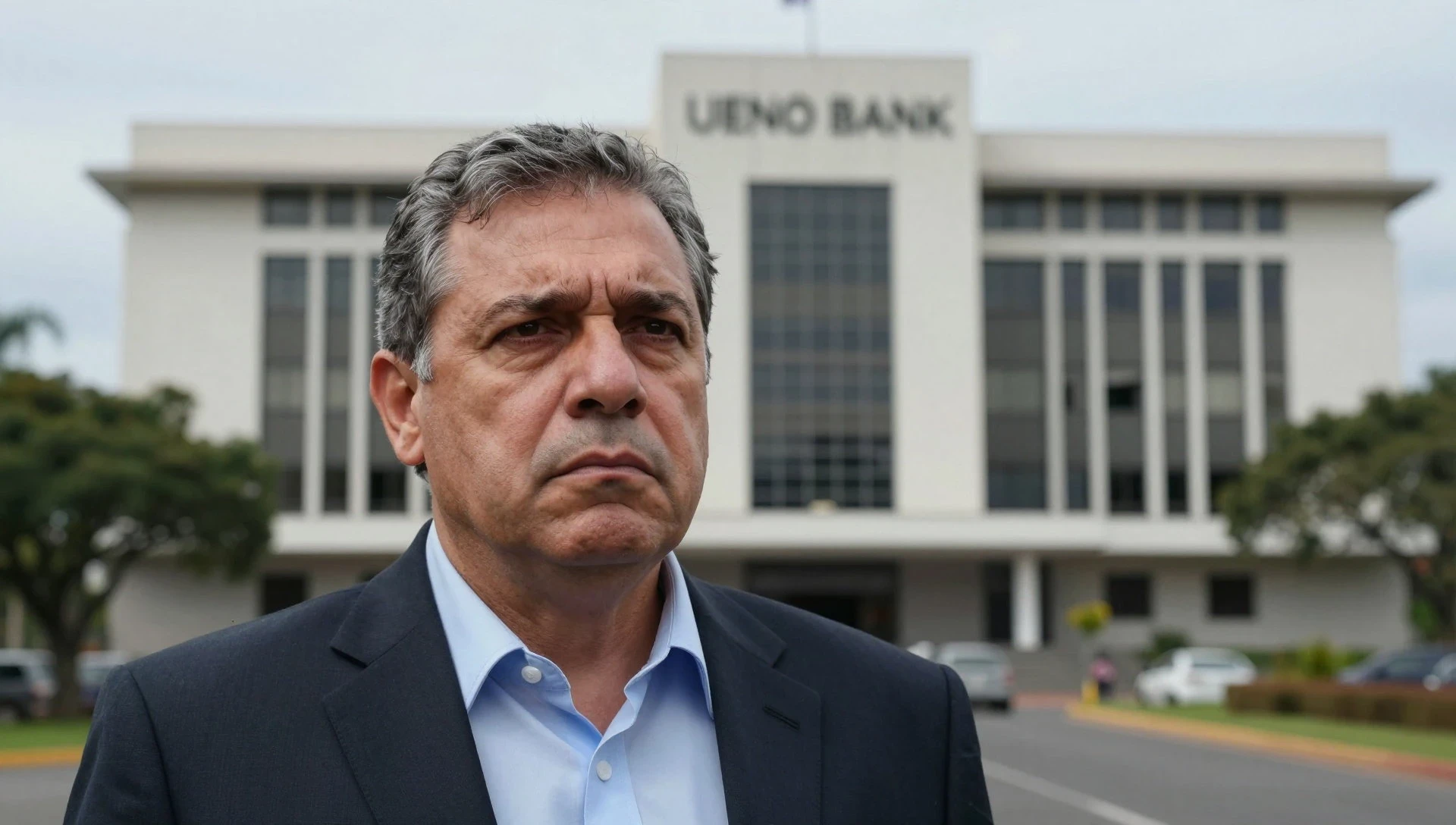
The removal of Paraguay's President Santiago Peña from office in November 2026 stands as one of the most consequential political ruptures in modern Latin American history, triggered not by a coup or an election but by the sudden collapse of a single digital bank. Ueno Bank, once a flagship of Paraguay's fintech ambitions, was shuttered after the central bank determined its solvency ratio had fallen below the regulatory minimum, instantly freezing the accounts of roughly 2.9 million customers in a nation of only about 6.1 million people. That arithmetic alone explains the fury that followed: nearly half the country woke up one morning unable to access its own money.
What began as a liquidity crisis rapidly metastasized into a legitimacy crisis. Long queues formed outside bank branches, protests spread across Asunción, and the public demanded answers about how a supervised institution could fail so spectacularly. Peña, an economist from the conservative Colorado Party, initially offered his resignation in a bid to restore calm, but Congress refused to accept it and instead moved to impeach him. The lower chamber voted unanimously, the Senate followed on Friday, and Vice President Pedro Alliana was sworn in shortly afterward, leaving Paraguay to reckon with the wreckage of both a bank and a presidency.
The scandal's core is a tangle of financial and personal conflicts that prosecutors are still unravelling. Peña had business ties to Ueno Bank's main shareholder, Grupo Vázquez, until he sold his stake in 2025, and investigators allege he intervened in decisions concerning public and pension funds deposited with the institution. They further claim the bank extended him two simultaneous loans in May 2024 totalling $580,000 to help build his summer home in San Bernardino. Charged with breach of trust and administration for personal gain, Peña denies all wrongdoing, yet the discovery of a sophisticated security vault at that same home has only deepened public suspicion.
On This Page
TL;DR Paraguay's President Santiago Peña was impeached and removed from office after the collapse of Ueno Bank, a digital lender whose solvency failure froze the accounts of roughly 2.9 million customers in a country of 6.1 million. Prosecutors allege Peña intervened in public and pension fund decisions tied to the bank and received $580,000 in loans from it while holding corporate ties to its main shareholder. He faces breach of trust and personal-gain charges carrying a potential 15-year sentence, denies wrongdoing, and is held in pretrial detention while investigators search his home and a security vault. Vice President Pedro Alliana has assumed the presidency.
The Anatomy of a Digital Bank Failure
Ueno Bank did not fail in the shadows of an obscure offshore jurisdiction; it failed in broad daylight, under the supervision of Paraguay's central bank, while holding deposits belonging to nearly half the population. The institution positioned itself as a modern, app-first alternative to traditional banking, attracting millions of customers with the promise of frictionless digital finance. That promise became a liability the moment solvency deteriorated, because digital banks concentrate risk in a way that makes runs instantaneous rather than gradual. When confidence evaporates, there are no queues at a single branch to slow the panic; there is only a frozen app and a nation discovering its savings are inaccessible.
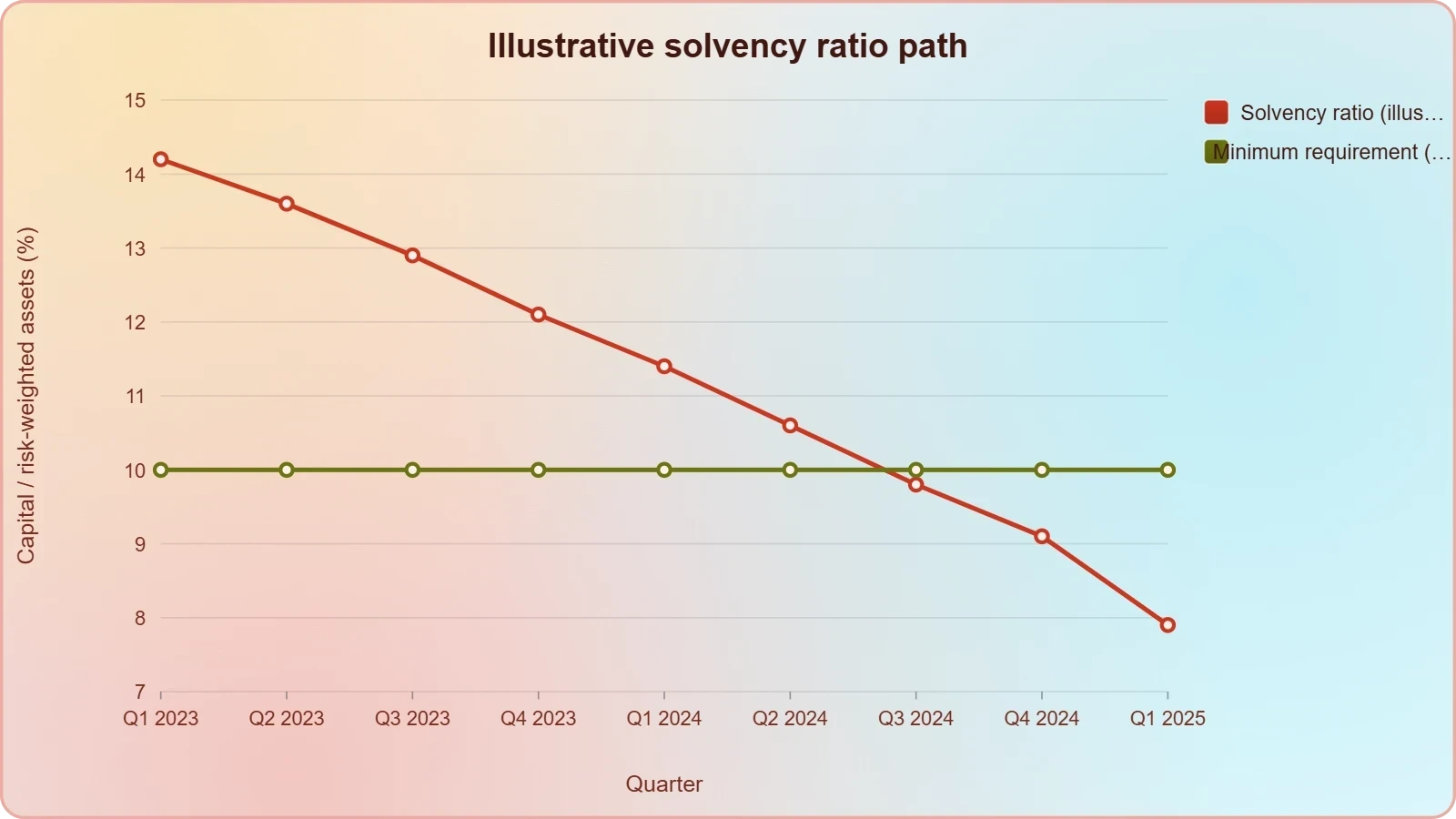
The central bank's finding that Ueno's solvency ratio had dropped below the required minimum is the technical trigger, but the deeper question is why supervision failed to catch the deterioration earlier. Solvency ratios exist precisely to provide an early warning system, and their breach typically follows months of erosion. Regulators now face uncomfortable scrutiny over whether political connections shielded the bank from timely intervention, and whether deposit insurance, if it existed at adequate levels, could have prevented the freeze from becoming a national emergency.
Solvency Ratios and the Mechanics of Collapse
A bank's solvency ratio measures its capital against risk-weighted assets, and regulators set minimum thresholds to ensure institutions can absorb losses without endangering depositors. When Ueno's ratio fell below that floor, the central bank had little choice but to act, because allowing an undercapitalised institution to keep operating risks an even larger and more chaotic failure later. The formula is conceptually simple: capital divided by risk-weighted assets must exceed the mandated minimum. Yet the simplicity masks the difficulty of valuing assets accurately, especially at a digital bank whose loan book may include concentrated exposures to politically connected borrowers.
For Paraguay, the collapse exposed a structural vulnerability: a single institution held deposits equivalent to a substantial share of national economic activity, and its failure instantly impaired the payment system for millions. The freeze did not merely inconvenience customers; it severed salaries, remittances, and small-business cash flows, which is why the political reaction was so swift and so severe. When a bank becomes systemically important by virtue of customer count rather than balance-sheet size, traditional supervisory categories may understate the real risk it poses to social and political stability.
The Contagion Risk in Concentrated Banking Systems
Contagion in a concentrated banking system operates through confidence rather than balance sheets alone. Once depositors at Ueno discovered their accounts were frozen, customers at other Paraguayan institutions began questioning whether similar hidden weaknesses lurked elsewhere, a phenomenon familiar from every major banking panic in history. Central banks typically respond with liquidity guarantees and public reassurances, but such measures require credibility, and credibility was precisely what the Peña government lacked once allegations of presidential entanglement with the failed bank surfaced.
The broader lesson for emerging economies is that digital banking growth can outpace the supervisory infrastructure designed to contain it. Fintech expansion brings genuine benefits in financial inclusion, yet it also concentrates deposits in platforms whose failure is felt instantly across an entire population. Paraguay's experience suggests regulators must pair innovation-friendly policies with capital requirements, stress testing, and deposit insurance calibrated to the actual concentration of risk, not merely to the formal size of the institution on paper.
The Impeachment: Constitutional Procedure Under Pressure
Paraguay's response to the crisis followed a constitutional path, but one executed at extraordinary speed and under immense public pressure. Peña announced his resignation on a Thursday, framing the decision as a gesture to give Paraguayans peace of mind and restore stability. Congress, however, declined to accept the resignation, and the lower chamber instead voted unanimously to impeach him, with the Senate formally removing him from office the following day. The distinction matters legally: a resignation is voluntary and negotiated, whereas impeachment is a formal political judgment that carries different constitutional consequences and signals a different verdict on the officeholder's conduct.
The unanimity of the lower chamber's vote is striking in a political system where the Colorado Party has long dominated. That even Peña's own partisan colleagues joined the impeachment suggests the allegations had become politically unsustainable, and that legislators calculated their own survival depended on decisive distance from the disgraced president. Vice President Pedro Alliana's swift swearing-in provided continuity of government, but it also underscored how rapidly the institutional machinery can move when public anger and financial collapse converge.
Resignation Versus Removal: Why the Distinction Matters
A resignation accepted by Congress would have allowed Peña to frame his departure as voluntary statesmanship, potentially preserving his eligibility for future office and softening the political verdict. Impeachment, by contrast, is an explicit finding that the officeholder committed acts warranting removal, and it carries lasting reputational and legal weight. By refusing the resignation, Congress effectively denied Peña the narrative of self-sacrifice and substituted a formal judgment of culpability, a choice that will shape how history and the courts treat his tenure.
The speed of the proceedings has drawn predictable criticism from those who argue that due process requires deliberation, evidence, and defence. Yet impeachment is inherently a political rather than criminal process, and the constitution permits legislatures to act swiftly when the public interest demands it. The criminal charges Peña now faces will proceed separately through the courts, where the evidentiary standards are higher and the burden of proof rests with prosecutors. The two tracks, political removal and criminal prosecution, run in parallel and serve distinct constitutional functions.
Political Fallout for the Colorado Party
The Colorado Party's willingness to sacrifice its own president reveals the depth of the electoral danger the scandal posed. With nearly half the population locked out of its accounts, legislators faced constituents who were not merely angry but financially wounded, and any appearance of protecting Peña would have been politically suicidal. Alliana's accession offers the party a chance to reset, but the taint of association will linger, particularly if prosecutors produce evidence implicating other officials in the supervision or facilitation of Ueno's operations.
Opposition movements, meanwhile, have gained an unexpected opening. The crisis has exposed the entanglement of political and financial elites in a way that resonates with voters across ideological lines, and reformist candidates may find fertile ground in demanding stronger banking supervision, transparency in public fund placements, and stricter conflict-of-interest rules. Whether that energy translates into durable institutional change or dissipates after the immediate crisis subsides will determine Paraguay's political trajectory for years.
We Also Published
The Conflict-of-Interest Allegations
At the heart of the case against Peña lies a question that haunts financial regulation everywhere: when a public official retains economic ties to a supervised institution, can any decision about that institution ever be clean? Prosecutors allege that during his presidency Peña intervened in decisions concerning public and pension funds placed in Ueno Bank, an entity with which he allegedly maintained economic and corporate ties. He had sold his stake in Grupo Vázquez, Ueno's main shareholder, in 2025, but the timing and completeness of that divestment remain central to the investigation.
The most concrete allegation concerns two simultaneous loans granted to Peña in May 2024, totalling $580,000, to help finance construction of his summer home in San Bernardino, roughly fifty kilometres from Asunción. Two simultaneous loans from a single institution to a sitting president, particularly one with corporate ties to that institution's majority shareholder, raise obvious questions about preferential treatment and whether ordinary credit standards were applied. Peña denies any wrongdoing, and his lawyer has been contacted for comment, but the optics are difficult to defend.
Public and Pension Funds as a Vector of Capture
Public and pension fund deposits represent an especially sensitive category of banking relationship because they involve money held in trust for citizens who have no say in where it is placed. If prosecutors can demonstrate that Peña influenced decisions to route such funds into Ueno Bank, the allegation moves beyond conflict of interest into something closer to abuse of public office. Pensioners, after all, are among the most vulnerable depositors in any society, and their funds are typically governed by strict prudential rules precisely to prevent political interference.
The mechanics of such capture are rarely crude. They typically involve appointments to fund boards, informal pressure on investment committees, or the selection of counterparties based on relationships rather than risk-adjusted returns. Establishing criminal liability requires proving intent and causation, which is why prosecutors have focused on documentary evidence and the testimony of officials involved in the relevant decisions. The search of Peña's home and the anticipated opening of his security vault suggest investigators believe such evidence exists.
The $580,000 Loan and the Divestment Timeline
The loan allegation is powerful because it is concrete, dated, and quantifiable. Two simultaneous loans in May 2024, while Peña held the presidency and maintained corporate ties to the bank's main shareholder, create a documentary trail that is difficult to explain away as coincidence. Even if the loans were commercially sound, the appearance of a president borrowing from an institution whose fortunes he could influence is precisely the scenario conflict-of-interest rules are designed to prevent.
The 2025 divestment from Grupo Vázquez adds another layer of complexity. Selling a stake does not erase prior relationships, and prosecutors will examine whether the sale was genuine, fairly priced, and complete, or whether informal influence persisted after the formal separation. Timing matters enormously in such inquiries: a divestment that occurs only after scrutiny begins looks very different from one undertaken years before any controversy. The courts will ultimately weigh these questions against the standard of proof required for criminal conviction.
- 01
- 02
- 03
- 04
Detention, Searches, and the Evidence Trail
Peña's path from the presidency to pretrial detention was swift. Initially placed under house arrest, he was later transferred to a military facility as the seriousness of the charges and the risk of interference with evidence became clearer. The transfer signals that judicial authorities regard him as a flight risk or a threat to the integrity of the investigation, assessments that carry significant weight in decisions about custody. For a former head of state to be held in a military facility rather than under house arrest is a striking statement about the gravity with which the case is viewed.
On Sunday, authorities searched his summer home in San Bernardino and discovered a highly sophisticated security vault, along with computers, devices, and potentially important documents. Prosecutors said they expected to open the vault on Tuesday, a detail that has fuelled intense public speculation about what it might contain. In financial crime investigations, physical evidence such as ledgers, contracts, and encrypted devices can be decisive, particularly when digital records may have been deleted or obscured.
What the Vault Search Signifies
The presence of a sophisticated security vault in a private residence is not itself evidence of wrongdoing; wealthy individuals routinely secure valuables and documents. But in the context of an investigation into hidden financial relationships, the vault becomes a symbol of the opacity prosecutors are trying to penetrate. Its contents, once catalogued, could either corroborate the allegations or prove irrelevant, and the manner in which the search was conducted will be scrutinised by defence lawyers seeking procedural grounds for challenge.
The seizure of computers and devices is equally significant. Digital forensics can reconstruct communications, transaction records, and deleted files, and modern investigative techniques are remarkably effective at recovering information that suspects believe has been destroyed. Defence counsel will likely argue that some materials are privileged or unrelated to the charges, setting up pre-trial disputes that could delay proceedings. The evidentiary battle over these items may prove as consequential as the testimony of witnesses.
Due Process in a Politically Charged Prosecution
Prosecuting a former president inevitably raises questions about political motivation and judicial independence. Peña's supporters will argue that the charges are a punitive response to his unpopularity, while his critics will insist that accountability requires exactly this kind of scrutiny. The credibility of Paraguay's judiciary now rests on its ability to conduct a fair trial, protect the presumption of innocence, and resist political pressure from any direction, a challenge that many Latin American legal systems have struggled to meet.
International observers, human rights organisations, and financial regulators will all be watching. A prosecution perceived as fair and evidence-driven would strengthen Paraguay's institutional reputation; one perceived as a show trial would undermine investor confidence and invite criticism from abroad. The balance is delicate, and the outcome will shape how the country is judged by the international community for years to come.
Implications for Banking Regulation and Deposit Protection
Paraguay's crisis is a case study in what happens when deposit protection is inadequate relative to the concentration of risk in a single institution. When Ueno Bank froze, millions of customers discovered that their access to money depended entirely on the solvency of one platform, with no visible safety net to cushion the shock. Robust deposit insurance schemes exist precisely to prevent bank failures from becoming social catastrophes, and their absence or insufficiency transforms a financial event into a political one.
Regulators across emerging markets should draw uncomfortable lessons. Digital banks can scale customer numbers far faster than they accumulate the capital and governance structures needed to support that scale, and supervisory frameworks designed for branch-based banking may not capture the speed at which digital runs occur. The solution is not to stifle fintech innovation but to ensure that capital requirements, liquidity buffers, and resolution mechanisms are calibrated to the actual risk profile of digital institutions.
Designing Deposit Insurance for Digital Institutions
Deposit insurance works by guaranteeing depositors up to a specified limit, removing the incentive to run at the first sign of trouble. For digital banks with millions of small depositors, the coverage limit must be high enough to protect the majority of accounts fully, otherwise the guarantee fails to prevent panic. Paraguay's experience suggests that coverage thresholds should be reviewed against the distribution of account sizes, not simply set at a nominal figure that sounds adequate but leaves most depositors exposed.
Funding such schemes is itself a challenge. Insurance funds are typically financed by premiums levied on banks, and a system concentrated in a few large institutions may struggle to build reserves sufficient to handle a failure of the largest participant. Pre-funding, risk-based premiums, and credible backstop arrangements with the central bank are all essential components of a system that can actually deliver on its promises when tested.
Supervisory Lessons for Emerging Markets
The most important supervisory lesson is that political connections must never be allowed to delay intervention. If regulators hesitated because Ueno's shareholders had ties to the president, the cost of that hesitation was borne by millions of depositors. Independence of supervision, protected by law and reinforced by institutional culture, is the only reliable defence against the capture that turns a manageable bank problem into a national crisis.
Emerging markets also need resolution regimes that allow authorities to intervene quickly, transfer deposits to a healthy institution, and impose losses on shareholders and creditors without destabilising the wider system. Paraguay's shutdown achieved the first objective but appears to have left depositors stranded, which is precisely the outcome a well-designed resolution framework is meant to avoid. Building such frameworks takes time, political will, and technical capacity, but the alternative is to repeat this crisis the next time a large institution falters.
Accountability, Public Trust, and the Road Ahead
Beyond the legal and regulatory dimensions, Paraguay faces a deeper challenge: rebuilding public trust in institutions that failed visibly and painfully. Millions of citizens experienced the collapse not as an abstraction but as a personal emergency, unable to pay rent, buy food, or meet obligations because their accounts were frozen. Restoring confidence requires more than prosecutions and reforms; it requires a credible demonstration that those responsible are held accountable and that the systems protecting ordinary people will function next time.
The new government under Pedro Alliana inherits an economy shaken by the failure and a public deeply sceptical of elite arrangements. Its first task is to restore access to funds for affected depositors, a logistical and financial operation that will determine whether the political transition translates into genuine relief. Its second is to pursue the institutional reforms that prevent recurrence, a longer project that will test the durability of the political consensus the crisis has temporarily created.
Rebuilding Confidence in Financial Institutions
Confidence in banking is a fragile public good, built over decades and destroyed in days. Paraguay's challenge is to convince citizens that their money is safe in institutions other than the one that failed, and that the state will protect them if another institution falters. Transparent communication, visible regulatory action, and prompt compensation for affected depositors are the practical steps that rebuild trust, and their absence would leave a permanent scar on financial participation.
The crisis also presents an opportunity. Countries that have weathered banking collapses often emerge with stronger institutions, precisely because the political will for reform becomes irresistible in the aftermath. If Paraguay uses this moment to strengthen supervision, establish credible deposit insurance, and enforce conflict-of-interest rules, the Ueno failure could mark the beginning of a more resilient financial system rather than the end of public faith in banking altogether.
What the Peña Case Means for Latin American Governance
Across Latin America, the case resonates because the entanglement of political and financial elites is a familiar pattern. Presidents with business interests, banks with political connections, and regulators reluctant to act against the powerful form a constellation that has produced scandals from Brazil to Mexico. Paraguay's swift impeachment demonstrates that publics will no longer tolerate such arrangements quietly, and that legislatures can act decisively when the evidence and the anger are sufficient.
The case also illustrates the power of financial crises to expose governance failures that might otherwise remain hidden. Ueno's collapse did not create the conflicts of interest; it revealed them, and the political system responded with unusual speed once the public could see the connections. For reformers across the region, the lesson is that transparency about financial relationships is not a technical nicety but a precondition for political accountability, and that institutions which conceal such relationships do so at their peril.
From our network :
- CISA’s Ten-Advisory Wave: Why Generic Patching Fails in OT and How to Build Product-Specific PlaybooksCISA released ten ICS advisories in one week, exposing critical infrastructure risks. Generic patching fails in OT. Learn to build product-specific remediation playbooks.
- The Hidden Cost of AI Convenience: Why Over-Permissioned Agents Are a Security Time BombDiscover why AI agents with excessive permissions create dangerous single points of failure, and learn how implementing least privilege principles can protect your organization from exploitation.
- Committed Mediterranean Precipitation Decline: Why Emissions Cuts Alone Cannot Restore Winter RainsNew NOAA research reveals that Mediterranean winter rains may decline irreversibly even with emissions cuts. Explore the science of committed climate change and regional impacts.
- Forbidden Matrix Patterns and Visible Lattice Points: A Geometric DictionaryExplore how multidimensional 0–1 matrices encode geometric truths, linking forbidden patterns to visible lattice points and hypergraph theory, with applications in combinatorics and computational geometry.
- How AI Agents Will Change the Way We Manage Personal FinancesExplore how AI agents are transforming personal finance through automated budgeting, bill payment, and investment management, while examining the critical security protocols and governance frameworks required for safe deployment.
- Live Online English Classes for Kids: Do They Actually Reduce Anxiety?A ten-week study reveals that synchronous online English classes can significantly reduce child language anxiety while improving listening and reading skills. Discover what makes these programs effective and how parents can select the right one.
- The Final Descent: How ESA Retired the Legendary Cluster Constellation After 24 Years of Space Weather ScienceAfter 24 years mapping Earth’s magnetosphere, ESA’s Cluster mission concluded with a precisely controlled reentry over the South Pacific. This analysis explores the scientific legacy, engineering decisions, and debris mitigation principles behind one of space exploration’s most responsible retirements.
- Mobile Learning and VR in English: What Global Evidence Reveals About Effective Language TechnologyA systematic review across 14 countries reveals which language-learning technologies genuinely work. Mobile learning, AI, and VR show measurable benefits when pedagogically integrated. This evidence-based guide helps educators and learners select technology that delivers real return on investment.
- University Language Proficiency Exams: Why Institutional Tests Demand Different Preparation Than IELTS and TOEFLDiscover why university-specific language proficiency examinations differ fundamentally from IELTS and TOEFL, and learn strategic preparation approaches for institutional assessment success.
RESOURCES
- Paraguay president impeached minutes after resigning ... - NPRnpr.org6 days ago ... Paraguayan lawmakers voted to impeach President Santiago Peña minutes after his resignation, as the collapse of a digital bank tied…
- Paraguay's president is impeached minutes after resigning following ...opb.org6 days ago ... A demonstrator holds a mock U.S. dollar bill depicting Paraguayan President Santiago Peña during a protest against the government and…
- Paraguay's Peña under criminal probe as Ueno Bank collapse ...apnews.com5 days ago ... Paraguayan President Santiago Peña is under criminal investigation following the collapse of a major digital bank, as the South American ...
- Paraguay's Peña resigns as bank collapse triggers political crisisreuters.com6 days ago ... Paraguayan President Santiago Peña resigned on Thursday after the collapse of digital lender ueno triggered a political and financial ...
- Paraguay president impeached and under house arrest ... - CNNcnn.com6 days ago ... Paraguay president impeached and under house arrest following bank collapse scandal ... Peña's arrest in relation to the Ueno Bank…
- Paraguay's former president charged after bank collapse - BBCbbc.com4 days ago ... Prosecutors in Paraguay have charged former president Santiago Peña over his alleged role in a banking scandal that led to…
- Paraguay Congress rejects President Pena's resignation after bank ...aljazeera.com5 days ago ... ... impeachment proceedings after the collapse of digital lender Ueno Bank. President since 2023, Pena had attempted to resign on…
- Paraguay prosecutor will seek charges against embattled president ...pbs.org6 days ago ... ... bank, prosecutors announced, hours after the South American leader's resignation and impeachment Thursday. The crisis at Ueno Bank turned…
- Peña skips Senate impeachment trial as Paraguay reels from Ueno ...abcnews.com5 days ago ... Paraguayan President Santiago Peña failed to appear at his impeachment trial following a scandal surrounding a collapsed bank.
- Paraguay Lawmakers Reject Peña's Resignation, Seek Impeachmentgfmag.com5 days ago ... The collapse of Ueno Bank sparked an impeachment crisis for Paraguay President Santiago Peña, whose family had ties to the…
- Paraguayan President Santiago Peña resigned from office this ...instagram.com6 days ago ... ... impeachment proceedings against Peña over the Ueno ... Paraguay President Santiago Peña resigned Thursday following the collapse of Ueno…
- Paraguay's President, Santiago Peña, Quits Amid Ueno Bank Scandalnytimes.com6 days ago ... Paraguay's Leader Resigns After Bank Failure Leaves Millions Without Savings ... Peña, who was facing an impeachment vote in the…
- Ousted Paraguayan president placed under house arrest after bank ...wral.com5 days ago ... ... collapse of Ueno Bank. On Friday, the Senate removed Peña in a unanimous vote by the 44 senators present,…
- Paraguay President Santiago Peña resigns following bank collapseny1.com6 days ago ... ASUNCIÓN, Paraguay (AP) — Paraguayan President Santiago Peña impeached minutes after resigning following bank collapse. THIS IS AN ...
- Ueno Bank scandal plunges Paraguay into political crisis - DW Newsdw.com5 days ago ... ... Paraguay is in serious crisis following the sudden collapse of Ueno Bank. President Santiago Pena is facing impeachment.
- 01
- 02
- 03
- 04
- 05
- 06
- 07
- 08
0 Comments