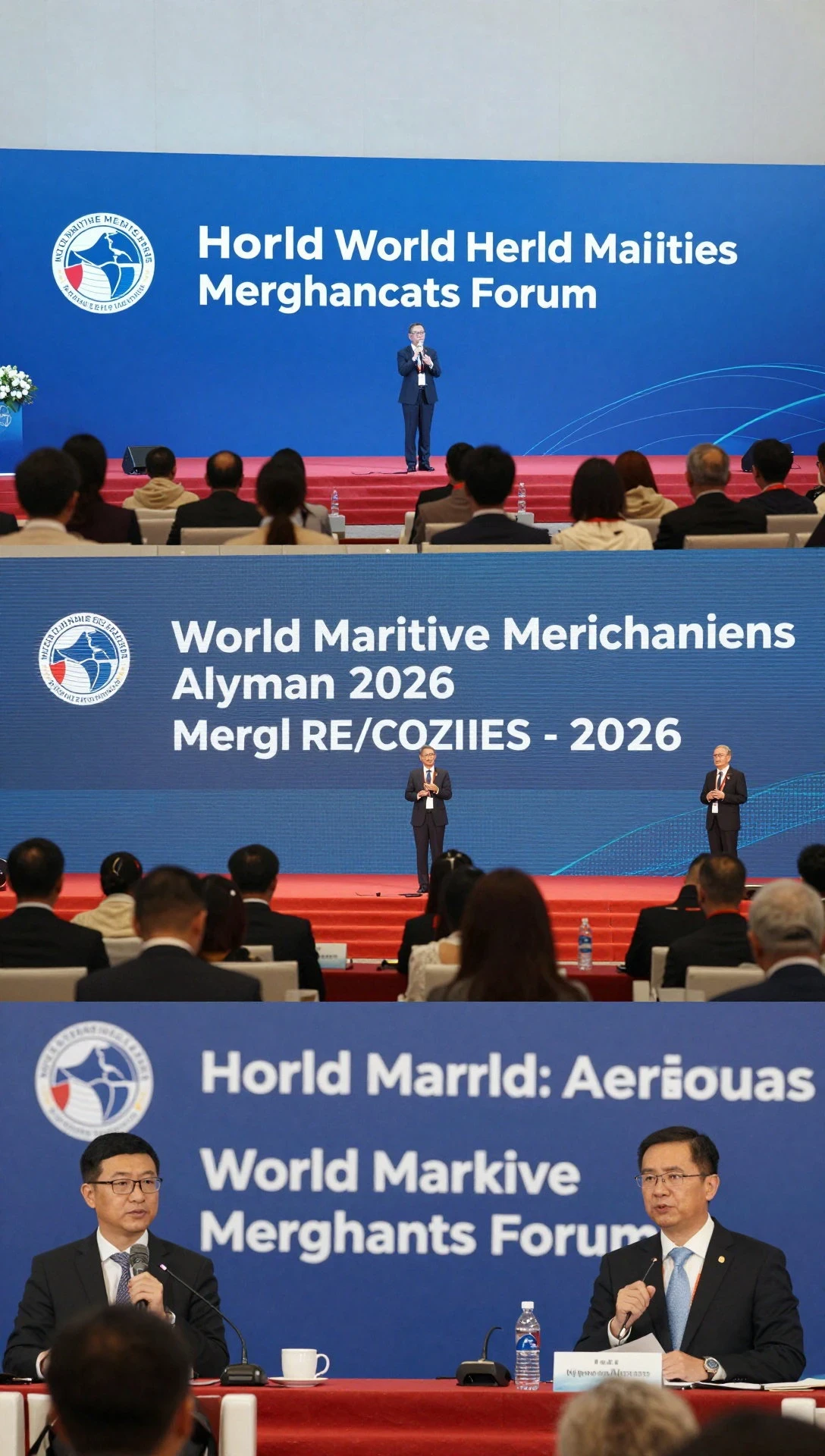
The World Maritime Merchants Forum 2026, convened in Hong Kong under the banner "Linking the World, Anchoring the Future," arrives at a moment when the architecture of global trade is being quietly rebuilt. Shipping, ports, trade finance and technology no longer operate as separate domains; they converge into a single nervous system that moves roughly ninety percent of world commerce.
The forum's opening on Monday drew senior officials, regulators and industry executives who framed the gathering not as ceremony but as a working session on coordination.
What distinguishes this edition is the explicit acknowledgment that the maritime order faces simultaneous pressure from geopolitics, decarbonisation and digitalisation. Leung Chun-ying, vice chairman of the National Committee of the Chinese People's Political Consultative Conference, described the industry as standing at a turning point, citing supply chain disruption alongside the green and digital transition. His prescription leaned on Hong Kong's legal system, business environment and maritime services as instruments for building a collaborative order.
On This Page
- The Strategic Logic Behind Hong Kong's Maritime Positioning
- Geopolitical Disruption and the Resilience Agenda
- The Green Transition and Alternative Fuel Infrastructure
- Digitalisation, Smart Ports and Intelligent Vessels
- Hong Kong Maritime Week and the Wider Institutional Ecosystem
- Reading the Forum as a Signal of Institutional Direction
John Lee, chief executive of the Hong Kong Special Administrative Region, positioned the city as a reliable safe harbor for the international maritime community during supply chain restructuring. The substance behind that claim lies in concrete agreements signed at the forum: a partner port relationship with Hainan's Yangpu Port, a first Green Energy Corridor with Zhanjiang, and a Green Shipping Corridor with Greece's Port of Piraeus. Each represents institutional infrastructure rather than rhetoric.
TL;DR The World Maritime Merchants Forum 2026 in Hong Kong gathered shipping, port, finance and technology stakeholders to address geopolitical supply chain disruption, decarbonisation and digitalisation under the theme "Linking the World, Anchoring the Future." Hong Kong reinforced its role as a maritime services hub through partner port agreements with Yangpu and Piraeus, a Green Energy Corridor with Zhanjiang, and the issuance of the Hong Kong Shipowners Mutual Assurance Association's first protection and indemnity policy. The forum, a flagship of Hong Kong Maritime Week 2026, ran nine thematic sessions across Hong Kong, Shenzhen and Shanghai covering green fuels, intelligent vessels and marine insurance.
The Strategic Logic Behind Hong Kong's Maritime Positioning
Hong Kong's maritime proposition rests on a cluster of services that few ports can replicate: common law arbitration, a ship registry of international standing, marine insurance capacity and deep capital markets. When John Lee describes the city as a safe harbor, the phrase carries technical weight. Shipowners facing sanctions risk, contractual disputes or insurance gaps need jurisdictions where law is predictable and enforcement credible.
The forum's timing amplifies this logic. Supply chain restructuring across Asia has pushed cargo flows toward alternative routing, and ports compete less on berth depth than on the quality of ancillary services. Hong Kong's strategy appears to be anchoring the invisible layer of maritime commerce, the contracts, policies and arbitrations that determine whether a voyage is commercially viable before a vessel ever sails.
Institutional Depth as Competitive Advantage
Li Xinghu, vice minister of transport, called for steady progress in Hong Kong's shipping industry with expanded openness, improved services and strengthened financial insurance, maritime arbitration, smart ports and green development. The list is instructive. It treats insurance and arbitration as infrastructure equivalent to terminals and cranes, acknowledging that modern maritime competitiveness is assembled from legal and financial components.
The establishment of the Hong Kong Shipowners Mutual Assurance Association's first protection and indemnity insurance policy illustrates the point concretely. Protection and indemnity cover shields owners against third-party liabilities, from crew injury to pollution claims. A domestic mutual capacity reduces dependence on London and Scandinavian markets, giving Hong Kong shipowners a local instrument for risk retention.
Diplomatic Signaling Through Port Partnerships
The partner port relationship with Yangpu in Hainan and the Green Shipping Corridor with Piraeus in Greece extend Hong Kong's reach across two strategic axes. Yangpu connects the city to China's free trade port experiment, while Piraeus links it to the Mediterranean gateway that Chinese investment has reshaped over the past decade. Both agreements embed Hong Kong in corridors rather than isolated routes.
Arsenio Antonio Dominguez Velasco, secretary-general of the International Maritime Organization, affirmed in a video address that Hong Kong ranks among the world's key international maritime centres, supported by its port, ship registry, finance, insurance and legal services. Endorsement from the IMO carries regulatory weight, signaling that the city's framework remains aligned with international conventions.
We Also Published
Geopolitical Disruption and the Resilience Agenda
Leung Chun-ying's reference to geopolitical disruption affecting supply chains reflects a measurable reality. Red Sea diversions, sanctions regimes and tariff realignments have lengthened voyages and inflated insurance premiums. For shipping lines, resilience has become a capital allocation question: how much redundancy can be justified against the cost of disruption. The forum treated this as a shared problem requiring coordinated institutional response.
Miao Jianmin, chairman of China Merchants Group, proposed building a diversified and resilient international transport corridor system, improving regular exchange among port and shipping enterprises, and enhancing the global shipping industry's ability to respond to uncertainties. Diversification here means multiple routes, multiple fuel options and multiple legal jurisdictions, a portfolio approach applied to physical infrastructure.
Corridor Diversification as Risk Management
The concept of corridor diversification borrows from financial portfolio theory. A single chokepoint, whether the Strait of Hormuz, the Suez Canal or the Malacca Strait, concentrates risk. By cultivating alternative corridors and partner ports, operators reduce exposure to any single disruption. Hong Kong's agreements with Yangpu, Zhanjiang and Piraeus fit this template, each adding a node to a distributed network.
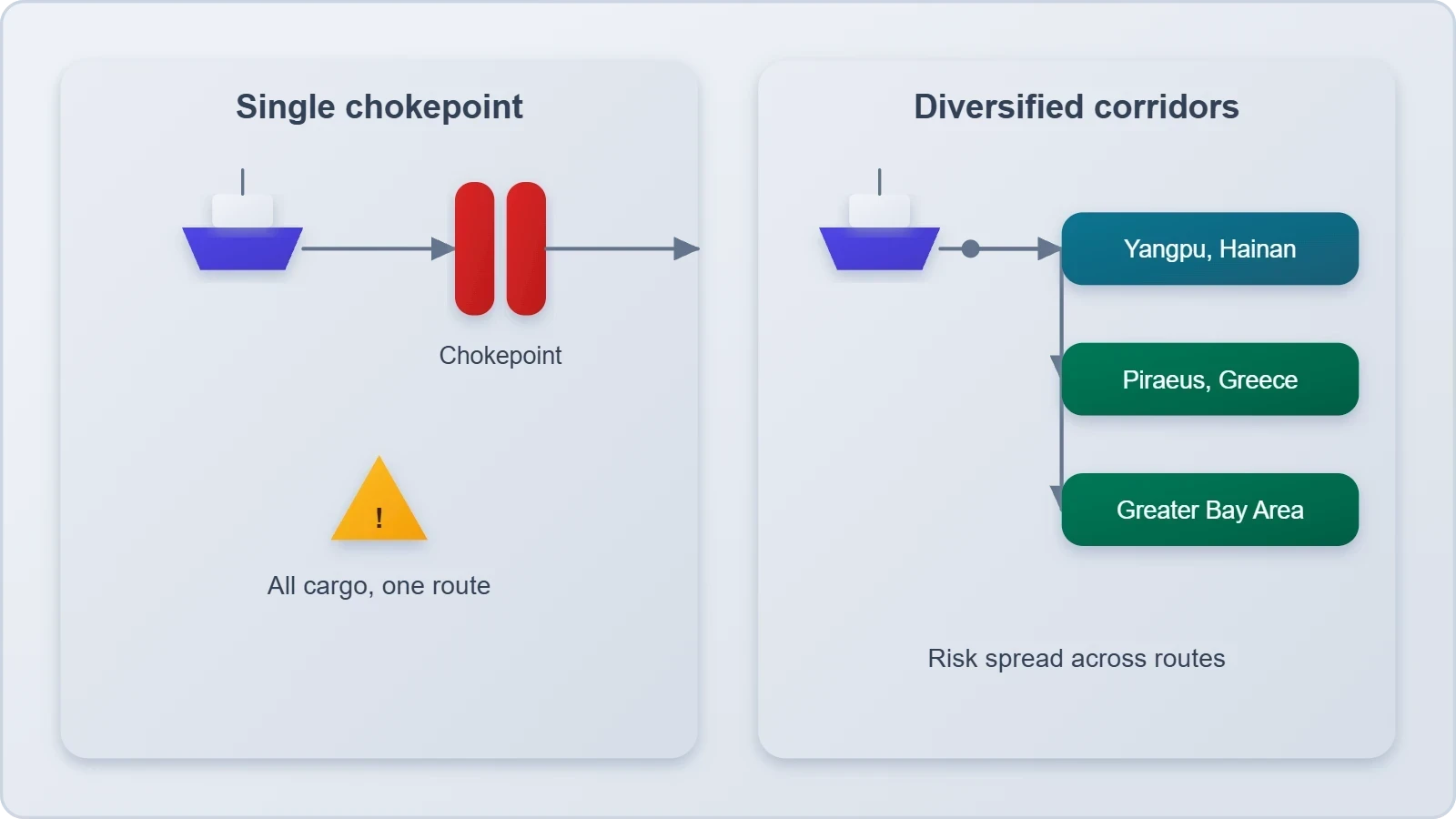
Regular exchange among port and shipping enterprises addresses an information problem. Disruption propagates faster than contracts can adapt, and informal channels between operators and port authorities shorten response times. The forum's structure, with nine thematic sessions across Hong Kong, Shenzhen and Shanghai, institutionalises exactly this kind of exchange across three distinct regulatory environments.
Legal Frameworks as Supply Chain Infrastructure
Upholding international maritime law and standards, as John Lee urged, is not abstract diplomacy. Charter parties, bills of lading and insurance contracts depend on predictable adjudication. When legal certainty erodes, freight rates embed a risk premium that ultimately reaches consumers. Hong Kong's arbitration capacity therefore functions as supply chain infrastructure, converting disputes into resolvable commercial events rather than systemic shocks.
The IMO secretary-general's endorsement reinforces this framing. International Maritime Organization conventions on safety, pollution and crew welfare provide the common language that allows vessels flagged in one state to trade with ports in another. A maritime centre that applies these standards consistently lowers transaction costs for every operator that touches it.
The Green Transition and Alternative Fuel Infrastructure
Decarbonisation has moved from pledge to procurement. The Green Energy Corridor with Zhanjiang and the Green Shipping Corridor with Piraeus represent physical commitments to alternative fuel supply and vessel demand along defined routes. Green corridors work by pairing ports that agree on fuel standards, bunkering infrastructure and incentives, creating enough certainty for owners to order dual-fuel vessels.
The economics are demanding. Methanol and ammonia propulsion carry capital premiums, and fuel availability remains patchy across regions. A corridor only functions when both ends can supply compatible fuel at predictable prices. Hong Kong's agreements attempt to solve the chicken-and-egg problem by anchoring demand and supply simultaneously, giving shipowners a route where the fuel question has a credible answer.
Financing the Fuel Switch
Green development, as Li Xinghu framed it, sits alongside financial insurance and smart ports in a single policy package. The sequencing matters. Without insurance products that price green technology risk, lenders hesitate; without port infrastructure, insurers cannot assess exposure. Hong Kong's role as a capital market allows it to structure green shipping finance, blending bank debt, bonds and export credit around corridor commitments.
Smart port investment complements the fuel agenda. Digital berth allocation, just-in-time arrival and emissions monitoring reduce fuel burn before propulsion technology changes. These are software and sensor investments with rapid payback, and they generate the data that insurers and regulators need to underwrite green transition risk with confidence rather than caution.
Insurance as an Enabler of Decarbonisation
The issuance of the first protection and indemnity policy by the Hong Kong Shipowners Mutual Assurance Association signals that local risk capacity is maturing. Green fuels introduce novel hazards, from ammonia toxicity to methanol fire risk, that traditional underwriting struggles to price. A domestic mutual with direct access to owners and technical data can develop bespoke cover faster than distant markets.
Marine insurance also governs the commercial viability of corridor investments. Lenders financing dual-fuel vessels require hull and machinery cover that recognises new propulsion systems. When local insurers develop that expertise, they shorten the approval cycle and reduce the risk premium embedded in green shipping finance, effectively subsidising decarbonisation through better information.
- 01
- 02
- 03
- 04
Digitalisation, Smart Ports and Intelligent Vessels
The forum's thematic sessions on intelligent vessels and smart ports reflect an industry moving from pilot projects to operational deployment. Autonomous navigation, remote monitoring and predictive maintenance are no longer speculative. The constraint is regulatory harmonisation: a vessel certified for autonomous operation in one jurisdiction may face restrictions in another, fragmenting the value of the technology.
Hong Kong's legal system offers a potential solution. A jurisdiction with recognised arbitration and adaptable regulation can host the contractual frameworks that govern autonomous operations, from liability allocation to data ownership. When a sensor failure causes a collision, the question of who bears responsibility requires a legal forum capable of handling technical evidence, and maritime arbitration centres are adapting to that demand.
Data as the New Maritime Commodity
Smart ports generate continuous streams of operational data: berth occupancy, crane cycles, vessel arrivals, emissions. This data has commercial value for insurers, charterers and port planners, but only if ownership and access rights are clearly defined. The forum's technology sessions implicitly address this governance gap, recognising that data disputes will become as common as cargo disputes.
Predictive analytics applied to vessel performance can reduce fuel consumption by identifying hull fouling and inefficient trim before they compound. These gains are modest individually but aggregate across a fleet into material savings. For operators facing carbon pricing, the marginal value of each efficiency improvement rises, making data infrastructure an economic necessity rather than a luxury.
Cybersecurity in Connected Shipping
Digitalisation introduces exposure. A connected vessel is a floating network node, and port systems are critical infrastructure. Ransomware attacks on terminal operators have already disrupted operations globally. The forum's agenda, while focused on opportunity, cannot ignore this risk. Insurance products covering cyber liability for maritime assets are emerging, and Hong Kong's insurers are positioned to underwrite them.
Regulatory guidance from the International Maritime Organization on cyber risk management provides a baseline, but implementation varies by flag state and operator size. Smaller owners often lack dedicated security teams, creating systemic vulnerability. Coordinated response protocols across partner ports, sharing threat intelligence and incident data, would strengthen resilience in the same way corridor diversification strengthens physical supply chains.
Hong Kong Maritime Week and the Wider Institutional Ecosystem
The forum functions as the flagship event of Hong Kong Maritime Week 2026, a structure that concentrates attention and activity into a single calendar window. Nine thematic sessions across Hong Kong, Shenzhen and Shanghai extend the conversation beyond a single venue, drawing on the Greater Bay Area's combined port capacity and financial depth. The geographic spread is deliberate, signalling integration rather than isolation.
Maritime weeks serve a practical function beyond networking. They compress deal-making into a defined period, when insurers, lawyers, brokers and owners are in the same city. Agreements announced at such events benefit from momentum and visibility, and the partner port arrangements signed this week illustrate how institutional calendars can accelerate commercial outcomes that might otherwise drift.
The Greater Bay Area as a Maritime Cluster
Hong Kong's maritime future is increasingly entangled with Shenzhen and Guangzhou, forming a cluster that combines deep-water terminals, manufacturing hinterland and financial services. The forum's sessions in Shenzhen acknowledge this reality. Coordination across the cluster allows each city to specialise: Hong Kong in arbitration and insurance, Shenzhen in technology and logistics, Guangzhou in bulk and container throughput.
This division of labour mirrors the corridor logic applied internationally. Just as Hong Kong pairs with Yangpu and Piraeus to distribute risk, it pairs with neighbouring cities to distribute function. The result is a regional system with greater resilience than any single port could achieve, and a template that other maritime clusters may study as they confront similar pressures.
What the Forum Signals for Global Shipping
The presence of the IMO secretary-general, even by video, and the participation of senior Chinese officials indicate that Hong Kong's maritime role retains international recognition. For shipowners weighing where to register vessels, insure liabilities or arbitrate disputes, such signals reduce perceived political risk. They confirm that the city's legal and financial infrastructure remains connected to global conventions.
Yet recognition is not the same as inevitability. Competing maritime centres in Singapore, Dubai and Shanghai invest heavily in the same services. Hong Kong's advantage lies in the combination of common law, capital access and proximity to mainland trade flows, a package that is difficult to replicate. Whether that package converts into sustained growth depends on execution of the agreements announced this week.
Reading the Forum as a Signal of Institutional Direction
Beneath the ceremonial language, the forum articulated a coherent thesis: maritime resilience is built from diversified corridors, credible legal frameworks, local risk capacity and green infrastructure. Each element reinforces the others. Corridors without insurance remain fragile; insurance without legal certainty is expensive; green infrastructure without finance stalls. Hong Kong's pitch is that it can supply several of these components simultaneously.
The measurable outcomes, three corridor or port agreements and a first mutual insurance policy, are modest in scale but significant in direction. They demonstrate that the city can convert diplomatic positioning into signed instruments. For an industry that prices credibility carefully, the distinction between announcements and executed agreements matters, and this week produced the latter.
Risks to the Trajectory
Several risks temper the optimistic reading. Geopolitical tension could narrow the pool of counterparties willing to sign agreements with Hong Kong entities. Competition from Singapore and Dubai in arbitration and insurance is intense and well-funded. And the green corridor concept depends on fuel supply chains that remain immature, meaning early commitments may require subsidy before they become self-sustaining.
Execution risk also sits within the city's own institutions. Building a mutual insurance association into a meaningful risk carrier takes years of underwriting discipline and capital accumulation. Corridors require operational coordination between port authorities with different governance cultures. The forum established intent; the harder work of implementation now falls to the organisations that signed.
Implications for Traders, Insurers and Investors
For commodity traders and shipowners, the practical takeaway is that Hong Kong is positioning itself as a one-stop venue for contracts, cover and dispute resolution along Asian and Mediterranean routes. For insurers, the emergence of local mutual capacity creates partnership opportunities and competitive pressure. For investors, green shipping finance and smart port technology represent investable themes with policy backing.
The broader implication concerns the geography of maritime influence. As supply chains fragment into corridors and partnerships, the centres that host the legal and financial layer of shipping gain leverage disproportionate to their physical throughput. Hong Kong's strategy explicitly targets that layer, betting that contracts and cover matter as much as cranes and berths in the next decade of global trade.
From our network :
- Mobile Learning and VR in English: What Global Evidence Reveals About Effective Language TechnologyA systematic review across 14 countries reveals which language-learning technologies genuinely work. Mobile learning, AI, and VR show measurable benefits when pedagogically integrated. This evidence-based guide helps educators and learners select technology that delivers real return on investment.
- The Final Descent: How ESA Retired the Legendary Cluster Constellation After 24 Years of Space Weather ScienceAfter 24 years mapping Earth’s magnetosphere, ESA’s Cluster mission concluded with a precisely controlled reentry over the South Pacific. This analysis explores the scientific legacy, engineering decisions, and debris mitigation principles behind one of space exploration’s most responsible retirements.
- The Hidden Cost of AI Convenience: Why Over-Permissioned Agents Are a Security Time BombDiscover why AI agents with excessive permissions create dangerous single points of failure, and learn how implementing least privilege principles can protect your organization from exploitation.
- University Language Proficiency Exams: Why Institutional Tests Demand Different Preparation Than IELTS and TOEFLDiscover why university-specific language proficiency examinations differ fundamentally from IELTS and TOEFL, and learn strategic preparation approaches for institutional assessment success.
- Forbidden Matrix Patterns and Visible Lattice Points: A Geometric DictionaryExplore how multidimensional 0–1 matrices encode geometric truths, linking forbidden patterns to visible lattice points and hypergraph theory, with applications in combinatorics and computational geometry.
- Live Online English Classes for Kids: Do They Actually Reduce Anxiety?A ten-week study reveals that synchronous online English classes can significantly reduce child language anxiety while improving listening and reading skills. Discover what makes these programs effective and how parents can select the right one.
- How AI Agents Will Change the Way We Manage Personal FinancesExplore how AI agents are transforming personal finance through automated budgeting, bill payment, and investment management, while examining the critical security protocols and governance frameworks required for safe deployment.
- Committed Mediterranean Precipitation Decline: Why Emissions Cuts Alone Cannot Restore Winter RainsNew NOAA research reveals that Mediterranean winter rains may decline irreversibly even with emissions cuts. Explore the science of committed climate change and regional impacts.
- CISA’s Ten-Advisory Wave: Why Generic Patching Fails in OT and How to Build Product-Specific PlaybooksCISA released ten ICS advisories in one week, exposing critical infrastructure risks. Generic patching fails in OT. Learn to build product-specific remediation playbooks.
RESOURCES
- 世界航商大会wmmhk.com
- World Maritime Merchants Forum (WMMF) | IUMIiumi.comJun 13, 2025 ... The World Maritime Merchants Forum (WMMF) is the opening and anchor event of Hong Kong Maritime Week. ... © 2026…
- Daily Schedule - Hong Kong Maritime Weekhkmw.hkThe World Maritime Merchants Forum 2026 will focus on core issues including geopolitical transformation and maritime corridor security supply chain resilience ...
- World Maritime Merchants Forum 2025 | The Marshall Islands Registryregister-iri.comChina Merchants Group. Venue. Address. Hall 5F & 5G, 1 Expo Drive, Wan Chai, Hong Kong. + Google Map. Website: See Website. Share this…
- Hong Kong Maritime Week 2026 - DNVdnv.com16 November 2026. 13:00 - 18:00 · 16 November 2026. 13:00 - 18:00 · World Maritime Merchants Forum 2026 · Hall 5FG, Convention Hall,…
- World Maritime Merchants Forum - BIMCObimco.org2 days ago ... Hong Kong Convention and Exhibition Centre · 16 Nov 2026 · 12:00 · Event.
- Xinde Marine Forum Hong Kong 2026 - IBIAibia.netWorld Maritime Merchants Forum – Xinde Marine Forum Hong Kong 2026 ; Theme: Connecting Trade, Energy and Capital ; Date: 17th November, 2026 ;…
- World Maritime Merchants Forum 2026 - Marine Surveyor Asiaiimsasia.asiaOct 29, 2026 ... International shipping forum during Hong Kong Maritime Week bringing shipowners, charterers, ports, financiers, technology providers and ...
- Yang Chen(陈洋)'s Post - LinkedInlinkedin.comJun 5, 2026 ... Save the Date | World Maritime Merchants Forum 2026 The World Maritime Merchants Forum 2026 ... global maritime community to…
- World Maritime Merchants Forum 2026 Held in Hong Kongnews.marketersmedia.comHongkong, China, November 17, 2026 -- The World Maritime Merchants Forum 2026 opened in Hong Kong on Monday, November 16, bringing together maritime leaders ...
- Hong Kong Maritime Forum - Capital Linkcapitallink.comHong Kong has long been a Global Maritime Center, facilitating trade between the East and West, and overcoming geopolitical and industry challenges and ...
- Hong Kong hosts World Maritime Merchants Forum 2026 - Xinhuaenglish.news.cn1 day ago ... 16 (Xinhua) -- The World Maritime Merchants Forum 2026 opened in Hong Kong on Monday, bringing together global shipping, port,…
- Speech by CE at Opening Ceremony of Hong Kong Maritime Week ...info.gov.hk1 day ago ... CE attends Opening Ceremony of Hong Kong Maritime Week 2026 cum World Maritime Merchants Forum 2026. View. Ends/Monday, November 16,…
- Officials: Multilateral collaboration to transform global shippingchinadailyasia.com1 day ago ... ... Hong Kong Maritime Week 2026 cum World Maritime Merchants Forum 2026 in Hong Kong on Nov 16, 2026. (PHOTO/HKSAR…
- Hong Kong Maritime Week 2026 | November 15–21globalmaritimehub.com2 days ago ... ... Shipping's third Hong Kong Global Maritime Trade Summit. November 16–17: World Maritime Merchants Forum and the Asian Logistics, Maritime ...
- 01
- 02
- 03
- 04
- 05
- 06
- 07
- 08
0 Comments