
The closing of the Alaska Senate contest marks the quiet end of a long and consequential midterm election cycle, and its significance reaches well beyond a single northern state. When a Democratic candidate defeated the Republican contender in the final Senate race to be called, the result completed the national picture that had been assembled piece by piece over the preceding weeks. Alaska's count was delayed while ballots were verified and tallied, a process that reflects the state's distinctive geography and its ranked-choice voting system. The outcome handed the Democratic Party one additional seat and flipped a position that Republicans had previously held, altering the arithmetic of the chamber at the margins.
What makes this result analytically interesting is not simply the party label attached to the winner, but the timing and mechanics of how it arrived. Most midterm races were settled within days of the November vote, yet Alaska remained unresolved as officials worked through absentee and mail ballots from remote districts. That delay turned a single state into the last outstanding question of the cycle, and it gave the result an outsized symbolic weight. The victory illustrates how narrow margins and procedural patience can combine to reshape legislative math, and it underscores why election administration, ballot design, and vote-counting transparency have become central subjects of public scrutiny in modern American politics.
Beyond the headline, the Alaska outcome invites a broader reading of midterm dynamics: the durability of incumbency, the shifting preferences of suburban and rural voters, and the role of national messaging in state-level contests. The source report is deliberately sparse, offering no candidate names, no vote totals, and no breakdown of the count, which means any serious analysis must situate the result within the wider architecture of Senate control and electoral strategy. This examination does exactly that, tracing the meaning of the final call, the structural forces behind it, and the implications for governance as the new legislative term approaches.
On This Page
- The Final Call That Closed the Midterm Cycle
- Alaska's Electoral Architecture and the Ranked-Choice Factor
- Reading the Seat Flip in the Context of Senate Control
- Campaign Strategy Lessons From a Late-Decided Race
- Public Trust, Transparency, and the Politics of Counting
- What the Alaska Result Signals for the Road Ahead
TL;DR A Democratic candidate won Alaska's U.S. Senate race, defeating the Republican contender in the last midterm race to be decided. The delayed count added one Democratic seat and flipped a Republican-held position, completing the national midterm picture. The result matters less for its margin than for its timing and mechanics: it demonstrates how ranked-choice voting, absentee ballot processing, and remote-district logistics can stretch a single contest into the final word of an election cycle. This analysis unpacks the structural, procedural, and political consequences of that final call and what it signals for Senate arithmetic and future campaigns.
The Final Call That Closed the Midterm Cycle
Every election cycle has a last domino, and in this midterm season it fell in Alaska. While most Senate, House, and state races were resolved within days of the November balloting, Alaska's contest lingered as officials verified ballots and worked through the state's ranked-choice tabulation. The eventual Democratic victory converted the final unresolved Senate race into a settled fact, allowing both parties to close their books on the cycle. That closure is more than administrative housekeeping; it determines how the chamber's composition is described, how committee ratios are negotiated, and how each party frames the national narrative heading into the next legislative session.
Why Alaska Counted Last
Alaska's counting timeline is shaped by factors that few other states share. Vast distances, sparse population centers, and reliance on absentee and mail ballots from remote communities all extend the period between election night and certification. The state's ranked-choice voting system adds another layer, because tabulation requires a full accounting of first-choice preferences before elimination rounds can proceed. Officials must also observe statutory windows for ballot receipt and curing, which means the process cannot be compressed without risking disenfranchisement. The delay, in other words, is not evidence of dysfunction but a predictable consequence of geography and law working together.
Understanding this mechanics matters because public confidence in elections often hinges on whether results appear quickly. When a single race remains open for weeks, speculation fills the vacuum, and partisans on both sides may question the integrity of the count. Alaska's experience offers a counter-narrative: a slow count can be a careful count, and the final result can be accepted precisely because the process was transparent and rule-bound. The state's model has therefore become a reference point in debates over how other jurisdictions might balance speed against accuracy and accessibility.
The Symbolism of the Last Seat
There is a peculiar psychology to the final result of any election. Because it arrives after the national narrative has largely formed, it can either confirm or complicate the story each party tells about its performance. In this case, the Democratic win added a seat to the party's Senate total and flipped a Republican-held position, a detail that carries disproportionate rhetorical weight. Pundits and strategists can point to the last race as evidence of momentum or as a footnote to a broader trend, depending on their priors. The symbolic value of the final call often exceeds its numerical significance.
That symbolism extends to how voters perceive competence. A party that wins the last outstanding contest can claim it ran a disciplined, full-cycle operation, while the losing side must explain why its advantage eroded in the closing stages. These interpretations shape fundraising appeals, recruitment of future candidates, and the internal post-mortems that parties conduct after every midterm. The Alaska result thus functions as a narrative capstone, giving both sides a final data point to cite as they prepare for the next electoral confrontation.
We Also Published
Alaska's Electoral Architecture and the Ranked-Choice Factor
Alaska occupies a singular place in American election administration. Its ranked-choice voting system, adopted by voters and refined through subsequent elections, requires officials to count first-choice preferences across every ballot before eliminating last-place candidates and redistributing those votes. This method rewards broad appeal and coalition-building rather than narrow plurality victories, and it can produce outcomes that differ from conventional plurality contests. For analysts, the system complicates easy partisan generalizations, because a candidate's path to victory may depend on second and third choices from voters who backed eliminated rivals.
How Ranked-Choice Voting Shapes Outcomes
Under ranked-choice rules, the winner is determined through successive rounds of tabulation. If no candidate secures a majority of first choices, the lowest finisher is eliminated and their supporters' next preferences are applied, a process repeated until one candidate crosses the threshold. Mathematically, this can be expressed as a majority condition in each round:
where ##v_i^{(r)}## denotes voter ##i##'s highest remaining preference in round ##r##. The practical effect is that candidates must court supporters of their rivals, and campaigns often invest heavily in second-choice messaging. In a state as politically diverse as Alaska, this dynamic can soften partisan edges and reward candidates with strong local identities. The final result therefore reflects not only party strength but also the strategic distribution of preferences across the electorate.
Geography, Logistics, and the Pace of Counting
Alaska's physical scale is a governing constraint on election administration. Ballots must travel from villages accessible only by air or water, and statutory receipt windows accommodate those distances. Officials also conduct signature verification and curing processes that protect voters from having ballots rejected on technical grounds. These safeguards inevitably extend the timeline, and the state has learned to communicate expectations accordingly. The result is a count that is slower than most but widely regarded as methodical, a trade-off that other jurisdictions with dispersed populations have studied closely when designing their own procedures.
The logistics also shape campaign strategy. Candidates must plan for a count that unfolds over days or weeks, which affects how they allocate resources for post-election legal and communications efforts. A campaign that anticipates a prolonged tabulation can prepare observers, maintain public messaging, and avoid premature declarations that might undermine confidence. Alaska's experience thus offers lessons that extend beyond its borders, informing how parties and administrators think about the relationship between geography, law, and public trust in the final result.
Reading the Seat Flip in the Context of Senate Control
A single Senate seat is rarely decisive on its own, but in a chamber where margins determine committee control, judicial confirmations, and the fate of legislation, every seat carries structural weight. The Alaska flip moved one position from the Republican column to the Democratic column, and that shift alters the baseline arithmetic for the coming term. Even where the overall majority remains unchanged, a one-seat swing can affect the leverage of individual senators, the calculus of bipartisan negotiations, and the ability of leadership to schedule votes. The final midterm result therefore matters as much for governance as for symbolism.
The Arithmetic of a One-Seat Shift
Senate arithmetic is unforgiving. With a narrow margin, a single defection can stall a nomination or sink a bill, and a one-seat gain or loss can shift the practical balance of power without changing the formal majority. The Alaska result adds a Democratic seat and removes a Republican one, which means the party's floor operation gains a reliable vote while the opposition loses one. That change ripples through committee assignments, where ratios are negotiated to reflect the chamber's composition, and through the informal networks that determine which legislation reaches the floor.
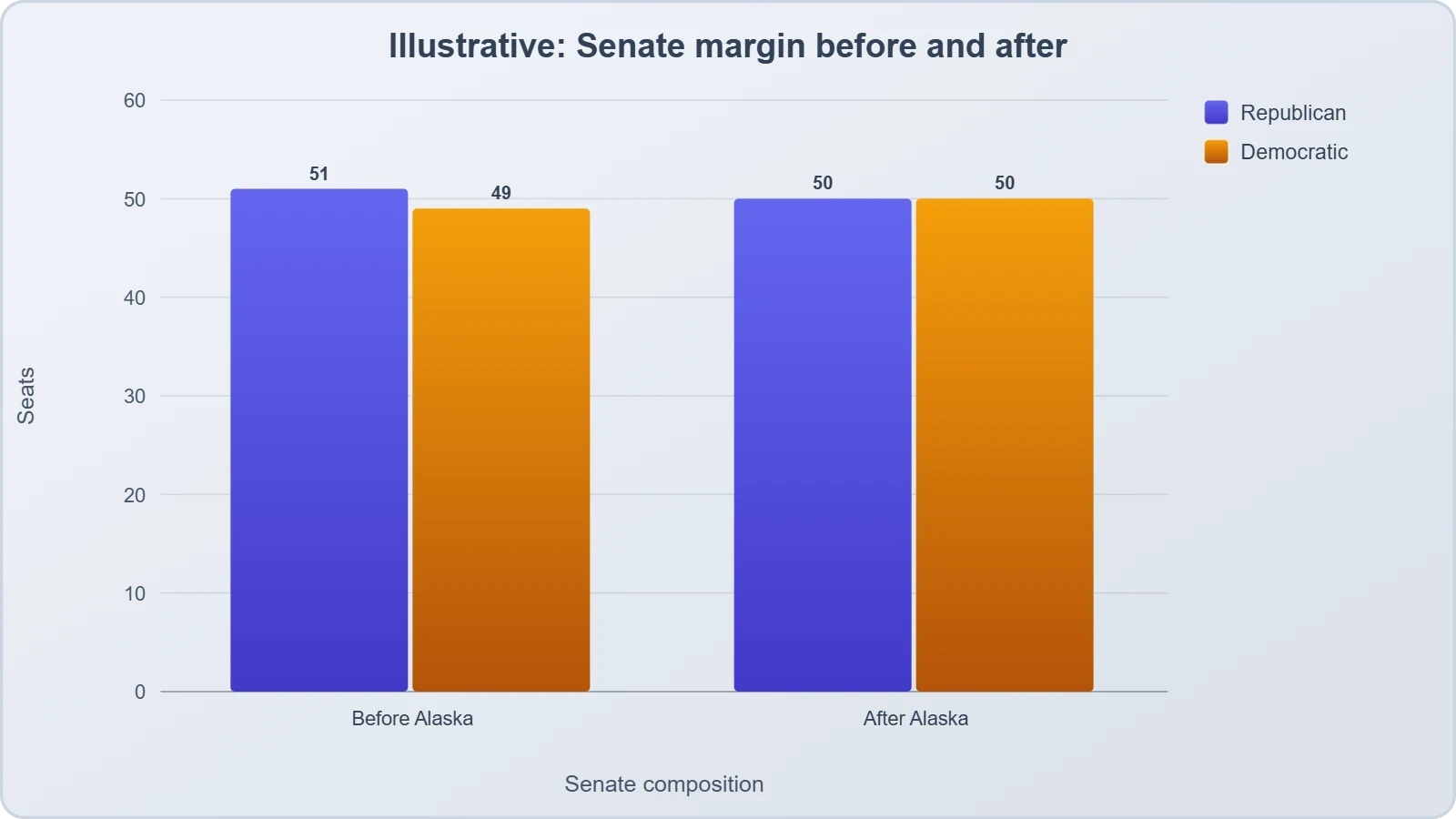
For voters, the practical consequence is that their state's representation now aligns with a different party, which can affect federal funding priorities, constituent services, and the state's influence in Washington. Alaska's delegation has historically cultivated a pragmatic, resource-focused identity, and the new senator will be expected to protect those interests regardless of party. The flip thus creates both opportunity and pressure: opportunity for the new majority to demonstrate responsiveness, and pressure on the incoming senator to deliver for a constituency that prizes independence.
Implications for the Next Legislative Session
As the new session approaches, the Alaska result becomes part of the strategic landscape. Leadership on both sides will factor the seat into their vote-counting, and the incoming senator will face immediate decisions about committee preferences and legislative priorities. The narrowness of the overall margin means that bipartisan coalitions will remain essential for major legislation, and the new senator could become a pivotal voice on energy, fisheries, and public lands issues that matter deeply to Alaska. The final midterm call therefore sets the stage for the negotiations that will define the term.
Beyond the chamber, the result signals to donors and activists that late-counted races can still shift outcomes, which may influence investment in future get-out-the-vote and ballot-curing operations. Parties that build robust legal and logistical teams for prolonged counts may gain an edge in close contests. The Alaska experience suggests that election infrastructure is not merely a back-office concern but a competitive asset, and that the final seat can be won or lost in the days and weeks after polls close.
- 01
- 02
- 03
- 04
Campaign Strategy Lessons From a Late-Decided Race
Late-decided races are laboratories for campaign strategy. When a contest stretches beyond election night, the skills that matter shift from persuasion to logistics: ballot curing, legal observation, volunteer retention, and disciplined communications. The Alaska outcome suggests that campaigns which plan for a prolonged count can protect their margins and avoid the erosion that occurs when supporters lose confidence. It also highlights the value of second-choice outreach in ranked-choice systems, where a candidate's ability to attract support from eliminated rivals can determine the final result.
Messaging and Coalition Building
In a ranked-choice environment, messaging must do double duty. A candidate needs to energize a base while remaining acceptable as a second choice to supporters of other candidates. That tension encourages pragmatic, locally focused appeals rather than purely nationalized rhetoric. Alaska's political culture, with its emphasis on resource management, self-reliance, and federal-state relations, rewards candidates who speak to those themes concretely. The winning campaign's ability to build a broad coalition, rather than simply consolidate a partisan plurality, is a strategic lesson that applies well beyond the state's borders.
Coalition building also affects post-election legitimacy. When a winner can credibly claim support from a majority of voters after transfers, the result is harder to contest and easier to accept. That legitimacy matters in a polarized environment, where narrow plurality victories are often dismissed by the losing side. The ranked-choice framework thus creates an incentive for civility and cross-camp engagement, even as it complicates the simple horse-race narratives that dominate national coverage.
Ground Game and Ballot Curing
The ground game in a prolonged count is about protecting every valid ballot. Campaigns deploy volunteers to help voters cure signature discrepancies, track absentee ballots, and ensure that military and overseas voters are not disenfranchised by administrative delays. These efforts are unglamorous but decisive in close races, where a few hundred ballots can determine the outcome. Alaska's experience demonstrates that a well-organized curing operation is a form of voter service as much as a partisan tactic, and that investing in it can pay dividends when the count extends beyond election night.
For future campaigns, the lesson is to treat election administration as a year-round discipline rather than a final-week scramble. Recruiting and training volunteers, building relationships with local officials, and preparing legal contingencies all contribute to a campaign's ability to weather a slow count. The Alaska result, decided last among the midterm Senate races, stands as a reminder that the final outcome is often shaped by the quiet, procedural work that happens after the cameras have moved on.
Public Trust, Transparency, and the Politics of Counting
Election results are only as durable as the public's willingness to accept them. When a race remains open for weeks, the window for misinformation widens, and partisans may seize on the delay to question the process. Alaska's experience illustrates both the risk and the remedy: transparent reporting of tabulation progress, clear explanations of ranked-choice mechanics, and consistent messaging from officials can sustain confidence even when the count is slow. The final Democratic victory was accepted precisely because the process, however lengthy, followed published rules and produced a verifiable outcome.
Communicating Delays Without Eroding Confidence
Officials and campaigns face a delicate communications challenge during a prolonged count. They must explain why the process takes time without suggesting that something is wrong, and they must provide enough detail to satisfy public curiosity without compromising ballot security. Best practice involves regular updates on the number of ballots remaining, the stages of tabulation, and the statutory deadlines that govern certification. When these updates are consistent and jargon-free, they reduce the space for rumor and reinforce the idea that a slow count is a normal feature of a well-administered election.
The media also plays a role. Coverage that treats every procedural step as a potential scandal can undermine trust, while coverage that explains the mechanics can build it. Alaska's final call offered an opportunity for journalists to educate audiences about ranked-choice voting and absentee processing, and the quality of that coverage likely influenced how the result was received. In an era of fragmented information, the responsibility for explaining election administration is shared among officials, campaigns, and the press.
Legal and Institutional Safeguards
Behind every count is a framework of law designed to ensure fairness. Statutory deadlines, observer access, audit requirements, and certification procedures all constrain how results are produced and challenged. In Alaska, these safeguards governed the ranked-choice tabulation and the handling of absentee ballots, providing a structured path from raw votes to certified outcome. The existence of such safeguards does not eliminate disputes, but it channels them into predictable processes rather than open-ended conflict, which is essential for maintaining legitimacy in a polarized environment.
The final midterm result also underscores the importance of institutional resilience. When a single race determines the last seat, the entire system's credibility is concentrated in that count. Officials who follow the law, campaigns that respect the process, and voters who accept the outcome all contribute to that resilience. The Alaska outcome, decided last among the Senate races, is therefore a case study in how procedural integrity can transform a potentially destabilizing delay into an ordinary, if slow, exercise in democracy.
What the Alaska Result Signals for the Road Ahead
The final midterm call in Alaska is a small event with a long shadow. It completes the electoral map, settles the Senate's composition at the margins, and provides a case study in how geography, ranked-choice voting, and procedural patience shape outcomes. For the Democratic Party, the win is a tangible gain that can be cited in fundraising and recruitment; for Republicans, it is a reminder that late-counted races can slip away without sustained attention to ballot logistics. For voters, it is evidence that every valid ballot can matter when the margin is narrow and the count is careful.
Signals for the Next Election Cycle
Looking ahead, the Alaska result offers several signals. First, ranked-choice systems are likely to spread or be debated in other jurisdictions, and candidates will need to adapt their messaging accordingly. Second, election administration will remain a contested political terrain, with parties investing in legal and logistical capacity as a form of competitive advantage. Third, the value of coalition-building in diverse, independent-minded states will continue to shape Senate contests, rewarding candidates who can appeal beyond their base. These dynamics will influence how both parties approach the next cycle.
The result also highlights the importance of patience in political analysis. Early narratives often harden before all votes are counted, and the final call can complicate or confirm those stories. Analysts who wait for complete data are better positioned to understand what actually happened and why. Alaska's late-decided race is a reminder that the last data point can be the most instructive, and that the full picture emerges only when every count is complete.
Governing With a Narrow Margin
As the new Senate convenes, the narrow margin will shape what is possible. Major legislation will require bipartisan support, and individual senators will wield outsized influence over priorities. The Alaska senator-elect will step into that environment with a mandate to represent a state whose interests are distinct and whose voters expect pragmatism. How that senator navigates committee assignments, legislative negotiations, and constituent expectations will determine whether the seat flip translates into durable influence or remains a footnote to a broader partisan story.
Ultimately, the Alaska result is a study in how democratic systems absorb uncertainty. A delayed count, a ranked-choice tabulation, and a final call that arrived after most of the country had moved on all combined to produce a legitimate outcome. The lesson is not that slow counts are desirable, but that well-designed processes can withstand delay without losing credibility. That resilience is the quiet achievement of the midterm cycle's final chapter, and it is the standard against which future contested counts will be measured.
From our network :
- Mobile Learning and VR in English: What Global Evidence Reveals About Effective Language TechnologyA systematic review across 14 countries reveals which language-learning technologies genuinely work. Mobile learning, AI, and VR show measurable benefits when pedagogically integrated. This evidence-based guide helps educators and learners select technology that delivers real return on investment.
- How AI Agents Will Change the Way We Manage Personal FinancesExplore how AI agents are transforming personal finance through automated budgeting, bill payment, and investment management, while examining the critical security protocols and governance frameworks required for safe deployment.
- The Final Descent: How ESA Retired the Legendary Cluster Constellation After 24 Years of Space Weather ScienceAfter 24 years mapping Earth’s magnetosphere, ESA’s Cluster mission concluded with a precisely controlled reentry over the South Pacific. This analysis explores the scientific legacy, engineering decisions, and debris mitigation principles behind one of space exploration’s most responsible retirements.
- CISA’s Ten-Advisory Wave: Why Generic Patching Fails in OT and How to Build Product-Specific PlaybooksCISA released ten ICS advisories in one week, exposing critical infrastructure risks. Generic patching fails in OT. Learn to build product-specific remediation playbooks.
- University Language Proficiency Exams: Why Institutional Tests Demand Different Preparation Than IELTS and TOEFLDiscover why university-specific language proficiency examinations differ fundamentally from IELTS and TOEFL, and learn strategic preparation approaches for institutional assessment success.
- Live Online English Classes for Kids: Do They Actually Reduce Anxiety?A ten-week study reveals that synchronous online English classes can significantly reduce child language anxiety while improving listening and reading skills. Discover what makes these programs effective and how parents can select the right one.
- The Hidden Cost of AI Convenience: Why Over-Permissioned Agents Are a Security Time BombDiscover why AI agents with excessive permissions create dangerous single points of failure, and learn how implementing least privilege principles can protect your organization from exploitation.
- Committed Mediterranean Precipitation Decline: Why Emissions Cuts Alone Cannot Restore Winter RainsNew NOAA research reveals that Mediterranean winter rains may decline irreversibly even with emissions cuts. Explore the science of committed climate change and regional impacts.
- Forbidden Matrix Patterns and Visible Lattice Points: A Geometric DictionaryExplore how multidimensional 0–1 matrices encode geometric truths, linking forbidden patterns to visible lattice points and hypergraph theory, with applications in combinatorics and computational geometry.
RESOURCES
- Election Results Map - Alaska Division of Electionselections.alaska.govElection Night Reporting. Alaska 2026 General Election. Results Status: Unofficial Results last updated at 11/16/2026 5:39 PM.
- Alaska voters could face a long wait for election results - Votebeatvotebeat.orgNov 4, 2026 ... The race appeared on Wednesday to be heading for ranked choice tabulation. Peltola held a narrow lead over the incumbent…
- Will ranked choice voting affect timing of Maine and Alaska's Senate ...pbs.orgNov 3, 2026 ... LIVE RESULTS: Alaska Senate midterm election. Alaska first ... election night aren't final or official, they're projected results. WATCH ...
- Alaska Primary Election Results 2026 : NPRapps.npr.orgLive election results: Get the latest on Alaska's primary races for governor, Senate and House.
- Live Results: Alaska Senate midterm election | PBS Newspbs.orgNov 3, 2026 ... Voters in Alaska are deciding between incumbent Republican Sen. Dan Sullivan and Democratic challenger Mary Peltola.
- U.S. Senate Election 2026 Live Results: Democrats Win Majoritynbcnews.com49 minutes ago ... Get live Senate election results from NBC News during the 2026 midterms. Follow charts, maps and battleground state tracking to…
- Alaska U.S. Senate Election Live Results 2026 | AP Newsapnews.com2 days ago ... In the 2024 general election, the AP first reported results in Alaska at 1:07 a.m. ET, or seven minutes after…
- Live updates: 2026 US midterm elections and results - BBC Newsbbc.comDonald Trump acknowledges the Iran war contributed to his party's defeat after Democrats win the House and the Senate.
- Democrats secure resounding US midterms victory as voters deliver ...reuters.comNov 4, 2026 ... Read more about the key takeaways from the night here. The final results in the two remaining uncalled Senate races…
- Democrat Mary Peltola unseats Republican in Alaska Senate racebbc.com5 hours ago ... Democrat Mary Peltola has won Alaska's hard-fought Senate race, completing a sweeping victory for the party in the US upper…
- Mississippi and Alaska Senate Races Remain Too Close to Calltime.comNov 3, 2026 ... ... result in a midterm election that has become a blue wave. AP ... J.D. Vance makes final pitch to…
- Trump administration sues to block Alaska's US Senate election ...alaskabeacon.comOct 23, 2026 ... Trump administration sues to block Alaska's US Senate election result if Peltola wins ... winner of the U.S. Senate election.…
- Alaska Senate race set for Democratic win with GOP poised to fight ...democracydocket.com17 hours ago ... As ballots continue to trickle in, Democrat Mary Peltola now needs just 103 net votes to win Alaska's U.S. Senate…
- Midterm Elections Live Updates: Democrats Project Power as G.O.P. ...nytimes.com4 days ago ... What we know, and don't, in the Alaska and Mississippi Senate vote counts. Image. In Alaska, the votes reported on…
- Blanche defends DOJ lawsuit blocking Alaska Senate results ... - NPRnpr.orgOct 25, 2026 ... Pressed on CNN about whether the suit was setting the stage for President Trump to challenge the outcome of next…
- 01
- 02
- 03
- 04
- 05
- 06
- 07
- 08
0 Comments