
A single line of research from the University of Calgary has quietly unsettled one of the most familiar assumptions about the Canadian Prairies: that chinook winds are a permanent, dependable feature of the winter landscape. Led by geography professor John Yackel, the study reports that southeastern Alberta is experiencing fewer chinook events and weaker ones when they do arrive, a pattern that runs against the broader warming narrative across North America. The finding matters because chinooks are not merely a meteorological curiosity; they shape agriculture, energy demand, livestock management, and the psychological rhythm of communities that endure long, dark winters.
What makes the research compelling is the framing of a regional "cold anomaly" that appears to have taken hold around 1980, persisting even as continental temperature averages climb. In other words, the story is not one of uniform climate change but of uneven, place-specific behaviour that defies easy generalization. Southeastern Alberta, according to this work, has been drifting in a direction opposite to much of the continent, and the chinook — that warm, dry, downslope wind that can lift a January afternoon from bitter frost to shirt-sleeve comfort within hours — is registering the shift. Understanding why requires attention to atmospheric circulation, topography, and the subtle mechanics of mountain-wave dynamics.
This analysis examines the study's core claims, situates them within the wider science of downslope winds, and considers what a declining chinook regime could mean for ranchers, utilities, municipalities, and researchers. It also weighs the limits of the evidence, because a regional signal of this kind invites scrutiny as much as it invites headlines. The intent is not to sensationalize a single paper but to read it carefully, connect it to established atmospheric physics, and translate its implications into terms that matter for people who live and work beneath the Rockies.
On This Page
- The Science Behind Chinook Winds and Why They Matter
- Inside the University of Calgary Study and Its Cold Anomaly
- Implications for Agriculture, Energy, and Winter Safety
- Reading the Evidence Carefully: Limits and Open Questions
- What a Weaker Chinook Regime Means for the Wider Climate Conversation
- Conclusion: A Regional Signal Worth Heeding
TL;DR New University of Calgary research led by geography professor John Yackel indicates that chinook winds in southeastern Alberta have become both less frequent and less intense, coinciding with a regional cooling trend that began around 1980. This "cold anomaly" contrasts with continental warming and suggests that local climate behaviour can diverge sharply from broad averages. The findings carry practical consequences for agriculture, energy planning, and winter safety, while also raising important questions about the spatial resolution of climate models and the reliability of long-held regional assumptions.
The Science Behind Chinook Winds and Why They Matter
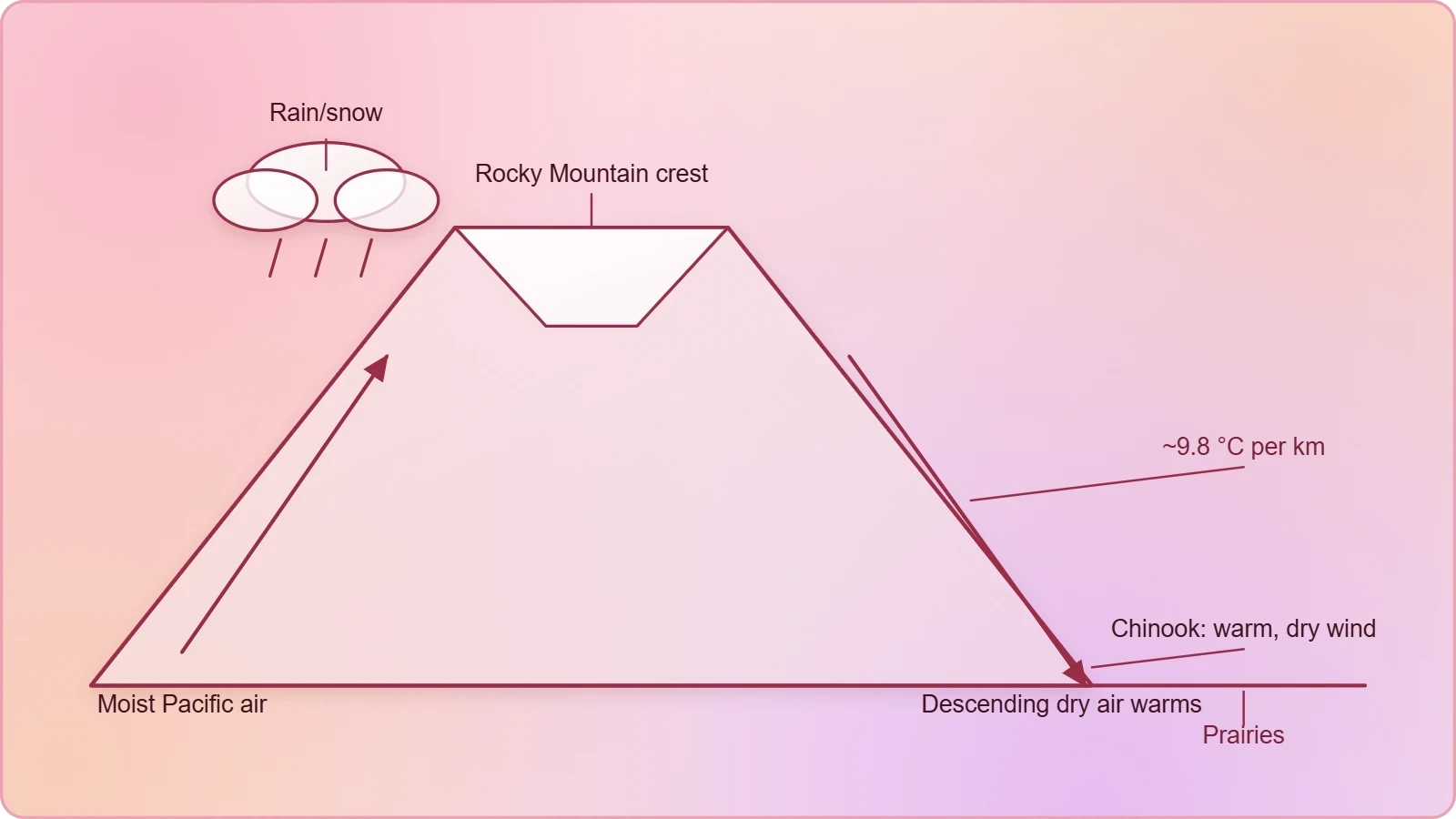
Chinook winds are the product of air descending the eastern slopes of the Rocky Mountains. As moist Pacific air is forced upward over the ranges, it cools and sheds precipitation; when the now-dry air descends the leeward side, it compresses and warms at a rate that can be dramatic. This adiabatic warming is the engine of the chinook, and it explains why communities such as Lethbridge, Pincher Creek, and Calgary can experience temperature swings of twenty degrees Celsius or more within a single day. The phenomenon is among the most striking examples of terrain-driven weather anywhere in the world.
The physical mechanism is well understood in principle but complex in practice. Descending air warms at the dry adiabatic lapse rate, roughly ##9.8\ \text{°C per kilometre}##, though moisture, mixing, and boundary-layer effects modulate the outcome. The result is a wind that can strip snow cover, dry out soils, and reshape the winter energy balance of an entire region. For southeastern Alberta, chinooks are not an occasional novelty but a defining climatic feature, and any change in their frequency or strength ripples through the local economy and environment.
Defining the Downslope Wind Phenomenon
Meteorologists classify chinooks as föhn-type winds, a family that includes the Santa Ana of California, the foehn of the Alps, and the zonda of Argentina. What unites them is the combination of topographic forcing and thermodynamic transformation: air loses moisture on the windward slope and gains heat on the leeward descent. The chinook's signature is its dryness and its capacity for rapid temperature escalation, often accompanied by gusty, turbulent flow that can disrupt transport and infrastructure. These characteristics make the wind both a blessing and a hazard.
The study's contribution is to treat the chinook as a measurable, trackable variable rather than a folkloric constant. By examining the frequency and intensity of these events over time, Yackel's team converts anecdote into data. That methodological shift is significant, because regional weather narratives are often built on memory and impression rather than systematic record. Quantifying the chinook allows researchers to test whether the lived experience of prairie residents — that winters feel different, that the warm breaks seem rarer — is borne out by the instrumental evidence.
Why a Declining Chinook Regime Matters
The practical stakes are considerable. Chinooks moderate winter heating demand, reduce snow accumulation, extend grazing windows, and influence everything from road maintenance budgets to mental health. A decline in their frequency implies colder, snowier winters with higher energy consumption and greater strain on infrastructure. For ranchers, fewer warm breaks can mean longer feeding periods and higher livestock stress. For municipalities, the calculus of snow removal and salting shifts. These are not abstract climate concerns but concrete operational realities that shape budgets and planning cycles across the region.
There is also an ecological dimension. Chinook-driven snowmelt affects soil moisture, streamflow timing, and the survival of overwintering crops and forage. A weaker chinook regime could alter the phenology of native plants and the availability of winter forage for wildlife. Researchers studying grassland ecosystems in southern Alberta have long noted the sensitivity of these systems to midwinter thaw events, and a sustained reduction in such events would constitute a meaningful ecological perturbation rather than a mere inconvenience.
Inside the University of Calgary Study and Its Cold Anomaly
The research, led by John Yackel of the University of Calgary's Department of Geography, identifies a cooling trend in southeastern Alberta that began around 1980 and has produced what the team calls a "cold anomaly." This is a striking claim in an era defined by global warming, and it demands careful reading. The anomaly does not contradict global climate change; rather, it illustrates how regional circulation patterns, land-surface feedbacks, and decadal variability can produce local trajectories that diverge from the planetary mean. Climate is not a uniform blanket, and the study is a reminder that averages conceal as much as they reveal.
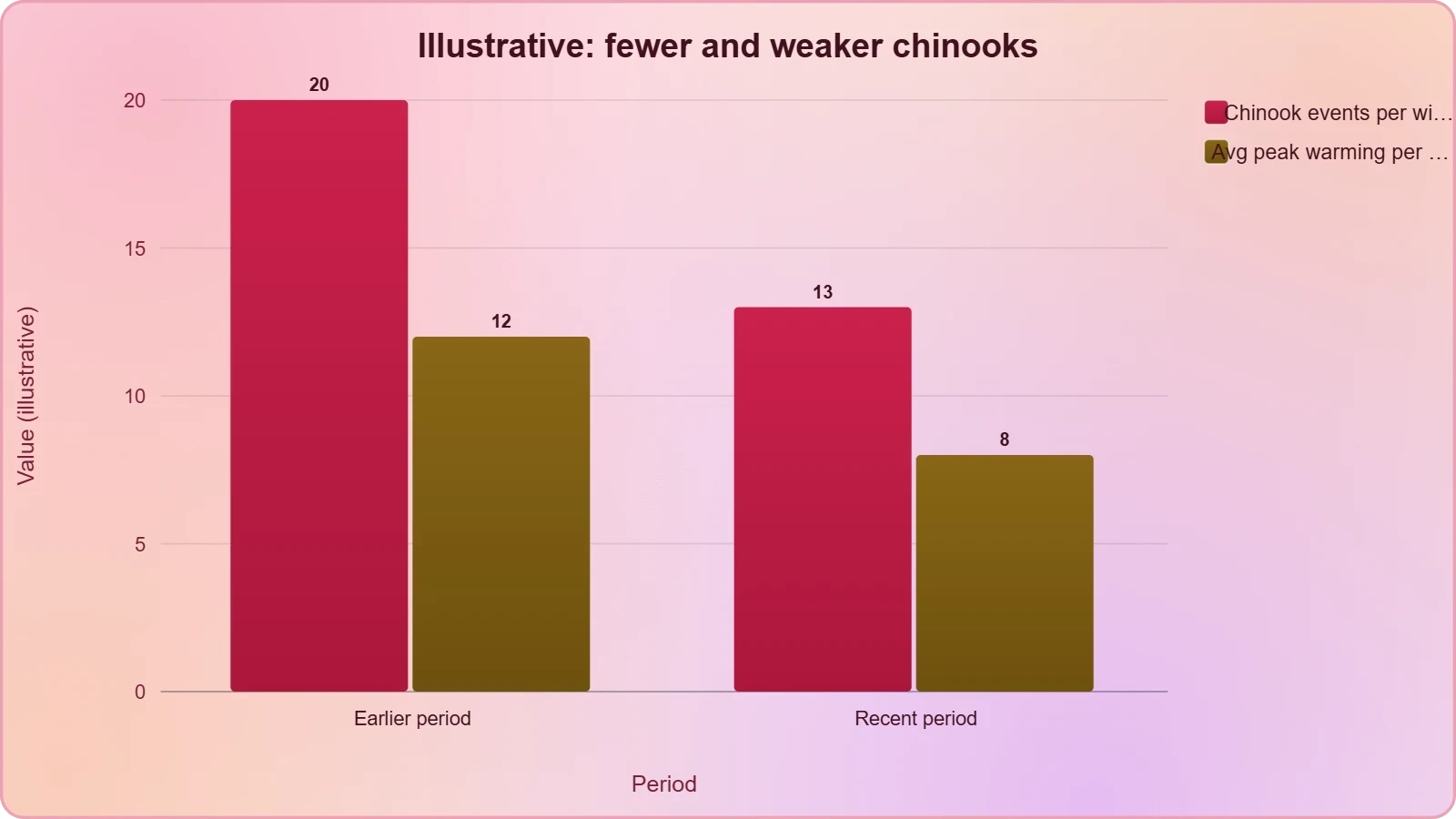
Yackel's team examined the frequency and intensity of chinook events over recent decades, finding declines in both dimensions. Fewer chinooks mean fewer abrupt warm spells; weaker chinooks mean those that occur are less pronounced. The combination points to a shift in the atmospheric conditions that generate downslope winds, possibly linked to changes in Pacific sea-surface temperatures, jet-stream positioning, or Arctic air-mass behaviour. The study does not claim to have resolved every causal question, and that intellectual honesty is itself noteworthy in a field often pressured toward tidy conclusions.
Methodology and the Weight of Evidence
Reconstructing chinook history requires station data, reanalysis products, and careful definitional choices. What counts as a chinook event? A temperature rise of a certain magnitude? A wind-speed threshold? A humidity criterion? Each definitional decision shapes the resulting trend, and the study's conclusions must be read with that sensitivity in mind. Long-term records in sparsely populated regions are also uneven, with station moves, instrument changes, and gaps introducing noise. These are familiar challenges in climatology, and they argue for cautious interpretation rather than dismissal.
Still, the convergence of evidence — a coherent regional signal, a plausible physical mechanism, and a timeline anchored around 1980 — gives the findings credibility. The 1980 inflection is intriguing because it coincides with well-documented shifts in Pacific decadal variability, a pattern that influences winter weather across western North America. If the chinook decline is linked to such large-scale oceanic cycles, it may prove partially reversible; if it reflects a more durable reorganization of circulation, the implications are longer-lasting. Distinguishing between these possibilities is the next frontier.
Contrasting Regional Cooling with Continental Warming
The apparent paradox of a cooling pocket within a warming continent is less contradictory than it first appears. Regional climate is shaped by circulation, topography, and feedbacks that can override global trends for decades at a time. The prairies sit at the confluence of Pacific, Arctic, and continental air masses, and small shifts in their relative influence can produce outsized local effects. Similar "warming holes" have been documented in parts of the southeastern United States and central Asia, where regional dynamics temporarily offset the broader signal.
This context matters for public communication. A headline about cooling in Alberta can be misread as evidence against climate change, which would be a serious misinterpretation. The more accurate reading is that climate change manifests as a redistribution of weather patterns, not a uniform thermostat adjustment. Some regions warm faster, some slower, and some may cool for extended periods. The chinook study is a case study in that heterogeneity, and it underscores why local adaptation planning cannot rely solely on global averages.
Implications for Agriculture, Energy, and Winter Safety
Fewer and weaker chinooks translate into colder, longer winters for southeastern Alberta, and that has direct consequences for the agricultural economy. Ranchers depend on midwinter warm spells to reduce feed requirements and ease livestock stress; a decline in those breaks means higher input costs and greater management complexity. Cropping systems also respond to freeze-thaw cycles, which influence soil structure, moisture retention, and the survival of fall-seeded crops. The study's findings therefore feed directly into farm-level planning and regional agricultural policy.
Energy systems face a parallel adjustment. Chinooks reduce heating demand during the coldest months, and their decline implies higher winter electricity and natural gas consumption. Utilities that model demand on historical chinook patterns may need to revise their forecasts, with implications for peak capacity planning and pricing. Municipal snow-removal budgets, road-salt procurement, and emergency-response planning are similarly sensitive. These operational realities rarely make headlines, but they represent the practical translation of atmospheric science into public expenditure.
Livestock, Forage, and Soil Dynamics
For cattle producers, chinook events function as natural relief valves in an otherwise harsh season. Warm, dry winds melt snow, expose forage, and reduce the need for supplemental feeding. A weaker chinook regime removes that relief, increasing feed costs and demanding more intensive herd management. The effects compound across a season: more snow cover, more energy expenditure by animals, and greater pressure on stored feed supplies. In a region where margins are thin, these shifts can determine the difference between a viable operation and a difficult year.
Soil dynamics add another layer. Repeated freeze-thaw cycles associated with chinooks can improve infiltration and reduce compaction, but they also risk premature loss of snow insulation and damage to overwintering plants. A decline in chinook activity may therefore alter the balance between these costs and benefits, with consequences for soil health and crop establishment. Researchers will need long-term field data to disentangle these effects, and the Calgary study provides a useful prompt for that work.
Infrastructure, Transport, and Public Wellbeing
Chinook winds are notorious for creating hazardous driving conditions, with rapid freeze-thaw transitions producing black ice and gusting winds reducing visibility. Paradoxically, fewer chinooks could reduce some of these acute hazards while increasing chronic ones: more sustained cold, more snow accumulation, and longer periods of icy surfaces. Transportation authorities will need to recalibrate maintenance schedules and salt usage, balancing safety against environmental and budgetary constraints. The net effect is not obviously positive or negative; it is a redistribution of risk.
There is also a human dimension that deserves attention. Chinooks are celebrated for their psychological relief, offering prairie residents a reprieve from the monotony of deep winter. A decline in these events could affect seasonal mood, outdoor activity, and community morale. While such effects are difficult to quantify, they are real and increasingly recognized in climate-health research. The study's findings thus extend beyond meteorology into public health and social wellbeing, reinforcing the case for treating regional climate change as a lived experience rather than an abstraction.
- 01
- 02
- 03
- 04
Reading the Evidence Carefully: Limits and Open Questions
Any single regional study deserves measured interpretation, and the Calgary research is no exception. The chinook record is short relative to the timescales of climate variability, and distinguishing a durable trend from a multi-decadal oscillation is genuinely difficult. The 1980 inflection could mark a regime shift, or it could represent one phase of a longer cycle that will eventually reverse. Researchers will need extended datasets and multiple lines of evidence before drawing firm conclusions about the permanence of the decline.
Definitional choices also matter. Different thresholds for what constitutes a chinook event can yield different trends, and the study's conclusions are sensitive to those choices. Independent replication using alternative datasets and methods would strengthen confidence. None of this undermines the work; it simply places it where good science belongs — as a credible, provocative contribution that invites further investigation rather than a final word. The scientific community's response over the coming years will be as informative as the original findings.
Statistical Significance and Record Length
Climate records in sparsely instrumented regions are inherently noisy, and statistical significance testing must account for autocorrelation and multiple comparisons. A trend that appears robust in one analysis can weaken under different assumptions. The chinook study's findings should therefore be read alongside uncertainty estimates and sensitivity analyses, which are standard practice in the field. Readers should look for confidence intervals and robustness checks when the full paper is examined, as these determine how much weight the conclusions can bear.
Record length is a related concern. Several decades of data can capture meaningful variability, but they may not span the full range of natural oscillation. Paleoclimate proxies and longer reanalysis products can help extend the view, and future work would benefit from integrating these sources. The question is not whether the observed decline is real — the data suggest it is — but whether it represents a persistent shift or a temporary excursion within a longer rhythm.
What Further Research Should Prioritize
The most valuable next step is attribution: identifying which large-scale drivers are responsible for the chinook decline. Pacific decadal variability, Arctic amplification, and jet-stream dynamics are all plausible candidates, and disentangling their contributions requires targeted modelling experiments. Researchers should also examine whether similar declines are occurring in other föhn regions, which would help distinguish local from systemic causes. Comparative studies across the Santa Ana, foehn, and zonda systems could be especially illuminating.
On the applied side, downscaled climate projections for southeastern Alberta should be evaluated for their ability to reproduce chinook behaviour. If models systematically misrepresent downslope winds, their projections for winter temperature, snowpack, and energy demand will be unreliable. Improving the representation of topographic forcing in regional models is therefore a priority with direct practical value. The Calgary study provides a benchmark against which such improvements can be measured, and that alone justifies its prominence.
We Also Published
What a Weaker Chinook Regime Means for the Wider Climate Conversation
The Calgary findings arrive at a moment when public discourse about climate often defaults to continental or global averages. That framing is useful for policy but inadequate for adaptation, because communities experience weather locally. A declining chinook regime in southeastern Alberta is a reminder that climate change is not a single, uniform signal but a mosaic of regional shifts, some of which run counter to the dominant trend. Communicators and policymakers would do well to embrace that complexity rather than flatten it into a simple warming narrative.
There is a broader lesson about humility in climate science. Regional anomalies have repeatedly surprised researchers, from the southeastern United States warming hole to unexpected cooling in parts of Antarctica. Each case forces a re-examination of assumptions and a refinement of models. The chinook study belongs to that tradition of productive surprise, and its value lies as much in the questions it raises as in the answers it provides. Science advances through such challenges, and the public understanding of climate is richer for them.
Adaptation Planning Beyond Averages
For regional planners, the practical takeaway is that historical climate norms may no longer be a reliable guide. Infrastructure designed for a chinook-rich winter regime may be under- or over-specified for a chinook-poor one, and the difference matters for budgets and safety. Adaptive planning should incorporate a range of plausible futures rather than a single projection, and it should be revisited as new evidence emerges. The Calgary study provides one input into that process, and its regional specificity makes it especially useful for local decision-makers.
Insurance and risk management also stand to be affected. Actuarial models that rely on historical weather distributions may need recalibration if chinook frequency and intensity shift durably. The same applies to agricultural insurance, energy hedging, and municipal budgeting. These are unglamorous but consequential adjustments, and they illustrate how a single atmospheric finding can propagate through the economy. The earlier such shifts are recognized, the more gracefully institutions can adapt.
The Value of Local Climate Research
Finally, the study underscores the importance of sustained investment in local climate research. Global models and satellite datasets are indispensable, but they cannot substitute for ground-level observation and regional expertise. Yackel's work at the University of Calgary exemplifies the kind of place-based science that detects signals invisible to coarser analyses. Supporting such research is not a luxury; it is a prerequisite for informed adaptation in a country as climatically diverse as Canada.
The chinook, that warm breath descending from the Rockies, has long been a symbol of prairie resilience. If it is indeed weakening, the symbol takes on a new meaning — a reminder that even the most familiar features of a landscape are subject to change, and that understanding them requires both scientific rigor and local attentiveness. The University of Calgary's findings invite exactly that combination, and they deserve to be read with the care their subject demands.
Conclusion: A Regional Signal Worth Heeding
The University of Calgary's research on chinook winds offers a disciplined, place-based contribution to a global conversation too often dominated by averages. By documenting fewer and weaker chinooks in southeastern Alberta and linking them to a cooling anomaly that began around 1980, John Yackel and his team have given residents, planners, and scientists a concrete phenomenon to examine. The findings do not overturn climate science; they enrich it, demonstrating that regional trajectories can diverge from continental trends in ways that matter profoundly for the people who live there.
What remains is the work of verification, attribution, and adaptation. Longer records, comparative studies of other föhn systems, and improved regional modelling will clarify whether the decline is durable or cyclical. In the meantime, the practical implications for agriculture, energy, transport, and public wellbeing are clear enough to warrant attention. The chinook may be weakening, but the case for careful, locally grounded climate research has rarely been stronger. Southeastern Alberta's winds are telling a story, and it is worth listening closely.
From our network :
- University Language Proficiency Exams: Why Institutional Tests Demand Different Preparation Than IELTS and TOEFLDiscover why university-specific language proficiency examinations differ fundamentally from IELTS and TOEFL, and learn strategic preparation approaches for institutional assessment success.
- Mobile Learning and VR in English: What Global Evidence Reveals About Effective Language TechnologyA systematic review across 14 countries reveals which language-learning technologies genuinely work. Mobile learning, AI, and VR show measurable benefits when pedagogically integrated. This evidence-based guide helps educators and learners select technology that delivers real return on investment.
- The Final Descent: How ESA Retired the Legendary Cluster Constellation After 24 Years of Space Weather ScienceAfter 24 years mapping Earth’s magnetosphere, ESA’s Cluster mission concluded with a precisely controlled reentry over the South Pacific. This analysis explores the scientific legacy, engineering decisions, and debris mitigation principles behind one of space exploration’s most responsible retirements.
- CISA’s Ten-Advisory Wave: Why Generic Patching Fails in OT and How to Build Product-Specific PlaybooksCISA released ten ICS advisories in one week, exposing critical infrastructure risks. Generic patching fails in OT. Learn to build product-specific remediation playbooks.
- Forbidden Matrix Patterns and Visible Lattice Points: A Geometric DictionaryExplore how multidimensional 0–1 matrices encode geometric truths, linking forbidden patterns to visible lattice points and hypergraph theory, with applications in combinatorics and computational geometry.
- Live Online English Classes for Kids: Do They Actually Reduce Anxiety?A ten-week study reveals that synchronous online English classes can significantly reduce child language anxiety while improving listening and reading skills. Discover what makes these programs effective and how parents can select the right one.
- How AI Agents Will Change the Way We Manage Personal FinancesExplore how AI agents are transforming personal finance through automated budgeting, bill payment, and investment management, while examining the critical security protocols and governance frameworks required for safe deployment.
- Committed Mediterranean Precipitation Decline: Why Emissions Cuts Alone Cannot Restore Winter RainsNew NOAA research reveals that Mediterranean winter rains may decline irreversibly even with emissions cuts. Explore the science of committed climate change and regional impacts.
- The Hidden Cost of AI Convenience: Why Over-Permissioned Agents Are a Security Time BombDiscover why AI agents with excessive permissions create dangerous single points of failure, and learn how implementing least privilege principles can protect your organization from exploitation.
RESOURCES
- Anomalous Winter and Spring Cooling in Southeastern Alberta ...tandfonline.comAmong the mesoscale processes influencing winter climate in southern Alberta, chinook winds ... southern Canada, including our study region. This provides ...
- Altered chinook winds result in cooler springs and winters, study findsucalgary.caNov 5, 2026 ... Cold anomaly in southern Alberta the result of climate change.
- Changes in chinook winds in southern Alberta affecting temperaturecalgaryherald.comNov 5, 2026 ... Southern Alberta is having colder winters due to declining and cooler chinook winds, a new University of Calgary study has…
- Chinook winds and migraine attack onset in children and ...headachejournal.onlinelibrary.wiley.comNov 5, 2025 ... Similarly, in Southern Alberta, Canada, Chinooks are dry and warm winds ... Research, the Alberta Children's Hospital Research Institute ...
- Climate change weakening southern Alberta chinooks: studyctvnews.caNov 5, 2026 ... Yackel says the decline in chinooks stems from larger-scale climate ... In addition, the study indicates more northerly, cold winds…
- Weather and chinook winds in relation to spontaneous ... - PMCpmc.ncbi.nlm.nih.govThe chinook winds of southern Alberta belong to a family of warm winter mountain winds ... Our study did not confirm a significant relation…
- New U of C research suggests chinook winds declining in frequency ...ca.news.yahoo.com16 hours ago ... New research out of the University of Calgary suggests fewer chinooks are occurring in southeastern Alberta. John Yackel, professor of ...
- Did Leonardo DiCaprio mistake a chinook for climate change?eenews.netMar 1, 2016 ... DiCaprio said he was caught off guard when strong, dry winds suddenly blew through southern Alberta in the middle of…
- Changes in chinook winds in southern Alberta affecting temperatureca.news.yahoo.comNov 5, 2026 ... ... research shows a decline in warm chinooks during winter in southern Alberta. More. He said this is a signal…
- Winter and early spring CO2 losses in a montane peatland ... - Naturenature.comMay 9, 2026 ... This study reveals that chinook wind events are a climate-sensitive ... Alberta subjected to climate change impact: 1900–2100. Theor ...
- Fire Behaviour Case Study of Two Early Winter Grass ... - Frames.govframes.govNov 27, 2011 ... Chinook Event in Southern Alberta on November, 27 2011 ... southern Alberta, 27 November 2011 – 20. 3.0 DESCRIPTION OF…
- Moisture Transport Diagnosis of a Wintertime Precipitation Event in ...journals.ametsoc.org... chinook wind over the southern MRB at this time. Moderate snow is reported ... Support for this research was provided by the Canadian…
- Chinook wind - Wikipediaen.wikipedia.orgChinook winds, or simply chinooks, are two types of prevailing warm, generally westerly winds in western North America: Coastal Chinooks and interior ...
- WRF Model Simulation of Two Alberta Flooding Events and the ...journals.ametsoc.orgof the province of Alberta, Canada, and they have a pro- found influence on regional weather and climate (e.g.,. Chinook winds and lee-side cyclogenesis).
- Are the number of Chinooks increasing (in Calgary)? - Matt Chernosmattchernos.wordpress.comDec 10, 2015 ... Southern Alberta even has a bunch of folklore centred around the Chinook ... From my breakfast research, I couldn't find…
- 01
- 02
- 03
- 04
- 05
- 06
- 07
- 08
0 Comments