
For decades, the popular imagination has treated idleness as a failure of character and constant focus as the hallmark of a productive mind. Neuroscience now tells a more interesting story. When you stare out of a window, stand under a shower, or walk without a destination, your brain does not power down; it switches into one of its most consequential operating modes. A distributed set of regions, collectively called the default mode network, begins stitching together memories, emotions, and social knowledge into a coherent sense of self. Understanding this system reframes rest not as wasted time but as essential cognitive maintenance.
The discovery of this network was itself an accident of scientific method. In brain-imaging studies from the 1990s and early 2000s, researchers measured activity during demanding tasks and used the quiet intervals between them merely as a baseline for comparison. To their surprise, certain regions were consistently busier during rest than during effortful concentration. That anomaly opened an entirely new field of resting-state neuroscience and forced a reconsideration of what the brain actually does when nobody is asking anything of it. The implications reach into education, workplace design, mental health, and the way we structure our days.
This analysis examines the default mode network in depth: its anatomy, its partnership with the salience network, its role in memory and identity, and the surprising economics of the brain's energy budget. It also considers the practical question the science raises. If mind-wandering supports memory consolidation, future planning, and empathy, then deliberately scheduling unstructured time may be one of the more intelligent things a person can do. The evidence suggests that the wandering mind is not a malfunction but a feature of human cognition worth protecting.
On This Page
TL;DR The default mode network is a set of connected brain regions that becomes active when attention is not directed at an external task. Discovered almost by accident in 1990s brain-imaging research, it supports memory processing, personal identity, future imagination, and perspective-taking. It interacts continuously with the salience network, which monitors for important signals and redirects attention when action is required. The brain consumes roughly 20 percent of the body's energy despite representing only about 2 percent of body weight, and this consumption stays remarkably stable whether you are resting or solving a complex problem. Scheduling genuine downtime may therefore support memory, identity, and social understanding.
The Architecture of a Wandering Brain
The default mode network is best understood not as a single structure but as a coalition of regions that coordinate their activity when external demands recede. Imaging research consistently implicates the medial prefrontal cortex, the posterior cingulate cortex, the precuneus, and angular gyri in this coalition. These areas share dense anatomical connections and tend to rise and fall together in synchronized patterns. When a person engages in a demanding task, this coalition quiets; when attention drifts inward, it reawakens. That rhythmic alternation between task-positive and task-negative states appears to be a fundamental organizing principle of human brain function.
Regions and Their Responsibilities
Each node of the network contributes a distinct capability. The medial prefrontal cortex is heavily involved in self-referential thinking and in simulating the mental states of other people. The posterior cingulate cortex and precuneus support autobiographical memory retrieval and the construction of imagined future scenarios. Angular gyri help integrate semantic knowledge with episodic experience, allowing abstract concepts to be woven into personal narrative. Together these regions produce the continuous inner commentary that most people recognize as ordinary consciousness, the background hum of reflection that fills unstructured moments.
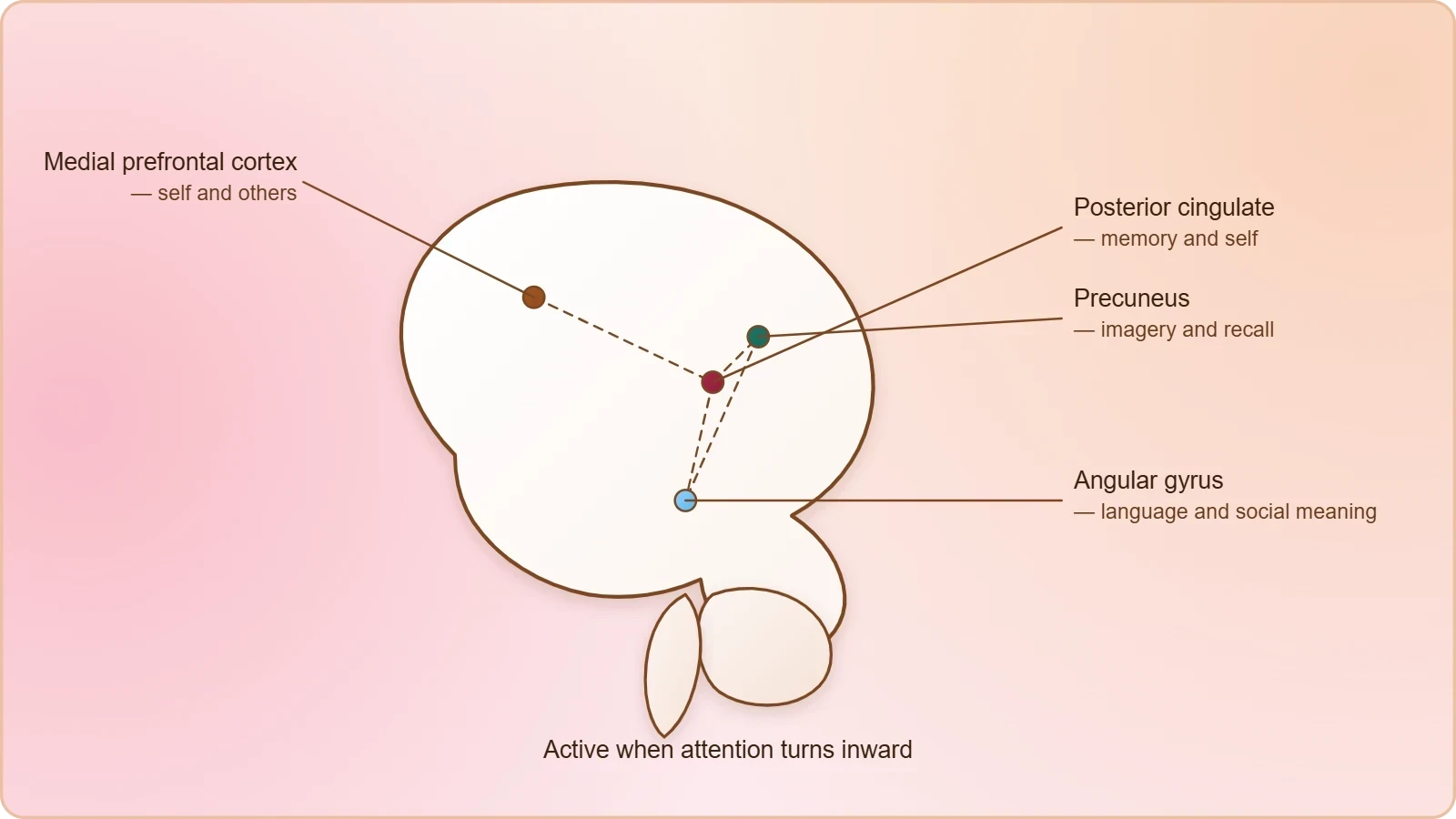
What makes the network remarkable is its integrative character. Rather than processing one category of information, it draws simultaneously on memory, emotion, social knowledge, and bodily sensation. This is why a random association can surface a forgotten conversation, or why a familiar smell can trigger an entire episode from childhood. The network functions as a convergence zone where disparate streams of data meet and are recombined. Researchers describe this as the construction of a situated self-model, an evolving representation of who you are, where you have been, and how you relate to the people around you.
The Accidental Discovery That Changed Neuroscience
The network's origin story is a useful reminder that scientific progress often arrives sideways. In early functional imaging experiments, participants performed cognitive tasks while researchers tracked blood flow as a proxy for neural activity. Rest periods between tasks were treated as neutral baselines, a zero point against which activation could be measured. Yet the data kept showing that specific regions were more active during rest than during the tasks themselves. Initially dismissed as noise or artifact, the pattern proved robust across laboratories, scanners, and participant populations, eventually compelling formal recognition of a resting-state system.
Once scientists began studying rest as a phenomenon in its own right, the field expanded rapidly. Resting-state connectivity became a standard tool for mapping how brain regions communicate, and it now underpins research into development, aging, anesthesia, and psychiatric conditions. The lesson is methodological as well as biological: what looks like an empty baseline may contain the most informative signal. The default mode network emerged precisely because researchers stopped treating quiet moments as irrelevant and started asking what the brain was doing when left to its own devices.
We Also Published
Memory, Identity, and the Narrative Self
Human beings do not experience life as a sequence of disconnected moments. We carry a running story about who we are, and that story is assembled largely by the default mode network. During quiet periods, the brain retrieves episodes from the past, compares them with present circumstances, and projects plausible futures. This narrative work is not idle nostalgia; it is the mechanism by which experience becomes identity. A person who loses the capacity for this integrative reflection loses something essential about personhood, which is why the network's integrity matters so much in aging and neurological disease.
How Memories Become a Sense of Self
Memory in the default mode network is not a filing cabinet but a workshop. The brain reconstructs past events rather than replaying them, blending stored traces with current emotional states and present concerns. This reconstructive process explains why memories shift over time and why the same event can be recalled differently depending on mood. Crucially, the network uses these reconstructions to build an evolving model of the self, one that incorporates knowledge, relationships, and values. The narrative that emerges is continuously revised, which is why identity feels stable yet remains capable of genuine change across a lifetime.
This narrative function also supports social cognition. Understanding another person requires simulating their perspective, imagining what they know, feel, and intend. The same regions that construct your own self-model are recruited to model other minds, which is why empathy and self-reflection share neural real estate. The overlap suggests that social intelligence is not a separate faculty bolted onto cognition but an extension of the machinery that makes selfhood possible. When the network functions well, we navigate both our inner world and our relationships with greater fluency.
Imagination as a Cognitive Tool
Imagining the future is arguably the network's most forward-looking capability. By recombining fragments of past experience, the brain generates simulations of events that have not yet occurred, allowing people to plan, anticipate consequences, and rehearse difficult conversations. This capacity is central to decision-making under uncertainty. A mind that can wander productively is a mind that can test scenarios cheaply before committing to them in reality. The apparent idleness of daydreaming is therefore a form of low-cost experimentation, a rehearsal space where possible selves and possible futures are tried on for size.
Creative insight frequently emerges from this same process. When attention is released from a narrow task, distant ideas can collide and form novel associations. Many people report that solutions arrive during showers, walks, or mundane chores rather than at the desk. This is not superstition but a predictable consequence of network dynamics. The default mode network links concepts across wide semantic distances, and its activity during undemanding periods gives those links time to surface. Deliberately protecting such moments may be one of the simplest ways to support originality in both personal and professional life.
The Salience Network and the Art of Switching
No system can afford to drift indefinitely. The brain needs a mechanism for detecting when the inner world must yield to external reality, and that role belongs to the salience network. Anchored in the anterior insula and dorsal anterior cingulate cortex, it monitors incoming signals for significance: a sudden sound, a physical pain, an emotional shift, a mistake in progress, or a threat in the environment. When something important is detected, the salience network shifts attention and recruits the resources needed for action. It is, in effect, the brain's interrupt handler.
Monitoring What Matters
The salience network operates continuously and largely below awareness, filtering an overwhelming stream of sensory and bodily information down to what deserves attention. This filtering is essential because the brain cannot process everything at once. Bodily signals such as hunger, fatigue, or a racing heartbeat are monitored alongside external cues, which is why emotional and physical states so strongly influence where attention lands. When the salience network flags something, it suppresses the default mode network and hands control to task-oriented systems, producing the familiar experience of being pulled out of a daydream by a ringing phone or a colleague's question.
Disruptions in this switching mechanism are associated with several clinical conditions. Excessive default mode activity has been linked to rumination and depressive symptoms, while impaired salience detection appears in attentional disorders. The balance between the two networks, rather than the activity of either alone, seems to predict healthy cognitive function. This dynamic interplay suggests that mental well-being depends on flexible transitions between inward reflection and outward engagement, not on the dominance of one mode over the other. The goal is not to silence the wandering mind but to keep it responsive to circumstance.
Why the Two Networks Must Cooperate
The relationship between the default mode and salience networks is best described as a partnership rather than a rivalry. The default mode network does not fully shut down during demanding tasks; it remains active at a reduced level, contributing context and meaning to ongoing work. Meanwhile, the salience network decides when internal reflection should be interrupted. This continuous negotiation allows a person to work intently while remaining alert to a child's cry, a change in the room, or an emerging problem. Cognition is thus a rhythmic alternation between absorption and awareness, not a single steady state.
Understanding this cooperation has practical implications. Environments that demand relentless focus without any opportunity for recovery may degrade both modes over time. Conversely, environments that permit periodic disengagement allow the salience network to reset and the default mode network to consolidate. The most productive rhythms tend to alternate deliberately between concentration and unstructured time. Recognizing this pattern can help individuals design workdays, study sessions, and even meetings in ways that respect the brain's natural oscillation rather than fighting it.
The Energy Economics of an Idle Brain
One of the most counterintuitive findings in modern neuroscience concerns energy. The adult human brain constitutes roughly 2 percent of body weight yet consumes approximately 20 percent of the body's energy budget. More striking still, this consumption remains roughly stable whether a person is resting quietly or wrestling with a complex problem. Effortful thinking does not dramatically increase the brain's total energy draw; it merely redistributes activity among regions. The default mode network is a major consumer of this baseline energy, which underscores how metabolically expensive internal reflection actually is.
Why Rest Is Not Free
The stability of cerebral energy use suggests that the brain is always doing something metabolically significant, even when behavior looks passive. Maintaining the default mode network's integrative work, sustaining synaptic readiness, and preserving the ionic gradients required for neural signaling all carry fixed costs. From an evolutionary perspective, such an expensive system would not persist unless it delivered substantial benefits. The capacity to simulate futures, model other minds, and consolidate memory evidently conferred enough advantage to justify the metabolic price. Rest, in this light, is an investment rather than an expense.
This reframing has practical consequences for how we think about productivity. If the brain's baseline metabolism is largely fixed, then the question is not how to reduce energy use during rest but how to ensure that the resting state is doing useful work. Chronic stress and constant stimulation may hijack the default mode network, converting productive reflection into anxious rumination. Genuine downtime, by contrast, allows the network to perform its consolidative and integrative functions. The quality of rest matters as much as its quantity, and protecting it may be as important as protecting working hours.
Implications for Learning and Performance
For students and professionals alike, the energy findings argue against the cult of continuous effort. Learning is consolidated during periods of disengagement, when the brain replays and reorganizes newly acquired information. Cramming without breaks may feel productive while undermining the very consolidation that makes knowledge durable. Similarly, creative problem-solving benefits from incubation periods during which the default mode network can form novel connections. Scheduling deliberate pauses is not indulgence; it is an evidence-based strategy for improving retention, insight, and long-term performance.
Organizations that treat every unstructured moment as waste may be quietly degrading the cognitive resources they depend on. Meetings scheduled back to back, notifications that fragment attention, and cultures that equate visible busyness with value all suppress the conditions under which the default mode network operates best. A more sophisticated approach recognizes that reflection, daydreaming, and unhurried conversation are part of the work of thinking. The most effective knowledge workers often protect blocks of unscheduled time precisely because that is when difficult problems quietly resolve themselves.
- 01
- 02
- 03
- 04
Rumination, Mental Health, and the Balance of Modes
The default mode network is not uniformly beneficial. When its reflective machinery becomes stuck, the same processes that support identity and planning can spiral into rumination, the repetitive replay of negative thoughts that characterizes depression and anxiety. The network's capacity to simulate futures can generate catastrophes rather than plans; its capacity to revisit the past can produce regret rather than learning. The difference between productive reflection and destructive rumination often lies in flexibility, context, and whether the salience network can interrupt the loop and redirect attention toward actionable reality.
When Reflection Turns Inward Destructively
Research on depression has repeatedly implicated altered default mode network activity, particularly heightened connectivity between regions involved in self-referential processing. A mind trapped in this pattern revisits failures, rehearses grievances, and constructs bleak futures with the same integrative machinery that otherwise supports wisdom. Mindfulness-based interventions aim to interrupt this cycle by training attention to return to present experience, effectively strengthening the salience network's capacity to disengage from unproductive loops. The goal is not to suppress self-reflection but to restore its flexibility and its connection to the external world.
Anxiety presents a related pattern. The network's future-simulation capability, so useful for planning, can become a generator of threat scenarios when unregulated. The line between prudent anticipation and chronic worry is thin and often crossed. Clinicians increasingly view these conditions through the lens of network dynamics rather than isolated symptoms, recognizing that mental health depends on the brain's ability to shift fluidly among modes. Interventions that restore this flexibility, whether behavioral, pharmacological, or environmental, may be more effective than those aimed at suppressing any single network.
Designing Days That Support Healthy Cognition
If the science points anywhere practical, it points toward rhythm. Days that alternate focused effort with genuine disengagement give both networks room to operate. A walk without headphones, a few minutes staring out of a window, a shower taken without a podcast, or a commute left unoccupied all create conditions for the default mode network to do its work. These are not luxuries to be earned after productivity; they are inputs to productivity. Protecting them requires intention, because modern environments are engineered to capture attention at every spare moment.
The broader cultural implication is that our suspicion of idleness may be misplaced. A society that fills every pause with stimulation may be trading reflection for reactivity. The capacity to sit with one's own thoughts, to let the mind wander, and to return refreshed is a skill worth cultivating. It supports memory, creativity, empathy, and a coherent sense of self. The wandering mind, properly understood, is not a problem to be solved but a resource to be protected, and the evidence for that claim is now substantial.
What the Default Mode Network Means for How We Live
The default mode network reframes several assumptions that modern life takes for granted. It suggests that attention is not a resource to be maximized at all times but a system that requires alternation between engagement and disengagement. It implies that identity is an active construction rather than a fixed possession, continuously rebuilt from memory and social experience. And it indicates that the brain's most distinctive human capacities, including empathy, foresight, and self-awareness, depend on periods when nothing external is demanding our focus. These are not minor adjustments to the conventional view; they are a different account of what thinking is.
Practical Habits That Respect the Science
Translating this into daily practice does not require dramatic change. It requires protecting small windows of unstructured time and resisting the urge to fill them. Leaving a phone in another room during a walk, allowing a few minutes of silence after a meeting, or simply sitting without input for a short period can be enough to let the network operate. The key is regularity rather than duration. Brief, repeated opportunities for reflection appear more valuable than occasional long retreats, because the network benefits from frequent activation and the flexibility that comes with it.
For parents, educators, and managers, the implications extend to how we structure other people's time. Children benefit from unscheduled play and boredom; students benefit from spacing and incubation; employees benefit from autonomy over their attention. Environments that eliminate every gap may produce short-term compliance at the cost of long-term capability. The evidence suggests that the most humane and effective approach is to treat reflection as a legitimate part of work and learning, not as a deviation from it. That shift in framing may be the most valuable practical takeaway from the entire field.
Open Questions and Future Research
Despite three decades of study, important questions remain. Researchers are still working out how the default mode network interacts with other large-scale systems, how its function changes across the lifespan, and how individual differences in its activity relate to personality and well-being. The relationship between mind-wandering and creativity is well documented but not fully explained. And the boundary between adaptive reflection and maladaptive rumination remains an active area of clinical investigation. Each of these questions carries implications for education, mental health treatment, and the design of everyday environments.
What is already clear is that the brain's resting state is not a void. It is a busy, structured, metabolically expensive mode of operation that does essential work. The default mode network builds the narrative of who we are, simulates the futures we might inhabit, and models the minds of the people around us. It is interrupted, appropriately, by the salience network whenever reality demands attention. Understanding this partnership offers a more accurate picture of human cognition and a more forgiving standard for how to live with our own minds.
From our network :
- How AI Agents Will Change the Way We Manage Personal FinancesExplore how AI agents are transforming personal finance through automated budgeting, bill payment, and investment management, while examining the critical security protocols and governance frameworks required for safe deployment.
- Live Online English Classes for Kids: Do They Actually Reduce Anxiety?A ten-week study reveals that synchronous online English classes can significantly reduce child language anxiety while improving listening and reading skills. Discover what makes these programs effective and how parents can select the right one.
- Forbidden Matrix Patterns and Visible Lattice Points: A Geometric DictionaryExplore how multidimensional 0–1 matrices encode geometric truths, linking forbidden patterns to visible lattice points and hypergraph theory, with applications in combinatorics and computational geometry.
- Committed Mediterranean Precipitation Decline: Why Emissions Cuts Alone Cannot Restore Winter RainsNew NOAA research reveals that Mediterranean winter rains may decline irreversibly even with emissions cuts. Explore the science of committed climate change and regional impacts.
- Mobile Learning and VR in English: What Global Evidence Reveals About Effective Language TechnologyA systematic review across 14 countries reveals which language-learning technologies genuinely work. Mobile learning, AI, and VR show measurable benefits when pedagogically integrated. This evidence-based guide helps educators and learners select technology that delivers real return on investment.
- CISA’s Ten-Advisory Wave: Why Generic Patching Fails in OT and How to Build Product-Specific PlaybooksCISA released ten ICS advisories in one week, exposing critical infrastructure risks. Generic patching fails in OT. Learn to build product-specific remediation playbooks.
- The Hidden Cost of AI Convenience: Why Over-Permissioned Agents Are a Security Time BombDiscover why AI agents with excessive permissions create dangerous single points of failure, and learn how implementing least privilege principles can protect your organization from exploitation.
- University Language Proficiency Exams: Why Institutional Tests Demand Different Preparation Than IELTS and TOEFLDiscover why university-specific language proficiency examinations differ fundamentally from IELTS and TOEFL, and learn strategic preparation approaches for institutional assessment success.
- The Final Descent: How ESA Retired the Legendary Cluster Constellation After 24 Years of Space Weather ScienceAfter 24 years mapping Earth’s magnetosphere, ESA’s Cluster mission concluded with a precisely controlled reentry over the South Pacific. This analysis explores the scientific legacy, engineering decisions, and debris mitigation principles behind one of space exploration’s most responsible retirements.
RESOURCES
- Rest to Promote Learning: A Brain Default Mode Network Perspectivepmc.ncbi.nlm.nih.govApr 22, 2024 ... The brain often switches freely between focused attention and divergent thinking, and the Default Mode Network (DMN) is activated during…
- Default mode network - Wikipediaen.wikipedia.orgRaichle coined the term "default mode" in 2001 to describe resting state brain function; the concept rapidly became a central theme in neuroscience. Around…
- Creativity and the default network: A functional connectivity analysis ...pmc.ncbi.nlm.nih.govCreativity and the default network: A functional connectivity analysis of the creative brain at rest ... default mode of brain function. Proceedings of the ...
- Rest: The Default Mode Network - Brain Factsbrainfacts.orgAug 30, 2022 ... The default mode network is a collection of brain regions active during quiet rest while awake.
- The brain's default mode network - PubMedpubmed.ncbi.nlm.nih.govJul 8, 2015 ... ... resting state; self. Publication types. Review. MeSH terms. Animals; Brain / physiology*; Humans; Neural Pathways / physiology*; Rest / ...
- The Brain's Default Mode Network - Annual Reviewsannualreviews.orgJul 8, 2015 ... Dynamic MR imaging of human brain oxygenation during rest ... Functional connectivity in the resting brain: a network analysis of…
- Functional connectivity in the resting brain - PubMed - NIHpubmed.ncbi.nlm.nih.govFunctional connectivity in the resting brain: a network analysis of the default mode hypothesis. Proc Natl Acad Sci U S A. 2003 Jan 7;100(1):253-8.…
- Coffee consumption decreases the connectivity of the posterior ...frontiersin.orgJun 27, 2023 ... Coffee consumption decreases the connectivity of the posterior Default Mode Network (DMN) at rest ... ). The brain's default network.…
- 20 years of the default mode network: A review and synthesissciencedirect.comDuring this time, at Stanford, we began to acquire whole-brain resting-state fMRI in healthy adult controls and in patients with depression or Alzheimer's ...
- Functional connectivity in the resting brain: A network analysis of the ...pnas.orgWe report significant inverse correlations among all three lateral prefrontal regions and PCC, suggesting a mechanism for attenuation of default mode network ...
- Know Your Brain: Default Mode Networkneuroscientificallychallenged.comJun 16, 2015 ... It was in one of these publications that they used the term default mode to refer to this resting activity,…
- A default mode of brain function | PNASpnas.orgIf this hypothesis is correct, the chosen regions should exhibit an OEF similar to that of the rest of the brain in this baseline…
- Resting-state global brain activity affects early β-amyloid ... - Naturenature.comNov 27, 2023 ... ... default mode network (DMN), years before AD diagnosis. Resting-state low-frequency ( < 0.1 Hz) global brain activity recently was…
- 01
- 02
- 03
- 04
- 05
- 06
- 07
- 08
0 Comments