High above the Spanish Pyrenees, the Aneto glacier clings to the slopes of the range's highest peak, a frozen remnant of a colder climate that has endured for millennia. Within roughly a decade, scientists expect it to be gone entirely. This is not a distant projection or a worst-case scenario buried in a modelling appendix; it is the measured trajectory of one of southern Europe's largest remaining glaciers, and it carries implications that reach far beyond the mountain itself. The Aneto's decline has become a visible, tangible marker of global warming in a region where the consequences of rising temperatures are arriving faster than almost anywhere else on the continent.
What makes the Aneto story so instructive is its clarity. Glaciers are among the most honest instruments climate science possesses: they accumulate snow in winter, lose ice through melt in summer, and their net mass balance records the difference with little ambiguity. When a glacier of this scale enters terminal decline, the signal is difficult to dispute and easy to communicate. Glaciologists studying the Pyrenees have watched the Aneto thin, retreat and fragment, and their findings now serve as a case study for understanding how mountain ice across southern Europe is responding to sustained warming.
This analysis examines the Aneto glacier's rapid melting, the science behind its projected disappearance, and the wider lessons it offers for glaciologists, water managers and communities downstream. It draws on reporting from France 24 journalists Maude Petit-Jové, Mathilde Lopinski and Sarah Morris, and situates the Pyrenees within the broader pattern of European glacier loss. The aim is to explain not only what is happening on the mountain, but why a single glacier in northern Spain matters to the way we understand climate change across the continent.
On This Page
TL;DR The Aneto glacier, one of the largest in southern Europe, sits on the highest peak of the Spanish Pyrenees and is melting at a pace that scientists expect will erase it within about ten years. Its decline is a clear, measurable signal of global warming and a valuable case study for glaciologists tracking how mountain ice responds to sustained temperature rise. The loss carries consequences for regional water systems, alpine ecosystems and the scientific record, and it places the Pyrenees at the leading edge of European glacier retreat.
The Aneto Glacier and Its Place in the Pyrenees
The Aneto glacier occupies the upper flanks of Pico Aneto, the 3,404-metre summit that crowns the Pyrenees and gives the massif its highest point. For centuries the glacier has been a defining feature of the Spanish side of the range, feeding meltwater into valleys and shaping the landscape around it. It ranks among the largest glaciers in southern Europe, a distinction that once spoke to its resilience but now underscores the scale of what stands to be lost. Its position on the range's highest ground means it has been among the last refuges for ice in the Pyrenees.
That refuge status is precisely what makes the Aneto's decline so telling. Glaciers at high altitude and in shaded aspects typically persist longer than those at lower elevations, so when the highest and largest ice bodies begin to fail, the signal is unambiguous. The Aneto has been monitored for decades, and the record shows sustained loss of both area and thickness. Researchers describe a glacier that is no longer merely retreating at its margins but thinning across its body, a pattern that points toward eventual disappearance rather than stabilisation.
The Geography and Significance of Pico Aneto
Pico Aneto rises above the Maladeta massif in the province of Huesca, within the Pyrenees that form the natural border between Spain and France. The mountain's glacier has long been a landmark for mountaineers and a subject of scientific interest, and its meltwater contributes to the headwaters of rivers that serve communities on both sides of the range. The glacier's setting at the roof of the Pyrenees gives it outsized symbolic weight: when the highest ice in a mountain range begins to vanish, the message about regional climate is difficult to soften or reinterpret.
The Aneto's significance extends beyond symbolism. As one of the southernmost substantial glaciers in Europe, it sits near the climatic limit at which mountain ice can survive. That position makes it a sensitive indicator, responding quickly to shifts in temperature and snowfall. Scientists value such glaciers precisely because they register change early, offering a preview of what may later unfold at higher latitudes and altitudes where ice is more extensive and slower to respond.
Why Southern European Glaciers Are Under Pressure
Southern Europe's glaciers face a combination of pressures that make them especially vulnerable. Summer temperatures in the Pyrenees and the Alps have risen markedly, lengthening the melt season and reducing the period during which snow cover protects ice from direct solar radiation. Winters have also changed, with more precipitation falling as rain rather than snow at moderate altitudes and with dust from the Sahara occasionally settling on glacier surfaces, darkening them and accelerating absorption of sunlight. Each factor compounds the others, pushing ice bodies toward a threshold beyond which recovery becomes implausible.
The Pyrenees are particularly exposed because their glaciers are small and scattered, lacking the mass and altitude buffers that protect larger ice fields. Once a glacier loses the capacity to retain snow through the summer, its decline tends to accelerate. Researchers studying the range have documented the disappearance of several small glaciers in recent decades, and the Aneto now stands at the front of that retreating line. Its fate is therefore not an isolated curiosity but part of a regional pattern with clear direction.
We Also Published
The Science of Rapid Glacier Loss
Glacier loss is governed by a simple accounting principle: ice gained through snowfall must balance ice lost through melting and sublimation. When temperatures rise, the melt side of the ledger grows while the accumulation side shrinks, and the glacier's mass balance turns negative. For the Aneto, that imbalance has persisted for years, and the cumulative effect is a body of ice that is both smaller and thinner than it was a generation ago. Scientists measure these changes through field surveys, satellite imagery and aerial photography, building a record that leaves little room for doubt about the direction of travel.
The speed of the Aneto's decline reflects feedback mechanisms that accelerate once a glacier begins to weaken. As ice thins, its surface sits at lower altitudes where temperatures are higher, increasing melt. Darkening of the surface through dust and the exposure of older, dirtier ice further reduces reflectivity, so the glacier absorbs more solar energy. These processes can push a glacier past a tipping point after which even favourable snow years cannot restore lost mass. The projected ten-year horizon for the Aneto reflects this compounding dynamic rather than a single season of extreme heat.
Mass Balance and the Measurement of Decline
Glaciologists describe a glacier's health through its mass balance, the net difference between accumulation and ablation over a year. A glacier with a consistently negative balance is losing more ice than it gains and is on a path toward retreat or disappearance. For the Aneto, measurements have shown sustained deficits, and the glacier's area has contracted as its margins pull back upslope. The science is painstaking: researchers stake the surface, drill into the ice and compare seasonal readings, while satellite data provide broader context on how the glacier's footprint has changed over decades.
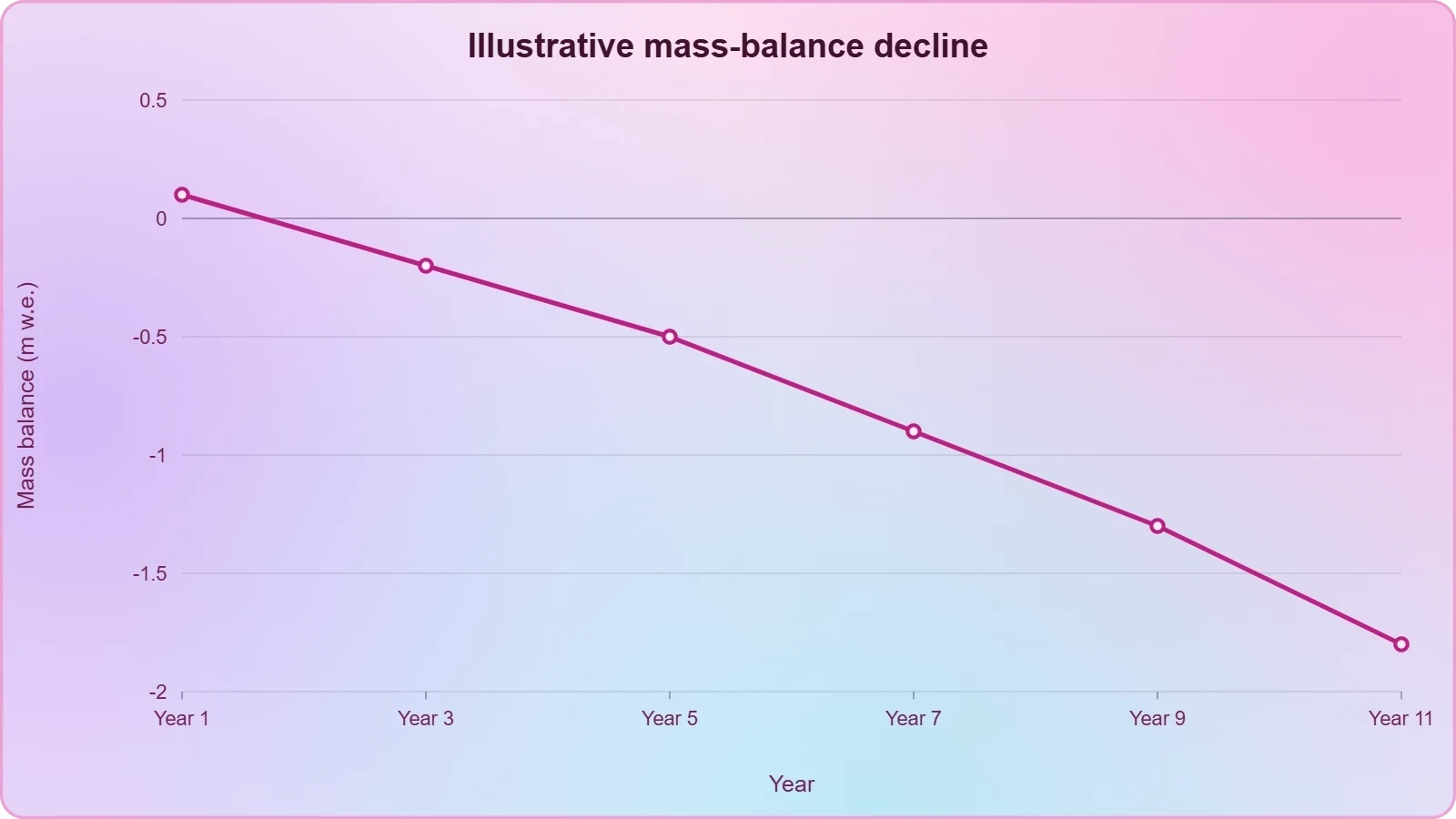
These measurements matter because they convert a visible landscape change into quantitative evidence. A retreating glacier is dramatic to observe, but its mass balance tells scientists how fast the loss is occurring and how close the ice body is to the threshold of no return. For the Aneto, the numbers point toward a terminal phase. The glacier is no longer simply adjusting to a few warm summers; it is responding to a climate that has shifted beyond the conditions that allowed it to persist.
Feedback Loops That Accelerate Melting
Several feedback loops work against the Aneto and similar glaciers. The albedo feedback is the most familiar: bright snow reflects sunlight, but darker ice and rock absorb it, warming the surface and hastening further melt. A second loop involves altitude: as the glacier's surface lowers, it encounters warmer air, which increases the energy available for melting. A third involves the loss of the insulating snowpack that once shielded ice from summer sun. Together these mechanisms create a self-reinforcing cycle that makes the final years of a glacier's life disproportionately rapid.
Understanding these loops is central to projecting the fate of mountain ice across Europe. A glacier that appears stable can cross a threshold and decline quickly once feedbacks dominate. The Aneto's trajectory suggests it has entered that phase, which is why scientists speak of disappearance within a decade rather than a slow, gradual fade over a century. The lesson for glaciologists is that timing matters: the difference between a glacier that survives and one that vanishes can hinge on a narrow margin of temperature and snow.
What the Aneto Teaches Glaciologists
The Aneto's decline offers a rare opportunity to study a glacier through its final phase. Most of the world's ice is retreating, but relatively few glaciers are small enough and well-monitored enough for scientists to observe the endgame in detail. The Aneto provides a natural laboratory where researchers can test models of glacier response, refine projections for larger ice bodies, and document the ecological and hydrological changes that accompany disappearance. The lessons learned here inform the study of mountain ice far beyond the Pyrenees.
There is also a methodological dimension. The Aneto has been photographed, surveyed and mapped for decades, giving scientists a long baseline against which to measure change. That historical record is invaluable for distinguishing long-term trends from short-term variability. When researchers say the glacier may vanish within a decade, they are drawing on a deep archive of observations, not a single season of data. The credibility of the projection rests on that accumulated evidence and on the consistency of the signal across multiple measurement methods.
A Natural Laboratory for Glacier Research
Small glaciers like the Aneto respond quickly to climate shifts, which makes them useful early-warning systems. Their sensitivity means that changes which might take centuries to manifest in a large ice sheet appear within years on a Pyrenean peak. Researchers can observe the full sequence of decline, from initial thinning to fragmentation to final disappearance, and use those observations to calibrate models that are applied elsewhere. The Aneto thus functions as a test case whose value extends well beyond its own slopes.
The glacier also offers insights into how ice bodies fragment as they die. Rather than shrinking uniformly, a declining glacier often splits into separate patches that melt at different rates, with shaded or debris-covered remnants persisting longer. Studying this fragmentation helps scientists interpret the behaviour of larger glaciers that may eventually face similar conditions. The Aneto's final years are, in effect, a preview of processes that could unfold across southern Europe's mountain ranges as warming continues.
Lessons for Water and Ecosystem Management
Glacier loss is not only a scientific concern; it has practical consequences for water resources and ecosystems. In the Pyrenees, glacier melt contributes to river flows during the dry summer months, supplementing snowmelt and rainfall when demand for water is highest. The Aneto's disappearance will not empty the rivers, but it will reduce a buffer that has historically helped sustain flows during droughts. Water managers in the region will need to account for a future in which that buffer is diminished or absent.
Ecosystems around the glacier will also change. Cold meltwater supports specialised plants and animals adapted to alpine conditions, and the loss of ice alters stream temperatures and flow patterns. The retreat of the glacier exposes new terrain that will be colonised by pioneer species, reshaping the landscape over time. These ecological shifts are already underway, and the Aneto's decline accelerates them. Understanding the full suite of consequences requires integrating glaciology with hydrology and ecology, a lesson that applies to mountain regions worldwide.
The Pyrenees in the Wider European Context
The Aneto's fate is part of a continental pattern. Glaciers across the Alps, the Pyrenees and other European ranges have been retreating for decades, and projections suggest that many will disappear or shrink dramatically by the end of the century. The European Environment Agency and national research bodies have documented widespread loss of glacier mass, with the pace accelerating in recent years. Southern Europe, where temperatures are rising faster than the global average, is at the sharp end of this trend, and the Pyrenees sit near the southern limit of European glaciation.
Comparing the Pyrenees with the Alps helps clarify what is at stake. The Alps hold far more ice and include glaciers large enough to persist for decades even under strong warming, though they too are losing mass rapidly. The Pyrenees, by contrast, have only a handful of glaciers, most of them small and vulnerable. The Aneto is among the largest of a diminishing group, and its loss would leave the range with even fewer ice bodies. The contrast illustrates how geography and scale shape the timing of glacier disappearance across Europe.
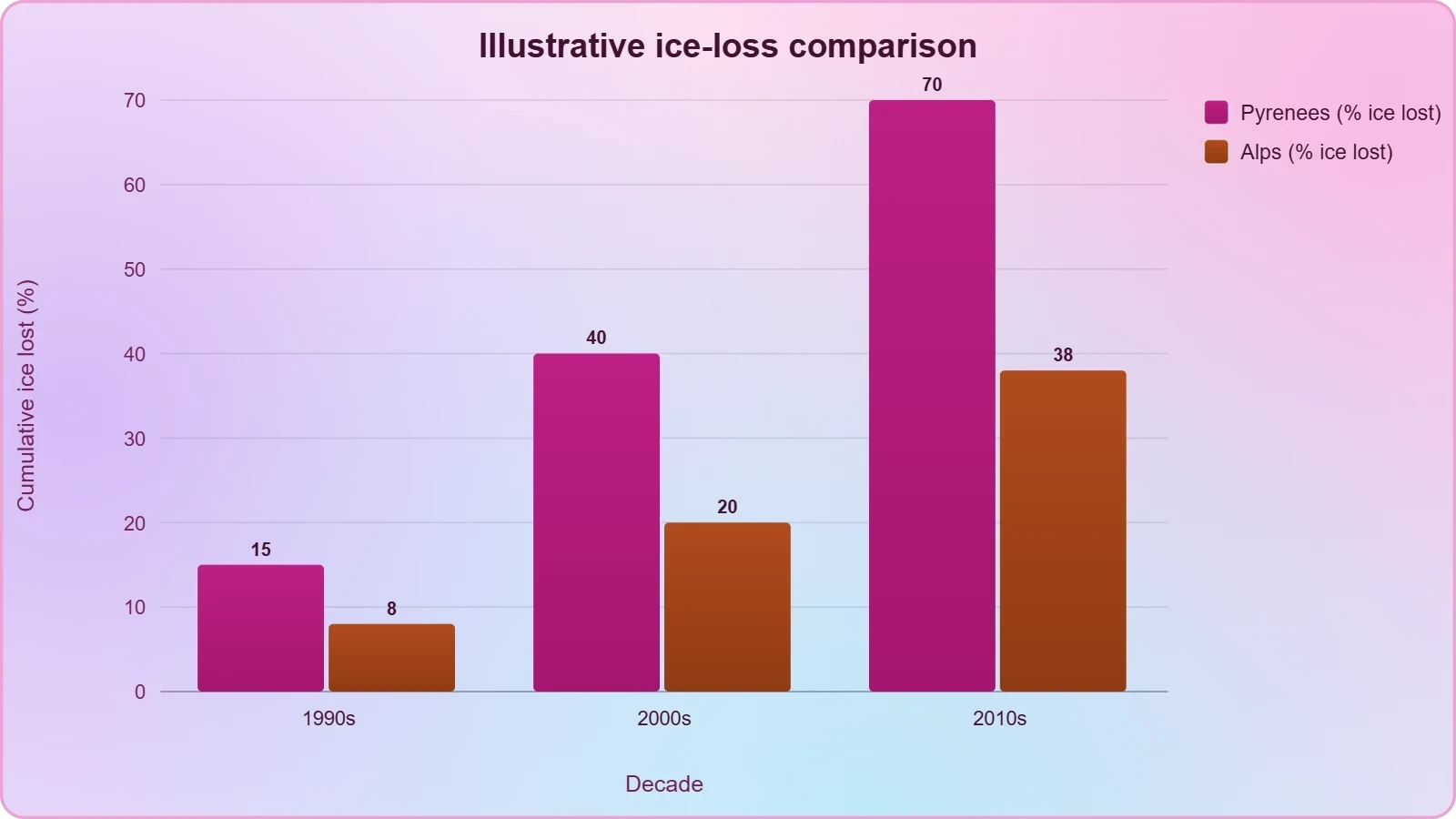
Comparing Pyrenean and Alpine Glacier Retreat
Alpine glaciers benefit from higher elevations and greater accumulation, which give them more resilience than their Pyrenean counterparts. Even so, Swiss and Austrian glaciers have lost substantial mass in recent decades, and some low-altitude glaciers have already vanished. The Pyrenees lack the altitude and the ice volume to buffer against warming, so their glaciers are retreating faster relative to their size. The Aneto's projected ten-year horizon is shorter than most Alpine projections, reflecting the range's marginal position for glacier survival.
This comparison carries a broader message: glacier loss is not uniform but follows a geographic gradient, with southern and lower-elevation ice disappearing first. The Pyrenees serve as an early indicator of what may later occur further north and higher up. Scientists studying European glaciers therefore pay close attention to the Pyrenees, not because the ice volume is large, but because the timing of loss provides a preview of the continent's climatic future.
Implications for European Climate Policy
The Aneto's decline adds weight to arguments for ambitious climate policy. Glacier loss is a visible, measurable consequence of warming, and it resonates with publics in ways that abstract temperature targets sometimes do not. The disappearance of a landmark glacier in a populated, visited mountain range makes the abstract concrete. For policymakers, the Pyrenees offer a case study in adaptation as well as mitigation: even with strong emissions reductions, some glacier loss is already locked in, and communities must plan for a future with less ice.
Adaptation will involve managing water resources more carefully, protecting alpine ecosystems under stress, and adjusting tourism and land use as the landscape changes. Mitigation remains essential to limit how far glacier loss extends, particularly for larger ice bodies that could still be saved. The Aneto's fate is largely sealed, but the broader trajectory of European glaciers is not. The choices made in the coming decade will determine how many other glaciers follow the Aneto into disappearance.
Reading the Aneto as a Climate Signal
Beyond its scientific value, the Aneto functions as a cultural and symbolic marker. Glaciers occupy a distinctive place in the public imagination: they are ancient, seemingly permanent features of the landscape, and their loss registers as a kind of bereavement. The Aneto has been climbed, photographed and written about for generations, and its disappearance will change the identity of the mountain. That cultural dimension matters because climate communication often struggles to make abstract trends feel real, and a vanishing glacier makes the change tangible.
The Aneto also illustrates the value of long-term observation. The glacier's decline has been documented by journalists as well as scientists, and reporting from outlets such as France 24 has brought the story to wider audiences. The work of Maude Petit-Jové, Mathilde Lopinski and Sarah Morris situates the glacier within a human narrative, connecting the science to the people who study and visit the mountain. That combination of rigorous measurement and accessible storytelling is essential for sustaining public attention on slow-moving environmental change.
Symbolism and Public Perception
Glaciers carry symbolic weight that few other natural features match. They represent permanence, purity and the passage of geological time, and their retreat is read as a warning about human impact on the planet. The Aneto's projected disappearance within a decade gives that warning a deadline, which can be more motivating than distant projections. Public perception matters because it shapes political will, and a visible, named glacier in a well-known mountain range is a more effective messenger than an abstract statistic.
At the same time, symbolism carries risks. Focusing on a single iconic glacier can obscure the broader pattern of loss and create the impression that climate change is only about distant landscapes. The Aneto's story is most useful when it is connected to the wider science: the same warming that is melting the Pyrenees is affecting water supplies, agriculture and ecosystems across Europe. The glacier is a signal, not an isolated tragedy, and its value lies in what it reveals about the larger system.
The Role of Journalism in Climate Reporting
Reporting on the Aneto demonstrates how journalism can translate scientific findings into public understanding. Field reporting from the mountain, interviews with glaciologists and visual documentation give audiences a concrete sense of what is happening. This kind of coverage complements the peer-reviewed literature by making the science accessible without oversimplifying it. The France 24 focus segment on the Aneto is an example of how media can bridge the gap between research and public awareness, bringing the story of a melting glacier to audiences who may never visit the Pyrenees.
Journalism also plays a role in accountability, pressing institutions to respond to documented environmental change. When a glacier's decline is reported clearly and repeatedly, it becomes harder for policymakers to ignore. The Aneto's story is part of a broader body of climate reporting that has raised the profile of glacier loss across Europe. That coverage helps sustain pressure for mitigation and adaptation, and it ensures that the fate of the Pyrenees remains part of the public conversation.
Looking Ahead: A Decade of Decision
The next ten years will determine whether the Aneto survives in any form or passes into memory. Scientists expect the glacier to disappear within roughly that window, and the processes driving its decline are well understood. The question is not whether the Aneto will vanish but how quickly, and what its loss will mean for the Pyrenees and for the broader effort to understand and respond to climate change. The glacier's fate is a reminder that some environmental changes are already irreversible, even as others remain within reach of policy.
For glaciologists, the Aneto's final years are an opportunity to document a disappearance in detail, adding to a growing body of knowledge about how mountain ice responds to warming. For communities in the Pyrenees, the loss is a practical challenge requiring adaptation in water management, tourism and ecosystem protection. For the wider public, the glacier is a signal that climate change is not a distant abstraction but a process unfolding now, on a mountain that has held ice for millennia and will soon hold none.
What Comes After the Ice
When the Aneto's ice is gone, the mountain will remain, but its character will change. Bare rock will replace the glacier, and new ecological communities will establish themselves on the exposed terrain. The scientific record will preserve the glacier's history, but the living ice body will be absent. This transition is already visible on other Pyrenean peaks where glaciers have vanished, offering a glimpse of what awaits the Aneto. The post-glacial landscape will be studied, visited and photographed, but it will not be the same mountain.
The loss also raises questions about how we remember vanished glaciers. Documentation, photography and scientific archives will preserve the record, and the Aneto's story will serve as a case study for future generations. There is a case for treating such losses as part of a broader environmental accounting, ensuring that the disappearance of a glacier is recorded not only as a scientific datum but as a cultural and ecological event. The Aneto's final decade is therefore a period of both observation and reckoning.
Adaptation and the Limits of Mitigation
Even with aggressive emissions reductions, the Aneto is unlikely to survive, because the warming that drives its decline is already committed. This reality underscores the distinction between mitigation, which limits future change, and adaptation, which manages the consequences that can no longer be avoided. For the Pyrenees, adaptation means planning for reduced summer meltwater, protecting vulnerable ecosystems and adjusting how the mountain is used and managed. These measures cannot save the glacier, but they can soften the impacts of its loss.
Mitigation remains essential for the larger picture. The choices made in the coming decade will determine how many other glaciers follow the Aneto, and whether the loss of mountain ice remains a regional phenomenon or becomes a continental one. The Aneto's fate is a warning, but it is also a call to action: the same science that predicts its disappearance can inform the decisions that shape the future of ice elsewhere. The glacier's final decade is, in that sense, a decade of decision for Europe as a whole.
From our network :
- Mobile Learning and VR in English: What Global Evidence Reveals About Effective Language TechnologyA systematic review across 14 countries reveals which language-learning technologies genuinely work. Mobile learning, AI, and VR show measurable benefits when pedagogically integrated. This evidence-based guide helps educators and learners select technology that delivers real return on investment.
- The Final Descent: How ESA Retired the Legendary Cluster Constellation After 24 Years of Space Weather ScienceAfter 24 years mapping Earth’s magnetosphere, ESA’s Cluster mission concluded with a precisely controlled reentry over the South Pacific. This analysis explores the scientific legacy, engineering decisions, and debris mitigation principles behind one of space exploration’s most responsible retirements.
- University Language Proficiency Exams: Why Institutional Tests Demand Different Preparation Than IELTS and TOEFLDiscover why university-specific language proficiency examinations differ fundamentally from IELTS and TOEFL, and learn strategic preparation approaches for institutional assessment success.
- Forbidden Matrix Patterns and Visible Lattice Points: A Geometric DictionaryExplore how multidimensional 0–1 matrices encode geometric truths, linking forbidden patterns to visible lattice points and hypergraph theory, with applications in combinatorics and computational geometry.
- Committed Mediterranean Precipitation Decline: Why Emissions Cuts Alone Cannot Restore Winter RainsNew NOAA research reveals that Mediterranean winter rains may decline irreversibly even with emissions cuts. Explore the science of committed climate change and regional impacts.
- How AI Agents Will Change the Way We Manage Personal FinancesExplore how AI agents are transforming personal finance through automated budgeting, bill payment, and investment management, while examining the critical security protocols and governance frameworks required for safe deployment.
- CISA’s Ten-Advisory Wave: Why Generic Patching Fails in OT and How to Build Product-Specific PlaybooksCISA released ten ICS advisories in one week, exposing critical infrastructure risks. Generic patching fails in OT. Learn to build product-specific remediation playbooks.
- The Hidden Cost of AI Convenience: Why Over-Permissioned Agents Are a Security Time BombDiscover why AI agents with excessive permissions create dangerous single points of failure, and learn how implementing least privilege principles can protect your organization from exploitation.
- Live Online English Classes for Kids: Do They Actually Reduce Anxiety?A ten-week study reveals that synchronous online English classes can significantly reduce child language anxiety while improving listening and reading skills. Discover what makes these programs effective and how parents can select the right one.
RESOURCES
- Climate change in Aneto Glacier - ArcGIS StoryMapsstorymaps.arcgis.comNov 9, 2023 ... In recent decades the rate of melting has increased and it is predicted that by 2070 there will be no…
- Aneto Glacier, Spain-Retreating and Disappearingglacierchange.blogApr 17, 2014 ... Glacier Change in a world of Climate Change ... Related. Aneto Glacier meltpyrenees glacier retreatSpain glacier meltSpain glacier retreat ...
- The Aneto glacier's (Central Pyrenees) evolution from 1981 to 2022tc.copernicus.orgAug 8, 2023 ... (d) Cumulative area change plot of the Aneto glacier for the ... Climate change and tropical Andean glaciers: Past, present…
- Herds in the forest and rethinking tourism to adapt the Pyrenees to a ...creaf.catDec 9, 2025 ... ... Pyrenean Climate Change Observatory (OPCC) of the Pyrenees Working Community. ... melting of the Pyrenean glaciers. In Catalonia, for ...
- Rising temperatures forecast to wipe out Spain's remaining glaciers ...reddit.comAug 11, 2023 ... Snow is common although unfortunately not that much as of lately due to climate change. We also have high mountains…
- Pyrenees Glaciers Are Rapidly Disappearing - Eos.orgeos.orgOct 4, 2021 ... ... Aneto Glacier in the Pyrenees mountains melts in September 2020. ... Climate Change, ENGAGE, Geophysical Research Letters, glaciers &…
- state of the glaciers after the extreme mass losses in 2022 and 2023link.springer.comNov 29, 2024 ... Glacier Dynamics and Climate Change Impacts. Introduction. As global ... In addition, glacier retreat (e.g. Aneto) is exposing new ...
- Aneto, one of southern Europe's largest glaciers, is melting awayfrance24.com4 hours ago ... Its demise is another sign of global warming and has much to teach glaciologists. FRANCE 24's Maude Petit-Jové, Mathilde Lopinski…
- The last glaciers of Southern Europe, the Pyreneesmountainwilderness.orgOct 21, 2025 ... Photo 1. Aneto Glacier. Many of these glaciers are ... Glaciers are excellent indicators of climate variability and change ...
- Glaciers in the Pyrenees experienced their third-largest annual ...instagram.com7 days ago ... As global temperatures continue to rise, the rapid retreat of glaciers highlights the growing impact of climate change and the…
- Rising temperatures forecast to wipe out Spain's remaining glaciers ...english.elpais.comAug 9, 2023 ... The most detailed study carried out on the Aneto glacier in the Pyrenees shows that it is in a 'terminal'…
- Funeral for a Glacier - KoozArchkoozarch.comDec 27, 2021 ... The project is focused on the evident disappearance of glaciers due to climate change. ... Pyrenean river fed by the…
- Accelerated climate change and heatwaves are affecting iconic ...opcc-ctp.orgJul 23, 2026 ... ... changes in forests and the accelerating retreat of glaciers are beginning to transform the Pyrenean landscape. Initial results from…
- No more glaciers in Catalonia as climate change melts Iberian ...catalannews.comJul 25, 2022 ... ... Aneto, the Iberian Peninsula's second-tallest mountain. Yet, according to the Pyrenean Institute of Ecology (IPE), the Aneto glacier is ...
- No hope for Pyrenean glaciers - Digital CSICdigital.csic.esclimate change; glaciers; ice thickness reconstruction; Instructed Glacier Model. (IGM); Pyrenees. Corresponding author: Juan Ignacio López-Moreno;. Email ...
- 01
- 02
- 03
- 04
- 05
- 06
- 07
- 08
0 Comments