
When South Korean education authorities confirmed that ninety-eight test-takers had been caught cheating on the national college entrance examination, the announcement carried a significance far beyond a single admissions cycle. The figure emerged in the aftermath of a widely publicised AI-assisted cheating scandal, and it arrived alongside a visibly tightened enforcement regime designed to restore confidence in one of the world's most consequential academic gateways. The Suneung, as the exam is known domestically, does not merely determine university placement; it shapes career trajectories, family expectations, and in many respects the social standing of an entire cohort. Any breach of its integrity therefore registers as a matter of national concern rather than a routine disciplinary statistic.
The Yonhap News Agency report, filed under a "LEAD" designation that signals editorial priority, framed the disclosure as the direct consequence of stricter surveillance and detection measures introduced after earlier irregularities came to light. That sequencing matters. The ninety-eight cases are not simply evidence that cheating persists; they are evidence that detection has improved, that institutional tolerance has narrowed, and that the apparatus surrounding the examination has been recalibrated in response to a specific technological threat. Reading the number as a failure of integrity alone would miss the more instructive story, which concerns how a high-stakes system adapts when generative tools place sophisticated assistance within reach of ordinary candidates.
What follows examines the incident through the lenses that matter most to policymakers, educators, and families: the mechanics of the crackdown, the specific vulnerabilities that AI introduced, the ethical questions raised by surveillance-heavy enforcement, and the broader implications for examination systems worldwide. The analysis treats the Korean case as an instructive precedent rather than an isolated episode, because the underlying tension between accessible technology and controlled assessment is now global in scope. Institutions everywhere face the same fundamental question, and Korea's response offers a concrete, contested, and still-evolving answer.
On This Page
- The Anatomy of the Crackdown and Its Immediate Results
- How Generative AI Reshaped the Cheating Threat Model
- The Ethics of Surveillance-Heavy Examination Security
- Lessons for Examination Systems Beyond South Korea
- The Statistical Context Behind the Ninety-Eight Cases
- Technology, Governance, and the Future of High-Stakes Testing
TL;DR Ninety-eight test-takers were caught cheating on South Korea's college entrance examination following a high-profile AI cheating scandal, prompting authorities to tighten surveillance and detection measures. The disclosure reflects both persistent integrity challenges and improved enforcement capacity. This analysis unpacks the mechanics of the crackdown, the specific vulnerabilities generative AI introduced into high-stakes testing, the ethical trade-offs of intensified monitoring, and the lessons the episode holds for examination systems confronting similar technological pressures worldwide.
The Anatomy of the Crackdown and Its Immediate Results
The enforcement regime that produced the ninety-eight detections was assembled quickly and deliberately, drawing on lessons from the preceding scandal. Authorities expanded invigilation ratios, restricted the personal devices permitted inside examination halls, and introduced screening protocols calibrated to detect the signatures of AI-generated assistance rather than only conventional crib notes. The result was a detection rate that surprised observers, not because cheating was newly rampant, but because the improved instrumentation surfaced conduct that earlier procedures had simply failed to register. Enforcement, in other words, did not create the problem; it made a previously obscured problem visible.
Detection Mechanisms and Their Operational Logic
Central to the tightened measures was a layered screening model. Physical searches addressed the most traditional vector, concealed written material, while electronic monitoring targeted the miniature earpieces and short-range receivers that have long featured in organised cheating rings. Layered atop these were analytical checks on answer patterns, comparing response distributions against statistical expectations to flag anomalies consistent with external guidance. Each layer addresses a distinct failure mode, and the combination is designed so that defeating one safeguard does not automatically defeat the system as a whole.
The operational logic reflects a broader principle in examination security: deterrence depends less on the severity of penalties than on the perceived probability of detection. When candidates believe that sophisticated assistance will pass unnoticed, prohibitions lose their force regardless of how sternly they are worded. By publicising both the measures and their yield, authorities sought to shift that calculus, making the expected cost of cheating concrete and immediate. Whether the deterrent effect persists beyond a single cycle remains an open question that only longitudinal data can answer.
Institutional Coordination and Public Communication
The response also demonstrated a notable degree of institutional coordination. Examination authorities, regional education offices, and law enforcement worked from a shared protocol, reducing the inconsistencies that had previously allowed procedural gaps to be exploited. Equally significant was the communication strategy: rather than quietly processing the cases, officials disclosed the aggregate figure and the circumstances surrounding it. Transparency of this kind serves a dual purpose, signalling vigilance to the public while warning prospective offenders that the enforcement apparatus is active and observable.
Public communication carries risks as well. A headline figure of ninety-eight cases can be read as evidence of systemic decay, particularly when reported without context about the size of the candidate pool. Authorities therefore face a delicate rhetorical task, presenting the number as proof of effective enforcement rather than as an indictment of an entire generation. The framing chosen by officials and amplified by media outlets substantially shapes how families, employers, and universities interpret the integrity of the credentials the examination confers.
How Generative AI Reshaped the Cheating Threat Model
The scandal that preceded the crackdown was not a conventional case of smuggled notes or paid proxies. It involved generative AI tools capable of producing fluent, contextually appropriate responses across subjects, tools that a candidate could consult discreetly and that left no physical evidence behind. This changed the threat model in ways that traditional invigilation was never designed to handle. A proctor scanning a hall for wandering eyes or hidden paper cannot readily detect a candidate receiving synthesised guidance through a concealed audio channel, nor can a search of pockets reveal assistance that exists only in the cloud.
The Collapse of the Distinction Between Preparation and Assistance
Generative tools blur a boundary that examination systems have long relied upon. A student who studies with an AI tutor and a student who consults the same system during the examination are engaged in activities that differ in timing but not necessarily in the nature of the output. This proximity between legitimate study aid and prohibited assistance complicates enforcement considerably, because the technology itself is not illicit. The regulatory question therefore shifts from banning a tool to policing a context, which is inherently more difficult to operationalise and to justify to a sceptical public.
The collapse of that distinction also raises uncomfortable questions about what the examination is actually measuring. If a candidate can produce strong answers with machine assistance, the assessment may be capturing access to tools rather than developed competence. Defenders of strict enforcement argue that this is precisely why the boundary must be held, since the credential's value depends on its signalling genuine individual capability. Critics counter that the capability most relevant to modern life increasingly includes the judicious use of such tools, making the prohibition an artefact of assessment design rather than a moral absolute.
Detection Asymmetry and the Economics of Evasion
AI assistance introduces a pronounced detection asymmetry. Producing prohibited help has become cheap and widely accessible, while detecting it reliably remains expensive and technically demanding. This asymmetry favours evasion over time unless enforcement costs fall or penalties rise sharply enough to offset the advantage. Authorities effectively face an arms race in which each defensive innovation invites a corresponding workaround, and the pace of that race is set largely by commercial incentives outside the education sector's control.
The economics extend beyond the examination hall. Organised cheating rings have historically monetised access to answers, and generative tools lower their operating costs while widening their potential clientele. Enforcement agencies must therefore contend not only with individual opportunism but with commercial enterprises built around circumventing assessment integrity. Understanding this economic dimension is essential, because a response focused solely on individual candidates will leave the supply side of the problem largely untouched and free to adapt.
The Ethics of Surveillance-Heavy Examination Security
Tightened enforcement inevitably raises questions about the balance between integrity and privacy. Measures that expand monitoring, restrict personal belongings, and analyse response patterns impose burdens on every candidate, the overwhelming majority of whom have done nothing wrong. Critics argue that treating an entire cohort as presumptively suspect corrodes the relationship of trust between institutions and students, and that the psychological cost of an examination conducted under suspicion may outweigh the integrity gains. These concerns are not abstract; they shape how young people experience a formative civic moment.
Proportionality and the Rights of the Compliant Majority
The principle of proportionality offers a useful framework for evaluating such measures. A safeguard is defensible when the intrusion it imposes is commensurate with the risk it addresses and when less restrictive alternatives have been genuinely considered. Blanket device bans and expanded invigilation may satisfy this test in the context of a national examination with documented abuse, but the reasoning must be articulated rather than assumed. Authorities who explain their rationale transparently are more likely to secure public acceptance than those who present security measures as self-evidently necessary.
There is also a distributive dimension. The burdens of intensified surveillance do not fall evenly. Candidates from well-resourced families can adapt more easily, securing legitimate tutoring and familiarising themselves with security procedures, while those from disadvantaged backgrounds may find the added stress disproportionately disruptive. An enforcement regime that inadvertently widens existing gaps would undermine the meritocratic promise the examination exists to uphold. Designing safeguards with this equity dimension in view is therefore not merely a matter of fairness but of preserving the institution's core legitimacy.
Due Process in Disciplinary Proceedings
The ninety-eight cases will each require adjudication, and the quality of that process matters as much as the detection itself. Accusations of AI-assisted cheating can rest on probabilistic inference, and probabilistic evidence demands careful handling. Candidates must have meaningful opportunities to respond, to examine the basis of the allegation, and to appeal adverse findings. Systems that treat algorithmic flags as conclusive risk both individual injustice and a broader erosion of confidence, since a single well-publicised wrongful accusation can do lasting damage to institutional credibility.
Due process also protects the integrity of the enforcement effort itself. Procedures that withstand scrutiny produce findings the public can trust, whereas shortcuts invite litigation and recrimination that ultimately weaken deterrence. Authorities would be well advised to publish aggregate data on outcomes, including the proportion of accusations upheld on appeal, as a demonstration of rigour. Such transparency converts enforcement from an assertion of authority into a verifiable practice, and verifiable practices are far more resilient when challenged.
We Also Published
Lessons for Examination Systems Beyond South Korea
South Korea's experience is instructive precisely because the country moved early and publicly. Other jurisdictions confronting the same technological pressures can observe both the successes and the frictions, adapting the approach to their own institutional contexts. The central lesson is that detection capacity must be built before a scandal forces the issue, since reactive enforcement tends to be rushed, expensive, and harder to justify. Systems that anticipate the threat can design safeguards deliberately rather than assembling them under duress.
Redesigning Assessment Rather Than Only Policing It
A complementary strategy focuses on assessment design itself. Examinations that emphasise reasoning, synthesis, and applied judgment are harder to game with generic AI output than those that reward recall and formulaic response. Some systems have begun experimenting with oral components, in-person practical tasks, and process-based evaluation that captures how a candidate arrives at an answer rather than only the answer itself. Such reforms are costly and logistically demanding, but they address the underlying vulnerability rather than merely raising the walls around it.
Redesign also reframes the conversation from prohibition to purpose. If the goal is to certify genuine capability, then the assessment should be constructed so that capability is what gets measured, regardless of what tools exist outside the hall. This shift does not eliminate the need for enforcement, but it reduces the pressure on enforcement to carry the entire burden of integrity. Systems that combine thoughtful design with proportionate security are likely to prove more durable than those that rely on surveillance alone.
Building Durable Institutional Trust
Ultimately, examination integrity rests on trust, and trust is sustained through consistent, transparent, and fair practice over time. The ninety-eight cases will be remembered less for their number than for how they were handled. If the adjudications are seen to be rigorous and just, the episode may strengthen confidence in the system. If they are seen as arbitrary or opaque, the damage could outlast the scandal that prompted the crackdown. Institutions should treat this moment as an opportunity to demonstrate that integrity and fairness are compatible commitments rather than competing ones.
The global dimension deserves emphasis. Cheating technologies cross borders as readily as any other digital product, and no national system can insulate itself entirely. International cooperation on detection standards, shared research on assessment design, and mutual recognition of best practices would strengthen every participating jurisdiction. Korea's disclosure offers a foundation for that cooperation, providing a documented case that others can study and improve upon. The most valuable export from this episode may be not a specific measure but a disposition toward candour and continuous adaptation.
- 01
- 02
- 03
- 04
The Statistical Context Behind the Ninety-Eight Cases
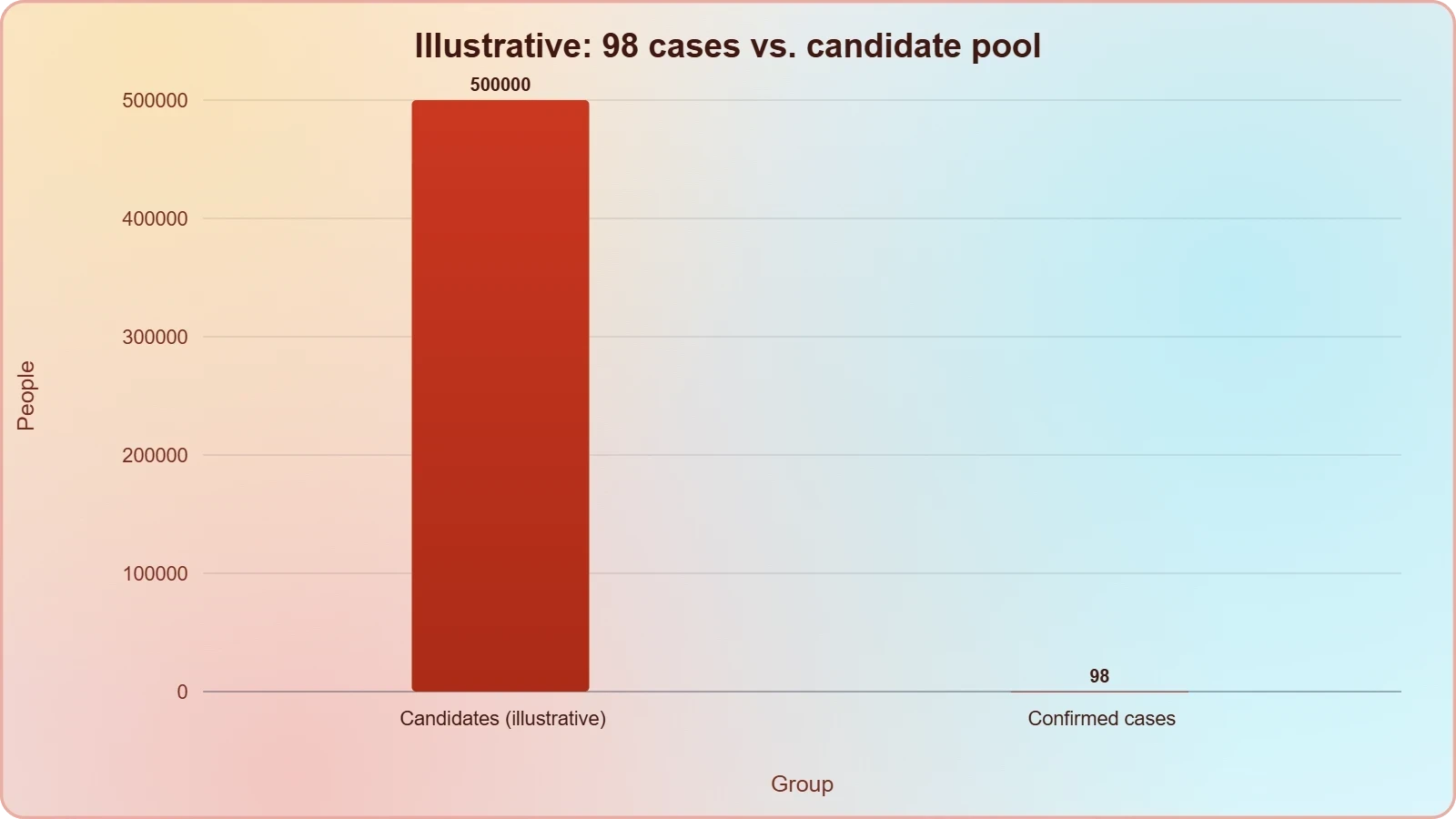
Numbers acquire meaning only in relation to their denominators. South Korea's college entrance examination involves hundreds of thousands of candidates annually, and ninety-eight confirmed cases represent a very small fraction of that population. Presented without context, the figure can appear alarming; situated within the scale of the examination, it reads as a modest but non-trivial integrity signal. The appropriate analytical response is neither complacency nor alarm but a careful examination of trends over time, since a single year's count cannot establish whether the problem is growing, stable, or receding.
Interpreting Detection Rates as a Measure of Capacity
Detection rates are frequently misread as prevalence rates. A rise in confirmed cases may indicate more cheating, but it may equally indicate better detection, and the two possibilities carry opposite policy implications. In Korea's case, the explicit introduction of new measures immediately before the disclosure strongly suggests that capacity effects are at work. Analysts should therefore treat the ninety-eight figure as a lower bound on actual violations rather than a complete census, and should look to the ratio of detections to enforcement resources for a more informative indicator of system performance.
Longitudinal comparison offers the most reliable path forward. If detection capacity is held roughly constant across cycles, changes in case counts can be attributed with more confidence to changes in behaviour. Authorities would strengthen their analytical position considerably by publishing consistent, methodologically stable statistics year over year, including the number of investigations opened, the number resolved, and the proportion resulting in sanctions. Such a dataset would allow researchers to disentangle capacity from prevalence and would give the public a firmer basis for judging the system's health.
Comparative Benchmarks Across Examination Systems
International comparison adds a further layer of context. Examination systems worldwide report integrity incidents with varying degrees of transparency and using inconsistent definitions, which complicates direct comparison. Some jurisdictions disclose only confirmed criminal cases, while others include administrative findings and procedural violations. Korea's relatively open disclosure is itself a notable feature, and it positions the country as a useful benchmark for others considering how much to reveal. Transparency of this kind carries short-term reputational costs but builds long-term credibility.
Benchmarking should extend beyond raw counts to the design of safeguards. Systems that publish their detection methodologies invite scrutiny and improvement, while those that conceal them forfeit the benefits of external expertise. A comparative registry of enforcement practices, maintained by an international education body, would allow jurisdictions to learn from one another's experience without each having to rediscover the same lessons. The Korean episode provides a well-documented entry for such a registry and demonstrates the value of candid reporting.
Technology, Governance, and the Future of High-Stakes Testing
The Korean episode sits at the intersection of two powerful trends: the rapid diffusion of generative AI and the intensifying competition for educational credentials. Neither trend shows signs of abating, and their interaction will continue to stress examination systems for the foreseeable future. Governance responses must therefore be designed for durability rather than as one-off reactions to particular scandals. The question is not whether new cheating methods will emerge, but whether institutions can build adaptive capacity sufficient to respond without sacrificing the values that make assessment meaningful.
Adaptive Regulation in a Fast-Moving Technological Environment
Adaptive regulation begins with continuous monitoring rather than periodic crisis response. Authorities should maintain standing technical units capable of assessing emerging tools, testing detection methods, and advising on policy adjustments as conditions change. Such units need sufficient independence to report uncomfortable findings and sufficient authority to act on them. The alternative, assembling a task force only after a scandal breaks, guarantees that the response will lag the threat and that each cycle will repeat the improvisation of the last.
Adaptive regulation also requires humility about prediction. The specific tools that will challenge assessment five years from now are unlikely to be those anticipated today, and rigid rules written around current technology will age poorly. Principles-based frameworks, which specify the outcomes to be protected rather than the methods to be prohibited, tend to be more resilient. They allow enforcement to evolve with the threat while preserving a stable commitment to integrity, fairness, and the legitimate interests of candidates who play by the rules.
Preserving the Social Function of Credentials
Beneath the technical questions lies a social one. Credentials derive their value from collective belief that they certify something real, and that belief is fragile. If the public comes to suspect that examination results reflect access to assistance rather than individual capability, the credential loses its function as a sorting and signalling device. Employers, universities, and the wider society would then need to develop alternative means of assessment, a transition that would be costly and disruptive. Protecting integrity is therefore a matter of preserving a public good, not merely enforcing rules.
That framing suggests a broader responsibility. Technology companies that build generative tools have a stake in how those tools are used in assessment contexts, and they could contribute through provenance signals, usage policies, and cooperation with detection efforts. Educators have a role in teaching ethical use rather than merely prohibiting misuse. Families and communities shape the norms that determine whether cheating is seen as clever or shameful. Integrity is a shared achievement, and the Korean case illustrates both how quickly it can be tested and how deliberately it must be defended.
From our network :
- Mobile Learning and VR in English: What Global Evidence Reveals About Effective Language TechnologyA systematic review across 14 countries reveals which language-learning technologies genuinely work. Mobile learning, AI, and VR show measurable benefits when pedagogically integrated. This evidence-based guide helps educators and learners select technology that delivers real return on investment.
- Committed Mediterranean Precipitation Decline: Why Emissions Cuts Alone Cannot Restore Winter RainsNew NOAA research reveals that Mediterranean winter rains may decline irreversibly even with emissions cuts. Explore the science of committed climate change and regional impacts.
- The Final Descent: How ESA Retired the Legendary Cluster Constellation After 24 Years of Space Weather ScienceAfter 24 years mapping Earth’s magnetosphere, ESA’s Cluster mission concluded with a precisely controlled reentry over the South Pacific. This analysis explores the scientific legacy, engineering decisions, and debris mitigation principles behind one of space exploration’s most responsible retirements.
- University Language Proficiency Exams: Why Institutional Tests Demand Different Preparation Than IELTS and TOEFLDiscover why university-specific language proficiency examinations differ fundamentally from IELTS and TOEFL, and learn strategic preparation approaches for institutional assessment success.
- Live Online English Classes for Kids: Do They Actually Reduce Anxiety?A ten-week study reveals that synchronous online English classes can significantly reduce child language anxiety while improving listening and reading skills. Discover what makes these programs effective and how parents can select the right one.
- CISA’s Ten-Advisory Wave: Why Generic Patching Fails in OT and How to Build Product-Specific PlaybooksCISA released ten ICS advisories in one week, exposing critical infrastructure risks. Generic patching fails in OT. Learn to build product-specific remediation playbooks.
- The Hidden Cost of AI Convenience: Why Over-Permissioned Agents Are a Security Time BombDiscover why AI agents with excessive permissions create dangerous single points of failure, and learn how implementing least privilege principles can protect your organization from exploitation.
- Forbidden Matrix Patterns and Visible Lattice Points: A Geometric DictionaryExplore how multidimensional 0–1 matrices encode geometric truths, linking forbidden patterns to visible lattice points and hypergraph theory, with applications in combinatorics and computational geometry.
- How AI Agents Will Change the Way We Manage Personal FinancesExplore how AI agents are transforming personal finance through automated budgeting, bill payment, and investment management, while examining the critical security protocols and governance frameworks required for safe deployment.
RESOURCES
- S. Korea scrambles to crack down on AI-assisted cheating ahead of ...english.kyodonews.net4 days ago ... SEOUL - Just days before South Korea's national college entrance exam this week, education authorities face a major headache in…
- Korea's college entrance exam captures global interest again, this ...koreatimes.co.kr2 days ago ... Korea's college entrance exam captures global interest again, this time over AI cheating crackdown ... South Korea's CSAT to deter…
- S. Korea to crack down on test cheating - Arkansas' Best News Sourcearkansasonline.com2 days ago ... ... South Korea's college entrance exams on Thursday ... AI-assisted cheating cases to affect exams in recent months. In a ...
- South Korea to check students after exam candidate used AI to cheatreuters.com3 days ago ... South Korea will tighten checks on students taking the high-stakes national university entrance exam this week, Prime Minister Han ...
- AI cheating fears spook South Korea ahead of high - Facebookfacebook.com4 days ago ... AI cheating fears spook South Korea ahead of high- stakes college entrance exam. South Korean officials are scrambling to prevent…
- Buttons get stickers, Big Tech gets a call in Suneung cheating ...koreaherald.com3 days ago ... The South Korean government announced a series of measures Tuesday to curb AI-assisted cheating during Thursday's high-stakes college entrance ...
- AI CHEATING CRACKDOWN! LOOK: South Korea has cut Wi-Fi ...facebook.com1 day ago ... Because…. of him. saba kaau ang Alert message dri sa Korea. Super.. higpit! kaaau.. ang Exam-Test for.. College Entrance 2027 ...
- Blame game erupts over last-minute Suneung checkskoreaherald.com3 days ago ... With a day to go before South Korea's national college entrance exam, students worried about others cheating and being wrongly…
- Accounting student's AI cheating sparks South Korean exam furoreft.com5 days ago ... Seoul promises crackdown just days ahead of annual university entrance test.
- South Korea checks glasses and collars for hidden AI in university ...scmp.com4 days ago ... Touch your glasses, fail the test: South Korea's AI exam cheat crackdown ... university entrance exam, denouncing it as a…
- South Korea's CSAT crackdown targets AI cheating, but doubts remainkoreajoongangdaily.com1 day ago ... ... exam admitting he had cheated using electronic devices and generative AI. The cases raised fears that the college entrance…
- SEOUL (AFP) – South Korea cut Wi-Fi around exam halls and is ...instagram.com14 hours ago ... South Korea has unveiled an emergency crackdown on AI cheating ahead of Thursday's Suneung college entrance exam, after the top…
- Top scorer on Korea's tax accountant exam admits to AI cheating ...m.arirang.com5 days ago ... Last month, test-takers were also caught using smart glasses to cheat during essay-based college entrance exams at Yonsei University and…
- When South Korea sits its biggest exam, the country holds its breath ...instagram.com7 hours ago ... South Korea has unveiled an emergency crackdown on AI cheating ahead of Thursday's Suneung college entrance exam, after the top…
- Korean Government's AI Cheating Crackdown Faces U.S. Legal ...chosun.com3 days ago ... ... cheating in national exams using artificial ... exam papers and asked questions during the college entrance exam period from…
- 01
- 02
- 03
- 04
- 05
- 06
- 07
- 08
0 Comments