
The Sea Lion oil project near the Falkland Islands has become the focal point of a renewed legal and diplomatic confrontation between Argentina and the United Kingdom, following a decision by an international maritime tribunal to reject Argentina's request to suspend drilling operations. The ruling, supported by eighteen of the tribunal's judges with three dissenting, rested on a narrow but consequential procedural finding: the tribunal concluded that the underlying question of sovereignty over the islands appeared to fall outside its jurisdictional reach. Argentina had sought a temporary halt to the project until the long-running sovereignty dispute was resolved, but the tribunal declined to intervene on those grounds, leaving the substantive quarrel to a separate arbitration process that could take years to conclude.
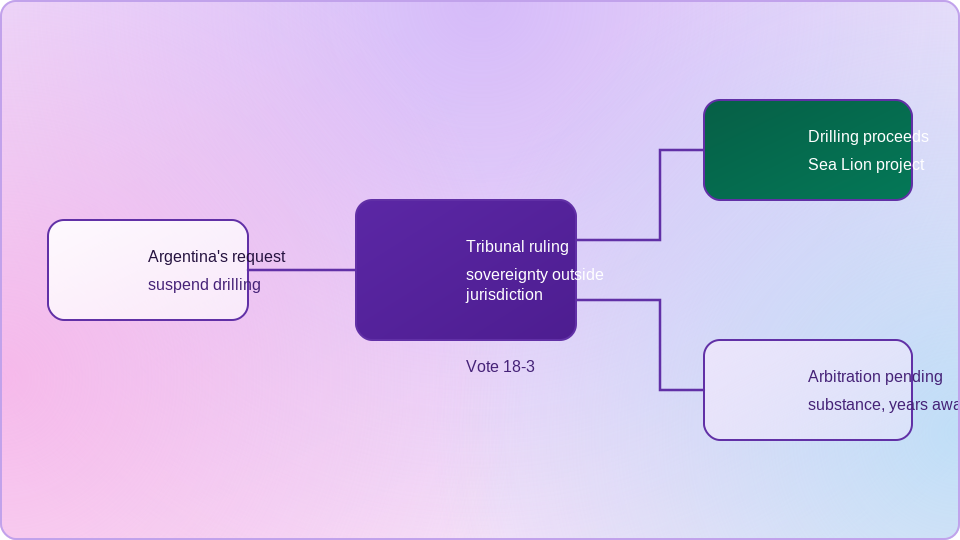
What makes this episode instructive is the way it exposes the layered architecture of international dispute resolution. A tribunal can decline jurisdiction without endorsing the merits of either party's position, and that distinction matters enormously in practice. The Sea Lion project, led by Israel's Navitas alongside the UK's Rockhopper Exploration, is scheduled to begin drilling in March, with commercial production anticipated from 2028 across an operating life of roughly thirty-five years. The United Kingdom framed the outcome as a vindication of the islanders' right to determine their own future and to develop natural resources, while urging Buenos Aires to abandon what London characterised as economic pressure on the islands.
Argentina's position remains anchored in its long-standing claim to the islands, which it calls Las Malvinas, and President Javier Milei has elevated sovereignty over the archipelago to the status of a national cause. His government has opposed the drilling programme and is advancing legislation that would criminalise involvement in the Falklands economy. Beneath the diplomatic rhetoric lies a hard economic calculus: the project is estimated to add around £8 billion to the islands' economy over its lifetime, potentially doubling their GDP. That figure explains why a territorial dispute dating back generations has acquired fresh urgency in the form of a drilling rig.
On This Page
- The Jurisdictional Ruling and What It Actually Decided
- The Sea Lion Project: Economics, Operators and Timelines
- Argentina's Legal and Political Strategy
- Historical Context and the 1982 Legacy
- Implications for Investors, Operators and International Law
- What Comes Next: Arbitration, Legislation and the Long Game
TL;DR An international maritime tribunal declined Argentina's request to suspend the Sea Lion oil project near the Falkland Islands, ruling that sovereignty questions fall outside its jurisdiction. The decision, reached by eighteen votes to three, clears the immediate path for drilling to begin in March, with production expected from 2028 over roughly thirty-five years. The project, led by Navitas and Rockhopper, could add an estimated £8 billion to the islands' economy and potentially double their GDP. Argentina continues to contest UK sovereignty, and a separate arbitration process will examine the substance of the dispute over a timeframe measured in years rather than months.
The Jurisdictional Ruling and What It Actually Decided
The tribunal's decision is best understood as a statement about the limits of its own authority rather than a verdict on who owns the Falklands. By concluding that the sovereignty question fell outside its jurisdiction, the panel effectively separated the immediate commercial question of whether drilling could proceed from the deeper political question of which state holds title to the islands. That separation is a familiar feature of international adjudication, where courts and tribunals frequently decline to reach issues that touch on contested territorial sovereignty, precisely because such questions are regarded as matters for negotiation or for other forums entirely.
The margin of eighteen judges in favour against three opposed lends the ruling a weight that a narrower split would not have carried. Dissenting voices presumably argued that the tribunal had both the authority and the obligation to address the suspension request on its merits, but the majority view prevailed. For the project operators, the practical consequence is clarity: the legal obstacle that Argentina sought to place in the path of drilling has been removed, at least for now, and the timetable toward a March spud date remains intact.
The Separation of Sovereignty from Commerce
International law has long struggled with the tension between territorial disputes and economic activity conducted in contested spaces. Tribunals typically avoid ruling on sovereignty because such rulings would bind states on questions of the highest political sensitivity, and because the consent of both parties to jurisdiction is rarely forthcoming in genuinely contested cases. The Falklands matter illustrates this dynamic with unusual clarity: Argentina asked for a suspension premised on an unresolved sovereignty claim, and the tribunal responded that the premise itself lay beyond its remit.
This does not mean the ruling is without consequence for the underlying dispute. By declining jurisdiction, the tribunal left the sovereignty question exactly where it found it, which is to say unresolved and subject to a separate arbitration whose timeline stretches into the coming years. The commercial project, meanwhile, proceeds on the assumption that the current administrative arrangements will hold. That assumption is legally defensible but politically fragile, and both operators and investors would be wise to treat it as such.
The Dissent and the Limits of Consensus
Three dissenting votes out of twenty-one is a small minority, but dissents in international tribunals often carry disproportionate analytical weight because they signal the fault lines that may resurface in future proceedings. A dissent on jurisdictional grounds typically argues that the tribunal has misread its own mandate, and such arguments can be revived if the matter returns in a different procedural posture. For Argentina, the dissent offers a rhetorical foothold, though not a legal remedy.
The broader lesson concerns the fragility of consensus in multilateral adjudication. A ruling that rests on jurisdictional restraint rather than substantive agreement is inherently provisional, because it resolves nothing about the merits. Should the separate arbitration reach conclusions that conflict with the assumptions underpinning the drilling programme, the entire commercial edifice could be destabilised. The tribunal's decision, in other words, buys time rather than delivering finality.
The Sea Lion Project: Economics, Operators and Timelines
The commercial substance behind the legal manoeuvring is substantial. Sea Lion is operated through a partnership between Israel's Navitas Petroleum and the United Kingdom's Rockhopper Exploration, and the project has been designed around a development schedule that begins with drilling in March and moves to first oil from 2028. The projected operating life of approximately thirty-five years means the venture is being planned on a generational horizon, one that will outlast the political careers of the officials currently contesting the islands' status. That mismatch between commercial time and political time is a recurring theme in resource disputes worldwide.
The economic projections attached to the project are striking relative to the size of the island economy. An estimated £8 billion contribution over the lifetime of the field would represent a transformation of the islands' fiscal position, with the potential to double GDP. For a small population with limited economic diversification, such figures carry implications that extend well beyond royalty receipts: they touch on infrastructure, public services, immigration policy and the islands' long-term viability as a self-governing entity. The UK government has framed the project in precisely these terms, presenting resource development as an instrument of self-determination rather than merely a commercial venture.
Operator Structure and Development Horizon
The partnership between Navitas and Rockhopper reflects the increasingly international character of frontier oil development, where mid-sized independent operators assemble capital and expertise across jurisdictions. Navitas, an Israeli energy company, brings development capability, while Rockhopper contributes long-standing acreage knowledge in the North Falkland Basin. This structure spreads risk but also introduces complexity: each partner answers to its own shareholders, its own regulators and its own political risk assessments, and any divergence in those assessments can complicate the project's forward momentum.
The development timeline deserves scrutiny. A March drilling start followed by first production in 2028 implies a construction and commissioning phase of roughly two years after a successful exploration and appraisal outcome. In offshore oil terms that is an aggressive but not implausible schedule, contingent on regulatory approvals, vessel availability and the absence of legal injunctions. Each of those contingencies is now more exposed to political risk than the tribunal ruling alone might suggest, because the arbitration track remains live and its conclusions are years away.
Fiscal Impact on a Small Island Economy
Doubling GDP is a phrase that sounds like unalloyed good news, but for a small island economy it raises as many questions as it answers. Rapid fiscal expansion can strain absorptive capacity, drive inflation in local markets, overwhelm infrastructure and create dependencies that outlast the resource itself. The islands' authorities will need to think carefully about sovereign wealth mechanisms, stabilisation funds and intergenerational equity, precisely the instruments that resource-rich small economies have used, with varying success, to convert finite extraction into durable prosperity.
The £8 billion figure should therefore be read as a gross contribution rather than a net benefit. Royalties, taxes, operating costs, decommissioning liabilities and the opportunity costs of environmental disturbance all sit between the headline number and the lived experience of island residents. None of this diminishes the project's significance, but it does suggest that the political argument over self-determination and resource development will increasingly be matched by a technocratic argument over fiscal management and long-term stewardship.
Argentina's Legal and Political Strategy
Argentina's response to the ruling must be read against the broader posture of the Milei government, which has made sovereignty over the islands a defining national commitment. The president has described the claim as a national cause, language that elevates the dispute above ordinary foreign policy and places it in the register of identity and historical grievance. That framing constrains the government's room for manoeuvre: having defined the issue in maximalist terms, Buenos Aires cannot easily accept a settlement that appears to concede the principle, even if the practical arrangements on the ground remain unchanged.
The legislative dimension is particularly significant. Argentina is pursuing a law that would make involvement in the Falklands economy a criminal offence, a measure aimed squarely at companies that participate in resource development on the islands. Such legislation would create legal exposure for operators, contractors, insurers and financiers, and its extraterritorial reach would be contested. Even if enforcement proves difficult, the deterrent effect on service providers and lenders could be considerable, and that is precisely the point: the law is designed to raise the cost of participation rather than to secure convictions.
The Criminalisation Bill and Its Reach
Criminalising economic engagement with a disputed territory is an instrument of pressure that sits at the intersection of domestic law and international dispute. Its effectiveness depends less on prosecutions than on the chilling effect it exerts on corporate decision-making. Banks, insurers and logistics firms are notoriously risk-averse, and a statute that threatens criminal liability, however uncertain its jurisdictional reach, can persuade them to decline involvement altogether. For Argentina, this is a low-cost lever with potentially high impact on the project's supply chain.
The counterargument is that such measures invite reciprocal action and damage Argentina's standing as a reliable commercial partner. Companies operating in Argentina itself may find their Falklands exposure scrutinised, and the legislation could complicate the country's broader investment climate at a moment when the government is seeking to attract foreign capital. The measure therefore carries costs that extend well beyond the Falklands question, and its net effect on the project remains genuinely uncertain.
Diplomatic Leverage and the Self-Determination Argument
The United Kingdom's response has centred on the principle of self-determination, framing the islanders' right to decide their future as the decisive consideration. This is a well-established diplomatic position, and it has the advantage of aligning with a principle that carries substantial normative weight in international discourse. By presenting resource development as an expression of self-determination rather than a commercial carve-out, London shifts the argument from contested sovereignty to the rights of a resident population, a framing that has historically proved difficult for Argentina to counter directly.
Yet the self-determination argument is not without its complications. Critics note that the principle is applied selectively in international practice, and Argentina's supporters argue that territorial integrity is an equally weighty norm. The tension between self-determination and territorial integrity is one of the unresolved fault lines of international law, and the Falklands dispute sits squarely upon it. Neither side is likely to abandon its preferred principle, which is why the dispute has persisted for generations and why legal rulings tend to defer rather than decide.
Historical Context and the 1982 Legacy
No analysis of the current dispute can ignore the war of 1982, which remains the defining event in the modern relationship between Argentina and the United Kingdom over the islands. The conflict cost hundreds of lives, ended in Argentine defeat and entrenched positions on both sides that have proved remarkably resistant to change. For Argentina, the war is a wound and a mandate; for the United Kingdom, it is a demonstration of resolve and a commitment to the islanders that successive governments have treated as binding. Every subsequent legal and diplomatic manoeuvre is read through the lens of that history.
The passage of more than four decades has changed the instruments of contestation without resolving the underlying disagreement. Direct military confrontation has been replaced by litigation, legislation, economic pressure and diplomatic campaigning, a shift that reflects both the costs of war and the institutionalisation of international dispute resolution. The tribunal ruling is the latest episode in this longue durée contest, and its significance lies less in what it decided than in what it reveals about the durability of the dispute and the limited capacity of legal institutions to resolve it.
From Armed Conflict to Legal Contestation
The transition from battlefield to courtroom is often presented as progress, and in many respects it is. Legal contestation is preferable to violence by any reasonable measure, and the institutional machinery of arbitration and adjudication offers channels for grievance that do not require the deployment of force. Yet the substitution of legal for military means also has costs: it can prolong disputes indefinitely, generate procedural victories that satisfy neither party, and create the appearance of resolution without its substance. The Falklands dispute illustrates all three tendencies.
For the islanders themselves, the shift has been broadly beneficial. Legal processes have not disturbed their governance arrangements, and the tribunal ruling removes an immediate threat to the drilling programme. But the underlying uncertainty persists, and the community remains dependent on the United Kingdom's diplomatic and military commitment for its security. That dependency is a structural feature of the islands' position, and no legal ruling is likely to alter it in the foreseeable future.
Why the Dispute Endures
Disputes of this kind endure because the interests at stake are not commensurable. Sovereignty is not a quantity that can be divided or traded; it is a claim to exclusive authority, and both parties regard their position as non-negotiable in principle. Economic interests, by contrast, are divisible, which is why commercial arrangements often proceed even where political settlement is absent. The Sea Lion project is a case in point: it advances on the basis of de facto control while the de jure question remains open, and that arrangement can persist for a very long time.
The endurance of the dispute also reflects domestic political dynamics on both sides. In Argentina, the sovereignty claim functions as a unifying national narrative that transcends partisan divisions, and no government can afford to appear indifferent to it. In the United Kingdom, support for the islanders is a matter of cross-party consensus reinforced by the 1982 legacy. These domestic constraints mean that even governments inclined toward compromise face prohibitive political costs, which is why the dispute has outlasted numerous administrations on both sides.
Similar Posts
- 01
- 02
- 03
- 04
Implications for Investors, Operators and International Law
For investors and operators, the ruling offers a measure of reassurance but not a clean bill of health. The immediate legal obstacle has been removed, and the project can proceed toward its March drilling date, but the underlying political risk has not diminished. Argentina's legislative offensive, the pending arbitration and the possibility of further legal challenges all represent sources of uncertainty that will need to be priced into financing arrangements, insurance contracts and long-term offtake agreements. Companies involved in the project will require robust political risk coverage and careful contractual structuring.
The financing dimension is particularly sensitive. Lenders to frontier energy projects typically require comfort on title, regulatory approval and dispute exposure, and the Falklands presents an unusually complex profile on all three counts. The tribunal ruling helps on the dispute exposure question, but it does not eliminate it, because the arbitration track remains live and its outcome is years away. Institutions with long memories of the 1982 conflict and its commercial aftermath will be cautious, and that caution will be reflected in the cost of capital.
Risk Assessment for Project Participants
A disciplined risk assessment would separate the project's technical and commercial merits from its political exposure. Technically, Sea Lion is a conventional offshore development with a defined resource base and a credible operator group. Commercially, the economics depend on oil prices, fiscal terms and the cost of capital, all of which are subject to normal market volatility. Politically, the project sits in a contested jurisdiction with an active sovereignty dispute, a hostile neighbouring state and a legal environment that could shift with changes in government on either side.
The interaction between these layers is what makes the project distinctive. A change in Argentine policy, a shift in UK political commitment or an adverse arbitration finding could each alter the project's risk profile materially, and these risks are correlated rather than independent. Prudent participants will therefore build in flexibility: staged capital commitments, contractual termination rights and insurance arrangements that respond to political events. The tribunal ruling buys time, but time is only valuable if it is used to prepare for the scenarios that remain open.
Precedents for Contested Resource Development
The Falklands case resonates with other contested resource disputes around the world, from the Eastern Mediterranean to the South China Sea, where commercial development proceeds in areas subject to overlapping sovereignty claims. The common thread is the reliance on de facto control and the willingness of operators to accept political risk in exchange for resource access. International tribunals have generally been reluctant to interfere with such arrangements, preferring to leave sovereignty questions to negotiation and to confine themselves to procedural and jurisdictional matters.
That pattern has implications for the broader international order. If legal institutions consistently decline to resolve sovereignty disputes, the practical effect is to entrench the position of whichever party exercises effective control, at least for as long as that control persists. Critics regard this as a failure of international law; defenders regard it as a realistic accommodation of political realities that no court can alter. The Falklands ruling will be cited by both camps, and its precedential value lies precisely in its ambiguity.
What Comes Next: Arbitration, Legislation and the Long Game
The immediate future of the dispute lies in three parallel tracks that will unfold on different timelines. The first is the arbitration process, which will consider the substance of the disagreement but whose conclusions are expected to take years. The second is Argentina's legislative programme, which could alter the commercial environment for the project well before any arbitral award is issued. The third is the drilling programme itself, which will generate facts on the ground that may in turn shape the political and legal context in which the other two tracks operate.
The sequencing matters. If drilling proceeds successfully and production begins in 2028, the project will have created a substantial economic stake that will be difficult to reverse, and that stake will strengthen the islanders' position in any future negotiation. Conversely, if legal or political obstacles delay the project, the momentum may shift toward Argentina. The tribunal ruling has tilted the immediate balance toward the operators, but the long game remains genuinely open, and the outcome will depend on developments that no single decision can determine.
The Arbitration Track and Its Uncertain Timeline
Arbitration offers a forum for the substance of the dispute, but its utility is constrained by the same jurisdictional and political realities that shaped the tribunal's ruling. A tribunal constituted to hear the merits will still confront the question of whether sovereignty is justiciable, and the answer may well be the same. Even if the arbitration proceeds to a substantive award, enforcement against a sovereign state is notoriously difficult, and the practical effect may be limited to shaping the diplomatic environment rather than altering the legal position.
The timeline is itself a factor of consequence. Years of proceedings mean that the commercial facts will have moved on considerably before any award is issued, and the arbitrators may find themselves assessing a situation that has been transformed by development. This is a familiar feature of long-running disputes: the legal process lags the commercial reality, and by the time judgment arrives, the question it was designed to answer may have been overtaken by events on the ground.
Scenarios for the Coming Decade
Three broad scenarios present themselves. In the first, the project proceeds on schedule, production begins in 2028, and the economic transformation of the islands entrenches the status quo, with Argentina's legal and legislative efforts proving largely symbolic. In the second, legal or political obstacles delay or disrupt the project, creating uncertainty that deters investment and weakens the islanders' economic position. In the third, a negotiated arrangement emerges that addresses economic cooperation without resolving sovereignty, a pragmatic outcome that both sides could present domestically as consistent with their principles.
The third scenario is the most interesting and the least discussed. Resource disputes have occasionally been managed through cooperative arrangements that defer sovereignty while sharing economic benefits, and such models exist in other contested maritime areas. Whether they could be adapted to the Falklands is doubtful given the depth of feeling on both sides, but the possibility should not be dismissed entirely. The tribunal ruling, by separating commerce from sovereignty, may inadvertently have created space for exactly this kind of pragmatic experimentation.
The tribunal's rejection of Argentina's suspension request is a procedural decision with substantive consequences, and its significance lies in the space it creates rather than the questions it settles. By declining jurisdiction over sovereignty, the panel allowed the Sea Lion project to proceed while leaving the underlying dispute untouched, a characteristically cautious outcome that reflects the limits of international adjudication in territorial matters. The drilling rig will move, the arbitration will grind on, and the political contest will continue on both sides of the South Atlantic.
What the episode ultimately demonstrates is the persistence of disputes that combine identity, territory and resources. Legal institutions can manage such disputes at the margins, buying time and creating procedural clarity, but they cannot resolve the fundamental disagreements that give rise to them. The Falklands question will be settled, if at all, through politics and diplomacy rather than litigation, and the tribunal's ruling is best understood as one move in a contest that will continue long after the current generation of officials has left office.
From our network :
- Mobile Learning and VR in English: What Global Evidence Reveals About Effective Language TechnologyA systematic review across 14 countries reveals which language-learning technologies genuinely work. Mobile learning, AI, and VR show measurable benefits when pedagogically integrated. This evidence-based guide helps educators and learners select technology that delivers real return on investment.
- How AI Agents Will Change the Way We Manage Personal FinancesExplore how AI agents are transforming personal finance through automated budgeting, bill payment, and investment management, while examining the critical security protocols and governance frameworks required for safe deployment.
- Committed Mediterranean Precipitation Decline: Why Emissions Cuts Alone Cannot Restore Winter RainsNew NOAA research reveals that Mediterranean winter rains may decline irreversibly even with emissions cuts. Explore the science of committed climate change and regional impacts.
- Forbidden Matrix Patterns and Visible Lattice Points: A Geometric DictionaryExplore how multidimensional 0–1 matrices encode geometric truths, linking forbidden patterns to visible lattice points and hypergraph theory, with applications in combinatorics and computational geometry.
- The Final Descent: How ESA Retired the Legendary Cluster Constellation After 24 Years of Space Weather ScienceAfter 24 years mapping Earth’s magnetosphere, ESA’s Cluster mission concluded with a precisely controlled reentry over the South Pacific. This analysis explores the scientific legacy, engineering decisions, and debris mitigation principles behind one of space exploration’s most responsible retirements.
- University Language Proficiency Exams: Why Institutional Tests Demand Different Preparation Than IELTS and TOEFLDiscover why university-specific language proficiency examinations differ fundamentally from IELTS and TOEFL, and learn strategic preparation approaches for institutional assessment success.
- CISA’s Ten-Advisory Wave: Why Generic Patching Fails in OT and How to Build Product-Specific PlaybooksCISA released ten ICS advisories in one week, exposing critical infrastructure risks. Generic patching fails in OT. Learn to build product-specific remediation playbooks.
- Live Online English Classes for Kids: Do They Actually Reduce Anxiety?A ten-week study reveals that synchronous online English classes can significantly reduce child language anxiety while improving listening and reading skills. Discover what makes these programs effective and how parents can select the right one.
- The Hidden Cost of AI Convenience: Why Over-Permissioned Agents Are a Security Time BombDiscover why AI agents with excessive permissions create dangerous single points of failure, and learn how implementing least privilege principles can protect your organization from exploitation.
RESOURCES
- What's at stake as Law of the Sea Tribunal set to rule on Malvinas ...argentinareports.com3 days ago ... ... Tribunal set to rule on Malvinas/Falklands Sea Lion project ... Lion, the first oil extraction project in the disputed…
- Falklands: Argentina's new legal fight over the Sea Lion oil projectlowyinstitute.orgNov 2, 2026 ... Argentina has taken its Falklands oil fight to an international court – but the case may stumble at the first…
- What's the Falklands oil project at the heart of latest UK-Argentina ...aljazeera.comNov 11, 2026 ... ... Sea Tribunal hearing, as Argentina seeks measures to block the offshore project. ... Sea Lion project's halt could help…
- UN-backed court to rule on Argentine bid to halt Falklands oil projectafp.com3 days ago ... In September, Argentina launched an arbitration process against London over the Sea Lion project off the Falklands, which is led…
- Argentina Seeks UNCLOS Ruling on UK-Backed Oil Project off the ...maritime-executive.comOct 22, 2026 ... The project, called Sea Lion, is a joint venture between UK and Israeli companies, and has been licensed to produce…
- Is a court about to rule against Britain on the Falklands?economist.com2 days ago ... Argentina's legal campaign against Britain over Falklands oil project Sea Lion, Javier Milei's sovereignty push and the International ...
- President Milei reacts after court rejects Argentina's bid to block ...news.sky.com1 hour ago ... ... court rejected his bid to block oil drilling off the disputed islands. Javier Milei opposes the Sea Lion project,…
- Argentina court orders halt to Sea Lion oil project off Falkland Islandsaa.com.trSep 17, 2026 ... Navitas and Rockhopper made a final investment decision on the project in late 2025. The ruling came after a lawsuit…
- Falkland Islanders face 'devastating consequences' if Argentina ...theguardian.comNov 10, 2026 ... Countries clash over Sea Lion project as Hamburg tribunal risks deepening sovereignty dispute.
- Argentina Takes UK to Law of the Sea Tribunal Over Sea Lion Oil ...sevenseasmedia.orgArgentina Takes the UK to the Law of the Sea Tribunal Over the Sea Lion Oil Project North of the Falklands ... Whether the…
- Sea Law Court Rules Today on Falklands Oil - The Rio Timesriotimesonline.com7 hours ago ... ... Sea Lion oil project off the Falklands ... An emergency order that could stop Sea Lion oil drilling or…
- Argentina's bid to stop Falklands oil drilling rejected - BBCbbc.com3 hours ago ... The UK responded that the Law of the Sea court had no jurisdiction over the issue, and that pausing the…
- Argentina's bid to stop UK oil activity near Falklands rejected by ...reuters.com2 hours ago ... Major US oil services firm Halliburton last month said it would not work on the Sea Lion project. Argentina in…
- Argentina fails to block oil drilling off Falkland Islands - The Guardiantheguardian.com4 hours ago ... An application by the South American country for suspension of the Sea Lion project was rejected on Saturday by the…
- Arbitration court to rule on Falklands oil development in 10 daysupstreamonline.comNov 18, 2026 ... Argentina took UK to maritime tribunal to halt Sea Lion FPSO oil project.
Related By Tags
- 01
- 02
- 03
- 04
- 05
- 06
- 07
- 08
0 Comments