Few fictional figures have travelled as far from their literary origins as John Rambo. When David Morrell published his debut novel First Blood in 1972, he delivered a lean, unsparing portrait of a homeless Vietnam veteran drifting through a Kentucky town, hunted by police and driven to lethal desperation. The book was a product of its anxious moment: America was still entangled in Southeast Asia, returning soldiers were met with suspicion rather than gratitude, and the national conversation about trauma, violence, and responsibility was raw. Morrell's Rambo was not a hero in any conventional sense; he was a casualty who refused to die quietly, and the novel ended in a way that offered little comfort.
What happened next is one of the more remarkable transformations in modern popular culture. When the story reached the screen in 1982 as First Blood, Sylvester Stallone and director Ted Kotcheff softened the character's edges, kept him alive, and reframed his rampage as a tragedy of neglect rather than a study in pathology. From that revision flowed four sequels, each recalibrating Rambo for a new decade and a new audience: a Cold War proxy mission in Afghanistan, a rescue in Southeast Asia, a belated reckoning with the Burmese junta, and finally a quiet homecoming in Arizona. Across those films, the character absorbed the anxieties of the eras that produced him.
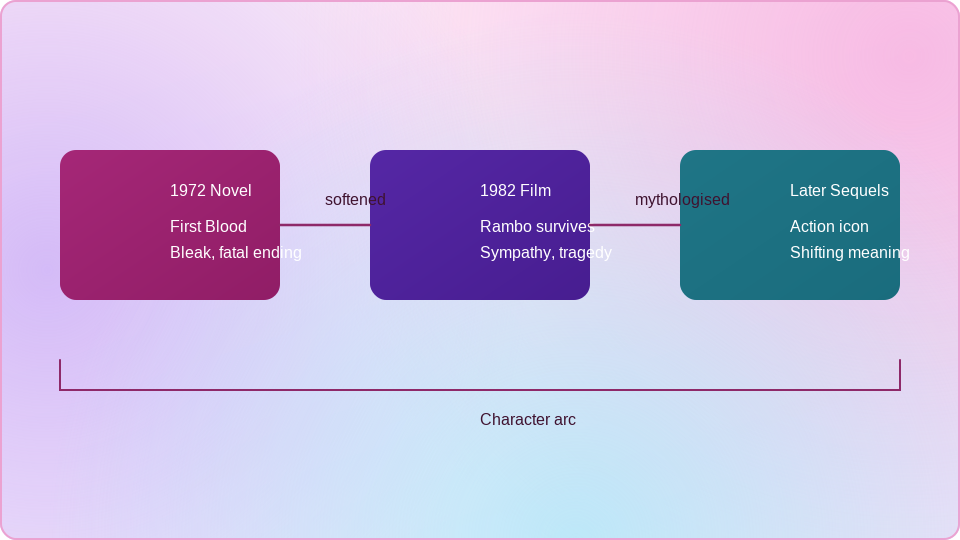
This analysis traces the full arc of the Rambo character, from Morrell's novel through the Stallone-led films, and examines why a figure built on national shame became an enduring emblem of resilience and action cinema. It considers the creative decisions that reshaped him, the cultural debates his image provoked, and the commercial logic that kept him on screen for nearly four decades. The aim is not merely to summarise plots but to explain how a single veteran became a pop culture icon whose silhouette carries meaning far beyond the films themselves.
On This Page
TL;DR John Rambo began as a traumatised Vietnam veteran in David Morrell's 1972 novel First Blood, a bleak study of a society that discarded its soldiers. The 1982 film adaptation, starring Sylvester Stallone, softened the character's fate and reframed his violence as a response to institutional cruelty, creating a more sympathetic figure. Four sequels followed, each adapting Rambo to the political mood of its decade, from Cold War adventurism to belated reckonings with authoritarian brutality. The character's endurance rests on a paradox: he is simultaneously a symbol of national guilt and a fantasy of individual resilience, a veteran whose body absorbs the wounds of the state and returns them transformed into spectacle.
The Literary Origins of John Rambo
David Morrell was a young academic when he wrote First Blood, and the novel carries the intensity of a writer working through a subject he could not set aside. He had been struck by reports of returning veterans facing hostility and indifference, and he built his protagonist as a composite of those stories. John Rambo in the novel is not a superhuman warrior but a drifter with a Green Beret background, a man whose skills were cultivated by the military and then rendered useless, even dangerous, in civilian life. The book's violence is intimate and ugly, and its ending is deliberately unresolved in moral terms.
The novel's structure is essentially a chase narrative, but its real subject is the machinery of pursuit: local police, National Guard, and eventually federal authorities converging on a single man. Morrell uses the manhunt to expose how institutions respond to perceived threats with escalating force, and how a community's fear can become self-justifying. Rambo's violence in the book is defensive and reactive, but it is also genuinely lethal, and Morrell refuses to absolve him. The result is a work that sits uneasily between thriller and social critique, and that unease is precisely what gives the novel its lasting force.
The Novel's Bleak Vision
Morrell's Rambo is a man who has already been broken by the time the story begins. His flashbacks to Vietnam are not presented as heroic exploits but as fragments of horror that he cannot integrate into a coherent self. The novel's most disturbing passages concern not combat but the aftermath: the difficulty of finding work, the suspicion of strangers, the sense of being an inconvenience to a country that would rather forget him. This is the ground on which the character's later mythology was built, and understanding it is essential to understanding why the films had to change so much.
The novel's conclusion, in which Rambo is killed by his former commanding officer, Colonel Trautman, is often read as a mercy killing and a final indictment. It denies the reader any catharsis, insisting that the veteran's story cannot be resolved by violence alone. That ending was too bleak for the filmmakers, and their decision to spare Rambo became the hinge on which the entire franchise turned. Yet the novel's vision remains the franchise's suppressed conscience, the version of the story that refuses to let the audience feel good about what they have witnessed.
From Page to Screen
The journey from Morrell's novel to the 1982 film involved a long and contested development process, with several directors and stars attached at different points. The eventual film, directed by Ted Kotcheff, retained the novel's central confrontation but altered its tone substantially. Stallone, then best known for Rocky, brought a wounded sensitivity to the role that complicated the character's violence. The screenplay trimmed the body count, emphasised the police provocation that triggers Rambo's flight, and gave him a climactic monologue in which he articulates his alienation directly to Trautman.
That monologue, delivered in a flood of grief and rage, became the emotional anchor of the film and the template for every subsequent instalment. It transformed Rambo from a figure of menace into a figure of sympathy, and in doing so it shifted the moral weight of the story from the individual to the institutions that produced him. The film's final image, of Rambo surrendering to authorities, offered a resolution the novel had refused. It was a commercial and artistic gamble that paid off, and it set the terms for the character's long afterlife.
First Blood and the Birth of a Screen Icon
The 1982 film arrived at a moment when American culture was beginning to revisit Vietnam, and its reception reflected that ambivalence. Critics were divided: some saw a potent critique of how veterans were treated, others a troubling celebration of vigilante violence. What is clear in retrospect is that the film succeeded because it grounded its action in a recognisable grievance. Rambo does not seek out conflict; he is pushed into it by a sheriff who sees a long-haired stranger and decides he is a problem. That initial injustice gives the audience permission to root for him even as his methods become extreme.
Stallone's performance is central to this effect. He plays Rambo as a man of few words whose silences suggest depths he cannot articulate, and his physicality carries the character's history without exposition. The film's most famous sequence, in which Rambo surrenders and is then abused in custody, triggers the flashbacks that explain his violence. It is a blunt but effective device, and it established the template that later films would follow: provoke the veteran, then watch the consequences unfold. The character became iconic precisely because his rage seemed justified, even when his actions were not.
The Trautman Relationship
Colonel Sam Trautman, played by Richard Crenna, functions as the bridge between Rambo and the institutions that made him. He is the only figure who understands what Rambo is, and his presence in the film introduces a crucial theme: the military creates such men and then disowns them. Trautman's authority is real but limited, and his inability to prevent the escalation becomes a quiet indictment of the system he represents. The relationship between the two men, mentor and weapon, became one of the franchise's most durable dramatic devices.
In later films, Trautman returns as a recurring anchor, and his presence always signals that Rambo is being drawn back into service. The dynamic is essentially tragic: the only person who can reach Rambo is also the person who trained him to be unreachable. This tension gives the series a thread of continuity that survives even its wildest tonal shifts. When Trautman is captured in the third film, the rescue mission becomes a personal obligation rather than a political one, and the franchise's emotional logic is laid bare.
Critical Reception and Cultural Debate
The film's reception was shaped by the political temperature of the early 1980s, when debates over the Vietnam War's legacy were still unresolved. Some commentators read First Blood as a conservative fantasy of the wronged soldier, others as a liberal critique of state neglect. The ambiguity was productive, allowing the film to appeal across the political spectrum. It also made Rambo a lightning rod, a character whose meaning was contested from the moment he appeared on screen. That contestation has never fully subsided, and it is part of why the character remains culturally visible.
Over time, the film's reputation has grown, and it is now often cited as one of the more thoughtful action films of its era. Its influence on the genre is considerable: the idea of a traumatised protagonist whose violence is a symptom of systemic failure became a staple of 1980s cinema. Yet the film's ambiguities are often flattened in retrospect, reduced to a simple story of a good man pushed too far. The more interesting reading is that Rambo is neither innocent nor guilty, but a product of forces he did not choose and cannot escape.
The Cold War Sequel and the Politics of Retribution
Rambo: First Blood Part II, released in 1985, is the film that cemented the character's status as a cultural icon and, arguably, distorted his meaning. Directed by George P. Cosmatos and co-written by Stallone and James Cameron, the film sends Rambo back to Vietnam to search for missing prisoners of war, only to discover that the government has abandoned them. The premise is a fantasy of vindication: the veteran returns to the site of his trauma and wins the war that was lost. It is a powerful and seductive narrative, and it resonated with an audience eager for a version of history in which America could be redeemed.
The film's politics are unmistakable, and they have been debated ever since. Critics on the left saw a militaristic fantasy that papered over the war's complexities, while supporters read it as a tribute to servicemen who had been denied recognition. What is less often noted is how the film reduces Rambo himself to a symbol. He speaks little, acts decisively, and becomes a vessel for national feeling rather than a character with an interior life. The transformation from Morrell's troubled drifter to a near-mythic figure was complete, and it set the template for the action heroes of the decade.
From Victim to Avenger
The shift in Rambo's character between the first and second films is one of the most consequential in the franchise. In First Blood, he is a man trying to survive; in the sequel, he is a man with a mission, and his violence is framed as righteous. The film gives him a love interest, a fellow operative named Co Bao, whose death provides the emotional justification for his final rampage. This narrative structure, in which personal loss licenses extreme retaliation, became a standard of 1980s action cinema and remains a familiar device today.
The sequel also introduced the image that would define Rambo in the popular imagination: the bare-chested figure with a bow and explosive-tipped arrows, emerging from water or jungle to wreak havoc. That image is now inseparable from the character, reproduced on posters, parodied in comedy, and referenced across media. It is worth remembering that this iconography was invented for the sequel, not inherited from the novel, and that it reflects a deliberate choice to make Rambo a figure of fantasy rather than realism.
Reagan-Era Resonances
The film's release coincided with a period of renewed American confidence and a president who frequently invoked national strength. Rambo became a shorthand for a certain kind of foreign policy posture, and the character was invoked in political discourse in ways that surprised even his creators. Stallone has said he intended the film as a tribute to soldiers rather than a political statement, but the reception ignored that distinction. The character's meaning was no longer controlled by his authors; he had become a floating signifier, available for whatever argument needed him.
This is a familiar fate for popular icons, but it is especially pronounced with Rambo because his origins were so explicitly critical. The novel was a warning about the cost of war and the mistreatment of veterans; the sequel was a fantasy of military redemption. The distance between those two positions is the space in which the franchise's contradictions live, and it is why the character continues to provoke argument. Rambo is not one thing but several, and which version you see depends on which film you watched first.
Rambo III and the Limits of the Formula
By 1988, the formula was well established, and Rambo III tested its limits. The film sends Rambo to Afghanistan to rescue Trautman from Soviet forces, a premise that placed the character on the side of the mujahideen during the final years of the Cold War. The politics of that choice have aged poorly, and the film is now often discussed as a cautionary example of how quickly geopolitical certainties can invert. At the time, however, it was a straightforward adventure story, and it performed respectably at the box office, though less spectacularly than its predecessor.
The film's critical reception was cooler, and it marked the beginning of a long hiatus for the character. Audiences were beginning to tire of the invincible hero, and the action genre was shifting toward more self-aware and ironic modes. Rambo, who had always been earnest to a fault, struggled to adapt. The film's attempts at humour and romance felt forced, and its set pieces, while technically accomplished, lacked the raw intensity of the earlier entries. It was a formula running out of energy, and the franchise went quiet for two decades.
The Geopolitical Problem
The decision to set the third film in Afghanistan was consistent with the franchise's habit of mapping Rambo onto contemporary conflicts, but it produced a film whose politics became increasingly awkward as the years passed. The mujahideen fighters who assist Rambo were, in the film's framing, freedom fighters resisting an occupying power. That framing was common in Western media at the time, and it collapsed spectacularly in the following decades. The film is now a document of a particular moment in Cold War propaganda, and its reputation has suffered accordingly.
This is not to say the film is without interest. It contains some of the series' most elaborate action sequences, and it develops the Trautman relationship in ways that pay off emotionally. But it also illustrates the risk of building a franchise around a character whose meaning is so tightly bound to the political moment. When the moment passes, the character can seem stranded, and the film's attempts to universalise Rambo's heroism feel strained. The hiatus that followed was, in retrospect, a necessary pause.
Commercial Performance and Fatigue
The commercial trajectory of the series tells its own story. The second film was a major success, the third less so, and the gap before the fourth stretched to twenty years. That pattern reflects both the changing economics of Hollywood and the difficulty of sustaining a character whose appeal depends on a particular kind of intensity. Stallone's career moved in other directions, and the action genre evolved. When Rambo returned in 2008, it was as a deliberate throwback, a film that acknowledged the character's age and the weight of his history.
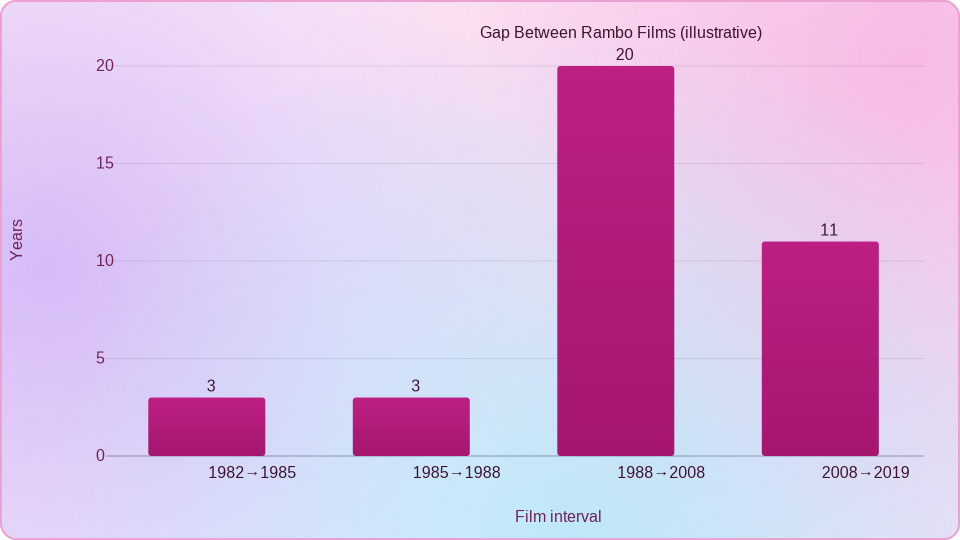
The fatigue was not merely commercial but creative. The third film had exhausted the Cold War framework, and there was no obvious next step. The character's mythology had become so inflated that any new instalment risked either repeating the formula or undermining it. The long pause allowed the franchise to reset, and when it returned, it did so with a darker, more sombre tone that acknowledged the passage of time. That reset was crucial to the character's survival, and it demonstrated that Rambo could be reinvented without being abandoned.
The 2008 Revival and the Weight of History
When Stallone returned to the character in 2008, he did so with a film that deliberately stripped away the gloss of the earlier sequels. Simply titled Rambo, the film is set in Myanmar and depicts the country's brutal military regime with unflinching violence. Rambo is older, quieter, and visibly damaged, working as a snake catcher and ferryman. The film's tone is elegiac, and its action sequences are among the most graphic in the series. It was a conscious attempt to return to the character's darker roots, and it divided critics accordingly.
The film's reception reflected a broader cultural reassessment of the action hero. Audiences who had grown up with the character were now middle-aged, and the film spoke to their sense of mortality and regret. Rambo's decision to escort missionaries into a war zone, and his subsequent rescue mission, is framed as a final act of service rather than a quest for glory. The film ends with him returning to the United States, a resolution that had been withheld for decades. It was a surprisingly tender conclusion to a notoriously violent series.
Violence as Moral Argument
The 2008 film is often criticised for its extremity, and the criticism is not unfounded. The violence is relentless and intimate, and it raises questions about what the audience is being asked to enjoy. Yet the film's defenders argue that the violence is intended as a moral argument, a depiction of real atrocities that demands a response. The Burmese military's abuses are documented, and the film's use of them is not gratuitous in intent, even if the execution is difficult to watch. The debate over this tension is central to any serious assessment of the franchise.
What distinguishes the 2008 film from its predecessors is its refusal to make the violence cathartic. The earlier sequels offered the pleasure of watching a wronged man triumph; the 2008 film offers something closer to exhaustion. Rambo's final act of violence is followed not by triumph but by a quiet departure, and the film's closing images are of a man returning home. That shift in register suggests a maturing of the franchise's understanding of what its hero represents, and it gives the character a dignity that the earlier films sometimes denied him.
Reception and Legacy
The film's critical reception was mixed, with some reviewers praising its intensity and others finding it repellant. Its commercial performance was solid but not spectacular, and it did not immediately generate a sequel. Over time, however, its reputation has grown, and it is now often seen as one of the more interesting entries in the series. Its willingness to confront the character's age and history gave the franchise a new direction, and it demonstrated that Rambo could be more than a relic of 1980s cinema.
The revival also prompted a wider reconsideration of the character's cultural significance. Scholars and critics began to examine Rambo's place in the history of American representations of veterans, and the films were reread in light of contemporary debates about trauma and reintegration. The character's journey from villain to hero to something more ambiguous was recognised as a reflection of changing attitudes toward military service. The 2008 film was not the end of that journey, but it was a significant waypoint.
Last Blood and the Domestic Turn
Rambo: Last Blood, released in 2019, moved the character decisively into new territory. The film is set largely in Arizona and Mexico, and its plot concerns Rambo's attempt to rescue his niece from a cartel. The shift from foreign battlefields to domestic crime was a significant departure, and it drew comparisons to revenge thrillers like Taken. The film was not well received by critics, who found its violence gratuitous and its politics troubling, but it performed adequately and gave the character a definitive conclusion, at least for the time being.
The film's most interesting aspect is its treatment of Rambo as a surrogate father. His relationship with his niece, and his grief at her fate, gives the character an emotional register that the earlier films rarely allowed. The violence that follows is framed as a failure of protection rather than a triumph of skill, and the film's final scenes are elegiac. Whether this constitutes a satisfying conclusion is debatable, but it does represent an attempt to reckon with the character's age and the accumulated weight of his history.
The Revenge Narrative Reconsidered
The revenge narrative is one of the oldest in popular culture, and Last Blood follows its conventions closely. A wrong is committed, the protagonist suffers, and retribution follows. What makes the film interesting is the way it complicates the satisfaction of revenge. Rambo's violence is not presented as cathartic but as a grim necessity, and the film's final images suggest that the cost has been too high. This is a more mature treatment than the earlier sequels offered, and it suggests that the franchise had learned something from its critics.
The film's critics, however, found the treatment insufficient. The violence against the cartel is graphic and prolonged, and the film's depiction of Mexico drew accusations of stereotyping. These criticisms are legitimate, and they point to a persistent tension in the franchise: its reliance on dehumanised enemies to justify its hero's actions. The film attempts to address this by giving Rambo a personal stake, but the underlying structure remains unchanged. The revenge narrative, for all its emotional power, is a blunt instrument.
What the Ending Means
The film's conclusion, in which Rambo sits on his porch, wounded but alive, has been read as a final farewell. Stallone has suggested that the character's story is complete, though he has also left the door open for further instalments. The ambiguity is fitting for a character whose meaning has always been contested. Whether or not another film is made, the ending offers a kind of closure: the veteran who could never come home has finally done so, and the violence that defined him has been set aside, at least temporarily.
That closure is complicated by the film's reception and by the character's ongoing cultural presence. Rambo remains a reference point in debates about masculinity, violence, and the representation of veterans, and his image continues to circulate in popular culture. The ending of Last Blood does not resolve those debates; it simply provides a pause. The character's legacy is larger than any single film, and it will continue to be reinterpreted as long as audiences find something in him worth arguing about.
Why Rambo Endures
The durability of the Rambo character rests on a paradox that the films have never fully resolved. He is at once a symbol of national guilt and a fantasy of national strength, a victim and an avenger, a man who cannot come home and a man who keeps returning. That contradiction is not a flaw in the character but the source of his power. Audiences can project onto him whatever they need: a critique of how veterans are treated, a celebration of martial skill, a meditation on aging and loss. The films offer enough material for all of these readings, and the character's meaning shifts with the viewer.
There is also the simple matter of iconography. The image of Rambo, with his bandana, bow, and bare chest, is one of the most recognisable in popular culture. It has been parodied, referenced, and appropriated so often that it has become detached from its origins. That visual power is a form of endurance that does not depend on the quality of any individual film. The character has become a piece of cultural shorthand, and shorthand is remarkably resilient. Even people who have never seen a Rambo film know what the name means.
The Veteran as Cultural Symbol
Rambo's most significant contribution to popular culture may be his role in shaping how Americans imagine the Vietnam veteran. The character gave a face and a body to a group that had been largely invisible in mainstream culture, and he did so in a way that was both sympathetic and troubling. The films acknowledge the veteran's suffering while also making him a vehicle for violence, and that combination has influenced countless subsequent portrayals. The figure of the damaged soldier who becomes a weapon is now a staple of film and television, and Rambo is its most famous ancestor.
That legacy is double-edged. On one hand, the films brought attention to the mistreatment of veterans and helped to humanise a group that had been stigmatised. On the other, they reinforced a stereotype of the veteran as dangerous and unstable, a stereotype that has real consequences for how returning soldiers are treated. The character's defenders argue that the films are sympathetic to Rambo and critical of the institutions that failed him; his critics argue that the sympathy is undermined by the spectacle of violence. Both readings have merit, and the tension between them is part of what makes the character worth discussing.
The Franchise's Contradictions
The Rambo franchise is a study in contradictions. It began as a critique of American militarism and became a celebration of it. It created a character who was meant to be a warning and turned him into a hero. It has been praised for its treatment of trauma and criticised for its glorification of violence. These contradictions are not accidents; they are the product of a character who was always overdetermined, carrying more meaning than any single story could contain. The films have never resolved them, and it is unlikely that any future instalment will.
What the franchise has done, however, is provide a vocabulary for talking about those contradictions. Rambo is a reference point in debates about war, masculinity, and national identity, and his name has become a shorthand for a particular kind of politics. That is a significant cultural achievement, even if it is not always a comfortable one. The character's endurance is a testament to the power of popular culture to engage with difficult subjects, and to the persistence of the questions that Morrell raised more than fifty years ago.
The final measure of Rambo's significance may be the simple fact that he is still being discussed. Characters fade; icons persist. The veteran who was discarded by his country has become one of the most recognisable figures in American popular culture, and his story continues to be told and retold. Whether he is read as a hero, a victim, or a warning, he remains a mirror in which audiences see their own ambivalence about war and its aftermath. That is a rare and durable legacy, and it explains why Rambo endures.
From our network :
- Live Online English Classes for Kids: Do They Actually Reduce Anxiety?A ten-week study reveals that synchronous online English classes can significantly reduce child language anxiety while improving listening and reading skills. Discover what makes these programs effective and how parents can select the right one.
- Committed Mediterranean Precipitation Decline: Why Emissions Cuts Alone Cannot Restore Winter RainsNew NOAA research reveals that Mediterranean winter rains may decline irreversibly even with emissions cuts. Explore the science of committed climate change and regional impacts.
- Forbidden Matrix Patterns and Visible Lattice Points: A Geometric DictionaryExplore how multidimensional 0–1 matrices encode geometric truths, linking forbidden patterns to visible lattice points and hypergraph theory, with applications in combinatorics and computational geometry.
- The Final Descent: How ESA Retired the Legendary Cluster Constellation After 24 Years of Space Weather ScienceAfter 24 years mapping Earth’s magnetosphere, ESA’s Cluster mission concluded with a precisely controlled reentry over the South Pacific. This analysis explores the scientific legacy, engineering decisions, and debris mitigation principles behind one of space exploration’s most responsible retirements.
- How AI Agents Will Change the Way We Manage Personal FinancesExplore how AI agents are transforming personal finance through automated budgeting, bill payment, and investment management, while examining the critical security protocols and governance frameworks required for safe deployment.
- University Language Proficiency Exams: Why Institutional Tests Demand Different Preparation Than IELTS and TOEFLDiscover why university-specific language proficiency examinations differ fundamentally from IELTS and TOEFL, and learn strategic preparation approaches for institutional assessment success.
- CISA’s Ten-Advisory Wave: Why Generic Patching Fails in OT and How to Build Product-Specific PlaybooksCISA released ten ICS advisories in one week, exposing critical infrastructure risks. Generic patching fails in OT. Learn to build product-specific remediation playbooks.
- Mobile Learning and VR in English: What Global Evidence Reveals About Effective Language TechnologyA systematic review across 14 countries reveals which language-learning technologies genuinely work. Mobile learning, AI, and VR show measurable benefits when pedagogically integrated. This evidence-based guide helps educators and learners select technology that delivers real return on investment.
- The Hidden Cost of AI Convenience: Why Over-Permissioned Agents Are a Security Time BombDiscover why AI agents with excessive permissions create dangerous single points of failure, and learn how implementing least privilege principles can protect your organization from exploitation.
RESOURCES
- The transformation of Rambo from broken veteran to unstoppable ...reddit.comJan 14, 2021 ... He was made to be an indestructible soldier by an uncaring military at the cost of his humanity. He's a…
- The Continuing Relevance and Reinterpretation of Ramboseanpcarlin.comSep 4, 2014 ... What a great article and analysis of john Rambo's character. I am currently reading the new french translation of the…
- My theory on what happened to Rambo after First Blood - Redditreddit.comMay 5, 2026 ... Rambo's ending explained. Rambo character analysis. First Blood vs Rambo comparison. Rambo's impact on public relations.
- John Rambo - Wikipediaen.wikipedia.orgIn the novel and first film, Rambo appears as a soldier who suffers from post-traumatic stress disorder and has difficulty adjusting to normal life.…
- Mary Rambo Character Analysis in Invisible Man - LitChartslitcharts.comMary is a motherly figure for the narrator, a caring woman who provides food and shelter in the narrator's time of need. The narrator…
- Mary Rambo - CliffsNotescliffsnotes.comCharacter Analysis Mary Rambo. As her name suggests, Mary Rambo is both Mary, the saintly mother of Jesus, and Aunt Jemima, the female version…
- Mary Rambo Character Analysis in Invisible Man - SparkNotessparknotes.comMary Rambo is a kind and generous Black woman who takes the narrator in after his traumatizing stay at the factory hospital. In addition…
- First blood legacy and rambo character analysis - Facebookfacebook.comOct 22, 2026 ... I don't think Hollywood ruined Rambo as a character. They repurposed him. And that repurpose certain very well in further…
- Rambo: Last Blood Ending & Real Meaning Explained - ScreenRantscreenrant.comFeb 10, 2025 ... The closing credits of Last Blood feature a dramatic montage of Sylvester Stallone's iconic character across all five films in…
- First Rambo movie plot and character analysis - Facebookfacebook.comApr 6, 2020 ... Will Teasle. First Blood (1982) The first of the Rambo movies was a very different animal to all those which…
- Last Blood' ending explained: Does Rambo die in the end?ew.comFeb 20, 2025 ... But what seems like an idyllic epilogue for the character is soon disrupted by a Mexican cartel, leading to a…
- Rambo Last Blood's Extended Cut Explained: Why It's Betterscreenrant.comMay 7, 2020 ... Rambo: Last Blood Extended Cut Strengthens His Tragic Characterization. Sylvester Stallone in Rambo V Last Blood. Rambo is a character…
- The Big Twist Behind Mortal Kombat 11's Rambo Explained - SVGsvg.comOct 8, 2020 ... Both characters begin sparring, but are quickly interrupted by the arrival of the Kombat Pack's third and most surprising character:…
- John Rambo - Rambo Wiki - Fandomrambo.fandom.comA former Vietnam War veteran and a highly skilled Green Beret, Rambo returned from the war as a decorated, but disturbed hero. He is…
Related By Tags
- 01
- 02
- 03
- 04
- 05
- 06
- 07
- 08
0 Comments