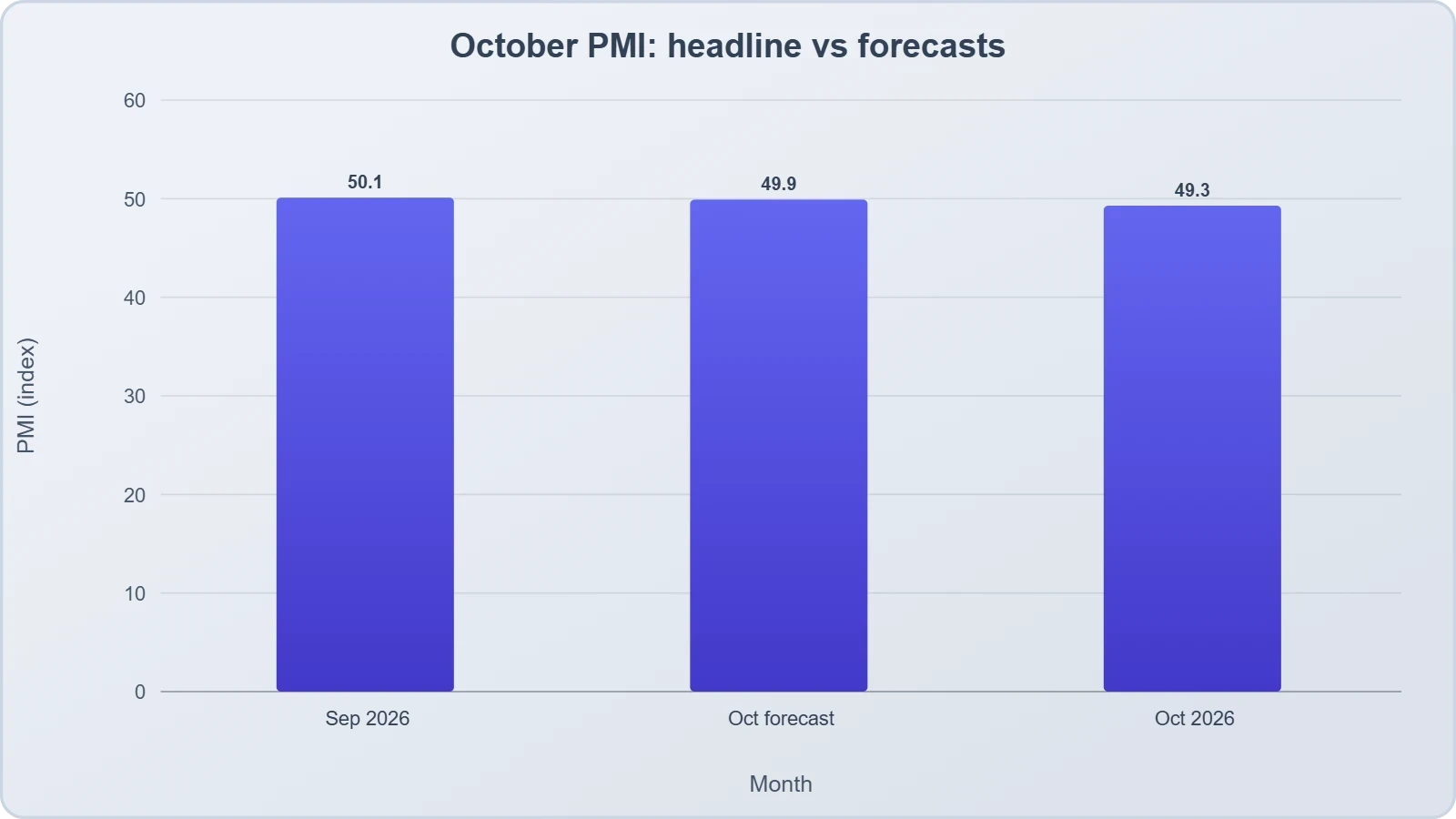
China's manufacturing sector slipped back into contraction in October 2026, with the official purchasing managers' index printing at 49.3, a reading that sits below the 50-point threshold separating expansion from contraction. The figure marked a retreat from September's 50.1 and August's 49.8, and it undershot a Bloomberg survey forecast of 49.9, signalling that consensus expectations for a stabilising industrial base were not met. For an economy targeting annual growth of 4.5 to 5.0 percent — its most modest goal in decades — the return to sub-50 territory is a pointed reminder that export resilience alone cannot carry the broader growth agenda.
The National Bureau of Statistics attributed part of the softness to a week-long national holiday at the start of October, which compressed working days and disrupted production schedules. Statistician Huo Lihui also pointed to a complex and volatile international environment, noting that rising international crude oil prices had pushed up input costs for coal, rubber and plastic products. Yet the holiday explanation only partly accounts for the weakness: the consumer goods sub-index fell 1.9 percentage points from the previous month, a decline that suggests genuine softening in market activity rather than a purely calendar-driven dip.
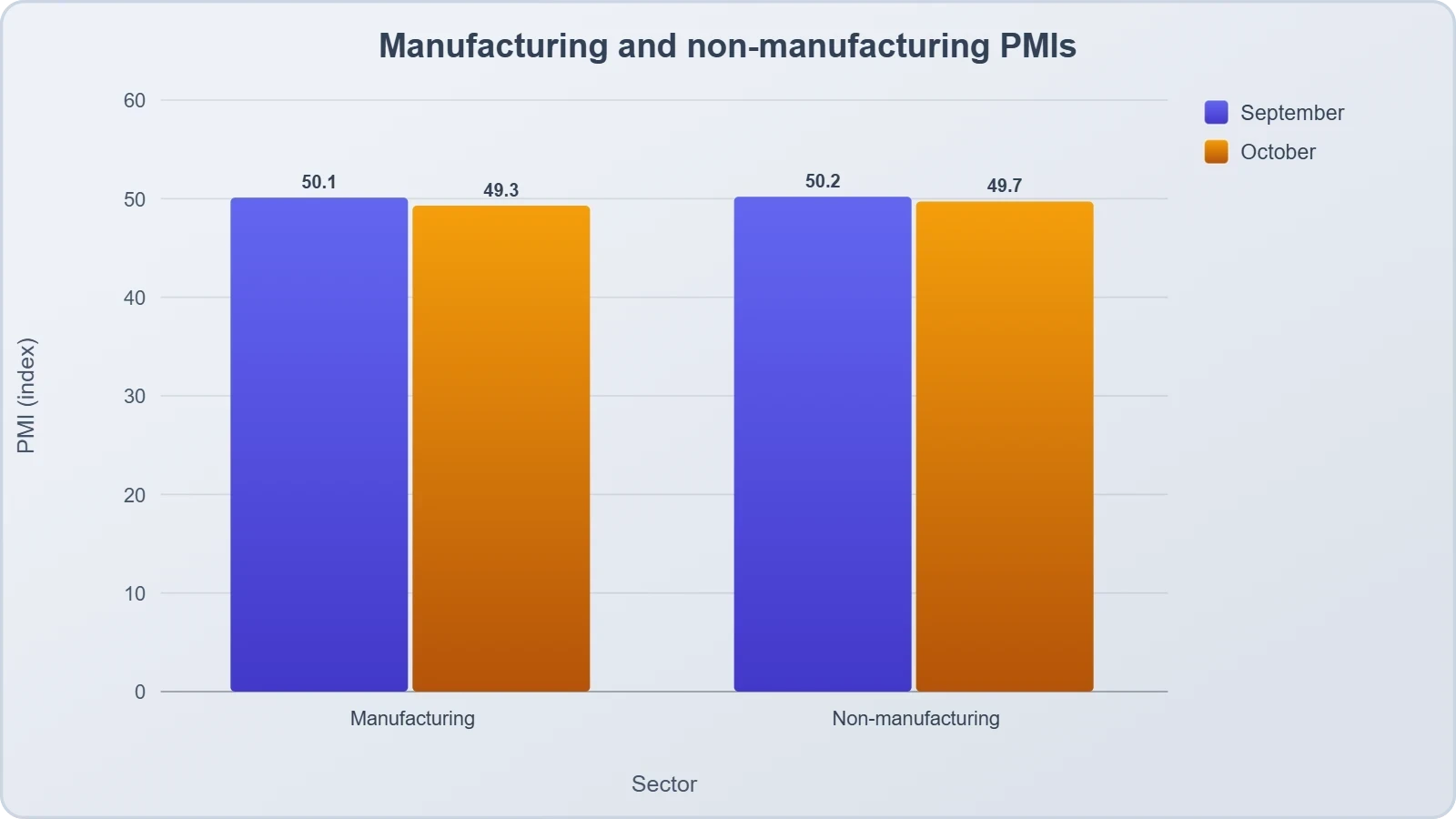
Beneath the headline number lies a more textured picture. High-tech industries continued to show positive momentum amid the global artificial intelligence boom, offering a counterweight to weakness elsewhere. The non-manufacturing PMI, which covers services and construction, also fell to 49.7 from 50.2 in September, missing a forecast of 50.0, with finance-sector business activity and construction both slowing. Zhiwei Zhang of Pinpoint Asset Management captured the strategic dilemma succinctly: strong exports alone are not enough to boost economic momentum, and if external demand weakens in 2027, Beijing will need more significant policy support to lift domestic demand.
On This Page
- The October PMI Reversal and What It Signals
- Holiday Effects, Input Costs and the Consumer Goods Drag
- Services, Construction and the Non-Manufacturing Gauge
- Growth Targets, Export Reliance and the Domestic Demand Gap
- Global Spillovers and the 2027 External Demand Question
- Interpreting the Signal Without Overreading It
TL;DR China's official manufacturing PMI fell to 49.3 in October 2026, back below the 50-point expansion threshold and short of the 49.9 consensus forecast, while the non-manufacturing gauge slipped to 49.7. A week-long national holiday, elevated crude-linked input costs, and a 1.9-point drop in the consumer goods sub-index all contributed to the softness. High-tech industries remained a bright spot on AI-driven demand, but economists warn that export strength alone cannot sustain momentum, and that weakening external demand in 2027 would require more forceful policy support to revive domestic consumption.
The October PMI Reversal and What It Signals
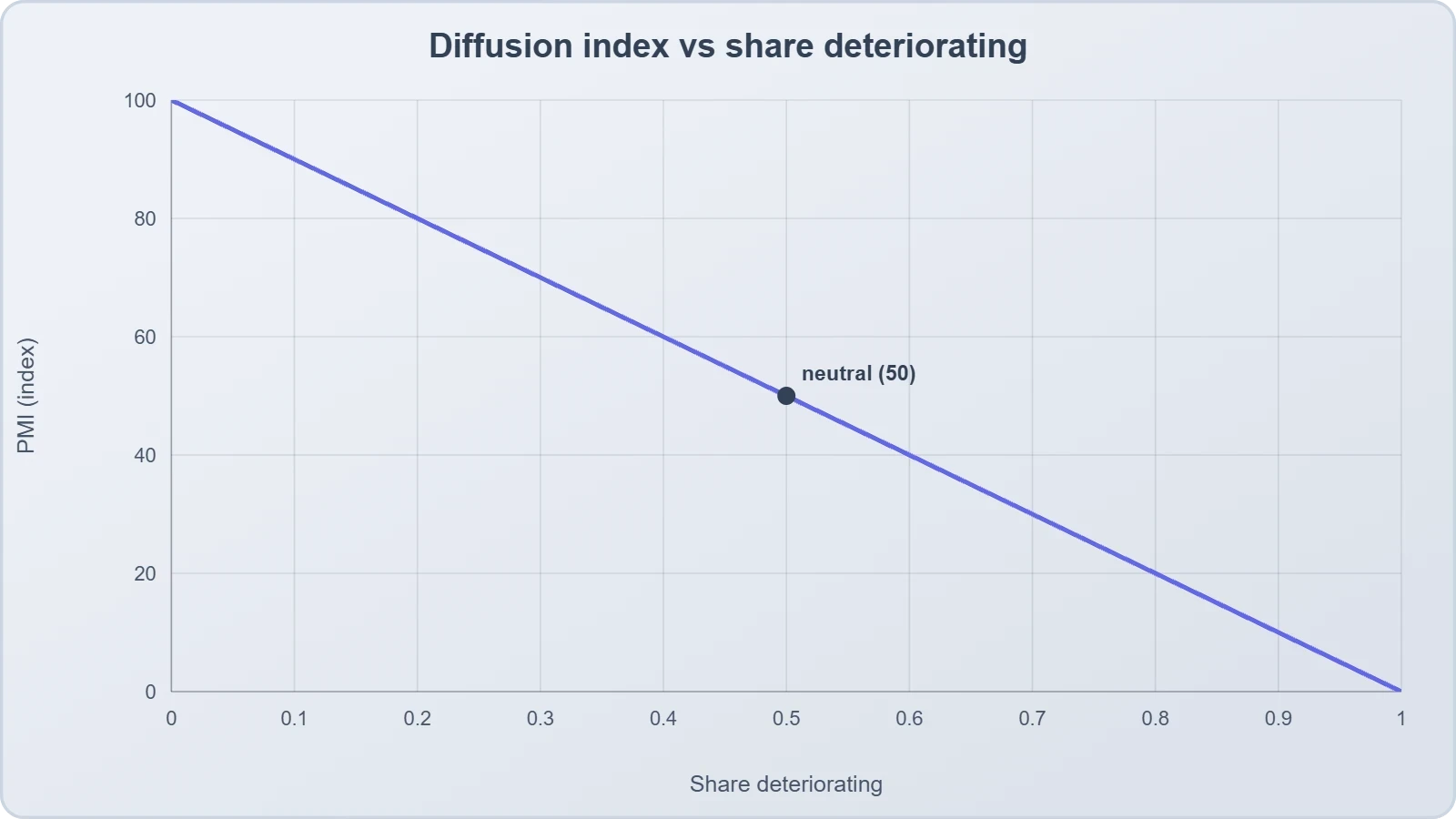
The October reading carries weight precisely because it interrupts a fragile narrative of stabilisation. September's 50.1 had been read by many analysts as evidence that Chinese industry was clawing its way back above the expansion line after a difficult summer. October's 49.3 reverses that trajectory and places the index closer to July's 49.2 than to the optimism that briefly surrounded the third quarter. Purchasing managers' indices are diffusion measures: they track the share of firms reporting expansion versus contraction, so a reading below 50 means more respondents saw deterioration than improvement across production, new orders, inventories and employment.
What makes the reversal analytically interesting is its composition. A headline miss of 0.6 points against consensus is modest in absolute terms, but the internal distribution matters more than the aggregate. When a holiday-distorted month produces weakness concentrated in consumer goods while high-tech segments hold firm, the implication is that the soft patch is structural as much as seasonal. Consumer-facing manufacturers appear to be responding to subdued household demand, while capital-intensive and technology-oriented producers continue to benefit from AI-related investment cycles that are global rather than domestic in origin.
Reading the Headline Number in Context
Contextualising 49.3 requires looking beyond a single month. The index has now oscillated around the 50 line for much of 2026, never establishing a decisive break into sustained expansion. That pattern is characteristic of an economy managing multiple transitions at once: from export-led to consumption-led growth, from traditional manufacturing to higher-value production, and from a property-driven investment model to something more balanced. Each transition exerts downward pressure on aggregate demand in the short run, even where the long-run direction is constructive. The October print should therefore be read as a symptom of those overlapping transitions rather than as an isolated shock.
The forecast miss adds a second layer of meaning. Bloomberg-surveyed economists expected 49.9, essentially a flat reading just below the threshold. When consensus anticipates near-stability and the data delivers a clearer contraction, it suggests that the drag from holiday effects and input costs was underestimated, or that underlying demand weakness is deeper than modelled. Either interpretation argues for caution about the pace of any industrial recovery heading into the final quarter of the year.
Why the Sub-50 Threshold Matters
The 50-point line is not merely a technical convention; it functions as a psychological and political marker. Sustained readings below 50 tend to correlate with weaker industrial production, softer corporate earnings in cyclical sectors, and reduced appetite for capital expenditure. For policymakers, a sub-50 print complicates the communication of economic stewardship, particularly when the annual growth target already sits at a historically modest 4.5 to 5.0 percent. Markets also react to the threshold effect, treating the direction of travel across the line as a signal about the likely direction of fiscal and monetary support.
Mathematically, the diffusion index can be expressed as a weighted share of respondents reporting improvement, no change, and deterioration:
where ##P_{improve}##, ##P_{unchanged}## and ##P_{deteriorate}## are the proportions of surveyed purchasing managers reporting each condition. A value of 50 therefore corresponds to a neutral balance, and any reading below it implies that the deteriorating share outweighs the improving share after weighting. This construction explains why modest headline moves can reflect meaningful shifts in business sentiment beneath the surface.
We Also Published
Holiday Effects, Input Costs and the Consumer Goods Drag
The official explanation for October's weakness leans heavily on calendar effects. A week-long national holiday at the start of the month reduces working days, disrupts logistics, and typically depresses production and new-order readings. Statisticians routinely caution against over-interpreting holiday-affected months for precisely this reason. Yet the magnitude of the miss relative to consensus suggests that calendar effects alone cannot explain the outcome. When forecasters already know the holiday schedule and still expect 49.9, a print of 49.3 implies that something beyond the calendar shifted between the survey period and the release.
Input costs provide part of the answer. Rising international crude oil prices fed through into higher prices for coal, rubber and plastic products, squeezing margins for manufacturers that lack the pricing power to pass costs onward. In a diffusion survey, cost pressure can depress sentiment even where output volumes hold steady, because purchasing managers factor profitability and forward orders into their assessments. The combination of fewer working days and higher input costs creates a plausible mechanism for the downside surprise, though it does not fully resolve the question of underlying demand.
The Consumer Goods Sub-Index Decline
The most telling detail in the release is the 1.9 percentage point fall in the consumer goods PMI. Consumer goods manufacturers sit closest to household demand, and their sentiment tends to track retail sales, disposable income expectations and confidence more closely than the capital goods segment does. A decline of that size implies that domestic consumption remains soft, consistent with the broader diagnosis that weak household demand is weighing on the economy. It also complicates the official narrative that holiday timing explains the headline weakness, since consumer goods producers face the same calendar as everyone else.
This matters for the growth target. Beijing's 4.5 to 5.0 percent objective for the year assumes a degree of demand recovery that the October data does not corroborate. If consumer goods manufacturers are reporting contraction while high-tech firms report expansion, the aggregate growth figure may be sustained by investment and exports even as the household sector lags. That composition is economically significant: growth driven by capital-intensive sectors generates fewer consumer-facing jobs and less broad-based income growth than balanced expansion would.
High-Tech Momentum as a Partial Offset
Against the gloom, high-tech industries continued to show positive momentum amid the global artificial intelligence boom. Demand for semiconductors, computing infrastructure and related components has been a genuine bright spot, and Chinese producers have participated in that cycle despite export controls and geopolitical friction. The AI investment wave is global in character, which means it can support Chinese high-tech output even when domestic demand is weak. This creates a two-speed industrial economy in which advanced segments expand while traditional and consumer-facing segments contract.
The two-speed pattern has implications for policy. Support measures aimed at aggregate demand, such as consumption vouchers or income transfers, would address the weak segment directly but may take time to transmit. Measures aimed at investment, such as infrastructure spending or credit easing for manufacturers, would reinforce the strong segment but risk widening the divergence. The optimal mix depends on whether policymakers judge the consumer weakness to be cyclical or structural, a question the October data leaves genuinely open.
Services, Construction and the Non-Manufacturing Gauge
The non-manufacturing PMI, which spans services and construction, fell to 49.7 in October from 50.2 in September, missing a Bloomberg forecast of 50.0. The move into contraction territory is significant because services have been the more resilient half of the Chinese economy in recent years, absorbing labour and offsetting weakness in property and heavy industry. When the services gauge slips below 50, it suggests that the softness is broadening rather than remaining confined to factory floors. Statistician Huo Lihui cited a decline in business activity in some service sectors, particularly finance, though he did not elaborate on the specific drivers.
Construction activity also slowed compared with the previous month, according to the same release. That is consistent with the prolonged adjustment in the property sector, where developers remain under financial pressure and new starts have been subdued. Construction is labour-intensive and has strong multiplier effects on materials, equipment and local government revenue, so its deceleration carries outsized macroeconomic weight. A simultaneous softening in manufacturing, services and construction is precisely the configuration that makes policymakers uncomfortable, because it leaves fewer engines of growth to lean on.
Finance as a Leading Indicator
The specific mention of finance-sector weakness deserves attention. Financial intermediation sits upstream of much of the real economy: when banks and insurers report slower business activity, it often presages tighter credit conditions or reduced demand for borrowing downstream. In a diffusion survey, a finance-sector decline can reflect lower loan volumes, compressed margins, or caution among lenders about asset quality. None of these readings is definitive from a single PMI release, but the direction is worth monitoring because credit conditions transmit to investment and consumption with a lag of several quarters.
For an economy managing a property downturn and local government debt constraints, the health of the financial sector is doubly important. Banks are the primary channel through which monetary easing reaches the real economy, and if their own activity is contracting, the transmission mechanism may be impaired. That possibility strengthens the case for fiscal measures that bypass the banking channel, such as direct transfers or targeted spending programmes, if policymakers conclude that demand support needs to be delivered quickly.
Construction and the Property Overhang
Construction's slowdown connects directly to the property overhang that has weighed on Chinese growth since 2021. Even as headline infrastructure spending has been maintained, residential construction has been constrained by developer defaults, presale delivery obligations and weak buyer confidence. The PMI's construction component captures both public and private activity, so a decline suggests that infrastructure support has not been sufficient to offset the residential drag. This is a structural constraint that monetary policy alone cannot resolve, because it reflects balance-sheet repair rather than a shortage of liquidity.
The interaction between construction weakness and consumer caution is also worth noting. Housing is the largest household asset for most Chinese families, and falling or stagnant property prices depress perceived wealth, which in turn suppresses consumption. That feedback loop helps explain why the consumer goods PMI fell even as high-tech industries expanded. Breaking the loop typically requires either stabilising property prices or providing households with alternative sources of income support, and both approaches carry fiscal costs that must be weighed against the growth target.
- 01
- 02
- 03
- 04
Growth Targets, Export Reliance and the Domestic Demand Gap
Beijing's growth target of 4.5 to 5.0 percent for 2026 is the lowest in decades, a deliberate recalibration that acknowledges structural headwinds. Even at that more modest level, achieving the objective requires contributions from consumption, investment and net exports simultaneously. October's PMI data suggest that two of those three engines are sputtering, leaving exports to carry more weight than is comfortable. The concern is not that exports are weak today, but that relying on them creates vulnerability to external shocks that China cannot control.
Zhiwei Zhang, chief economist at Pinpoint Asset Management, articulated the strategic risk plainly: strong exports alone are not enough to boost economic momentum. His warning that weakening external demand in 2027 would require more significant policy support to boost domestic demand points to a timing problem. Policy support takes time to design, legislate and transmit through the economy. If the external environment deteriorates in 2027, measures initiated only after the deterioration becomes visible may arrive too late to prevent a sharper slowdown.
The Limits of Export-Led Momentum
Export strength has been a genuine asset for China through 2026, supported by competitive pricing, supply chain depth and demand for electric vehicles, batteries and solar equipment. But export-led growth has diminishing returns when trading partners respond with tariffs and industrial policy of their own. The more China's surplus grows in strategic sectors, the more likely it is to provoke defensive measures abroad. That dynamic means the marginal value of additional export growth is lower than headline figures suggest, because it carries rising political and regulatory risk.
There is also a compositional issue. Export-oriented manufacturing tends to be capital-intensive and concentrated in specific regions, so its benefits do not spread evenly across the labour market. Consumer-facing services and small manufacturers employ far more people per unit of output, and those are precisely the segments showing weakness. A growth model that leans on exports can therefore produce respectable GDP numbers while leaving household income growth and employment quality lagging, which in turn feeds back into weak consumption.
What Policy Support Might Look Like
If domestic demand requires more significant support, the policy toolkit includes several distinct instruments. Fiscal transfers to households, expanded social safety nets, and targeted consumption subsidies address demand directly. Monetary easing, including reserve requirement cuts and interest rate reductions, works through credit channels but depends on willing borrowers. Infrastructure spending supports construction and materials but has diminishing returns where existing capital stock is already high. The choice among these instruments reflects a judgment about whether the problem is insufficient income, insufficient confidence, or insufficient credit supply.
Timing and credibility matter as much as the choice of instrument. Households that expect future tax increases or job insecurity may save rather than spend any transfer they receive, weakening the multiplier. Similarly, firms that expect demand to remain soft may not invest even when credit is cheap. This is why economists emphasise that demand support must be perceived as sustained rather than temporary. A one-off stimulus may shift the timing of spending without raising its level, whereas a credible multi-year programme can alter expectations and behaviour.
Global Spillovers and the 2027 External Demand Question
China's industrial cycle does not stay within its borders. As the world's largest manufacturer, its PMI readings ripple through commodity markets, shipping rates and supply chains across Asia and beyond. A sub-50 reading implies softer demand for iron ore, copper, oil and intermediate components, which affects exporters from Australia to Brazil to Southeast Asia. The October data therefore matter not only for Chinese policymakers but for anyone with exposure to global industrial demand, including investors in cyclical equities and commodities.
The oil price channel cuts both ways. Higher crude prices raised input costs for Chinese manufacturers in October, contributing to the PMI weakness, but they also reflect global demand conditions that are partly independent of China. If oil prices remain elevated, the cost pressure on Chinese manufacturers persists, particularly for firms producing plastics, rubber goods and energy-intensive materials. That creates a margin squeeze that can persist even if demand recovers, complicating the outlook for industrial profitability in the quarters ahead.
Commodity and Supply Chain Implications
For commodity exporters, the relevant question is whether October's weakness represents a temporary holiday-affected dip or the start of a deeper slowdown. The distinction matters enormously for pricing. A one-month soft patch can be absorbed by inventories and forward contracts, whereas a sustained contraction would require producers to adjust output and investment plans. The fact that both manufacturing and non-manufacturing gauges missed consensus in the same month tilts the evidence toward genuine softness, though a single month is never conclusive.
Supply chain participants should also watch the two-speed dynamic within Chinese industry. High-tech segments remain a source of demand for specialised components, while consumer goods and construction-related segments are contracting. Suppliers exposed to the strong segment may see continued orders, whereas those tied to consumer durables or building materials face a more difficult environment. This divergence argues against treating "China demand" as a single variable and in favour of segment-level analysis when assessing exposure.
Preparing for Weaker External Demand in 2027
Zhang's warning about 2027 deserves serious consideration because it identifies a specific vulnerability rather than a general concern. If external demand weakens, China's export engine loses power at precisely the moment when domestic demand is already soft. The policy response would need to be larger and faster than would otherwise be required, and its effectiveness would depend on how much preparatory work had been done in advance. Building social safety nets, improving household income expectations and reducing precautionary savings are slow-moving reforms, but they are the ones that make demand support work when it is needed.
There is also a strategic dimension. An economy that relies on exports for growth while suppressing domestic consumption generates large surpluses that invite trade friction. Rebalancing toward domestic demand is therefore not only a cyclical stabilisation strategy but a geopolitical one. The October PMI data, by showing consumer goods weakness alongside export strength, illustrate the imbalance that rebalancing is meant to correct. Whether Beijing treats the data as a prompt for faster rebalancing or as a reason to reinforce export support will shape the trajectory well beyond 2026.
Interpreting the Signal Without Overreading It
Single-month PMI releases are noisy, and October's reading is unusually exposed to calendar distortion. A responsible interpretation acknowledges both the weakness and its limits. The index has hovered near 50 for months, and one print at 49.3 does not establish a durable downtrend any more than September's 50.1 established a durable recovery. What the October data do provide is corroboration: the consumer goods decline, the non-manufacturing miss and the finance-sector softness all point in the same direction, which strengthens the signal beyond what the headline alone would justify.
The appropriate analytical posture is to treat October as a data point within a range rather than as a verdict. Monitoring the next two to three releases will reveal whether the weakness persists after holiday effects fade and whether input cost pressures ease if oil prices stabilise. If November and December print below 50, the case for significant policy support becomes compelling. If they recover above the threshold, October will be remembered as a seasonal aberration. The honest conclusion is that the evidence is suggestive but not yet decisive.
What to Watch in the Coming Months
Several indicators will clarify the picture. The consumer goods sub-index is the most important, because it speaks directly to the domestic demand gap that policymakers are trying to close. New orders, which lead production, will indicate whether forward demand is stabilising. The finance-sector component of the non-manufacturing gauge will show whether credit conditions are tightening or easing. And the high-tech segment will reveal whether AI-driven demand remains a reliable offset or begins to fade as the global investment cycle matures.
Beyond the PMI family, retail sales, industrial production and credit growth will provide cross-checks. If retail sales weaken alongside the consumer goods PMI, the domestic demand diagnosis is confirmed. If credit growth slows alongside the finance-sector reading, the transmission concern gains support. Cross-referencing multiple indicators is essential because each has its own measurement quirks, and the October release is best understood as one input into a broader assessment rather than as a standalone conclusion.
The Bottom Line for Observers
China's October PMI data describe an economy in transition, with advanced manufacturing holding up while consumer-facing and construction-linked segments soften. The return to sub-50 territory is a reminder that the growth target is demanding and that export strength is doing more work than is comfortable. The policy question is not whether support will be needed if external demand weakens, but whether the groundwork for that support is being laid now. Observers should watch the consumer goods sub-index, the finance component and the next two PMI releases for confirmation of whether October was a dip or a turning point.
For investors, the practical implication is to distinguish between segments rather than treating China as a monolith. Exposure to high-tech supply chains rests on a different demand driver than exposure to consumer durables or building materials. For policymakers elsewhere, the data are a reminder that the world's second-largest economy remains a significant source of global demand volatility. And for analysts, the release is a case study in why diffusion indices require careful reading: the headline number tells only part of the story, and the composition often tells more.
From our network :
- How AI Agents Will Change the Way We Manage Personal FinancesExplore how AI agents are transforming personal finance through automated budgeting, bill payment, and investment management, while examining the critical security protocols and governance frameworks required for safe deployment.
- CISA’s Ten-Advisory Wave: Why Generic Patching Fails in OT and How to Build Product-Specific PlaybooksCISA released ten ICS advisories in one week, exposing critical infrastructure risks. Generic patching fails in OT. Learn to build product-specific remediation playbooks.
- Mobile Learning and VR in English: What Global Evidence Reveals About Effective Language TechnologyA systematic review across 14 countries reveals which language-learning technologies genuinely work. Mobile learning, AI, and VR show measurable benefits when pedagogically integrated. This evidence-based guide helps educators and learners select technology that delivers real return on investment.
- The Hidden Cost of AI Convenience: Why Over-Permissioned Agents Are a Security Time BombDiscover why AI agents with excessive permissions create dangerous single points of failure, and learn how implementing least privilege principles can protect your organization from exploitation.
- Forbidden Matrix Patterns and Visible Lattice Points: A Geometric DictionaryExplore how multidimensional 0–1 matrices encode geometric truths, linking forbidden patterns to visible lattice points and hypergraph theory, with applications in combinatorics and computational geometry.
- The Final Descent: How ESA Retired the Legendary Cluster Constellation After 24 Years of Space Weather ScienceAfter 24 years mapping Earth’s magnetosphere, ESA’s Cluster mission concluded with a precisely controlled reentry over the South Pacific. This analysis explores the scientific legacy, engineering decisions, and debris mitigation principles behind one of space exploration’s most responsible retirements.
- University Language Proficiency Exams: Why Institutional Tests Demand Different Preparation Than IELTS and TOEFLDiscover why university-specific language proficiency examinations differ fundamentally from IELTS and TOEFL, and learn strategic preparation approaches for institutional assessment success.
- Live Online English Classes for Kids: Do They Actually Reduce Anxiety?A ten-week study reveals that synchronous online English classes can significantly reduce child language anxiety while improving listening and reading skills. Discover what makes these programs effective and how parents can select the right one.
- Committed Mediterranean Precipitation Decline: Why Emissions Cuts Alone Cannot Restore Winter RainsNew NOAA research reveals that Mediterranean winter rains may decline irreversibly even with emissions cuts. Explore the science of committed climate change and regional impacts.
RESOURCES
- Resources will be updated soon.
- 01
- 02
- 03
- 04
- 05
- 06
- 07
- 08
0 Comments