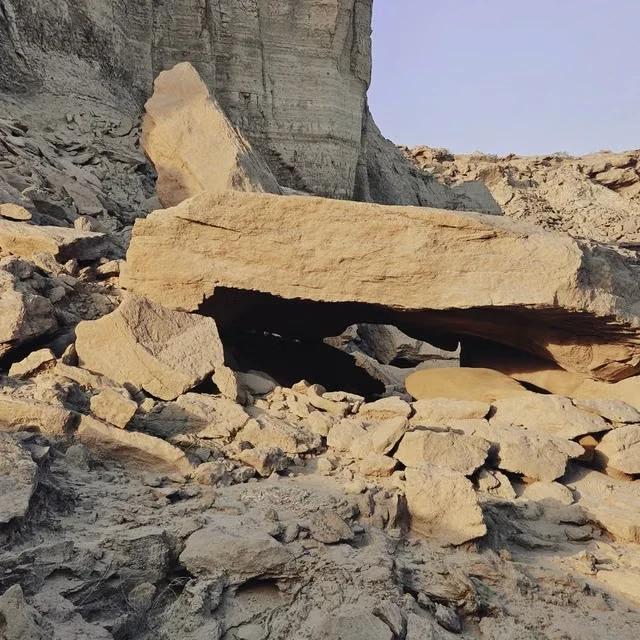
AlUla’s ancient past has once again been placed under careful scholarly scrutiny, and that matters because this is no ordinary archaeological site. It is a living archive of human settlement, trade, ritual, and empire, layered across one of the most historically charged landscapes in the Arabian Peninsula.
When a French archaeologist documents these civilizations, the act is not merely descriptive; it becomes an act of preservation, interpretation, and international cultural stewardship.
The significance of such work extends well beyond academic circles. AlUla has long stood at the crossroads of oasis agriculture, caravan routes, and successive civilizations that left behind inscriptions, tombs, monumental rock-cut architecture, and settlement patterns.
On This Page
Any serious documentation of the region helps protect fragile heritage, strengthens historical understanding, and builds a clearer narrative of how ancient communities adapted to desert life while remaining connected to wider regional networks.
In practical terms, this kind of research does three things at once: it records evidence before time erodes it, it frames the site within broader Near Eastern history, and it gives modern audiences a more disciplined account of a place often treated only as a tourist spectacle. The real message is straightforward: AlUla is not a decorative backdrop. It is a deep civilization landscape, and scholars who document it are helping secure its memory for the future.
TL;DR A French archaeologist has documented the historic civilizations of AlUla, reinforcing the site’s importance as a major heritage landscape in Saudi Arabia. The work underscores AlUla’s role as a crossroads of ancient cultures, trade, and settlement, while highlighting the urgent value of rigorous archaeological recording in protecting fragile evidence for future study.
Why AlUla Commands Scholarly Attention
AlUla is not simply an archaeological location; it is a historical system built from layers of habitation, exchange, and cultural continuity. Situated in northwest Saudi Arabia, it contains traces of societies that interacted across Arabia and the wider ancient world. That density of evidence makes it a magnet for researchers seeking to understand long-term human adaptation in harsh environments.
A landscape shaped by continuity
Unlike isolated ruins that represent a single era, AlUla preserves a sequence of civilizational traces that span centuries. This continuity matters because it allows archaeologists to compare settlement forms, burial practices, and symbolic expression across time. Such comparisons reveal not only who lived there, but how political and social organization evolved.
That depth is precisely why documentation is essential. Every survey note, field record, and interpretive map helps turn scattered remains into a coherent historical argument. Without that discipline, the site risks being reduced to fragments rather than understood as an integrated cultural landscape.
The desert as a record keeper
Arid climates can preserve exceptionally well, but they are also unforgiving. Wind erosion, development pressure, and uncontrolled visitation can damage fragile surfaces quickly. Archaeological documentation therefore serves as a defensive measure, capturing evidence before it is lost or altered beyond reliable study.
In AlUla, preservation is inseparable from knowledge production. The more precisely scholars record inscriptions, architecture, and spatial patterns, the stronger the historical reconstruction becomes. In this sense, archaeology is not merely about discovery; it is about disciplined memory.
The Meaning of Archaeological Documentation
To document a civilization is to do more than describe ruins. It is to create a controlled record of evidence that can be reviewed, challenged, and expanded by later scholars. Archaeology depends on this rigor because the ground itself cannot speak unless its traces are carefully catalogued and interpreted.
From observation to historical argument
Field documentation typically includes measurements, photographs, drawings, contextual notes, and interpretive classification. These elements transform raw observation into an intelligible historical framework. In a place like AlUla, such methods help distinguish between ritual space, domestic settlement, funerary practice, and trade-related infrastructure.
That process is not decorative bureaucracy. It is the core of credible archaeology. When done well, documentation enables international comparison, supports conservation planning, and prevents exaggerated claims from overtaking evidence.
Why foreign scholars still matter
International archaeologists often contribute technical expertise, comparative training, and institutional collaboration. Their work can be especially valuable when paired with local partners who bring deep regional knowledge and stewardship responsibility. The strongest research emerges when scholarship respects both scientific method and cultural ownership.
In this case, a French archaeologist documenting AlUla reflects that broader model of collaboration. The value lies not in nationality itself, but in the discipline applied to a site whose significance crosses academic, cultural, and geopolitical boundaries.
AlUla in the Wider Story of Ancient Arabia
The civilizations of AlUla belong to a broader pattern of ancient Arabian history marked by mobility, exchange, and adaptation. Far from being isolated, the region participated in commercial and cultural systems that linked inland oases with neighboring powers. That connection explains why its remains carry significance far beyond local history.
Trade routes and cultural exchange
Oasis settlements flourished because they offered water, rest, and strategic advantage along long-distance routes. Such places became points of contact where goods, languages, beliefs, and artistic forms met. AlUla’s historical value therefore lies partly in its role as a mediator between environmental constraint and regional connectivity.
When archaeologists document these interactions, they expose how ancient societies built resilience through exchange. The result is a more mature understanding of civilization: not as a fixed monument to power, but as a dynamic process shaped by movement and negotiation.
Identity, memory, and modern relevance
Heritage research also influences present-day identity. By reconstructing the past of AlUla, scholars help communities and institutions articulate continuity rather than rupture. This is especially important in regions where historical memory is being reintroduced into public discourse and cultural planning.
The practical outcome is larger than scholarship alone. Documentation can inform museums, conservation policy, educational programming, and responsible tourism. In other words, history becomes usable without being flattened.
Preservation, Tourism, and Responsible Stewardship
Once heritage sites enter public view, the stakes change immediately. Documentation must now support preservation, interpretation, and visitor management at the same time. AlUla’s growing visibility makes this balance essential, because popularity without discipline can damage the very resources that made the destination valuable.
Protection before promotion
Conservation should lead, not follow, public enthusiasm. That means access rules, site monitoring, controlled presentation, and research-based planning must guide development. Archaeology is strongest when it resists the temptation to become spectacle first and scholarship later.
Well-documented sites can accommodate visitors without surrendering integrity. The key is to treat heritage as a finite archive. Once details vanish, they cannot be casually restored, and no amount of marketing can replace them.
What responsible storytelling looks like
Responsible interpretation avoids exaggeration and treats uncertainty honestly. It explains what is known, what remains debated, and what still requires excavation or analysis. That standard protects public trust and gives audiences a more accurate understanding of ancient history.
In AlUla, the best storytelling will pair visual appeal with methodological seriousness. The heritage becomes richer, not poorer, when the public learns how archaeology actually works and why recorded evidence matters more than dramatic claims.
- 01
- 02
- 03
- 04
We Also Published
The Broader Lesson Behind the Report
The deeper message of this report is that archaeological work is inseparable from cultural responsibility. A civilization becomes legible to the present only when someone carefully records its traces and resists the haste of simplification. AlUla’s importance lies in its ability to force that discipline on everyone who studies it.
History needs method
Public fascination often favors grand narratives, but heritage demands evidence. That is why archaeological documentation remains one of the most important scholarly acts in the preservation of human history. It guards against distortion, protects fragile remains, and gives future researchers a reliable foundation.
In AlUla, method is not a technical footnote. It is the difference between a romanticized ruin and a usable historical archive. That distinction should be preserved with the same seriousness as the site itself.
What should be remembered
Readers should take away a simple truth: AlUla is a civilizational landscape of exceptional depth, and every careful record adds to its survival. The French archaeologist’s work, as reported, is best understood as part of a larger effort to map, protect, and interpret a shared human inheritance.
That inheritance is fragile, and fragility is precisely why scholarship matters. The value of documentation is not abstract; it is the mechanism by which the past remains available to the future. In AlUla, that responsibility is already in motion.
What This Means for Cultural Heritage Policy
Reports like this quietly shape policy by reminding institutions that heritage is evidence, not ornament. When documentation is strong, officials can make smarter decisions about conservation zones, excavation priorities, educational outreach, and visitor access. In that sense, archaeology becomes a public instrument, not just an academic pursuit.
The broader policy implication is unmistakable: sites of AlUla’s stature deserve sustained funding, trained specialists, and protective frameworks that outlast individual news cycles. Heritage cannot depend on momentum alone; it requires institutions that understand how to preserve complexity without freezing it in time.
From our network :
- Live Online English Classes for Kids: Do They Actually Reduce Anxiety?A ten-week study reveals that synchronous online English classes can significantly reduce child language anxiety while improving listening and reading skills. Discover what makes these programs effective and how parents can select the right one.
- University Language Proficiency Exams: Why Institutional Tests Demand Different Preparation Than IELTS and TOEFLDiscover why university-specific language proficiency examinations differ fundamentally from IELTS and TOEFL, and learn strategic preparation approaches for institutional assessment success.
- Mobile Learning and VR in English: What Global Evidence Reveals About Effective Language TechnologyA systematic review across 14 countries reveals which language-learning technologies genuinely work. Mobile learning, AI, and VR show measurable benefits when pedagogically integrated. This evidence-based guide helps educators and learners select technology that delivers real return on investment.
- Forbidden Matrix Patterns and Visible Lattice Points: A Geometric DictionaryExplore how multidimensional 0–1 matrices encode geometric truths, linking forbidden patterns to visible lattice points and hypergraph theory, with applications in combinatorics and computational geometry.
- Committed Mediterranean Precipitation Decline: Why Emissions Cuts Alone Cannot Restore Winter RainsNew NOAA research reveals that Mediterranean winter rains may decline irreversibly even with emissions cuts. Explore the science of committed climate change and regional impacts.
- The Hidden Cost of AI Convenience: Why Over-Permissioned Agents Are a Security Time BombDiscover why AI agents with excessive permissions create dangerous single points of failure, and learn how implementing least privilege principles can protect your organization from exploitation.
- The Final Descent: How ESA Retired the Legendary Cluster Constellation After 24 Years of Space Weather ScienceAfter 24 years mapping Earth’s magnetosphere, ESA’s Cluster mission concluded with a precisely controlled reentry over the South Pacific. This analysis explores the scientific legacy, engineering decisions, and debris mitigation principles behind one of space exploration’s most responsible retirements.
- How AI Agents Will Change the Way We Manage Personal FinancesExplore how AI agents are transforming personal finance through automated budgeting, bill payment, and investment management, while examining the critical security protocols and governance frameworks required for safe deployment.
- CISA’s Ten-Advisory Wave: Why Generic Patching Fails in OT and How to Build Product-Specific PlaybooksCISA released ten ICS advisories in one week, exposing critical infrastructure risks. Generic patching fails in OT. Learn to build product-specific remediation playbooks.
RESOURCES
- French archaeologist documents AlUla's historic civilizationsarabnews.jp2 days ago ... Among them was Dr. Laila Nehmé, a French archeologist who has worked in AlUla since 2002 on various projects as…
- French archaeologist documents AlUla's historic civilizationsarabnews.com3 days ago ... Laila Nehmé, a French archeologist who has worked in AlUla since 2002 on various projects as a research fellow with…
- French archaeologist Dr. Laila Nehmé documents AlUla's historic ...facebook.com3 days ago ... French archaeologist Dr. Laila Nehmé documents AlUla's historic civilizations. https://arab.news/4a8nt.
- French archeologist documents AlUla's historic civilizationspressreader.com2 days ago ... Richness and diversity of AlUla provides 'unique window' into societies that developed over time.
- French archaeologist documents AlUla's historic civilizationsgulfcontractnews.com2 days ago ... French archaeologist documents AlUla's historic civilizations. JEDDAH: Long before AlUla became a thriving tourism and commercial hub, ...
- Jean-Yves Le Drian: AlUla at the heart of deepening Saudi-French tiesarabnews.pkAug 24, 2026 ... AlUla encompasses a vast landscape of archaeological sites, historic ... French archaeologist documents AlUla's historic civilizations · Saudi ...
- The inscriptions of the Old Town of AlUla | Heritage of the Middle Eastarcheologie.culture.gouv.frSpread knowledge about threatened and attacked sites in the Middle East to enable further research and to show what these universal civilizations and sites ...
- AlUla expands global ties with Saudi-French cultural partnershipenglish.ajel.saAug 24, 2026 ... ... document AlUla's historical periods and daily life. One of ... Today, AlUla continues its historic role as a bridge…
- Course of study - Programme Jaussen & Savignacjaussen-et-savignac.pantheonsorbonne.fr... (Document in French, containing a table) [Pdf file: 7 KB] ... Pr Pascal BUTTERLIN, Professor of Near Eastern Archaeology (History, Civilization, Archaeology, and ...
- The Royal Commission for AlUla | RCUrcu.gov.saJun 17, 2026 ... ... ancient civilizations. Sustainable Tourism. RCU is transforming AlUla into a breathtaking destination where adventure and culture meet ...
- AlUla, Wonder of Arabia : Symposium - Doors Art and Culture Agencydoors-agency.com... France. Master in Ancient History and Civilisations, Bordeaux University, France. 2014-2019: Director of the Department of Archaeology, Art History and ...
- Royal Commission for AlUla Publishes 'Umm Daraj: Beacon of the ...spa.gov.sa... French. The book forms part of RCU's ongoing efforts to preserve and document AlUla's cultural heritage, enrich specialist knowledge in archaeology and history ...
- Hegra Archaeological Site (al-Hijr / Madā ͐ in Ṣāliḥ)whc.unesco.orgFrench; Arabic ... The Nomination files produced by the States Parties are published by the World Heritage Centre at its website and/or in working…
- AlUla Oasis, a Living Heritage #10 Inscriptions Numerous engraved ...instagram.comMar 2, 2026 ... ... archaeological discoveries that document thousands of years of human adaptation to the desert environment. ... civilizations of the ancient…
- The Arabian desert reveals long-hidden jewels | CNRS Newsnews.cnrs.frSep 29, 2025 ... ... French Agency for Alula Development (AFALULA) in 2018. ... A central figure in French archaeology in Saudi Arabia, Laïla…
- 01
- 02
- 03
- 04
- 05
- 06
- 07
- 08
0 Comments