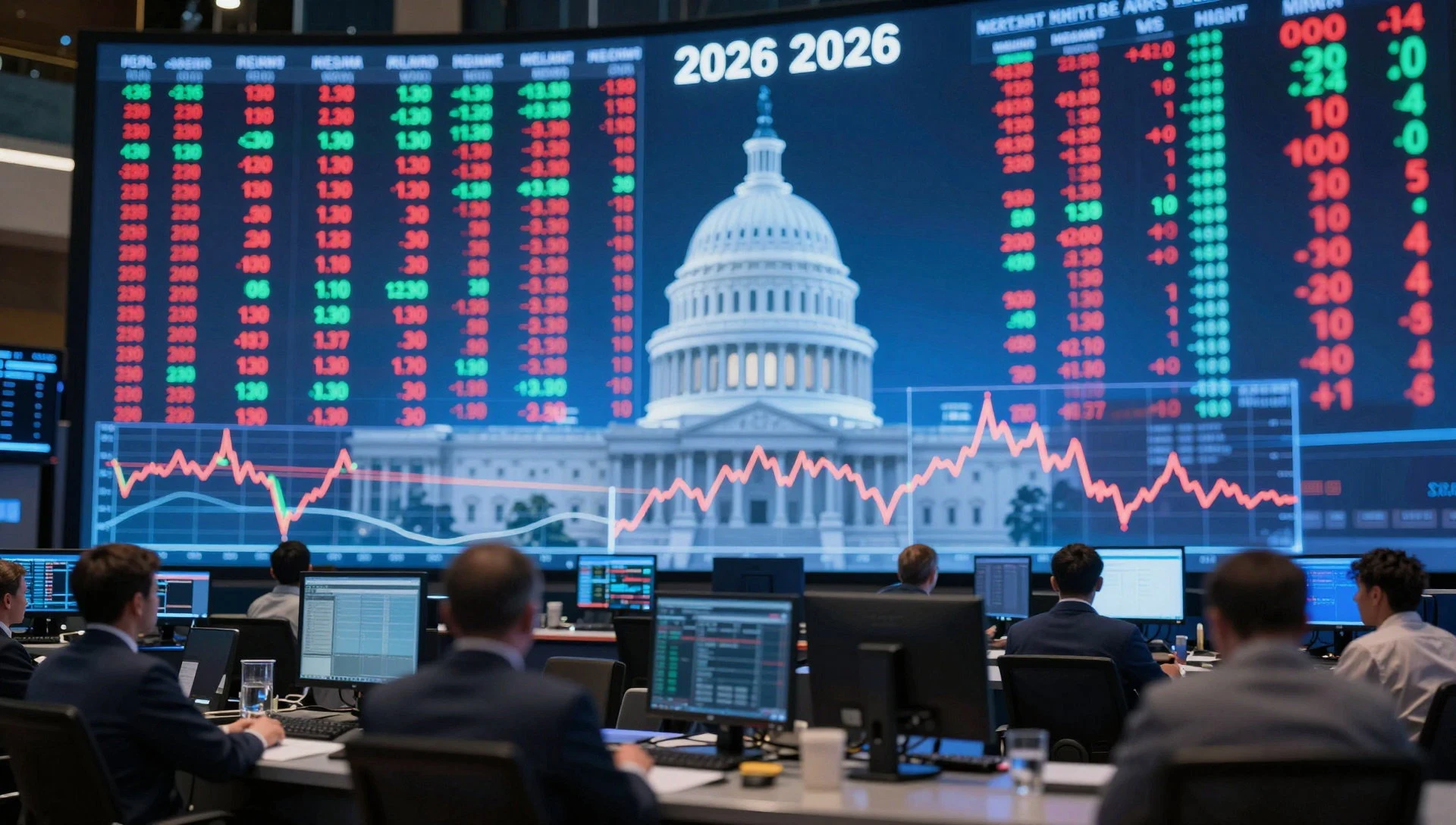
When American voters delivered divided government in the 2026 midterms, Wall Street responded not with anxiety but with something closer to relief. The Democratic sweep of both the House and the Senate, paired with a string of statehouse victories in Texas, Georgia, and Ohio, produced a counterintuitive rally: Dow futures climbed roughly 1.9 percent, or nearly 1,000 points, before the opening bell, while S&P 500 futures added about 1 percent and Nasdaq-100 futures edged up 0.3 percent. Investors, it seemed, had priced in gridlock long before the ballots were counted, and the absence of a single-party mandate removed the tail risk of abrupt legislative shocks to taxes, tariffs, and regulation.
Yet the same result that lifted the broad indices punished the companies most closely tied to Elon Musk. SpaceX fell nearly 8 percent in premarket trading, heading toward its lowest opening since late August, and Tesla dropped more than 5 percent early Wednesday. Analysts traced the divergence to Democratic victories in Texas, where James Talarico captured a Senate seat and Gina Hinojosa unseated three-term Governor Greg Abbott. A Democratic Congress and governor, the reasoning went, could mean sharper scrutiny of Musk's role in government efficiency efforts, of Tesla's self-driving technology, and of SpaceX's environmental footprint — a political revaluation that markets translated into immediate selling pressure.
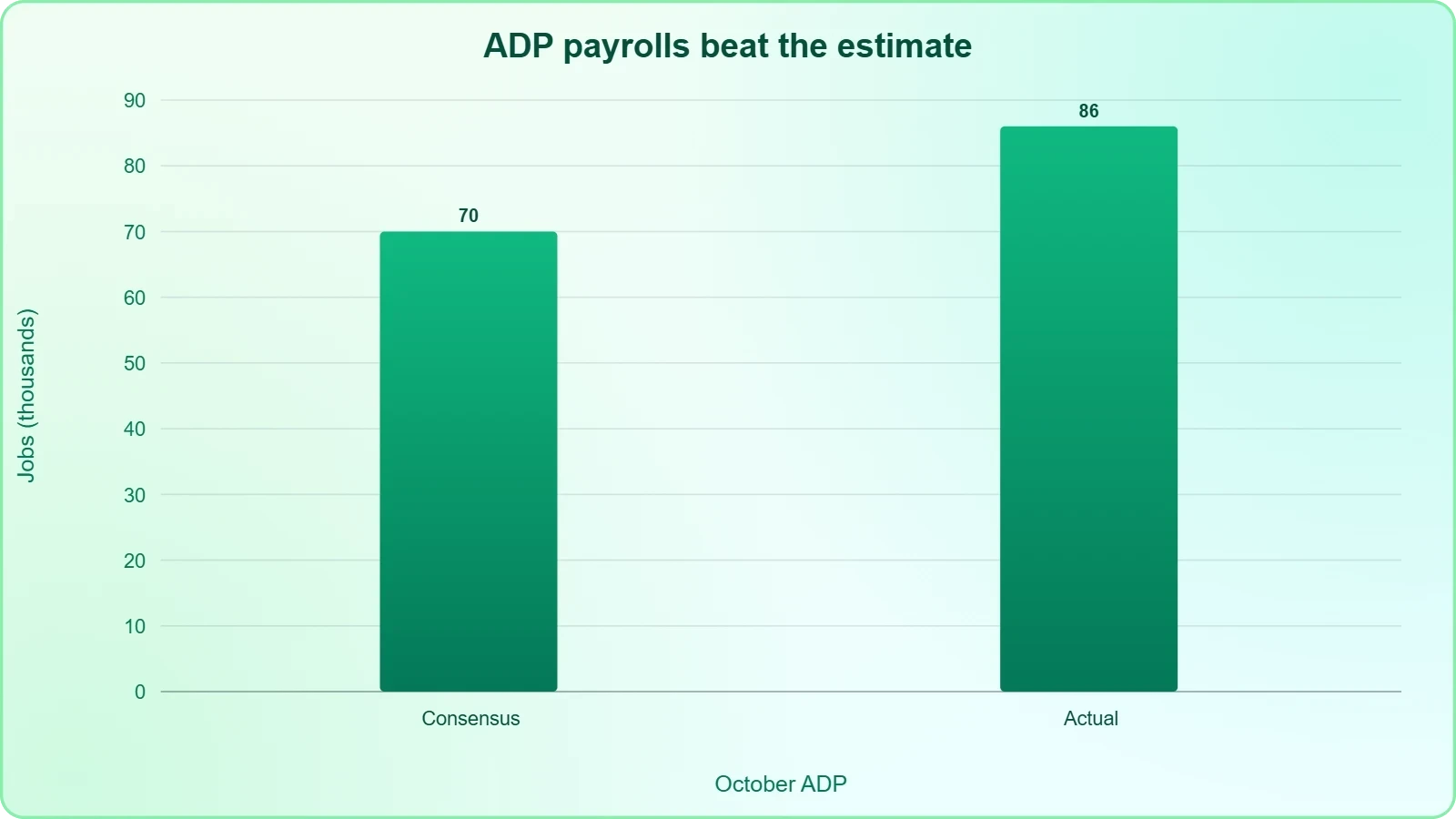
The session also carried consequences far beyond American borders. Asian technology stocks slipped early as investors weighed the prospect of new regulations, with Taiwan Semiconductor Manufacturing Company down 1.5 percent and SoftBank Group off 3.2 percent. Democratic wins in the Texas, Georgia, and Ohio governors' races raised concerns that state-level rules could delay construction of data centers powering artificial intelligence. Oil oscillated between gains and losses as traders balanced the election outcome against the ongoing US-Israel war in Iran, with West Texas Intermediate near $94.40 a barrel and the global benchmark around $102. Meanwhile, ADP reported private payrolls rose by 86,000 in October, comfortably above the 70,000 estimate.
On This Page
TL;DR The 2026 US midterms handed Democrats control of both chambers of Congress and several pivotal governorships, and equity markets rallied on the logic that divided government constrains sweeping policy change. Dow futures surged roughly 1,000 points while the dollar touched a one-month low, gold advanced, and the 10-year Treasury yield eased to 4.92 percent. The rally was not universal: Tesla and SpaceX suffered sharp declines as Democratic gains in Texas raised the specter of intensified regulatory scrutiny of Elon Musk's ventures, and Asian chip and technology names weakened on data-center and AI rule uncertainty.
The Political Backdrop That Moved Markets
The midterm outcome was never a simple verdict on one party; it was a verdict on the limits of power itself. By splitting control between a Democratic Congress and the presidency, voters effectively installed a brake rather than an accelerator on federal policymaking. For equity investors conditioned to fear legislative surprises — whether on corporate taxation, energy mandates, or antitrust — that brake is a feature, not a bug. The premarket surge in Dow futures reflected a rapid repricing of political risk, and the softer dollar alongside rising gold suggested that markets were simultaneously hedging against the uncertainty that remains.
Divided Government as a Market Catalyst
History offers a useful frame here. Markets have repeatedly rewarded gridlock because it preserves the status quo in tax treatment, sector subsidies, and regulatory frameworks that businesses have already capitalized into their valuations. When neither party can impose a sweeping agenda, earnings forecasts become more stable and risk premiums compress. The 2026 reaction followed that playbook almost mechanically: index futures jumped, Treasury yields slipped as investors rotated toward duration, and defensive assets like gold caught a bid. The dollar's slide to a one-month low underscored that currency traders were reading the same signal — less fiscal adventurism, more predictable policy drift.
What makes this cycle distinctive is the state-level dimension. Federal gridlock does not neutralize governors, and the Democratic wins in Texas, Georgia, and Ohio introduced a new layer of regulatory variability. Investors must now model not one policy regime but fifty, each capable of accelerating or delaying projects depending on local politics. That fragmentation is precisely why the index-level rally coexisted with sector-specific carnage, and why the market's initial euphoria may prove more selective than the headline numbers suggest.
Texas Turns Blue and the Musk Calculus
Few developments captured the session's crosscurrents better than Texas. James Talarico's Senate victory and Gina Hinojosa's defeat of Greg Abbott signaled a genuine political realignment in a state long treated as a conservative fortress. For Musk's enterprises, the implications are concrete rather than abstract. Tesla's self-driving rollout depends on permissive state regulators, SpaceX's launch and testing operations depend on environmental approvals, and Musk's advisory role in government efficiency efforts depends on political goodwill that a Democratic Austin may no longer extend. Markets priced that dependency swiftly and without sentiment.
The selloff in SpaceX and Tesla therefore reads less as a verdict on either company's fundamentals than as a repricing of political access. Companies that build their moats partly through regulatory relationships are, by definition, exposed when the political map shifts. The roughly 8 percent premarket decline in SpaceX and the more than 5 percent drop in Tesla early Wednesday illustrate how quickly investors can reclassify a political asset into a political liability. Whether that reclassification proves durable will depend on how aggressively the new Congress and Texas governorship actually pursue oversight.
Why the Dollar, Gold, and Treasuries Told a Different Story
Equities were only one channel through which the election result expressed itself. The dollar's retreat to a one-month low, gold's advance, and the slip in the 10-year Treasury yield to 4.92 percent together described a market that expected less fiscal stimulus and more policy caution. Lower yields translate directly into cheaper government borrowing costs, a quiet but meaningful tailwind for a federal balance sheet already stretched by years of deficit spending. Gold's bid, meanwhile, suggested that investors were not simply celebrating gridlock but hedging against the geopolitical and fiscal uncertainties that persist regardless of who controls Congress.
The Yield Signal and Borrowing Costs
A 10-year yield at 4.92 percent remains elevated by the standards of the previous decade, but the direction matters more than the level. When investors anticipate divided government, they typically price out the fiscal expansions and borrowing surges that unified control might produce, and yields drift lower as a result. That dynamic lowers mortgage rates, corporate refinancing costs, and the interest burden on federal debt. For a market that has spent years fretting about deficit trajectories, the midterm result offered a modest but welcome reprieve — one that equity investors clearly noticed as they bid up index futures before the bell.
The currency and commodity moves reinforce the same narrative. A softer dollar tends to flatter multinational earnings and dollar-denominated commodities, while gold's strength reflects demand for assets that do not depend on any single government's fiscal discipline. Together, these signals suggest that markets were not simply cheering Democrats or Republicans but pricing a more constrained, and therefore more predictable, policy environment. That is a subtle distinction, but it is the one that separates a durable repricing from a one-day headline trade.
Oil, Geopolitics, and the Iran Conflict
Commodity markets had a second variable to digest: the ongoing US-Israel war in Iran. Oil oscillated between gains and losses as traders weighed the election outcome against the risk of supply disruption, with West Texas Intermediate trading around $94.40 a barrel and the global benchmark near $102. That spread between benchmarks itself tells a story about logistical friction and regional risk premiums. Divided government may constrain domestic policy, but it does not resolve foreign conflicts, and energy traders were careful not to conflate the two. The result was a choppy, indecisive session in crude — a reminder that political clarity in Washington does not automatically translate into clarity in the Strait of Hormuz.
For consumers and businesses, the practical implication is that energy costs remain a wildcard. A Democratic Congress could pursue different energy priorities, but legislative change moves slowly, while geopolitical shocks move instantly. Markets, as always, priced the instant risk more aggressively than the legislative one. That asymmetry explains why equities could rally on gridlock even as crude refused to commit to a direction, and why the session's overall tone was one of cautious relief rather than unbridled optimism.
Asia's Technology Complex Feels the Ripple
The election's tremors reached Asia before the American opening bell finished ringing. Taiwan Semiconductor Manufacturing Company slipped 1.5 percent and SoftBank Group fell 3.2 percent as investors contemplated the possibility of new regulations emerging from a Democratic Congress. The concern was not abstract: technology supply chains, semiconductor subsidies, and cross-border data rules all depend on legislative and regulatory continuity, and a change in Washington's posture can ripple through Taipei, Tokyo, and Seoul within hours. Asian markets, trading while Americans slept, effectively served as the first referendum on what divided government might mean for the global technology complex.
Data Centers, AI, and State-Level Risk
The more consequential anxiety centered on artificial intelligence infrastructure. Democratic victories in the Texas, Georgia, and Ohio governors' races raised concerns that state-level rules could delay construction of data centers — the physical backbone of the AI boom. These facilities consume enormous quantities of electricity and water, and state governments wield substantial authority over permitting, zoning, and utility contracts. A governor inclined toward stricter environmental review can add months or years to a project timeline, and investors in chipmakers, cloud providers, and utilities must now incorporate that political variable into their models.
Later in the session, large technology companies including Amazon, Alphabet, and Nvidia recovered from earlier declines, suggesting that the market's initial regulatory fear gave way to a more measured assessment. That intraday reversal is instructive. It implies investors distinguished between headline risk and fundamental risk, concluding that state-level friction, while real, is unlikely to derail the broader AI capital expenditure cycle overnight. Still, the episode demonstrated how quickly political news can transmit through the technology supply chain, and how sensitive AI-linked valuations remain to any hint of permitting delays.
The Labor Market's Quiet Counterpoint
Amid the political theater, a quieter data point arrived that deserved equal attention. ADP reported that private payrolls rose by 86,000 in October, comfortably above the 70,000 estimate. That beat suggested the labor market retained more resilience than many forecasters had assumed, and it complicated the narrative that the economy was decelerating sharply into the election. For investors, the combination of solid hiring and divided government is close to a Goldilocks scenario: growth without the wage-driven inflation that might force the Federal Reserve into a more aggressive posture, and policy stability without legislative surprises.
What 86,000 Jobs Means for Rates
The ADP figure is not the official payrolls report, but it carries weight as a leading indicator of labor demand. A print of 86,000 against a 70,000 consensus implies that employers were still hiring through October, even as political uncertainty dominated headlines. That matters for rate expectations because a resilient labor market gives the Federal Reserve room to hold rates steady rather than cutting aggressively. The 10-year yield's slip to 4.92 percent, then, reflects a nuanced judgment: investors expect slower fiscal expansion under divided government, but they do not expect a collapsing economy that would force emergency easing.
This is the kind of equilibrium that equity markets tend to enjoy, at least temporarily. Moderate growth, stable policy, and contained inflation expectations form a backdrop in which earnings can compound without the whipsaw of legislative shocks. The risk, of course, is that the equilibrium is fragile. A single disappointing inflation print or a geopolitical escalation could disrupt it, and the market's initial enthusiasm could reverse as quickly as it appeared. For now, though, the labor data provided a reassuring counterpoint to the political noise.
- 01
- 02
- 03
- 04
We Also Published
Reading the Session as a Whole
Step back from the individual data points, and a coherent picture emerges. The 2026 midterms produced a market reaction that was simultaneously enthusiastic and discriminating. Index-level futures rallied on the expectation of gridlock, but the gains were not indiscriminate: Tesla and SpaceX fell sharply, Asian technology names wobbled, and oil refused to commit to a direction. That pattern suggests investors were not simply buying "the market" but making granular judgments about which companies and sectors would benefit or suffer from the new political configuration. The dollar, gold, and Treasury moves added a macro layer to that micro story.
Gridlock's Winners and Losers
The clearest winners were broad, diversified indices and rate-sensitive assets that benefit from lower borrowing costs and predictable policy. The clearest losers were companies whose valuations depend on regulatory goodwill or state-level cooperation — precisely the profile of Musk's ventures in Texas. Between those poles sat the technology complex, which initially sold off on regulatory fears before recovering as investors distinguished between headline risk and fundamental risk. That sorting process is the essence of how markets digest political change: not as a single verdict, but as a thousand small revaluations, each reflecting a specific exposure to the new balance of power.
What makes this session worth studying is its demonstration of how political and financial risk interact. Divided government is often described in abstract terms, but its effects are concrete: a yield that slips a few basis points, a stock that falls 8 percent, a currency that touches a one-month low. Investors who understand those transmission channels are better positioned to anticipate the next political shock, whether it arrives through a statehouse, a congressional committee, or a foreign conflict. The midterms were a reminder that politics is not background noise for markets; it is a primary input.
What Comes Next for Investors
The midterm reaction is best understood as an opening bid rather than a final verdict. Markets have priced the expectation of divided government, but they have not yet priced the specific legislative and regulatory battles that will unfold over the coming months. Oversight hearings, state-level permitting decisions, and the trajectory of the Iran conflict will all shape the next phase of the repricing. Investors who treat the election as a single event risk missing the longer sequence of policy decisions that will determine which sectors outperform and which lag.
Watchpoints for the Months Ahead
Several concrete watchpoints deserve attention. First, the pace of data-center permitting in Texas, Georgia, and Ohio will signal how aggressively Democratic governors intend to assert environmental authority over AI infrastructure. Second, congressional scrutiny of Musk's government efficiency role will determine whether the political discount on Tesla and SpaceX persists or deepens. Third, the Federal Reserve's reading of labor data like the 86,000 ADP print will shape rate expectations, which in turn drive the dollar, gold, and Treasury yields. Each of these channels transmits political news into financial outcomes, and each deserves a place on the investor's dashboard.
Beyond the domestic scene, the US-Israel war in Iran remains the wildcard that could overwhelm all other considerations. Oil near $94 to $102 a barrel already embeds a geopolitical premium, and any escalation would test the market's composure far more severely than an election result. The midterms demonstrated that investors can absorb political change with remarkable equanimity when the change is anticipated. They are far less forgiving of shocks that arrive without warning, which is why the coming months warrant vigilance rather than complacency.
The Bigger Lesson
The deeper lesson of the 2026 midterms is that political outcomes are not monolithic signals but bundles of specific exposures. Divided government helped the Dow and hurt Tesla; it reassured bondholders and unsettled Asian chipmakers; it lowered borrowing costs and left oil traders guessing. Investors who reduce politics to a single directional bet will consistently miss these nuances. Those who map the transmission channels — regulation, permitting, oversight, fiscal policy, and geopolitics — will be better equipped to navigate the next surprise, whenever and wherever it arrives.
That is ultimately why sessions like this one matter beyond their immediate headlines. They reveal how markets actually process democracy: incrementally, selectively, and often counterintuitively. The Dow's 1,000-point surge and Tesla's 5 percent slide were not contradictions but two expressions of the same underlying logic. Understanding that logic is the difference between reacting to political news and anticipating it, and in an era of divided government, anticipation is the more valuable skill.
From our network :
- Forbidden Matrix Patterns and Visible Lattice Points: A Geometric DictionaryExplore how multidimensional 0–1 matrices encode geometric truths, linking forbidden patterns to visible lattice points and hypergraph theory, with applications in combinatorics and computational geometry.
- The Hidden Cost of AI Convenience: Why Over-Permissioned Agents Are a Security Time BombDiscover why AI agents with excessive permissions create dangerous single points of failure, and learn how implementing least privilege principles can protect your organization from exploitation.
- How AI Agents Will Change the Way We Manage Personal FinancesExplore how AI agents are transforming personal finance through automated budgeting, bill payment, and investment management, while examining the critical security protocols and governance frameworks required for safe deployment.
- CISA’s Ten-Advisory Wave: Why Generic Patching Fails in OT and How to Build Product-Specific PlaybooksCISA released ten ICS advisories in one week, exposing critical infrastructure risks. Generic patching fails in OT. Learn to build product-specific remediation playbooks.
- Mobile Learning and VR in English: What Global Evidence Reveals About Effective Language TechnologyA systematic review across 14 countries reveals which language-learning technologies genuinely work. Mobile learning, AI, and VR show measurable benefits when pedagogically integrated. This evidence-based guide helps educators and learners select technology that delivers real return on investment.
- The Final Descent: How ESA Retired the Legendary Cluster Constellation After 24 Years of Space Weather ScienceAfter 24 years mapping Earth’s magnetosphere, ESA’s Cluster mission concluded with a precisely controlled reentry over the South Pacific. This analysis explores the scientific legacy, engineering decisions, and debris mitigation principles behind one of space exploration’s most responsible retirements.
- Live Online English Classes for Kids: Do They Actually Reduce Anxiety?A ten-week study reveals that synchronous online English classes can significantly reduce child language anxiety while improving listening and reading skills. Discover what makes these programs effective and how parents can select the right one.
- Committed Mediterranean Precipitation Decline: Why Emissions Cuts Alone Cannot Restore Winter RainsNew NOAA research reveals that Mediterranean winter rains may decline irreversibly even with emissions cuts. Explore the science of committed climate change and regional impacts.
- University Language Proficiency Exams: Why Institutional Tests Demand Different Preparation Than IELTS and TOEFLDiscover why university-specific language proficiency examinations differ fundamentally from IELTS and TOEFL, and learn strategic preparation approaches for institutional assessment success.
RESOURCES
- Midterm Elections and Stock Market Trends - BlackRockblackrock.comOct 1, 2026 ... Annual U.S. stock market returns, on average, have been ... Investors may be pausing as the markets react to the…
- Market analysts react to Democratic sweep in US midterms - Reutersreuters.com1 day ago ... 2026 US midterm elections. Item 1 of 2 ... The starting point for financial markets into this election, particularly for…
- Stock market news for Nov. 4, 2026 - CNBCcnbc.com11 hours ago ... Stocks ripped higher on Wednesday after a decisive victory by Democrats in the U.S. midterm elections removed political risk that…
- U.S. Midterm Elections Stock Market Impact 2026 | Morgan Stanleymorganstanley.comJul 22, 2026 ... The executive branch remains the primary driver of policies that matter most to investors. Equity markets have generally shown limited…
- Stocks Rise as Democrats Flip Control of Congressnytimes.com10 hours ago ... ... as Democrats Flip Control of Congress. https://www.nytimes.com/2026/11/04/business/midterm-elections-stock-market.html. Share full article. 112.
- 2026 midterms: How the election results could drive marketsameriprise.comSep 14, 2026 ... 2026 midterms: What a new Congress could mean for investors. As the 2026 U.S. midterm elections approach, Ameriprise Financial experts…
- How midterm elections affect the stock market | U.S. Bankusbank.comOct 28, 2026 ... Historical analysis of stock market performance before and after midterm elections shows varying effects.
- US stock markets and government bonds rally while dollar falls after ...theguardian.com1 day ago ... European shares also power ahead as markets react to blue wave in US midterm elections. ... Voters cast ballots in ...
- How might midterm elections impact the stock market? | Fidelityfidelity.comThen investors can go back to basics, researching investments and analyzing economic metrics. "Markets love gridlock," Gaggar says. Why the 2026 midterm ...
- US Midterms: How Markets Are Reacting to Democrats ... - Morningstarglobal.morningstar.com19 hours ago ... International Stock Market Winners and Losers: Defense Stocks Slide. The midterm elections also raise questions about the course ahead for…
- What the 2026 Midterms Could Mean for the Marketsschwab.comAug 18, 2026 ... Key takeaways. In the 2026 midterm elections, control of Congress is likely to remain closely contested, with Democrats modestly favored…
- How Should Investors Position Portfolios Before the 2026 Midterm ...vaneck.comSep 18, 2026 ... Emerging Markets Equity; Digital Assets; Private Markets. Should the 2026 Midterm Elections Drive Major Shifts in Gold Allocations? Fiscal ...
- What the Midterm Elections Will Mean for Markets | Morningstarmorningstar.comAs voters focus on AI data centers and affordability, the market impact will depend on the results. Sarah Hansen Oct 8, 2026. Share.
- Midterm mindset seeping into the U.S. stock marketrbcwealthmanagement.comSep 9, 2026 ... Voter concerns leading up to the election are wide-ranging. RBC Capital Markets equity analysts seem mostly unfazed by the election ...
- How Do the Midterm Elections Impact the Stock Market?harvestportfolios.comBy Ambrose O'Callaghan. The 2026 United States midterm elections are drawing significant attention from markets and investors as the fall season approaches.
- 01
- 02
- 03
- 04
- 05
- 06
- 07
- 08
0 Comments