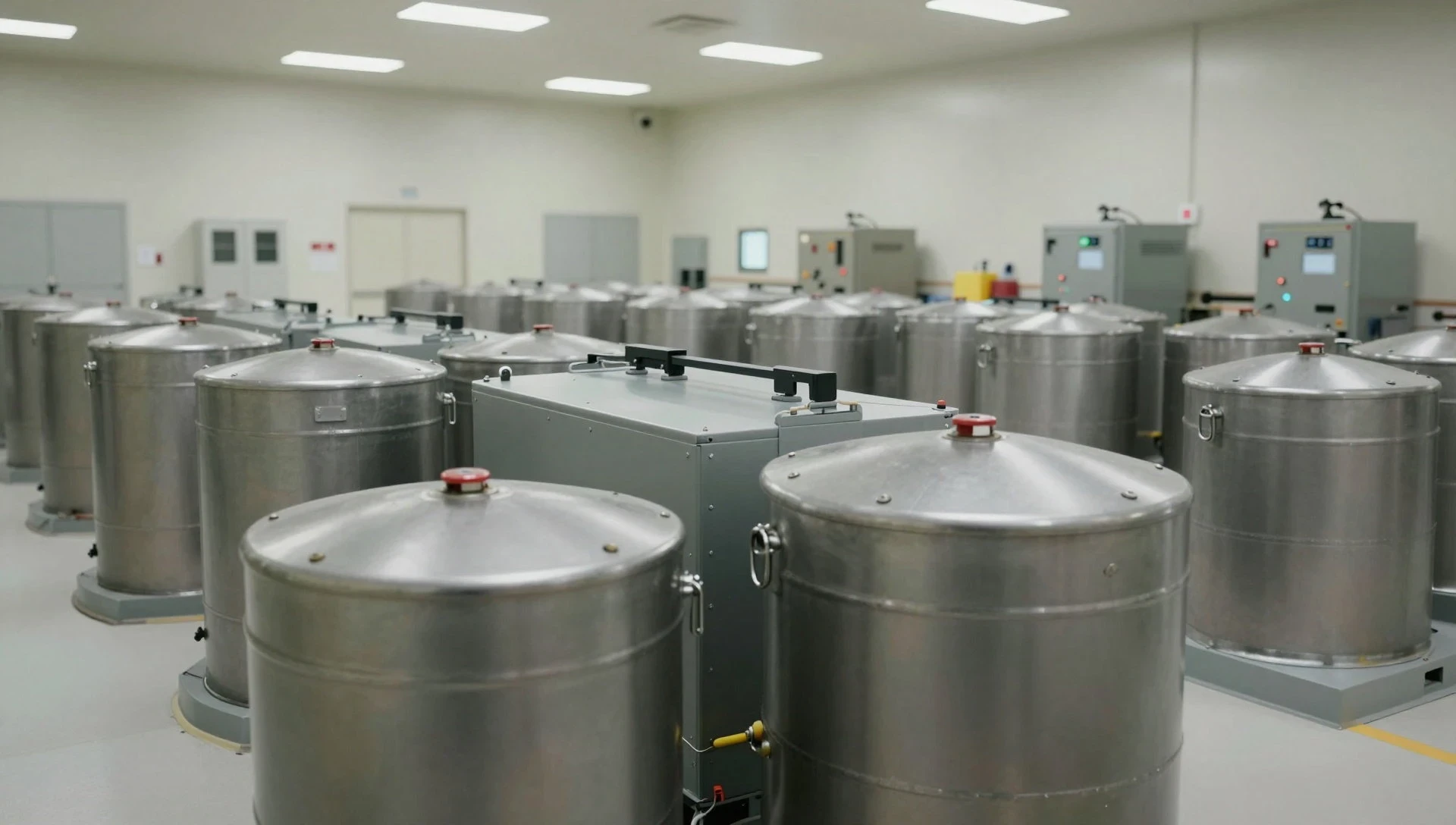
When Iran's security chief declared that enriched nuclear material would not be permitted to leave the country, the statement landed with the quiet weight that only nuclear diplomacy can carry. Reported by Reuters on 11 November 2026 without elaboration on circumstances or any immediate response from counterparties, the remark is deceptively brief. Yet in the grammar of nonproliferation, custody of enriched uranium is never a technical footnote; it is leverage, insurance, and sovereignty compressed into a single sentence. The declaration signals that Tehran intends to keep its stockpile physically inside national borders, whatever negotiations, inspections, or shipment proposals may follow.
Understanding why this matters requires looking past the headline to the machinery beneath it. Enriched material sits at the intersection of energy policy, weapons latency, sanctions relief, and national pride. Any proposal to move it abroad—whether for safekeeping, conversion, or dilution—touches the rawest nerve of a state that has spent decades building domestic enrichment capacity under pressure. The security chief's phrasing, as conveyed by Reuters, frames the stockpile as a red line rather than a bargaining chip, and that framing shapes how allies, adversaries, and international inspectors must now calculate their next moves.
This analysis unpacks the statement's strategic meaning, the technical realities of enriched material custody, the diplomatic precedents that inform it, and the market and security implications that follow. It treats the Reuters report as a starting point rather than a conclusion, situating a single sentence within the broader architecture of nuclear bargaining, regional deterrence, and global energy politics. Readers will find a structured examination of what the declaration reveals, what it deliberately leaves unsaid, and why the difference between those two things will define the next phase of negotiations.
On This Page
TL;DR Iran's security chief stated that enriched nuclear material will not be allowed to leave the country, per Reuters, without further detail or immediate reaction from other parties. The remark asserts physical custody of enriched uranium as a sovereign red line, complicating proposals that would ship stockpiles abroad for safekeeping or dilution. It reinforces Tehran's long-standing position that domestic enrichment capacity is non-negotiable, while leaving room for interpretation on inspections, monitoring, and the scope of any future transfer. Markets, regional powers, and international inspectors must now read the statement as both a bargaining posture and a policy signal.
The Strategic Meaning of a Single Sentence
Diplomatic statements about nuclear material are rarely casual, and this one carries the unmistakable signature of calculated ambiguity. By declaring that enriched material will not leave Iran, the security chief draws a boundary around physical custody without specifying what happens inside that boundary—monitoring, dilution, storage, or continued enrichment. That gap is deliberate. It allows Tehran to appear inflexible on the principle of possession while preserving flexibility on the mechanics of oversight, a distinction that matters enormously when negotiators eventually sit down to translate rhetoric into verifiable arrangements.
Why Custody Equals Leverage
In nonproliferation practice, possession of enriched uranium is a form of stored optionality. Material held inside a country can be inspected, sealed, diluted, or redirected depending on political conditions, whereas material shipped abroad is effectively removed from the national toolkit. Iran's insistence on retaining custody therefore protects its ability to reverse or adjust course if agreements collapse. It also denies adversaries the satisfaction of a visible concession, since transferring stockpiles abroad would be read domestically as capitulation. The statement converts a technical inventory question into a question of national dignity, which is far harder to negotiate away.
This logic explains why shipment proposals have historically struggled. Any deal that requires enriched material to cross a border must answer who controls it, who inspects it, and who can return it. Tehran's position effectively answers the first question in its own favor and leaves the others open. For counterparties, that means any future arrangement must be built around in-country custody rather than removal, a design constraint that reshapes verification models and the political packaging of any agreement.
The Reuters Report and Its Limits
The Reuters dispatch is notable for what it does not contain. It reports the security chief's statement without detailing the circumstances, the venue, or any response from the International Atomic Energy Agency, the United States, or regional powers. That sparseness is itself informative: it suggests the remark was made in a setting where Tehran wanted the message heard but not elaborated, and where no counterparty was prepared to respond immediately. Analysts should treat the absence of reaction as temporary rather than meaningful, since nuclear statements typically generate delayed diplomatic commentary once capitals have consulted their negotiating teams.
Reading a single-source report responsibly means separating the confirmed claim from its implications. The confirmed element is straightforward: a senior Iranian security official said enriched material will not leave the country. The implications—about inspections, about the durability of any agreement, about regional reactions—are inferences that require corroboration. This analysis treats the statement as a significant data point while flagging that the full diplomatic context will emerge only as other parties respond and as inspectors report on the ground.
We Also Published
Enriched Material Custody: The Technical Backdrop
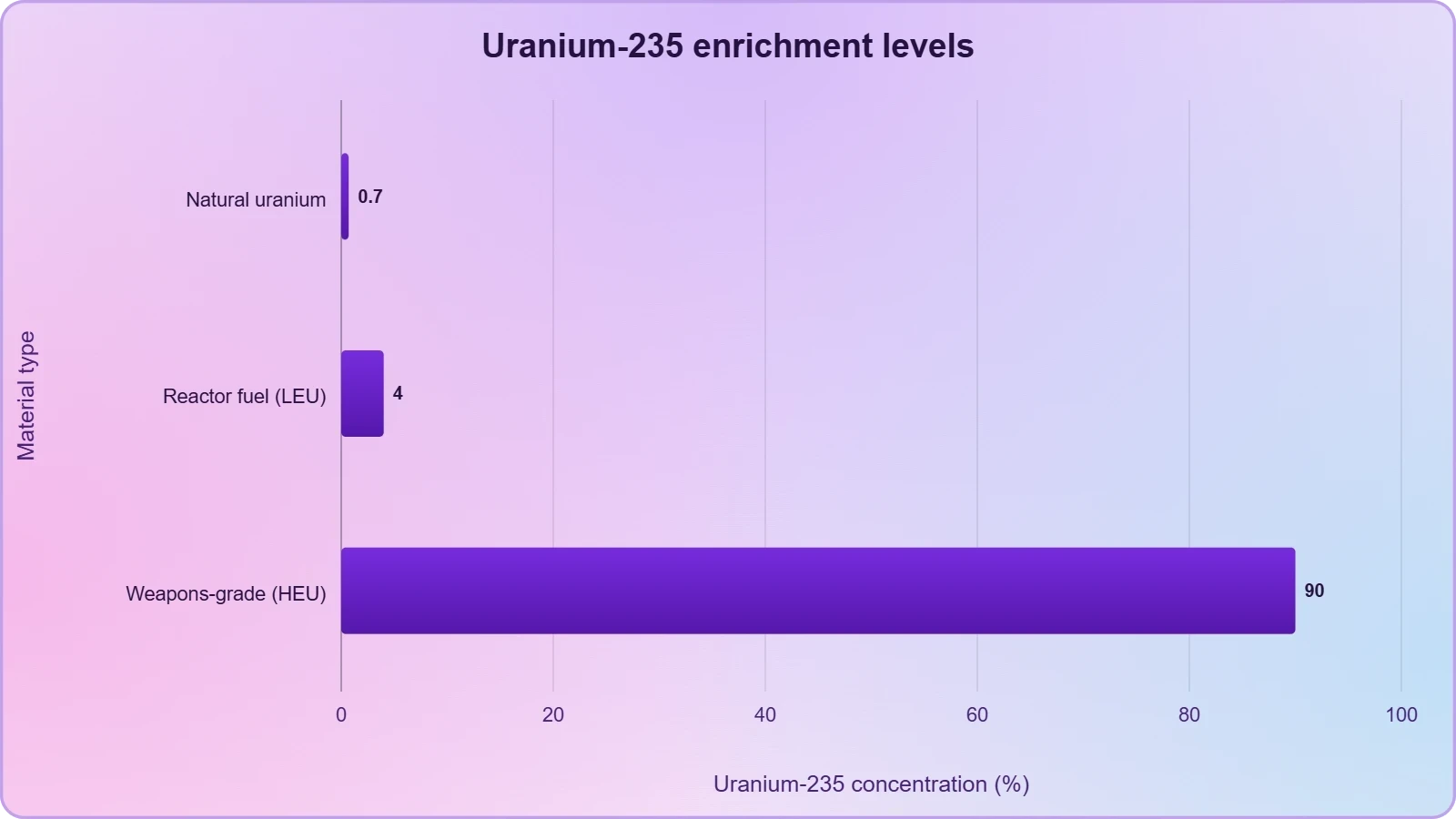
Enriched uranium is measured by the concentration of the fissile isotope uranium-235, and the difference between reactor-grade and weapons-grade material is a matter of degree rather than kind. Low-enriched uranium used in power reactors typically sits below twenty percent U-235, while highly enriched material climbs far higher. The same centrifuges, facilities, and expertise can move material along that spectrum, which is precisely why custody matters: possession of the stockpile is possession of the option to enrich further. Any statement about where material may or may not travel is therefore a statement about latent capability.
Why Location Is a Security Variable
For inspectors and intelligence agencies, the physical location of enriched material determines how quickly it can be verified, secured, or—in a crisis—weaponized. Material stored inside a country under monitoring is visible but proximate; material shipped abroad is distant but harder to reclaim. Iran's insistence on domestic custody keeps the stockpile within its own security perimeter, which shortens breakout timelines in any worst-case scenario but also keeps the material under continuous international gaze if monitoring arrangements survive. The statement thus trades one form of risk for another, and the balance depends entirely on verification.
This is why shipment proposals have always been politically loaded. Moving material abroad can reduce proliferation risk by placing it beyond a state's immediate reach, but it also strips that state of leverage and can be portrayed domestically as surrender. Tehran's position rejects the trade outright, signaling that it values custody over the diplomatic goodwill that transfer might purchase. For negotiators, that means any future deal must be engineered around in-country storage, with monitoring intensity substituting for physical removal as the primary confidence-building mechanism.
Monitoring as the Substitute for Removal
If material stays put, the burden shifts to verification. Seals, cameras, tamper-indicating devices, and inspector access become the instruments that convert a sovereign stockpile into a transparent one. The security chief's statement does not address these mechanisms, which leaves room for Tehran to accept robust monitoring while refusing physical transfer—a combination that could satisfy nonproliferation concerns without conceding the custody principle. Whether such a hybrid is acceptable to counterparties depends on how much they trust monitoring to detect diversion quickly enough to matter.
Historical experience suggests monitoring can be surprisingly effective when access is guaranteed and data is shared in near real time. The failure mode is not technical but political: monitoring collapses when inspectors are expelled or access is restricted. Iran's declaration therefore raises an implicit question about the durability of any monitoring regime it might accept. If custody is non-negotiable but oversight is negotiable, the entire architecture of confidence rests on the credibility of access commitments that the statement leaves conspicuously unaddressed.
Diplomatic Precedents and the Bargaining Table
Nuclear negotiations have repeatedly wrestled with the question of where enriched material should live. Proposals to ship stockpiles to a third country for safekeeping or conversion have surfaced in multiple rounds of talks, often as confidence-building gestures designed to buy time and reduce immediate breakout risk. Iran's declaration effectively pre-empts that playbook, signaling that future discussions must begin from the premise of domestic custody. That shift matters because it narrows the menu of concessions available to negotiators and forces them to innovate on verification rather than relocation.
Lessons From Past Transfer Proposals
Past arrangements involving the transfer or dilution of enriched material have succeeded only when the receiving state was trusted by all parties and the sending state received tangible political or economic benefits. Where those conditions were absent, transfer proposals stalled or were rejected outright. Iran's statement reflects a learned skepticism: shipping material abroad creates dependency on others' goodwill and can be reversed only with difficulty. By ruling out departure of the material, Tehran keeps its options symmetric—it can always choose to dilute or convert domestically if the price is right, without first surrendering physical control.
For counterparties, the lesson is that incentives must be recalibrated. If removal is off the table, then sanctions relief, economic integration, and security guarantees become the currency of any deal. The statement implicitly raises the asking price for cooperation while lowering the likelihood of the kind of dramatic, photographable concession that negotiators often crave. Diplomacy will have to proceed through incremental, technical steps rather than grand gestures, and success will be measured in monitoring access rather than shipping manifests.
Regional Reactions and Deterrence Signaling
Statements about nuclear custody are heard differently in different capitals. Regional rivals may read the declaration as confirmation that Iran intends to retain a latent capability, prompting their own hedging or calls for extended deterrence. Global powers may treat it as a negotiating position rather than a final word, since security chiefs often speak more bluntly than foreign ministries. The absence of immediate reaction in the Reuters report does not mean silence will persist; it means the statement is being absorbed and will shape consultations in the days that follow.
Deterrence signaling works through clarity about red lines, and this declaration is clear about one thing: the material stays. That clarity can stabilize expectations by removing a source of uncertainty, or it can escalate competition by confirming worst-case assumptions. Which outcome prevails depends on whether accompanying signals—about inspections, about enrichment levels, about intent—are reassuring or ambiguous. The statement alone provides the boundary but not the reassurance, leaving the interpretive work to the diplomatic process that follows.
- 01
- 02
- 03
- 04
Market and Energy Implications
Nuclear statements rarely move oil markets on their own, but they contribute to a risk premium that traders price continuously. A declaration hardening Iran's position on enriched material signals prolonged uncertainty, which tends to support crude benchmarks and complicate shipping insurance in the Gulf. The effect is incremental rather than dramatic, since markets have grown accustomed to periodic escalations. Still, each statement narrows the probability of a near-term breakthrough, and that probability shift is what desks quietly adjust for when they recalibrate exposure to Middle East supply risk.
Reading the Risk Premium
Energy analysts distinguish between headline risk and structural risk. A single statement is headline risk: it may spike volatility briefly but fades unless followed by action. Structural risk arises when statements accumulate into a pattern that makes conflict or disruption more likely. Iran's declaration contributes to the structural side by reinforcing the view that negotiations will be long and contested. For portfolio managers, that argues for maintaining modest hedges rather than dramatic repositioning, since the statement changes the odds at the margin rather than the fundamentals of supply and demand.
Currency and sovereign risk markets respond similarly. Sanctions expectations, which influence the rial and Iranian trade finance, shift when diplomatic prospects dim. The declaration does not impose new sanctions, but it reduces the likelihood of relief in the near term, which feeds into pricing for anyone exposed to Iranian trade or regional counterparties. The transmission mechanism is expectations rather than immediate policy, and expectations are precisely what such statements are designed to shape.
Technology and Supply Chain Exposure
Beyond hydrocarbons, nuclear ambiguity touches technology supply chains. Export controls on dual-use equipment, centrifuge components, and monitoring instrumentation tighten or loosen in response to diplomatic signals. A statement ruling out material transfer may prompt counterparties to emphasize verification technology—seals, sensors, data links—as the primary tool of oversight, creating demand for monitoring hardware and expertise. Companies in the verification and safeguards ecosystem watch such declarations closely because they hint at where future procurement and cooperation budgets will flow.
For the broader technology sector, the implications are indirect but real. Prolonged nuclear uncertainty sustains geopolitical risk premiums that affect semiconductor supply chains, rare earth sourcing, and energy-intensive manufacturing. Investors who track these linkages treat nuclear diplomacy as one input among many, but they do not ignore it. The declaration is a reminder that a single sentence from a security chief can ripple through markets that seem far removed from centrifuges and inspection protocols.
Verification, Trust, and the Road Ahead
The declaration's most consequential silence concerns verification. If material stays inside Iran, the international community's ability to confirm its status depends on inspector access, sensor networks, and data-sharing arrangements that the statement does not mention. That silence can be read two ways: as an opening for Tehran to offer robust monitoring in exchange for recognition of its custody principle, or as a warning that oversight will be constrained. Which reading proves correct will determine whether the declaration becomes a foundation for negotiation or a barrier to it.
Designing Monitoring That Works
Effective monitoring of a domestic stockpile requires continuous surveillance, tamper-evident seals, and short-notice access to enrichment facilities. The technical toolkit exists; the challenge is political commitment. Iran's statement leaves the door open for such arrangements by not rejecting them, and counterparties would be wise to treat that omission as an opportunity rather than a rebuke. A deal built around in-country custody plus intrusive monitoring could achieve many of the same nonproliferation goals as physical transfer, provided both sides accept that verification, not relocation, is the operative currency.
Trust, however, is the scarce resource. Monitoring regimes collapse when either side concludes the other is cheating, and rebuilding confidence after a collapse is slow. The declaration's bluntness may actually help here by clarifying expectations: Tehran will not surrender custody, so negotiators should stop asking and start designing. Clarity about red lines can reduce miscommunication, even when the red line itself is unwelcome. The road ahead runs through technical diplomacy rather than dramatic gestures, and progress will be measured in access and transparency rather than in shipments.
Scenarios for the Next Phase
Three broad scenarios follow from the declaration. In the first, Tehran offers enhanced monitoring in exchange for sanctions relief, preserving custody while satisfying oversight demands. In the second, negotiations stall and the statement becomes a marker of prolonged stalemate, with periodic escalations and diminishing diplomatic bandwidth. In the third, regional actors respond with their own hedging, raising the risk of a competitive dynamic that neither global powers nor markets welcome. The declaration does not determine which scenario unfolds, but it narrows the pathways by removing transfer from the menu of easy options.
Each scenario carries distinct implications for energy markets, regional security, and the credibility of nonproliferation norms. The monitoring scenario is the most constructive and the most technically demanding; the stalemate scenario is the most likely absent sustained engagement; the competitive scenario is the most dangerous and the least predictable. Policymakers should prepare for all three while working to make the first viable, since the alternatives offer little beyond managed uncertainty and periodic crisis management.
What the Declaration Reveals About Iranian Strategy
Read closely, the statement is a window into how Tehran prioritizes sovereignty over transaction. By placing enriched material beyond the reach of transfer proposals, the security chief signals that Iran views its nuclear program as a permanent attribute of national power rather than a temporary bargaining asset. That worldview has implications far beyond this single declaration: it suggests that future negotiations will succeed only if they accommodate a durable Iranian enrichment capability under monitoring, rather than seeking to dismantle or export it. The statement is thus both a boundary and a hint about the shape of any eventual settlement.
Sovereignty as the Organizing Principle
Iranian nuclear policy has long been framed in the language of rights and self-reliance, and this declaration fits that tradition precisely. Custody of enriched material is presented as an attribute of sovereignty, not a concession to be traded. Understanding this framing helps explain why transfer proposals have repeatedly failed: they ask Tehran to surrender something it regards as inherent rather than negotiable. Negotiators who internalize this principle can design agreements that work within it, focusing on transparency and limits rather than on relocation, which the statement has now effectively foreclosed.
The sovereignty frame also shapes domestic politics. Any Iranian official who agreed to ship enriched material abroad would face accusations of capitulation, regardless of the benefits secured. By stating the red line publicly, the security chief insulates the system from pressure to make that concession and shifts the burden of creativity onto counterparties. This is a familiar negotiating tactic: define the unacceptable, then invite the other side to propose alternatives. The declaration is therefore less a rejection of diplomacy than a redefinition of its terms.
Implications for Global Nonproliferation Norms
Every state that retains enriched material under monitoring tests the durability of nonproliferation norms. Iran's declaration reinforces a model in which possession is accepted in exchange for transparency, rather than prohibited outright. That model has precedents, but each application strains the regime's credibility with states that forgo enrichment entirely. The statement thus raises a broader question: can the international community maintain a consistent standard when some states are permitted domestic enrichment under safeguards while others are pressed to abandon it? The answer will shape the regime for years.
For now, the practical task is to make the transparency model work in this specific case. That means investing in monitoring technology, securing access commitments, and building dispute-resolution mechanisms that can survive political shocks. The declaration does not solve these problems, but it clarifies the terrain on which they must be solved. A clear-eyed reading suggests that the next phase will be technical, incremental, and unglamorous—precisely the kind of diplomacy that rarely makes headlines but determines whether nuclear risk rises or falls.
From our network :
- The Hidden Cost of AI Convenience: Why Over-Permissioned Agents Are a Security Time BombDiscover why AI agents with excessive permissions create dangerous single points of failure, and learn how implementing least privilege principles can protect your organization from exploitation.
- How AI Agents Will Change the Way We Manage Personal FinancesExplore how AI agents are transforming personal finance through automated budgeting, bill payment, and investment management, while examining the critical security protocols and governance frameworks required for safe deployment.
- Live Online English Classes for Kids: Do They Actually Reduce Anxiety?A ten-week study reveals that synchronous online English classes can significantly reduce child language anxiety while improving listening and reading skills. Discover what makes these programs effective and how parents can select the right one.
- The Final Descent: How ESA Retired the Legendary Cluster Constellation After 24 Years of Space Weather ScienceAfter 24 years mapping Earth’s magnetosphere, ESA’s Cluster mission concluded with a precisely controlled reentry over the South Pacific. This analysis explores the scientific legacy, engineering decisions, and debris mitigation principles behind one of space exploration’s most responsible retirements.
- Mobile Learning and VR in English: What Global Evidence Reveals About Effective Language TechnologyA systematic review across 14 countries reveals which language-learning technologies genuinely work. Mobile learning, AI, and VR show measurable benefits when pedagogically integrated. This evidence-based guide helps educators and learners select technology that delivers real return on investment.
- Forbidden Matrix Patterns and Visible Lattice Points: A Geometric DictionaryExplore how multidimensional 0–1 matrices encode geometric truths, linking forbidden patterns to visible lattice points and hypergraph theory, with applications in combinatorics and computational geometry.
- Committed Mediterranean Precipitation Decline: Why Emissions Cuts Alone Cannot Restore Winter RainsNew NOAA research reveals that Mediterranean winter rains may decline irreversibly even with emissions cuts. Explore the science of committed climate change and regional impacts.
- University Language Proficiency Exams: Why Institutional Tests Demand Different Preparation Than IELTS and TOEFLDiscover why university-specific language proficiency examinations differ fundamentally from IELTS and TOEFL, and learn strategic preparation approaches for institutional assessment success.
- CISA’s Ten-Advisory Wave: Why Generic Patching Fails in OT and How to Build Product-Specific PlaybooksCISA released ten ICS advisories in one week, exposing critical infrastructure risks. Generic patching fails in OT. Learn to build product-specific remediation playbooks.
RESOURCES
- Trump May Seize Iran's Nuclear Stockpile: Why Airstrikes Alone ...csis.orgMar 13, 2026 ... ... enrichment. If this occurs, 440.9 kg of 60 percent enriched HEU would be enough material for approximately 10 nuclear…
- Iran rejects demands to transfer its enriched uranium abroad despite ...facebook.comOct 20, 2026 ... ... custody of the nuclear material. “Not even a tiny bit of enriched nuclear material will leave Iran,” security chief…
- Atomic watchdog says Iran not complying with nuclear safeguardsnews.un.orgJun 12, 2025 ... ... Iran's atomic energy body reportedly announced plans to open a new uranium enrichment plant and increase production of enriched…
- Senior US official: Pending deal 'leads to' Washington getting Iran's ...timesofisrael.comJun 13, 2026 ... Deal 'dismantles' nuclear program, cedes enriched material. According to the official, the agreement accomplishes five US goals. “First, it ...
- Iran's security chief Mohsen Rezaei said Iran "will not remove a ...facebook.com4 hours ago ... Iran's security chief Mohsen Rezaei said Iran "will not remove a single atom of enriched nuclear material" and that Russia,…
- Iran Nuclear Deal: Debunking the Mythsarmscontrolcenter.orgAug 31, 2015 ... If Iran had material that could be used to make a nuclear bomb at a ... Before the interim agreement…
- UN nuclear chief says it's possible Iran's highly enriched uranium 'is ...reuters.comJun 25, 2025 ... ... nuclear materials and equipment. "They did not get into details as to what that meant but clearly that was…
- The Deal That Got Away: The 2009 Nuclear Fuel Swap with Iranbelfercenter.org... enriched uranium (LEU) stockpile—1200kg of product enriched to roughly 3.5% uranium-235. In return, Russia would supply around 120kg of material enriched ...
- Nuclear material found in Syria will remain in the country, minister saysreuters.comAug 18, 2026 ... Nuclear material found at an undisclosed site in Syria was not dangerous and would remain in Syrian custody, subject to…
- Analysis of IAEA Iran Verification and Monitoring Report — August ...isis-online.orgSep 9, 2024 ... ... custody until it received sanctions relief. Iran ... Iran's enrichment facilities or measure in-process low enriched nuclear material.
- How Iran's enriched uranium could be secured | AP Newsapnews.comApr 1, 2026 ... Nuclear material is probably stored in tunnels. IAEA inspectors have not been able to verify the near weapons-grade uranium since…
- Analysis of IAEA Iran Verification and Monitoring Report — February ...isis-online.orgMar 4, 2024 ... ... Iran's enrichment facilities or measure in-process low enriched nuclear material. It has not had access to data from on-line…
- Iran's Nuclear Program Has Survivedcarnegieendowment.orgJul 23, 2025 ... Iran has been enriching uranium for over 20 years, and its ... nuclear materials and facilities. If the United States…
- Iran's Nuclear Timetable: The Weapon Potentialiranwatch.orgJun 11, 2025 ... Nuclear Weapon Potential of Iran's Centrifuges and Enriched Uranium ... Conversely, Iran could use more material at a lower level…
- 01
- 02
- 03
- 04
- 05
- 06
- 07
- 08
0 Comments