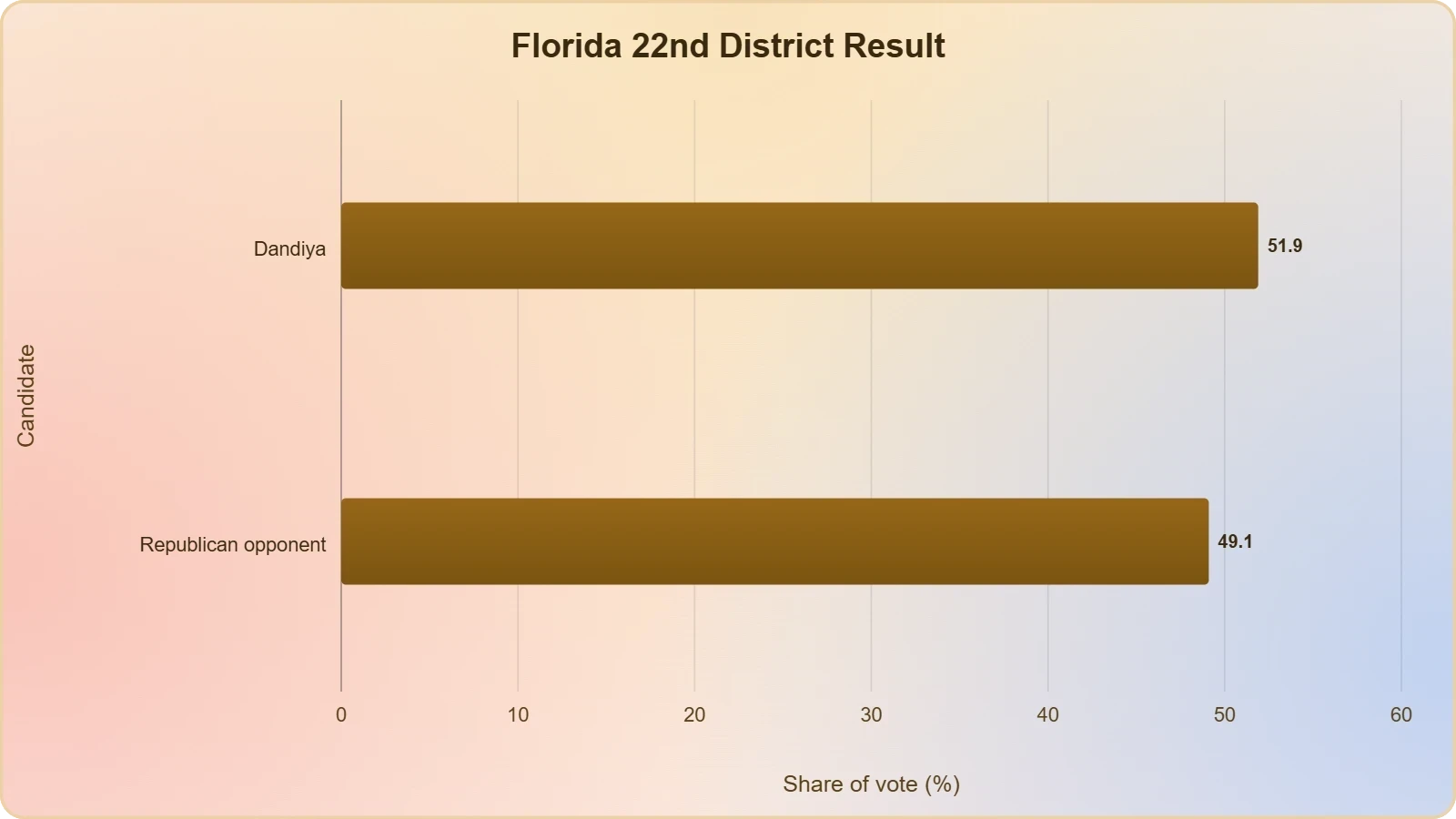
Pia Dandiya's victory in Florida's 22nd congressional district carries a significance that reaches well beyond a single seat in the United States House of Representatives. Declared on Tuesday, November 3, 2026, her 51.9 percent to 49.1 percent win over Marine veteran Casey Askar represents a narrow but decisive margin in one of the nation's most closely watched battlegrounds. For Democrats, the result converts a competitive open district into a foothold; for the Indian-American community, it adds another voice to a congressional caucus that has expanded steadily across recent election cycles. The numbers alone, however, tell only part of the story.
What makes Dandiya's ascent notable is the biography she brings to Washington. A first-generation Indian-American born and raised in Palm Beach County, she began her professional life as a classroom teacher before becoming a high school principal in Harlem. Her campaign website records that she founded a high school at age 28, placing her among the youngest principals in the country, and that every graduate of that school gained college admission despite 86 percent of students coming from low-income households. That record of educational leadership, rather than traditional political apprenticeship, formed the spine of her candidacy and her appeal to voters.
Her path to Congress also reflects the mechanics of modern American redistricting. Dandiya initially set her sights on challenging Republican Brian Mast, chairman of the House Foreign Affairs Committee, in the 21st district. She later shifted to the newly drawn 22nd district, created through redistricting and left without an incumbent. That open-seat dynamic, combined with the district's competitive profile, gave her campaign a rare structural opening. Indian American Impact, which backed her from the outset, described the district as one of the most competitive for Democrats and credited her with turning it blue. This analysis examines the meaning of that win, the coalition behind it, and what it signals for 2026 and beyond.
On This Page
- The Anatomy of a Narrow Victory in Florida's 22nd District
- A First-Generation Story Rooted in Public Education
- The Strategic Pivot From the 21st to the 22nd District
- Indian-American Representation and the Impact of Community Organizing
- What the 2026 Midterms Reveal About Competitive Districts
- The Road Ahead for Florida's Newest Congresswoman
TL;DR Pia Dandiya, a first-generation Indian-American and former high school principal, won Florida's 22nd congressional district with 51.9 percent of the vote against Marine veteran Casey Askar's 49.1 percent. Running in a newly drawn, incumbent-free district after initially targeting Brian Mast in the 21st, she converted one of the Democrats' most competitive opportunities into a seat. Her victory adds a new Indian-American voice to Congress and underscores how redistricting, biography-driven campaigning, and targeted community organizing shaped the 2026 midterms.
The Anatomy of a Narrow Victory in Florida's 22nd District
Election outcomes in the modern United States are rarely decided by landslides, and Dandiya's 2.8-point margin fits squarely within the era of competitive, finely balanced districts. Florida's 22nd was drawn through redistricting and arrived on the map without an incumbent, a combination that historically produces volatile and expensive races. Both parties recognized the opening early, and the contest quickly became a proxy for broader national questions about representation, education policy, and the direction of suburban Florida. The final tally, 51.9 percent to 49.1 percent, confirms that the district remains genuinely purple even as it sent a Democrat to Washington.
Reading the Vote Share and Turnout Dynamics
A margin of fewer than three percentage points means that turnout mechanics mattered as much as message. In open-seat races, the candidate who converts occasional voters into consistent ones typically prevails, and Dandiya's campaign appears to have done exactly that. Her opponent's profile as a Marine veteran gave him credibility with certain segments of the electorate, yet the result suggests that education-focused messaging and community-level organizing carried the day. The narrow spread also implies that the district will remain a target for Republicans in subsequent cycles, making Dandiya an immediate incumbent under pressure rather than a safely entrenched lawmaker.
Analysts will spend months dissecting precinct-level returns, but the aggregate picture is already instructive. A first-time congressional candidate defeating a veteran with military credentials in a swing district indicates that candidate quality and local credibility can outweigh conventional resume advantages. The outcome also reinforces a pattern seen across recent midterms: districts created through redistricting often reward candidates who establish roots quickly and speak directly to the concerns of newly drawn constituencies. Dandiya's Palm Beach County upbringing gave her precisely that kind of rooted authenticity.
The Redistricting Factor and the Open-Seat Advantage
Redistricting is the quiet engine of American political change, and Florida's 2020-cycle maps reshaped the state's congressional landscape in ways that created both opportunity and uncertainty. The 22nd district emerged without an incumbent, which removed the incumbency advantage that typically protects sitting members and leveled the fundraising and name-recognition playing field. Dandiya's decision to pivot from the 21st district, where she would have faced the formidable Brian Mast, to the open 22nd demonstrates strategic discipline. Recognizing where structural conditions favored her candidacy proved as important as any policy position she articulated.
The open-seat dynamic also shaped the campaign's resource allocation. Without an incumbent to attack or defend, both candidates had to build their identities from scratch, which placed a premium on biography and early advertising. Dandiya's campaign website leaned heavily on her record as an educator, and that framing resonated in a district where public education and household costs dominate voter concerns. Redistricting created the stage; her biography supplied the script. Together, they produced a victory that political observers had flagged as possible but far from certain.
A First-Generation Story Rooted in Public Education
Dandiya's political identity rests on a narrative that is at once deeply personal and broadly resonant. The daughter of parents who emigrated from India, she was born and raised in Palm Beach County and entered the workforce as a teacher. Her subsequent tenure as a high school principal in Harlem placed her at the center of some of the most demanding educational environments in the country. That trajectory, from classroom to school leadership to Congress, offers voters a story of upward mobility achieved through public institutions, a theme that crosses party lines and speaks to the aspirations of immigrant families nationwide.
From Classroom Teacher to Harlem Principal
Teaching is often described as the profession closest to the lived reality of American families, and Dandiya's years in the classroom gave her direct exposure to the pressures facing students, parents, and educators. Her move into school leadership in Harlem deepened that experience, placing her in charge of institutions serving communities where resources are scarce and expectations are high. Campaign materials emphasize that she founded a high school at 28, an achievement that positioned her among the youngest principals in the nation. Such credentials carry weight with voters who prioritize education and distrust career politicians.
The Harlem chapter of her career also broadens her geographic and cultural credibility. A candidate who has led schools in both Florida and New York can speak to urban and suburban concerns alike, and that versatility helped her navigate a district with diverse constituencies. Her campaign consistently framed her leadership in terms of measurable outcomes rather than rhetoric, pointing to graduation and college admission rates as evidence of effectiveness. In an era when voters increasingly demand proof over promises, that results-oriented framing proved persuasive.
The 86 Percent Low-Income Statistic and Its Political Weight
Few data points in Dandiya's biography carry as much political force as the claim that every graduate of the school she founded was admitted to college despite 86 percent of students coming from low-income households. That statistic does double duty: it establishes her as an effective leader and it signals her commitment to equity in education. For voters concerned about opportunity gaps, the figure offers concrete evidence that disadvantage need not determine destiny. For her opponents, it presented a difficult target, since attacking a record of college admissions success risks appearing to attack the students themselves.
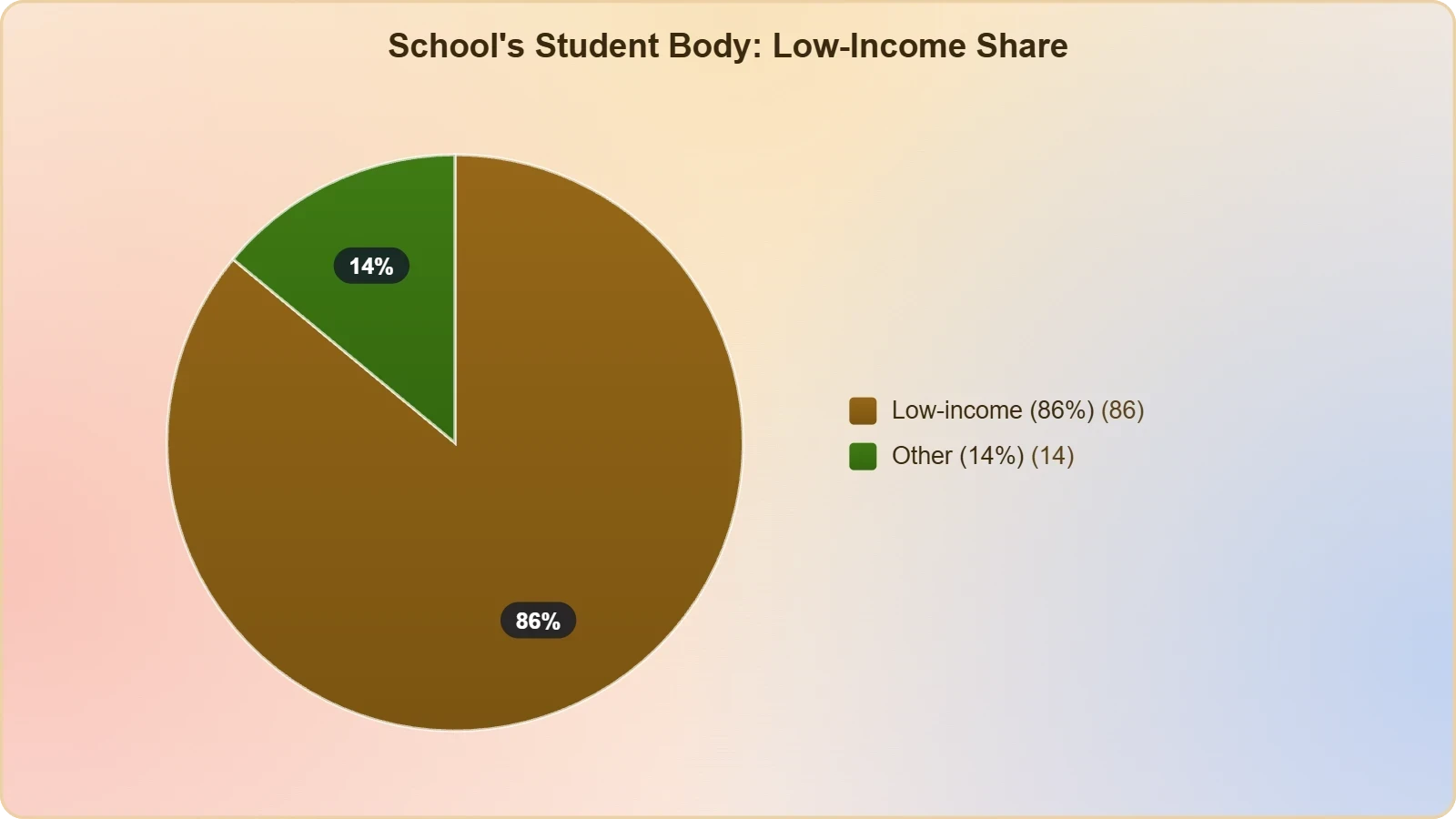
The political weight of that number extends beyond the district. Education remains one of the most salient issues in American politics, and candidates who can point to tangible improvements in student outcomes often outperform those who rely on abstract policy positions. Dandiya's campaign website made the statistic central to her messaging, and the strategy appears to have worked. In a race decided by fewer than three points, a compelling education record may well have been the difference between victory and defeat, particularly among suburban parents who prioritize school quality.
We Also Published
The Strategic Pivot From the 21st to the 22nd District
Few decisions in a campaign reveal more about a candidate's judgment than where to run. Dandiya's initial intention to challenge Brian Mast, chairman of the House Foreign Affairs Committee, in Florida's 21st district was ambitious but daunting. Incumbents of Mast's stature command deep fundraising networks, established name recognition, and committee platforms that amplify their messaging. Recognizing those obstacles, Dandiya redirected her efforts to the newly created 22nd district, where no incumbent stood and the playing field was genuinely open. That pivot, executed before the campaign fully crystallized, proved to be one of its most consequential choices.
Why Challenging an Incumbent Chairman Was a Tall Order
Committee chairmen occupy a privileged position in congressional politics. They control legislative agendas, attract national media attention, and typically raise campaign funds at levels that deter serious challengers. Brian Mast's chairmanship of the House Foreign Affairs Committee gave him precisely that kind of platform, elevating his profile on national security and international affairs. For a first-time candidate, mounting a challenge against such an incumbent would have required extraordinary resources and a compelling rationale for change. Dandiya's decision to seek a different district reflected a clear-eyed assessment of those structural realities rather than any retreat from ambition.
The 21st district's political composition also factored into the calculus. Incumbent-held districts often carry a partisan lean that reinforces the sitting member's advantage, making even well-funded challengers unlikely to prevail. By contrast, the newly drawn 22nd offered a genuinely competitive environment where neither party held a structural edge. Dandiya's willingness to adapt her strategy mid-course demonstrates the kind of pragmatic decision-making that successful candidates often display. In politics, as in education, recognizing when to change approach can be the difference between progress and stagnation.
Seizing the Open Seat Created by Redistricting
Redistricting reshapes political geography, and the creation of Florida's 22nd district handed both parties a rare opportunity. With no incumbent to defend, the seat became a pure contest of ideas, personalities, and organizing capacity. Dandiya moved quickly to establish herself in the new district, building relationships with community leaders and presenting her education record to voters who had never cast a ballot for this seat before. The absence of an incumbent also meant that both campaigns had to introduce their candidates from scratch, which placed a premium on early advertising and grassroots outreach.
The open-seat advantage is well documented in American political science. Candidates in open seats face no incumbency disadvantage, and the outcomes often hinge on national political tides and local candidate quality. In 2026, with Democrats seeking to expand their congressional presence, the 22nd district represented a prime target. Dandiya's campaign capitalized on that opportunity, and Indian American Impact's early endorsement provided organizational and financial support. The result validated the strategic pivot and demonstrated that redistricting can create pathways for new voices to enter Congress.
- 01
- 02
- 03
- 04
Indian-American Representation and the Impact of Community Organizing
The election of Pia Dandiya adds another chapter to the expanding story of Indian-American participation in American political life. Over the past two decades, the community has moved from the margins of electoral politics to a position of growing influence, with members serving in Congress, state legislatures, and senior administrative roles. Dandiya's victory, celebrated by Indian American Impact as a turning point in a competitive district, reflects both the community's demographic growth and the effectiveness of organizations that mobilize Indian-American voters and donors. Her presence in the House will shape how those constituencies are represented and heard.
The Growing Congressional Caucus of Indian-American Lawmakers
Indian-American representation in Congress has grown steadily, and each new member alters the caucus's composition and priorities. Lawmakers of Indian descent have championed issues ranging from immigration reform to small business development, and their presence has encouraged greater engagement between Washington and the diaspora. Dandiya joins this group at a moment when American politics is increasingly attentive to the concerns of Asian American and Pacific Islander communities. Her background in education adds a distinct policy focus to a caucus that has often emphasized commerce, technology, and foreign affairs.
The symbolic dimension of her victory should not be underestimated. For young Indian-Americans, seeing a first-generation candidate win a competitive congressional seat offers a tangible example of political possibility. For the broader electorate, it reinforces the idea that American leadership reflects the country's immigrant heritage. These symbolic effects can translate into concrete political engagement, as communities that see themselves represented are more likely to vote, donate, and run for office. Dandiya's win may therefore influence turnout and candidacies well beyond her own district.
Indian American Impact and the Machinery of Endorsement
Indian American Impact, led by executive director Chintan Patel, played a visible role in Dandiya's campaign. The organization's statement emphasized that Florida's 22nd District was among the most competitive for Democrats and that Dandiya had turned it blue. Endorsements from community organizations provide more than symbolic support; they often unlock donor networks, volunteer capacity, and targeted outreach to specific voter blocs. For a first-time candidate, such backing can be decisive in the final weeks of a campaign, when resources and enthusiasm determine turnout.
The group's early support for Dandiya also illustrates a broader trend in American politics: the professionalization of ethnic community organizing. Organizations like Indian American Impact have built sophisticated operations that identify competitive races, vet candidates, and deploy resources strategically. Their influence extends beyond any single election, shaping the pipeline of candidates and the priorities of elected officials. Dandiya's victory validates that model and will likely encourage similar investments in future cycles, both by Indian-American groups and by other community organizations seeking political influence.
What the 2026 Midterms Reveal About Competitive Districts
The 2026 midterm cycle unfolded against a backdrop of intense national debate over representation, education, and the direction of American governance. Dandiya's victory in Florida's 22nd district offers a case study in how competitive districts behave when incumbency is removed from the equation. The result, a 2.8-point margin, suggests that such districts remain genuinely contested and that neither party can take them for granted. For Democrats, the win demonstrates that targeted investment in open seats can yield returns; for Republicans, it signals that redistricting created vulnerabilities requiring sustained attention in future cycles.
Lessons for Both Parties in Open-Seat Contests
Open-seat contests reward different skills than incumbent races. Without a record to defend or attack, candidates must build name recognition quickly and articulate a compelling personal narrative. Dandiya's education background provided that narrative, while her opponent's military service offered a competing frame. The outcome suggests that in districts where both candidates are relatively new to voters, biography and local credibility can outweigh national partisan trends. Parties seeking to replicate her success will need to recruit candidates with authentic community ties and invest early in defining them before opponents do.
The race also highlights the importance of resource allocation. Competitive open seats attract national money and attention, but campaigns that build grassroots infrastructure early often outperform those that rely on late advertising. Dandiya's support from Indian American Impact and her emphasis on community outreach suggest a campaign that prioritized relationships over spectacle. For both parties, the lesson is clear: in the narrow band of truly competitive districts, the quality of the campaign organization frequently determines the outcome more than the national mood.
Implications for Future Indian-American Candidacies
Dandiya's victory will likely accelerate efforts to recruit and support Indian-American candidates across the country. Her success demonstrates that candidates from the community can win in competitive, non-majority-minority districts, not merely in safe seats drawn to reflect demographic concentrations. That distinction matters because it expands the map of viable candidacies and encourages party committees to look beyond traditional recruitment channels. Organizations that support Indian-American candidates now have a concrete case study to present to donors and party leaders, strengthening their case for investment in future cycles.
The implications extend to policy as well. As more Indian-American lawmakers enter Congress, issues such as immigration processing, small business access, and educational equity are likely to receive greater attention. Dandiya's background in education positions her to advocate for school funding and teacher development, areas where her experience gives her credibility. Her presence may also influence how the Democratic caucus frames outreach to immigrant communities, reinforcing the idea that representation is not merely symbolic but substantively connected to legislative priorities and constituent service.
The Road Ahead for Florida's Newest Congresswoman
Winning an election is one achievement; governing effectively is another entirely. Dandiya arrives in Washington as a freshman member of the minority or majority party, depending on the broader 2026 results, and will face the immediate challenges of committee assignments, office setup, and constituent service. Her education background suggests she will seek seats on committees related to schools, labor, or workforce development, where her expertise can shape legislation. The narrow margin of her victory also means she must begin campaigning for reelection almost immediately, balancing governance with the perpetual demands of a competitive district.
From Campaign Trail to Legislative Agenda
Freshman lawmakers typically spend their first months learning procedural rules, building relationships, and identifying opportunities to influence policy. Dandiya's experience leading schools may translate into advocacy for federal education funding, teacher recruitment, and college access programs. Her personal story as a first-generation American could also inform her positions on immigration and workforce development. The transition from campaign rhetoric to legislative reality requires discipline, and her record as a school leader suggests she understands how to set priorities and measure outcomes in complex institutions.
Constituent service will be equally important. In a district decided by fewer than three points, responsiveness to local concerns can solidify support and deter challengers. Dandiya's campaign emphasized community ties, and maintaining those relationships through town halls, casework, and local engagement will be essential. The district's diverse population, spanning suburban and coastal communities, will demand attention to issues ranging from housing costs to environmental resilience. How she navigates those demands in her first term will shape her prospects for a second.
Accountability and the Next Election Cycle
The 2028 cycle will arrive quickly, and Dandiya's narrow margin ensures that Republicans will target her seat. Her ability to deliver tangible results, maintain visibility, and avoid missteps will determine whether she becomes an entrenched incumbent or a one-term member. Political scientists note that freshmen in competitive districts often face the toughest reelection battles, since they lack the name recognition and fundraising networks of longer-serving colleagues. Dandiya's campaign infrastructure and community support will need to persist beyond election day to provide a foundation for future races.
Accountability also runs in the other direction. Voters in the 22nd district will judge her on whether she fulfills the promises that won them over, particularly on education and economic opportunity. Her campaign's emphasis on measurable outcomes, such as college admission rates, sets a standard that her constituents may apply to her legislative record. If she can translate her educational leadership into effective representation, she may build the kind of durable coalition that turns a narrow victory into a lasting political career.
From our network :
- Live Online English Classes for Kids: Do They Actually Reduce Anxiety?A ten-week study reveals that synchronous online English classes can significantly reduce child language anxiety while improving listening and reading skills. Discover what makes these programs effective and how parents can select the right one.
- Mobile Learning and VR in English: What Global Evidence Reveals About Effective Language TechnologyA systematic review across 14 countries reveals which language-learning technologies genuinely work. Mobile learning, AI, and VR show measurable benefits when pedagogically integrated. This evidence-based guide helps educators and learners select technology that delivers real return on investment.
- The Final Descent: How ESA Retired the Legendary Cluster Constellation After 24 Years of Space Weather ScienceAfter 24 years mapping Earth’s magnetosphere, ESA’s Cluster mission concluded with a precisely controlled reentry over the South Pacific. This analysis explores the scientific legacy, engineering decisions, and debris mitigation principles behind one of space exploration’s most responsible retirements.
- Forbidden Matrix Patterns and Visible Lattice Points: A Geometric DictionaryExplore how multidimensional 0–1 matrices encode geometric truths, linking forbidden patterns to visible lattice points and hypergraph theory, with applications in combinatorics and computational geometry.
- The Hidden Cost of AI Convenience: Why Over-Permissioned Agents Are a Security Time BombDiscover why AI agents with excessive permissions create dangerous single points of failure, and learn how implementing least privilege principles can protect your organization from exploitation.
- University Language Proficiency Exams: Why Institutional Tests Demand Different Preparation Than IELTS and TOEFLDiscover why university-specific language proficiency examinations differ fundamentally from IELTS and TOEFL, and learn strategic preparation approaches for institutional assessment success.
- Committed Mediterranean Precipitation Decline: Why Emissions Cuts Alone Cannot Restore Winter RainsNew NOAA research reveals that Mediterranean winter rains may decline irreversibly even with emissions cuts. Explore the science of committed climate change and regional impacts.
- How AI Agents Will Change the Way We Manage Personal FinancesExplore how AI agents are transforming personal finance through automated budgeting, bill payment, and investment management, while examining the critical security protocols and governance frameworks required for safe deployment.
- CISA’s Ten-Advisory Wave: Why Generic Patching Fails in OT and How to Build Product-Specific PlaybooksCISA released ten ICS advisories in one week, exposing critical infrastructure risks. Generic patching fails in OT. Learn to build product-specific remediation playbooks.
RESOURCES
- Pia Dandiya for Congress — A New Future for Floridapiaforcongress.comFlorida's newly formed District 22, which includes South Naples, Marco Island, and Palm Beach County, is the focus of a competitive congressional race between ...
- Florida 22nd Congressional District Election Resultsnytimes.com1 hour ago ... About this race. Casey Askar, a Republican businessman and former Marine, and Pia Dandiya, a Democrat and former high school…
- Florida's 22nd Congressional District election, 2026 - Ballotpediaballotpedia.orgPia Dandiya (D) and Casey Askar (R) ran in the general election for U.S. House Florida District 22 on November 3, 2026. Candidate. Image…
- Democrat Pia Dandiya wins Florida's newly redrawn ... - CBS Newscbsnews.com4 hours ago ... Democrat Pia Dandiya has won the race for Florida's 22nd Congressional District, defeating Republican Casey Askar in one of South…
- Battle lines drawn in Florida's 22nd congressional district race over ...wlrn.orgAug 31, 2026 ... Democratic congressional candidate Pia Dandiya says her Republican opponent, Casey Askar, wants to end the Affordable Care Act for millions ...
- Florida's 22nd Congressional District Candidates 2026 Generalsparkers-soapbox.comSep 11, 2026 ... Who's Running for Florida's 22nd Congressional District in the 2026 General Election · Casey Askar (Republican) · Pia Dandiya (Democrat)…
- EMILYs List Celebrates Pia Dandiya's Primary Victory in Florida's ...emilyslist.orgAug 18, 2026 ... WASHINGTON, D.C. – Following Pia Dandiya's decisive win in the Democratic primary for Florida's 22nd Congressional District, EMILYs List ...
- Florida's 22 Congressional District race rated 'Toss Up' - WLRNwlrn.orgSep 25, 2026 ... Democrat Pia Dandiya (right) and Republican Casey Askar (left) are competing for a newly drawn congressional district that covers four…
- Political newcomer Pia Dandiya defeats Casey Askar in race for ...local10.com18 hours ago ... Florida's 22nd Congressional District covers a large area of Palm Beach County, parts of Broward County, including Weston, Davie and…
- HMP Poll: Pia Dandiya Leads Casey Askar in FL-22thehousemajoritypac.comSep 9, 2026 ... Washington, D.C. – A new House Majority PAC poll of Florida's 22nd Congressional District ... election were held today. Pia…
- Casey Askar, Pia Dandiya clash in Florida District 22 race - WPBFwpbf.comOct 23, 2026 ... The race for Florida's 22nd Congressional District seat is intensifying as Republican Casey Askar and Democrat Pia Dandiya compete for…
- Democrat Pia Dandiya wins election to U.S. House in Florida's 22nd ...newsday.com4 hours ago ... Democrat Pia Dandiya won election Tuesday to the U.S. House of Representatives representing Florida's 22nd Congressional District, ...
- Democrat Pia Dandiya is fighting to win Florida's re-drawn 22nd ...instagram.comSep 24, 2026 ... A new report has shifted Pia Dandiya's race for Florida's 22nd Congressional District from “Lean Republican” to “Toss Up,” putting…
- Redistricting shuffle: Pia Dandiya shifts candidacy to open CD 22 ...floridapolitics.comMay 22, 2026 ... Democratic congressional candidate Pia Dandiya says she will run for an open seat representing Florida's 22nd Congressional District.
- Lean Republican Florida House Race Attracts Outside Spendinglegis1.comAug 19, 2026 ... Casey Askar wins Republican primary, Pia Dandiya claims Democratic nomination in Florida's 22nd Congressional District.
- 01
- 02
- 03
- 04
- 05
- 06
- 07
- 08
0 Comments