1972 arrives in the historical imagination less as a headline than as a hinge. It was the year the postwar settlement began to visibly loosen: fixed currency pegs gave way, great-power rivalry settled into a long détente, and the environmental movement crossed the threshold from protest into statute. What makes the year so instructive is not any single event but the density of them — a cluster of decisions, treaties, technologies and cultural shocks that quietly installed the operating system under which the following half-century would run. To study 1972 is to watch institutions being born in real time.
The year's signature is durability disguised as routine. A photograph taken from orbit, a diplomatic handshake in Beijing, a treaty signed in Moscow, a break-in at a Washington office complex, a new pocket calculator, a landmark environmental law — each looked discrete at the time, yet each left a trace that persists in modern politics, media, law and daily habit. The 1972 legacy is therefore best read as an inheritance rather than an anniversary: we still live inside structures that were drafted, argued over and ratified during those twelve months, often by people who had little sense of how long their choices would echo.
This analysis examines six of those threads and traces them forward to the present. It treats the year not as nostalgia but as a diagnostic tool — a way of understanding why today's institutions behave as they do, why certain arguments keep recurring, and where the seams of the modern world were first stitched. Readers who want to understand the 1972 impact today will find it less in commemorations than in the ordinary machinery of governance, finance, media and memory that the year set in motion.
On This Page
- The Monetary Rupture That Redrew Global Finance
- Diplomacy Reopens: Beijing, Moscow and the Long Détente
- Environmental Law Comes of Age
- Watergate and the Remaking of Political Trust
- Consumer Technology Enters the Home
- Culture, Sport and the Shaping of Collective Memory
- Institutions, Treaties and the Architecture of the Present
- Why the Year Still Reads as a Turning Point
TL;DR 1972 functioned as a hinge year in which the postwar order visibly loosened and a new one was improvised. Currency pegs collapsed, great-power diplomacy reopened, environmental law matured, a Washington burglary metastasized into a constitutional crisis, consumer technology began its march into the home, and global institutions took shape. None of these events looked epochal at the time; together they drafted the operating system under which modern politics, media, finance and daily life still run. The 1972 historical significance lies in that durability — the year's decisions remain legible in the institutions and habits we inhabit today.
The Monetary Rupture That Redrew Global Finance
On 15 August 1971, President Nixon suspended the dollar's convertibility into gold, and 1972 was the year the world discovered there was no going back. The Smithsonian Agreement of December 1971 had attempted to patch the Bretton Woods system with new parities, but speculative pressure through 1972 exposed the patch as temporary. By the time the major currencies were allowed to float in early 1973, the architecture of postwar money had already been dismantled in practice. What 1972 delivered was not a single decision but a realization: the fixed-rate world was over, and no one had a replacement blueprint.
The consequences were structural rather than merely technical. Floating exchange rates handed currency risk back to businesses, households and governments, and in doing so created entire industries — derivatives, hedging desks, currency forecasting — that barely existed before. Inflation, already stirring, would accelerate through the decade, and the policy debates of 1972 about money supply, wage-price controls and central-bank independence remain recognizably modern. The year marks the moment when finance became globally integrated and permanently volatile, a condition that defines markets to this day.
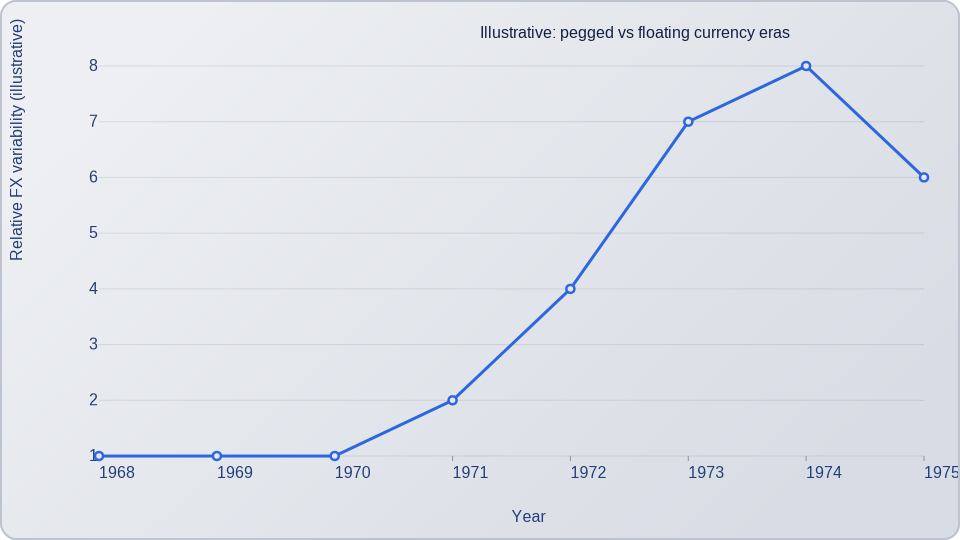
From Pegs to Floating Rates
The intellectual shift was as consequential as the mechanical one. Economists who had spent careers defending fixed parities found themselves arguing for floating rates within months, and the discipline's consensus reorganized around monetarist ideas that would dominate the following decades. The 1972 debates over the proper role of central banks, the measurement of money and the causes of inflation set the terms for policy arguments that persist in contemporary central banking. In that sense, the year's monetary rupture was also an intellectual rupture, and its vocabulary still shapes how finance ministers and commentators describe the world.
For ordinary citizens, the change arrived as rising prices and unfamiliar uncertainty. Savings that had seemed safe began to lose purchasing power, and the assumption that money would hold its value — a pillar of postwar middle-class life — started to erode. The 1972 legacy in personal finance is therefore intimate: it is the beginning of the modern relationship between households and inflation, in which vigilance about prices, interest rates and currency becomes a permanent feature of economic life rather than a wartime exception.
Diplomacy Reopens: Beijing, Moscow and the Long Détente
February 1972 produced one of the most photographed diplomatic moments of the century: Richard Nixon walking into a Beijing receiving hall to meet Mao Zedong. The visit ended more than two decades of estrangement between Washington and the People's Republic, and the Shanghai Communiqué that followed established a formula for managing differences while acknowledging them. In May, Nixon was in Moscow signing the Strategic Arms Limitation Talks agreements, the first serious limits on nuclear arsenals. Within a single year, the Cold War's geometry had been redrawn by a president who would soon be consumed by scandal at home.
The strategic logic was triangular, and it outlasted the personalities involved. By opening to China while negotiating with the Soviet Union, Washington created leverage that neither communist capital could ignore, and the resulting détente shaped arms control, trade and regional politics for the rest of the decade. The 1972 legacy in geopolitics is visible in the assumptions that still govern great-power relations: that adversaries can be engaged without being endorsed, that communiqués can manage disputes, and that triangular diplomacy can substitute for confrontation when interests align.
The Shanghai Communiqué and Its Afterlives
The communiqué's most durable innovation was its willingness to state disagreements openly while committing both sides to a framework for handling them. That template — candid acknowledgment of differences paired with a shared interest in stability — has been reused in countless bilateral statements since. For students of diplomacy, 1972 is the year the modern practice of managed rivalry took recognizable form, and the document remains a reference point whenever Washington and Beijing seek to stabilize a relationship that has grown far more complex than either side imagined in 1972.
Arms control followed a parallel path. SALT I and the Anti-Ballistic Missile Treaty established the principle that nuclear competition could be bounded by negotiated rules, an idea that survived through subsequent treaties and their eventual unraveling. The 1972 historical significance here is architectural: the year built the first durable framework for nuclear restraint, and even its later collapse testifies to how much subsequent policy was defined by the attempt to preserve or replace what 1972 created.
Environmental Law Comes of Age
In 1972, environmental concern moved from the margins of politics to the center of governance. The Stockholm Conference, the first United Nations gathering devoted to the human environment, produced the Stockholm Declaration and helped launch the United Nations Environment Programme. In the United States, the Clean Water Act passed over a presidential veto, and the pesticide DDT was banned after Rachel Carson's warnings had spent a decade reshaping public opinion. The Environmental Protection Agency, created in 1970, was still new, but 1972 gave it teeth and a mandate.
The year's environmental decisions established a template that persists: scientific evidence translated into statutory standards, enforced by agencies with authority to sue and be sued. That template has been contested ever since, but its basic grammar — permits, thresholds, impact statements, judicial review — remains the operating language of environmental regulation worldwide. The 1972 impact today is therefore institutional: whenever a government issues an emissions standard or a water-quality permit, it is working within a framework whose foundations were laid in that year.
Stockholm, the Clean Water Act and the Regulatory Template
Stockholm's significance lay in internationalizing the environment as a subject of diplomacy. For the first time, nations agreed that pollution, resource depletion and conservation were matters of shared concern rather than purely domestic policy. The conference also exposed the divide between industrialized and developing countries over priorities, a tension that has shaped climate negotiations ever since. The 1972 legacy in global environmental politics is thus double-edged: it created the institutions and the unresolved arguments that still structure the debate.
Domestically, the Clean Water Act demonstrated that ambitious environmental legislation could survive political opposition and presidential veto. Its framework of water-quality standards, discharge permits and citizen suits became a model for later statutes and for regulators abroad. The year's environmental record is often overshadowed by its political dramas, but its practical consequences — cleaner rivers, restored fisheries, enforceable limits — are among the most tangible inheritances of 1972.
Watergate and the Remaking of Political Trust
The break-in at the Watergate complex on 17 June 1972 was, at the time, a minor crime story. Its transformation into a constitutional crisis over the following two years made it the defining political scandal of the era and permanently altered how Americans regard their government. The burglary itself was unremarkable; the cover-up, the secret tapes and the eventual resignation of a president were not. What 1972 supplied was the spark, and the fire it lit reshaped the relationship between citizens, the press and the state.
The 1972 legacy in politics is a durable skepticism. Investigations became a permanent feature of political life, and the presumption that officials might be concealing something moved from fringe suspicion to mainstream default. The scandal also elevated the role of investigative journalism, establishing a model of adversarial reporting that newsrooms have aspired to ever since. When commentators speak of a post-Watergate mentality, they are describing a habit of scrutiny that began with a burglary in 1972.
Investigative Journalism as a Permanent Institution
The Washington Post's reporting, powered by anonymous sources and dogged verification, became the template for investigative journalism worldwide. It demonstrated that sustained, unglamorous reporting could bring down a government, and it inspired a generation of reporters to treat official statements as claims to be tested rather than facts to be relayed. The 1972 impact today is visible in every newsroom that maintains an investigations desk and in every reader who expects the press to hold power accountable.
The scandal also changed the law. Campaign finance reform, ethics rules and the independent counsel mechanism all emerged in its wake, each an attempt to prevent a recurrence. Those reforms have themselves been debated, revised and sometimes abandoned, but the underlying question — how to constrain executive power without paralyzing it — remains as live as it was when the Senate hearings began. In that sense, 1972 opened an argument that has never fully closed.
Consumer Technology Enters the Home
The first scientific pocket calculator, the Hewlett-Packard HP-35, went on sale in 1972, and with it a quiet revolution in how ordinary people performed arithmetic. The device was expensive, but it signaled that computing power was migrating from laboratories and corporate data centers into pockets and living rooms. The same year saw the debut of the video game that would become Pong, the launch of the first successful home video game console, and the beginnings of the microprocessor era that would accelerate through the decade.
These products were novelties in 1972, but they established a pattern that has never reversed: consumer electronics improving rapidly while falling in price, and each generation of devices reshaping daily habits. The 1972 legacy in technology is the assumption that computation will keep getting cheaper and more personal. Every smartphone, laptop and smart speaker descends from the logic that a powerful machine could be small, affordable and owned by an individual rather than an institution.
From Pocket Calculators to Personal Computing
The pocket calculator's cultural effect was disproportionate to its capabilities. It displaced slide rules and logarithm tables, changed how mathematics was taught, and provoked debates about whether students should be allowed to rely on machines. Those debates recur with every new technology, from graphing calculators to search engines to generative models, and they reveal how much of our relationship with tools was formed in the early 1970s. The 1972 historical significance here is pedagogical as much as technical.
Meanwhile, the microprocessor — introduced commercially in 1971 and embedded in products throughout 1972 — made the personal computer conceivable. The hobbyist culture that would produce Apple and Microsoft was forming in the same months, and the idea that individuals might own and program their own machines moved from speculation to plausible ambition. The year thus sits at the threshold of the digital age, close enough to its origins that the excitement and improvisation are still visible.
Culture, Sport and the Shaping of Collective Memory
1972 was also a year of cultural shocks that lodged in public memory. The Munich Olympics began as a showcase of postwar German renewal and ended in tragedy when Palestinian militants killed Israeli athletes, an event that reshaped security at global sporting events and the way television covered terrorism. In the same year, the Soviet Union and the United States played the Summit Series in hockey, a contest that transcended sport and became a proxy for Cold War rivalry. These moments demonstrated the power of broadcast media to turn events into shared experiences.
The cultural record of 1972 is unusually rich: landmark albums, influential films and the emergence of genres that would define the following decades. But the year's deeper significance lies in how these artifacts were consumed. Television had become the primary medium through which the world was witnessed, and events were increasingly experienced as collective spectacles. The 1972 legacy in media is the assumption that major moments will be seen simultaneously by millions, an assumption that social platforms have since intensified rather than invented.
Munich, the Summit Series and Televised Spectacle
The Munich massacre forced a reckoning with the vulnerability of open, televised events and led to sweeping changes in Olympic security that persist today. The Summit Series, meanwhile, showed how sport could carry political meaning without being explicitly political, as Canadian and Soviet players became symbols of rival systems. Both events demonstrated that broadcast media could transform local occurrences into global narratives, a dynamic that now defines everything from elections to disasters.
These moments also shaped how later generations remember the early 1970s. For many, 1972 is less a set of policies than a set of images: the masked figure on a Munich balcony, the hockey goal heard across a continent, the president walking into a Beijing hall. Collective memory works through such images, and the year supplied an unusual number of them. The 1972 historical significance is partly a matter of iconography, and that iconography still frames how the era is understood.
Institutions, Treaties and the Architecture of the Present
Beyond the headlines, 1972 was a year of institution-building. The United Nations Conference on Trade and Development gained new momentum, the World Heritage Convention was adopted to protect cultural and natural sites, and the Biological Weapons Convention opened for signature. The year also saw the founding of the International Institute for Applied Systems Analysis and the publication of the Club of Rome's The Limits to Growth, a report that introduced systemic thinking about resource constraints into public debate. Each of these initiatives outlived the circumstances that produced them.
The common thread is a faith in multilateral problem-solving that characterized the era. Governments believed that shared challenges — weapons, heritage, environment, development — could be addressed through negotiated frameworks and permanent institutions. That faith has been tested repeatedly since, but the architecture it produced remains standing. The 1972 legacy in global governance is the network of treaties and agencies that still structure international cooperation, even when the political will behind them fluctuates.
The Limits to Growth and the Systems View
The Club of Rome's report was controversial from the moment of publication, criticized for its assumptions and defended for its ambition. Its lasting contribution was methodological: it popularized the idea that global problems are interconnected and that policy choices have long-term systemic consequences. That perspective now underpins everything from climate modeling to supply-chain analysis, and it entered mainstream thought through a 1972 publication that many dismissed at the time.
The World Heritage Convention, meanwhile, created a mechanism for international cooperation on conservation that has since protected thousands of sites. The Biological Weapons Convention established a norm against an entire class of weapons, a norm that has held despite periodic stress. These instruments demonstrate the year's characteristic approach: identify a shared risk, negotiate a framework, and build institutions to monitor compliance. The 1972 impact today is embedded in the routines of international law.
Why the Year Still Reads as a Turning Point
What unites these six threads is a shared characteristic: each represents a decision or event whose consequences outran its moment. The monetary rupture, the diplomatic opening, the environmental statutes, the political scandal, the consumer technologies and the cultural spectacles all began as discrete occurrences and ended as permanent features of modern life. That is what makes 1972 a turning point rather than merely a busy year. The 1972 legacy is the accumulated weight of choices that were made quickly and have been lived with ever since.
There is also a cautionary dimension. Many of the year's decisions were improvisations, taken under pressure and without full understanding of their implications. The shift to floating rates was not planned; the Watergate cover-up was not foreseen; the environmental statutes were drafted in haste and amended repeatedly. Recognizing this should temper any temptation to treat 1972 as a golden age of foresight. Its significance lies in the durability of its improvisations, not in the wisdom of its planners.
Reading the Present Through 1972
For contemporary readers, the year offers a useful lens. Arguments about inflation and central-bank independence, about great-power rivalry and arms control, about environmental regulation and its costs, about press freedom and executive accountability, about technology's effect on daily life — all of these have recognizable ancestors in 1972. Understanding those ancestors clarifies why today's debates take the forms they do and why certain positions feel intuitively right to the people who hold them.
The 1972 impact today is therefore less about commemoration than about diagnosis. When a currency crisis unfolds, when a diplomatic communiqué is drafted, when a regulator sets a pollution limit, when a scandal tests public trust, when a new device enters the home, the patterns established in 1972 are being replayed with new actors. The year remains legible because its structures remain active, and that is the strongest argument for continuing to study it.
From our network :
- Live Online English Classes for Kids: Do They Actually Reduce Anxiety?A ten-week study reveals that synchronous online English classes can significantly reduce child language anxiety while improving listening and reading skills. Discover what makes these programs effective and how parents can select the right one.
- Forbidden Matrix Patterns and Visible Lattice Points: A Geometric DictionaryExplore how multidimensional 0–1 matrices encode geometric truths, linking forbidden patterns to visible lattice points and hypergraph theory, with applications in combinatorics and computational geometry.
- Committed Mediterranean Precipitation Decline: Why Emissions Cuts Alone Cannot Restore Winter RainsNew NOAA research reveals that Mediterranean winter rains may decline irreversibly even with emissions cuts. Explore the science of committed climate change and regional impacts.
- University Language Proficiency Exams: Why Institutional Tests Demand Different Preparation Than IELTS and TOEFLDiscover why university-specific language proficiency examinations differ fundamentally from IELTS and TOEFL, and learn strategic preparation approaches for institutional assessment success.
- Mobile Learning and VR in English: What Global Evidence Reveals About Effective Language TechnologyA systematic review across 14 countries reveals which language-learning technologies genuinely work. Mobile learning, AI, and VR show measurable benefits when pedagogically integrated. This evidence-based guide helps educators and learners select technology that delivers real return on investment.
- CISA’s Ten-Advisory Wave: Why Generic Patching Fails in OT and How to Build Product-Specific PlaybooksCISA released ten ICS advisories in one week, exposing critical infrastructure risks. Generic patching fails in OT. Learn to build product-specific remediation playbooks.
- The Hidden Cost of AI Convenience: Why Over-Permissioned Agents Are a Security Time BombDiscover why AI agents with excessive permissions create dangerous single points of failure, and learn how implementing least privilege principles can protect your organization from exploitation.
- The Final Descent: How ESA Retired the Legendary Cluster Constellation After 24 Years of Space Weather ScienceAfter 24 years mapping Earth’s magnetosphere, ESA’s Cluster mission concluded with a precisely controlled reentry over the South Pacific. This analysis explores the scientific legacy, engineering decisions, and debris mitigation principles behind one of space exploration’s most responsible retirements.
- How AI Agents Will Change the Way We Manage Personal FinancesExplore how AI agents are transforming personal finance through automated budgeting, bill payment, and investment management, while examining the critical security protocols and governance frameworks required for safe deployment.
RESOURCES
- Elvis Presley: Prince from Another Planet, As Recorded Live At ...legacyrecordings.comElvis Presley: Prince from Another Planet, As Recorded Live At Madison Square Garden, New York City, June 10, 1972 · July 31, 2012 ...…
- The background and legacy of Lewontin's apportionment of human ...royalsocietypublishing.orgApr 18, 2022 ... Abstract. Lewontin's 1972 article 'The apportionment of human diversity' described a key feature of human genetic diversity that would have ...
- Remembering René Leibowitz (1913-1972): Composer and ...eamdc.comJul 21, 2024 ... ... 1972): Composer and Champion of Schoenberg's Legacy ... historical significance lies in its being the clearest example of Schoenberg's…
- Canada is still haunted by the legacy of the 1972 Summit Seriestheconversation.comSep 18, 2022 ... ... historical significance, its influence on internal and external conceptions of Canadian identity, efforts to proliferate the tournament's legacy ...
- J. Edgar Hoover, May 10, 1924 - May 2, 1972 - FBIfbi.govJ. Edgar Hoover led the FBI for nearly a half-century, from 1924 until 1972. Under Director Hoover, the Bureau grew in responsibility and importance, ...
- A Legacy on Ice: Northbrook Speed Skating's Enduring Impactnorthbrook.il.usApr 9, 2026 ... ... 1972 U.S. Olympic women's speedskating team. ... Historical context for this article was provided by the Northbrook Historical Society.
- World Heritage - UNESCOunesco.orgThe 1972 World Heritage Convention protects sites of outstanding universal value for all humanity ... Heritage is our legacy from the past, what we…
- The Legacy of the Gary Convention - AAIHSaaihs.orgMar 25, 2022 ... In many ways, Black intellectual and political history has been trapped in the amber of a post-1972 framework. There are…
- About The Untreated Syphilis Study at Tuskegee - CDCcdc.govBackground. The U.S. Public Health Service (USPHS) Untreated Syphilis Study at Tuskegee was a study conducted between 1932 and 1972. The study was supposed…
- Fifty Years Legacy: The Sport Venues of the 1972 Munich Olympic ...scholarlypublishingcollective.orgOct 1, 2025 ... The Olympic Games and the sports venues built for them attract considerable attention. The 1972 Olympic Games in Munich made…
- Shirley Chisholm | National Women's History Museumwomenshistory.org... (1972). Her motto and title of her autobiography—Unbought and Unbossed ... On her legacy, Chisholm said, “I want to be remembered as a…
- An enduring legacy: 50 years of The Godfather - Newsnews.lafayette.eduFeb 24, 2022 ... For questions about page contents, contact the Communications Division. Prof. Andy Smith shares insights about the history, significance ...
- History | George Mason Universitygmu.eduFifteen years later, on April 7, 1972, then-Governor A. Linwood Holton signed legislation to separate George Mason College from the University of Virginia.
- Dive into the legacy of Shirley Chisholm at Changing the Face of ...facebook.comNov 27, 2024 ... The post's caption connects this historical context to the current ... She reflects on her historical milestones in 1968 and…
- Final Report of the Syphilis Study Legacy Committee1—May 20, 1996tuskegee.eduMay 20, 1996 ... 40 Years,” New York Times, 26 July 1972: 1, 8. ... will place the Study within its broadest social and…
Related By Tags
- 01
- 02
- 03
- 04
- 05
- 06
- 07
- 08
0 Comments