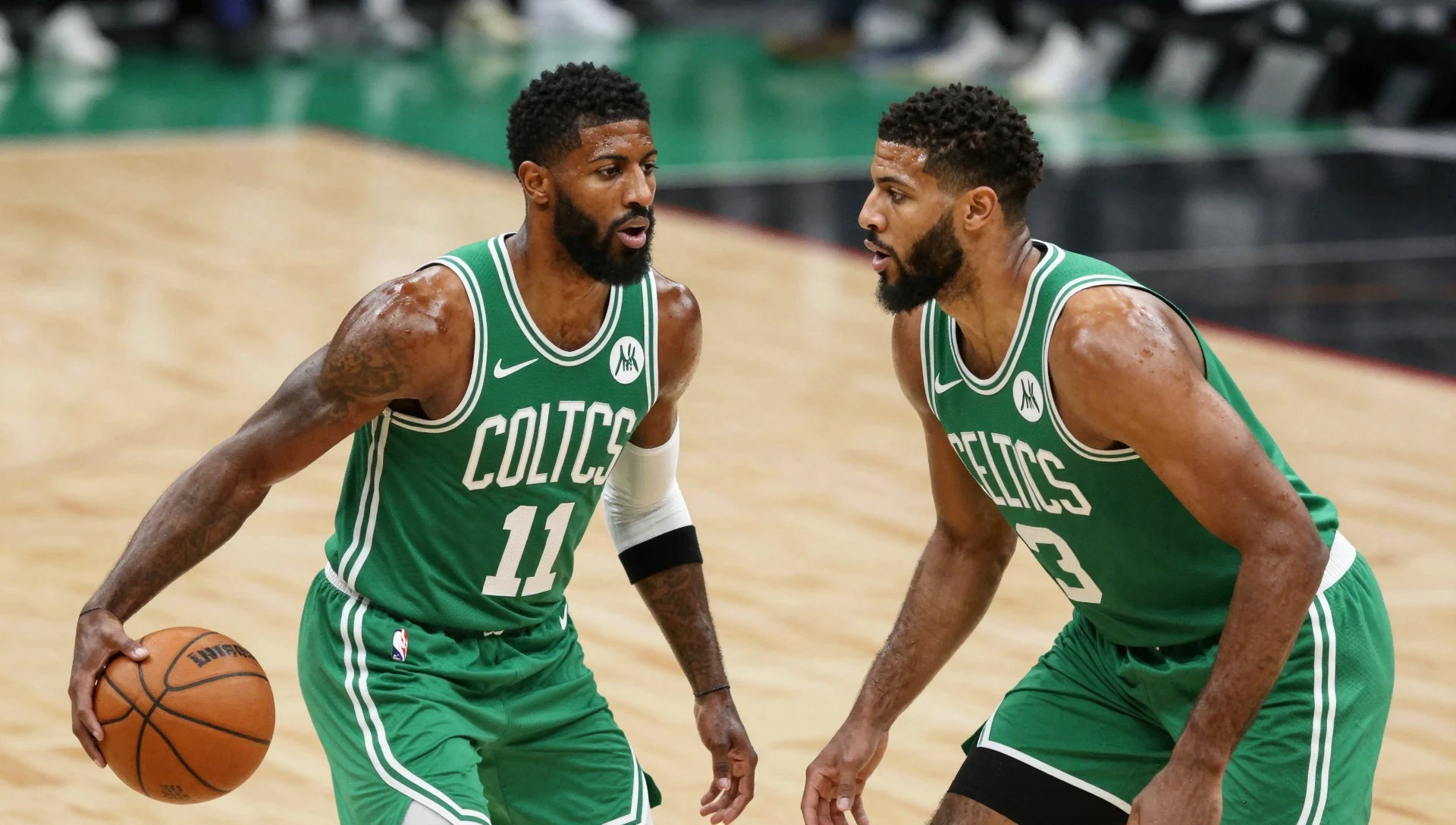
Jaylen Brown stepping onto the floor against the Boston Celtics for the first time in an opposing jersey instantly became one of the most emotionally charged storylines of the 2026-27 NBA calendar, and the evening delivered a second, unexpected narrative when Paul George produced a performance that commanded the spotlight. According to reporting from The Athletic, George's play drew the bulk of the attention and quickly became the defining story of the matchup, overshadowing even the reunion subplot that had framed the game for weeks. The collision of a franchise icon facing his former team and a veteran wing authoring a statement night gave the contest a layered significance that extended well beyond a single result in the standings.
What makes this particular fixture so compelling is how it compresses several distinct basketball stories into one evening. Brown's return carried the weight of a decade-long relationship with Boston — the draft night, the Finals runs, the contract negotiations, and eventually the difficult decision to move on. George, meanwhile, arrived with his own narrative arc as a player whose career has been defined by reinvention and late-career resilience. When those two threads intersected, the game became less about a routine regular-season meeting and more about legacy, identity, and the psychological toll of competing against people who once shared a locker room. The Athletic's framing of George as the standout performer suggests the night belonged to the player with something to prove rather than the one seeking closure.
This analysis examines the deeper meaning embedded in that matchup: the mechanics of a high-profile reunion, the way media narratives attach themselves to returning players, the tactical adjustments that made George effective, and the broader implications for both franchises as the season progresses. It also considers how a single game can reshape perceptions of players and teams in a league where reputation is constantly renegotiated. By unpacking the layers beneath the headline, we can understand why a November contest between Boston and Philadelphia generated such outsized attention and what it reveals about the modern NBA's relationship with story, sentiment, and spectacle.
On This Page
TL;DR Jaylen Brown's first game against the Boston Celtics was expected to dominate the narrative, but Paul George's standout performance, as reported by The Athletic, became the evening's central story. The matchup fused a high-emotion reunion with a veteran's statement night, illustrating how the NBA's media ecosystem elevates individual narratives above team results. This analysis explores the reunion dynamics, George's tactical impact, the psychological dimensions of facing a former team, and the broader implications for both franchises as the season unfolds.
The Anatomy of a High-Profile Reunion Game
Reunion games occupy a peculiar space in professional sports. They are regular-season fixtures on the schedule, worth the same in the standings as any other night, yet they arrive loaded with emotional freight that no coaching staff can fully control. When a player of Jaylen Brown's stature returns to face the organization that drafted him, developed him, and celebrated championships with him, the event transcends basketball. The Athletic's coverage framed the evening around that tension, noting that Brown's initial meeting with his former team provided the backdrop against which everything else unfolded. The game became a stage for memory, grievance, gratitude, and competitive pride to collide in real time.
The mechanics of these reunions are well understood by now. Front offices prepare tribute videos, fan bases wrestle with mixed loyalties, and players insist publicly that it is just another game while privately acknowledging the weight of the moment. Brown's situation carried additional complexity because his departure from Boston was not a simple free-agent exit but a franchise-altering decision that reshaped the Celtics' roster and identity. Every possession he played against his former teammates was scrutinized for signs of extra motivation or uncharacteristic hesitation. The psychological load on returning players is enormous, and it often manifests in uneven performances that reveal more about emotion than about skill.
The Emotional Ledger of Returning Players
Sports psychologists have long observed that athletes facing former employers experience a distinct cognitive burden. Familiar faces on the opposing bench trigger associative memories, while the crowd's reaction — whether adulation, indifference, or hostility — adds a layer of social evaluation that can disrupt normal decision-making. Brown's first game against Boston fit this pattern precisely. Every cut, every defensive assignment, and every interaction with former teammates became material for interpretation. The Athletic's decision to foreground the reunion suggests that the emotional ledger, not the box score, was the evening's most newsworthy element, even as George's performance ultimately stole the headline.
There is also a commercial dimension to these fixtures. League schedulers deliberately place reunion games in prominent slots because they reliably draw elevated viewership and social media engagement. Broadcasters build promotional packages around the returning star, and sponsors benefit from the heightened attention. This commercial logic shapes how the game is presented and remembered, often amplifying the reunion narrative at the expense of tactical analysis. Understanding that dynamic helps explain why a single November matchup between Boston and Philadelphia generated coverage disproportionate to its competitive stakes, and why the storylines attached to it persisted well after the final buzzer.
How Media Framing Shapes Perceived Outcomes
The Athletic's report illustrates a recurring pattern in sports journalism: the pre-game narrative often determines which post-game facts get elevated. Because Brown's return was the anticipated story, any deviation from that script — such as George dominating — becomes inherently more newsworthy. Reporters arrive with a framework, and when reality diverges, the divergence itself becomes the headline. This is not cynicism but an accurate description of how editorial judgment works under deadline pressure. The result is that George's performance was framed as a surprise that overshadowed the reunion, which in turn made the reunion seem more fraught than it may have actually been on the floor.
Readers should therefore approach such coverage with an awareness of framing effects. The absence of detailed game statistics in the source material is itself instructive: the report prioritized narrative over numerical evidence, which means our understanding of the contest is mediated through editorial choices rather than raw data. This does not diminish the validity of the reporting, but it does remind us that sports media constructs meaning as much as it transmits it. Recognizing that construction allows fans to appreciate the drama while maintaining a critical distance from the story being sold to them.
We Also Published
Paul George and the Art of the Statement Performance
Paul George's career has been a study in adaptation. From his early years as an athletic wing in Indiana to his evolution into a perimeter-oriented scorer and defensive disruptor, George has repeatedly rebuilt his game around changing physical realities and team contexts. A standout performance against Boston, on a night when all eyes were trained on Brown's reunion, fits a recognizable pattern: George has long been at his most dangerous when the spotlight is pointed elsewhere. The Athletic's characterization of his play as the evening's main story suggests a player operating with freedom and precision, unburdened by the expectations that weighed on the returning star.
There is a tactical logic to why veterans like George thrive in these environments. Reunion games tend to produce heightened defensive attention on the returning player, which can create spacing advantages for teammates. If Boston's defensive game plan prioritized Brown, George would have found himself facing softer coverages and more favorable matchups. His ability to exploit those opportunities reflects both basketball intelligence and the kind of professional pride that surfaces when a player feels overlooked. The result was a performance that reminded observers of George's ceiling even as it raised questions about his consistency across the broader season.
Reading the Performance Through Tactical Lenses
Without granular box-score data in the source report, we must reason from established patterns. George's most effective nights typically feature high-volume three-point shooting off movement, mid-range creation against switching defenses, and opportunistic transition scoring. Against a Celtics team likely focused on containing Brown and managing the emotional tempo of the evening, George would have found room to operate in exactly those areas. His defensive length also tends to disrupt opposing wings, which may have compounded Boston's difficulties. The Athletic's emphasis on his standout play implies a two-way impact rather than a purely offensive outburst, consistent with George's reputation as a complete player.
It is also worth considering the psychological dimension of George's performance. Players who have spent years absorbing criticism about playoff shortcomings and late-career decline often carry a quiet reservoir of motivation. A nationally covered game against a marquee opponent provides a rare platform to answer critics without saying a word. George's ability to seize that platform reflects a competitive maturity that only comes with experience. The performance was not merely a statistical achievement but a statement about relevance, a reminder that veteran wings can still dictate the terms of a game when circumstances align.
The Consistency Question That Follows
Every standout performance invites the same follow-up question: can it be sustained? George's career has been marked by brilliant stretches punctuated by injury interruptions and shooting slumps. The value of a night like this depends on whether it becomes a catalyst for sustained production or remains an isolated highlight. Coaches and analysts will watch the following games closely for signs of rhythm, shot selection discipline, and defensive engagement. If George can string together similar performances, the narrative shifts from a single memorable evening to a genuine late-career resurgence, which would carry significant implications for his team's playoff ambitions.
The broader lesson is that individual brilliance in a single game rarely resolves deeper questions about a player's trajectory. What it does provide is evidence — a data point that complicates lazy assumptions and forces observers to recalibrate. George's performance against Boston served exactly that function. It reminded the league that reputations are provisional and that veteran players retain the capacity to surprise. Whether that reminder translates into durable value is a question only the remainder of the season can answer, but the performance itself earned its place in the evening's story.
Jaylen Brown and the Psychology of Facing a Former Team
For Jaylen Brown, the evening represented something more than a schedule date. Facing the Celtics for the first time meant confronting a decade of shared history — the championship celebrations, the playoff disappointments, the relationships with coaches and teammates who had become family. The Athletic's framing placed his reunion at the center of the pre-game narrative, and rightly so. Very few players experience a clean break from the organization that defined their prime. Brown's departure reshaped both his career and Boston's future, making the first meeting a moment of mutual reckoning for player and franchise alike.
The psychology of such moments is complex. Athletes often describe a strange duality: the desire to perform well against former employers coexisting with genuine affection for former teammates. Brown has spoken in the past about his deep connection to Boston and its community, which makes the competitive stakes feel personal in ways that a game against a neutral opponent never could. The crowd's reception — likely a mixture of gratitude and ambivalence — would have added another layer of emotional complexity. Navigating all of that while executing a game plan against a well-coached opponent is a genuine test of professional composure.
Performance Under Emotional Load
Research on athletic performance under emotional stress suggests that heightened arousal can either enhance or impair execution depending on the athlete's experience and coping strategies. Veteran players like Brown typically develop routines that channel emotion into focus rather than letting it disrupt mechanics. The challenge is that reunion games introduce novel stimuli — unfamiliar jerseys on familiar faces, altered crowd dynamics, former coaches on the opposing bench — that bypass those routines. Brown's performance in the game, whatever its statistical shape, must be understood against that backdrop of cognitive and emotional load.
It is also worth noting that the media's fixation on the reunion can become a self-fulfilling narrative. When every possession is analyzed for signs of emotional struggle, ordinary variance gets interpreted as psychological revelation. Brown's actual performance may have been perfectly solid, but the framing of the evening ensured that any imperfection would be magnified. This is an unfair burden that returning players carry, and it explains why many of them prefer to downplay the significance of such games publicly. The professional approach is to treat the fixture as routine, even when everyone knows it is anything but.
Leadership and Legacy After Departure
Brown's post-Boston career carries its own narrative weight. Players who leave championship organizations face persistent questions about whether they can replicate that success elsewhere. Every game against the Celtics becomes a referendum on the decision, at least in the eyes of commentators. Brown's response to that pressure — his professionalism, his continued development, his leadership in a new locker room — will ultimately define how his career is remembered. The first meeting was merely the opening chapter of that longer story, and its significance will only become clear in retrospect.
Legacy, after all, is not determined by single games but by sustained performance across seasons. Brown's place in basketball history is already secure given his contributions to Boston's championship runs, but his post-Celtics chapter remains unwritten. The reunion game provided a symbolic starting point, a moment when the past and future briefly occupied the same court. How Brown processes that experience and channels it into his ongoing career will matter far more than the outcome of one November evening, however much attention it generated in the moment.
Franchise Implications for Boston and Philadelphia
Beyond the individual narratives, the game carried meaningful implications for both franchises. For Boston, facing Brown was a reminder of a roster decision that reshaped the team's competitive window. The Celtics' front office bet on a different configuration, and every game against their former star provides a data point about whether that bet is paying off. For Philadelphia, George's performance offered evidence that their investment in a veteran wing can deliver in high-pressure moments. The two organizations are pursuing different strategies, and their head-to-head meetings serve as natural experiments in team-building philosophy.
The Eastern Conference context amplifies the stakes. Both teams harbor playoff ambitions, and regular-season meetings between them carry seeding implications that extend beyond narrative intrigue. A standout performance from George could signal that Philadelphia has a reliable second option behind its primary star, while Boston's handling of the emotional evening could reveal something about its defensive adaptability and coaching resilience. Analysts will revisit this game later in the season when assessing how each team has evolved, using it as a reference point for tactical adjustments and psychological durability.
Roster Construction and Competitive Windows
Boston's decision to move on from Brown reflected a broader calculation about salary cap flexibility, age curves, and the pursuit of a different competitive balance. Such decisions are always judged retrospectively, and the first meeting provided an early opportunity for both supporters and critics to claim vindication. Philadelphia's acquisition of George followed a different logic, prioritizing proven veteran production over long-term developmental upside. These contrasting approaches will be tested over multiple seasons, and no single game can settle the debate. What the matchup did accomplish was to make the philosophical differences visible on the court.
The salary cap mechanics underlying both strategies deserve attention. Modern NBA roster construction is a puzzle of max contracts, luxury tax thresholds, and trade exceptions, and every major decision ripples through the rest of the roster. Boston's flexibility may allow it to pursue complementary pieces, while Philadelphia's commitment to veteran stars limits its maneuverability but raises its immediate ceiling. Understanding these constraints helps explain why franchises make the choices they do, and why a single regular-season game can feel like a referendum on decisions that were made years earlier in conference rooms rather than on basketball courts.
Coaching Adjustments and Tactical Responses
Coaches approach reunion games with a mixture of routine preparation and heightened awareness. Boston's staff would have anticipated the emotional intensity surrounding Brown and prepared defensive schemes designed to contain him without overcommitting. Philadelphia's staff, meanwhile, would have looked to exploit any defensive attention paid to Brown by creating opportunities for George. The tactical chess match between these priorities shaped the game's flow. George's standout performance suggests that Philadelphia's approach succeeded, finding seams in a defense stretched by competing obligations and converting those seams into productive possessions.
The adjustments made during the game itself are equally instructive. Reunion games often feature early emotional surges followed by tactical corrections as coaches identify what is working. If George capitalized early, Boston would have been forced to adjust its coverages mid-game, potentially opening space elsewhere. These cascading effects are the essence of basketball strategy, where every decision creates new trade-offs. The final result, whatever it was, emerged from dozens of such micro-decisions, each shaped by the unique pressures of an evening that meant more than the standings suggested.
The Media Ecosystem and the Making of a Headline
The Athletic's report is a useful window into how modern sports media operates. A game between two Eastern Conference contenders becomes a story not because of its competitive significance alone but because of the narratives attached to it. Brown's reunion provided the hook, George's performance provided the twist, and the resulting article prioritized the human drama over tactical detail. This is neither unusual nor improper; it reflects what audiences demonstrably want. But it does mean that the version of the game most fans encounter is a curated narrative rather than a comprehensive record.
Understanding this ecosystem helps explain why certain players and moments become disproportionately famous. A standout performance in a nationally covered reunion game generates more discussion than an equally impressive performance in a low-profile matchup. The media's role is not merely to report but to assign significance, and that assignment follows its own logic of drama, novelty, and audience attention. George benefited from that logic on this occasion, while Brown's reunion served as the narrative scaffolding that made the story legible to a broad audience. Both players were, in a sense, characters in a script neither fully controlled.
Narrative Selection and Editorial Judgment
Editorial judgment involves countless small decisions: which quotes to include, which statistics to highlight, which angle to lead with. The Athletic's choice to frame George as the standout and Brown's reunion as the context reveals a preference for the unexpected over the anticipated. This is sound editorial instinct, since readers already know the reunion story and are more likely to engage with a surprise. But it also means that the reunion's actual emotional texture — the hugs, the tribute video, the private moments — may have been underreported in favor of the competitive angle that generated the headline.
Readers benefit from recognizing these selection effects. When a report emphasizes one storyline, it implicitly de-emphasizes others, and the resulting picture is necessarily partial. A fuller understanding of the evening would require multiple sources, box scores, and perhaps player interviews conducted days later when emotions have settled. The single-source account we have is valuable but incomplete, and treating it as definitive would be a mistake. The professional approach is to appreciate the narrative while remaining aware of the editorial machinery that produced it.
Audience Attention and the Attention Economy
In an attention economy, sports narratives compete with an enormous volume of content for audience engagement. Reunion games are valuable precisely because they generate built-in interest, reducing the marketing effort required to attract viewers. This economic reality shapes scheduling, promotion, and coverage in ways that are largely invisible to fans. The Brown-George matchup was, from a business perspective, an efficient content product: a familiar storyline with a fresh twist, packaged for maximum engagement across television, digital, and social platforms.
The attention economy also rewards controversy and surprise, which explains why George's performance became the headline rather than a footnote. A predictable outcome — Brown playing well, Boston winning comfortably — would have generated modest coverage. The unexpected emergence of a different protagonist created a more compelling story. This dynamic is not unique to sports; it governs news, entertainment, and social media alike. Recognizing it allows audiences to consume coverage more critically, distinguishing between what happened and what the market found most sellable about what happened.
What the Evening Reveals About Modern Basketball
Strip away the specific names and the game becomes a case study in what modern basketball values. It values narrative, because narrative drives engagement. It values versatility, because players like George who can score and defend are disproportionately valuable. It values emotional intelligence, because navigating high-pressure moments is as important as shooting mechanics. And it values adaptability, because the league's tactical landscape shifts constantly and players who cannot adjust find themselves marginalized. The Brown-George matchup touched all of these themes, which is why it resonated beyond its competitive significance.
The game also illustrated the interconnectedness of player careers. Brown and George are linked not just by this single evening but by the broader ecosystem of trades, free agency, and roster construction that constantly reshapes the league. A decision made by one front office creates ripple effects that touch players and teams across the conference. Understanding basketball at a sophisticated level requires tracing these connections, recognizing that no game exists in isolation and that every matchup carries the residue of past decisions and the seeds of future ones.
Lessons for Players and Organizations
For players, the lesson is that preparation and professionalism matter most when circumstances are least routine. George's ability to deliver on an emotionally charged night reflects habits built over years of high-stakes competition. For organizations, the lesson is that narrative management is part of the job. How a franchise handles a returning star — the tribute, the communication, the tone of public comments — shapes how the reunion is remembered and how the player's legacy is framed. These soft factors rarely appear in analytics models, but they influence reputation, recruiting, and fan loyalty in ways that are difficult to quantify but impossible to ignore.
There is also a lesson about patience. Reunion games generate immediate judgments, but their true significance emerges over time. A standout performance may be a turning point or an outlier; a difficult evening may be a temporary stumble or a warning sign. The disciplined approach is to gather evidence across multiple games before drawing conclusions. This is harder than reacting to the latest headline, but it produces a more accurate understanding of players and teams. The Brown-George matchup deserves analysis precisely because it resists easy conclusions.
The Enduring Appeal of Sports Narrative
Finally, the evening reminds us why sports remain culturally powerful. They provide structured drama with real stakes, genuine uncertainty, and human protagonists whose struggles and triumphs feel meaningful. A reunion game is a particularly efficient form of this drama because it comes pre-loaded with backstory. The audience does not need to be taught why Brown's return matters; the history does that work automatically. George's performance then added a layer of surprise that made the story memorable. This combination of familiarity and novelty is the engine of sports storytelling, and it explains why we keep watching.
The professional takeaway is that sports narratives are neither pure fiction nor pure fact. They are interpretations of events shaped by editorial judgment, audience demand, and the inherent drama of competition. Appreciating them fully requires both emotional engagement and critical awareness. The Brown-George game was a real contest with real consequences, and it was also a story told by people making choices about what to emphasize. Holding both truths simultaneously is the mark of a sophisticated fan, and it is the perspective this analysis has tried to model throughout.
From our network :
- Forbidden Matrix Patterns and Visible Lattice Points: A Geometric DictionaryExplore how multidimensional 0–1 matrices encode geometric truths, linking forbidden patterns to visible lattice points and hypergraph theory, with applications in combinatorics and computational geometry.
- The Hidden Cost of AI Convenience: Why Over-Permissioned Agents Are a Security Time BombDiscover why AI agents with excessive permissions create dangerous single points of failure, and learn how implementing least privilege principles can protect your organization from exploitation.
- Live Online English Classes for Kids: Do They Actually Reduce Anxiety?A ten-week study reveals that synchronous online English classes can significantly reduce child language anxiety while improving listening and reading skills. Discover what makes these programs effective and how parents can select the right one.
- CISA’s Ten-Advisory Wave: Why Generic Patching Fails in OT and How to Build Product-Specific PlaybooksCISA released ten ICS advisories in one week, exposing critical infrastructure risks. Generic patching fails in OT. Learn to build product-specific remediation playbooks.
- Committed Mediterranean Precipitation Decline: Why Emissions Cuts Alone Cannot Restore Winter RainsNew NOAA research reveals that Mediterranean winter rains may decline irreversibly even with emissions cuts. Explore the science of committed climate change and regional impacts.
- The Final Descent: How ESA Retired the Legendary Cluster Constellation After 24 Years of Space Weather ScienceAfter 24 years mapping Earth’s magnetosphere, ESA’s Cluster mission concluded with a precisely controlled reentry over the South Pacific. This analysis explores the scientific legacy, engineering decisions, and debris mitigation principles behind one of space exploration’s most responsible retirements.
- Mobile Learning and VR in English: What Global Evidence Reveals About Effective Language TechnologyA systematic review across 14 countries reveals which language-learning technologies genuinely work. Mobile learning, AI, and VR show measurable benefits when pedagogically integrated. This evidence-based guide helps educators and learners select technology that delivers real return on investment.
- University Language Proficiency Exams: Why Institutional Tests Demand Different Preparation Than IELTS and TOEFLDiscover why university-specific language proficiency examinations differ fundamentally from IELTS and TOEFL, and learn strategic preparation approaches for institutional assessment success.
- How AI Agents Will Change the Way We Manage Personal FinancesExplore how AI agents are transforming personal finance through automated budgeting, bill payment, and investment management, while examining the critical security protocols and governance frameworks required for safe deployment.
RESOURCES
- Jaylen Brown says 76ers standout was 'flopping around' in Game 7 ...sports.yahoo.comMay 3, 2026 ... The Philadelphia 76ers appeared in control throughout Game 7 against the Boston Celtics. They built an early lead in the…
- Celtics vs 76ers NBA Matchup Nov 10, 2026 at 8:00 PM ET - Facebookfacebook.com15 hours ago ... It features standout performances from Jayson Tatum and Jaylen Brown for Boston, and Paul George and Julius Randle for Brooklyn.…
- Eagles' WR DeVonta Smith predicts a Celtics win vs. Sixers in Game 7sports.yahoo.comMay 2, 2026 ... After Boston controlled much of the series early, Philadelphia has surged behind standout performances from the dynamic trio of Tyrese…
- Hardwood Houdini: Boston Celtics news, trade rumors & analysishardwoodhoudini.comThe Boston Celtics' dominant win over the Bucks showed clear signs of Mazzulla-ball, fueled by standout performances from Paul George and Mitchell Robinson.
- “As If I'm a Dog”: Paul George Explains Why He Flipped Off 76ers ...ground.news5 hours ago ... With spotlight on Jaylen Brown and Jayson Tatum, Paul George found plenty of reasons to enjoy his return to Philadelphia.…
- Unbeaten Grizzlies host winless Kings in rookie showcasefieldlevelmedia.comOct 30, 2026 ... He turned in a 34-point, 14-assist performance at New ... NBA roundup: In reunion with Jaylen Brown, Celtics thump Sixers.…
- 'He's Been Their Best Player': Joel Embiid Praises Paul George After ...yardbarker.com4 hours ago ... Paul George did deliver a standout performance against the 76ers. ... Jaylen Brown. With Brown traded to Philadelphia and George…
- Paul George Can Still Change Games on Defense - CelticsBlogcelticsblog.comSep 16, 2026 ... When the Boston Celtics traded Jaylen Brown this offseason, the move left many questioning the rationale behind such a significant…
- Drake Maye Dominates in Win Over Dolphins - CLNS Mediaclnsmedia.comNov 2, 2026 ... Ben Brown swapping in at left guard for Walter Rouse in the ... The Patriots defensive line had a standout…
- Boston Celtics News, Scores, Highlights, Stats, Standings, and ...bleacherreport.com... Brown Round 1 was Paul George, getting Philly revenge. hardwoodhoudini.com0s · After a muted reunion with Jaylen ... standout performances from Paul George…
- Reminder before y'all meltdown because of the Brown trade. - Redditreddit.comJul 2, 2026 ... No one expected that the Celtics will accept that return for Jaylen Brown. ... paul george is 36!!!! and he…
- Eagles' Cooper DeJean out of practice; Zack Baun earns NFC ...inquirer.comSep 16, 2026 ... Jaylen Brown faces Celtics for first time, but former Sixer Paul George steals show in Boston's blowout win · Brown,…
- “Making Me Sick”: Celtics Legend Rips Jaylen Brown Trade but ...essentiallysports.comJul 5, 2026 ... Across the NBA, league legends continue questioning the Boston Celtics' front office, and not because Paul George arrived in return.…
- It's an NBA Power Rankings Tuesday ... for the first time this seasonmarcstein.substack.comOct 23, 2024 ... but the Celtics' performance only amplified how much the ... Paul George away from Clipperland. They then duly re-signed Maxey…
- Heavy on Celticsheavy.comNBA World Reacts To Paul George's Performance In Celtics-Pistons Game ... Celtics Won Jaylen Brown-Paul George Trade, Argues NBA Champion · NBA Trade ...
- 01
- 02
- 03
- 04
- 05
- 06
- 07
- 08
0 Comments