Washington's proposed tightening of overseas access to advanced artificial intelligence chips has landed with particular force in Southeast Asia, where an extraordinary data center build-out has been financed largely by Chinese technology giants seeking lawful workarounds to American export limits.
Malaysia, Indonesia, Thailand and Singapore now function as offshore computing corridors, hosting facilities that give firms such as Alibaba and ByteDance remote access to Nvidia hardware they cannot legally import into China. The arrangement has channelled billions of dollars of capital into the region while quietly reshaping the geography of global compute.
The policy question at the heart of the dispute is deceptively simple: does a chip sitting in Johor or Batam count as a chip inside China? American officials who favour stricter containment of Beijing's AI ambitions increasingly answer yes, arguing that remote access delivers the same strategic capability as physical possession. Southeast Asian governments, meanwhile, see sovereign investment, employment and digital infrastructure.
On This Page
Caught between them sits Nvidia, whose leadership turmoil and board-level security overhaul have added a corporate governance dimension to an already delicate diplomatic standoff.
This analysis unpacks the commercial architecture of the offshore compute trade, the enforcement logic behind the proposed rules, and the market reaction that followed. It examines why data centers became the pressure point, how the Nvidia succession crisis intersects with national security scrutiny, and what the episode reveals about the widening gap between export control doctrine and the borderless reality of cloud computing.
TL;DR The Trump administration has proposed restricting China's access to advanced AI chips hosted in overseas data centers, targeting a Southeast Asian compute boom built substantially on Chinese demand. Malaysia, Indonesia, Thailand and Singapore have attracted billions in investment by offering remote access to Nvidia hardware that Chinese firms cannot import directly. Washington views these facilities as an economic and national security loophole. The controversy intensified after Nvidia chief executive Jensen Huang was removed following a relationship with Alice Huang, linked to Singapore-based data center firm Megaspeed, which is under investigation for alleged chip smuggling. Nvidia's board has created a national security and export compliance committee while searching for a permanent successor. Technology shares in Hong Kong fell sharply, with Alibaba, Tencent, MiniMax and Z.AI all declining.
The Architecture of Offshore Compute Access
The offshore compute model rests on a straightforward arbitrage. Chinese firms cannot lawfully purchase or import Nvidia's most capable accelerators, so they rent capacity in jurisdictions where those chips are legally available. Data center operators in Southeast Asia purchase the hardware, install it in sovereign facilities, and sell remote training and inference time to clients whose ultimate ownership sits in Shenzhen, Hangzhou or Beijing. Capital flows west, compute flows north.
This structure is not clandestine in the ordinary sense. Contracts are signed, taxes are paid, and regulators in host countries have generally welcomed the investment. The ambiguity lies in end-use attribution: once a workload is dispatched over a network link, the physical location of the silicon becomes a formality rather than a meaningful control point. Export rules written for shipping manifests struggle to govern distributed computing.
Why Southeast Asia Became the Preferred Corridor
Geography, power and policy converge in the region. Malaysia offers competitive electricity tariffs and fast permitting in Johor; Indonesia has courted hyperscale investment through its downstream industrial strategy; Thailand has expanded incentives for digital infrastructure; and Singapore remains the region's financial and connectivity hub despite its own sensitivity to American enforcement priorities. Together they form a credible alternative to domestic Chinese capacity constrained by chip sanctions.
The economic prize is substantial. Data center construction, land acquisition, power purchase agreements and fibre deployment generate visible local benefits, which explains why host governments are reluctant to foreclose the model preemptively. For Chinese cloud providers, the corridor preserves access to the frontier hardware that determines training efficiency, model scale and ultimately competitive position in a market where compute scarcity is the binding constraint.
The Economics That Sustain the Model
For host nations, the arithmetic is compelling. A single hyperscale campus can represent hundreds of millions of dollars in foreign direct investment, alongside grid upgrades and fibre routes that serve domestic users too. Governments reason that compute is becoming the electricity of the century, and that hosting it confers strategic relevance. Refusing Chinese demand would simply redirect capital to rival jurisdictions with looser scrutiny.
For Chinese firms, the calculus is existential. Frontier model training requires dense clusters of the highest-end accelerators, and domestic substitutes remain constrained by yield and scale. Renting abroad preserves timelines. The premium paid for offshore capacity is trivial against the cost of falling a generation behind in model capability, which is why demand has proven resilient to enforcement risk.
Washington's Enforcement Logic and the Loophole Debate
American officials who advocate tighter controls frame the data center corridor as a structural flaw rather than an isolated abuse. Export rules govern the sale and shipment of controlled items, but they were drafted before cloud computing matured into the dominant delivery mechanism for AI capability.
A chip that never crosses a Chinese border can still train a Chinese model, and that asymmetry is what the proposed restrictions aim to close.
The national security argument rests on dual-use reasoning. Advanced accelerators enable military-adjacent applications, including surveillance analytics, autonomous systems and cryptographic research. Officials contend that permitting remote access effectively grants the same capability as export, merely intermediated by a landlord in Kuala Lumpur. Critics counter that broad restrictions would penalise legitimate commercial cloud services and accelerate indigenous Chinese chip development.
From Shipping Manifests to Compute Governance
Enforcing controls on remote access requires a fundamentally different toolkit. Regulators would need visibility into who is consuming compute, where workloads originate, and what models are being trained. That implies contractual audits, telemetry requirements, know-your-customer obligations for cloud providers, and cooperation from host governments whose own investment strategies depend on the traffic.
The technical difficulty is considerable. Workloads can be routed through intermediaries, resold through brokers, or split across jurisdictions. Verification would depend on logging standards that do not yet exist uniformly. In effect, Washington is being pushed from controlling objects toward governing services, a transition with profound implications for how export control law is written and enforced globally.
The Nvidia Succession Crisis and Megaspeed Investigation
The policy dispute acquired a corporate governance dimension when Nvidia's chief executive, Jensen Huang, was removed following a relationship with Alice Huang, a woman who had formed a Singaporean data center company called Megaspeed. American authorities assessed her as an asset of Chinese intelligence services and are investigating Megaspeed over allegations of smuggling chips into China. Beijing has denied that she was engaged in espionage.
The timing could scarcely be more sensitive. Nvidia sits at the centre of the export control regime as both its principal beneficiary and its most exposed corporate subject. A leadership vacuum at such a moment invites scrutiny of internal controls, board oversight and the adequacy of compliance culture at a company whose products are the most geopolitically consequential manufactured goods in the world.
Board-Level Security Governance Takes Shape
Nvidia's board responded by establishing a committee to oversee national security policies, export control compliance and global trade risk management, while searching for a permanent successor to Huang. The interim chief executive is set to preside over the release of quarterly financial results, a moment when investors will press for clarity on both governance and guidance.
The creation of a dedicated board committee signals recognition that export compliance is no longer a back-office function but a strategic risk category. For investors, the question is whether structural oversight can substitute for the founder-led judgment that defined Nvidia's rise. For regulators, it offers a counterparty with clearer accountability lines during an active investigation.
Market Reaction Across Hong Kong and New York
Equity markets registered the risk immediately. In Hong Kong trading, Alibaba dropped more than five percent while Tencent fell nearly four percent. Chinese AI specialists suffered steeper declines, with MiniMax Group down more than seven percent and Z.AI off more than five percent. The pattern suggests investors read the proposal as a direct threat to offshore compute access rather than a distant policy abstraction.
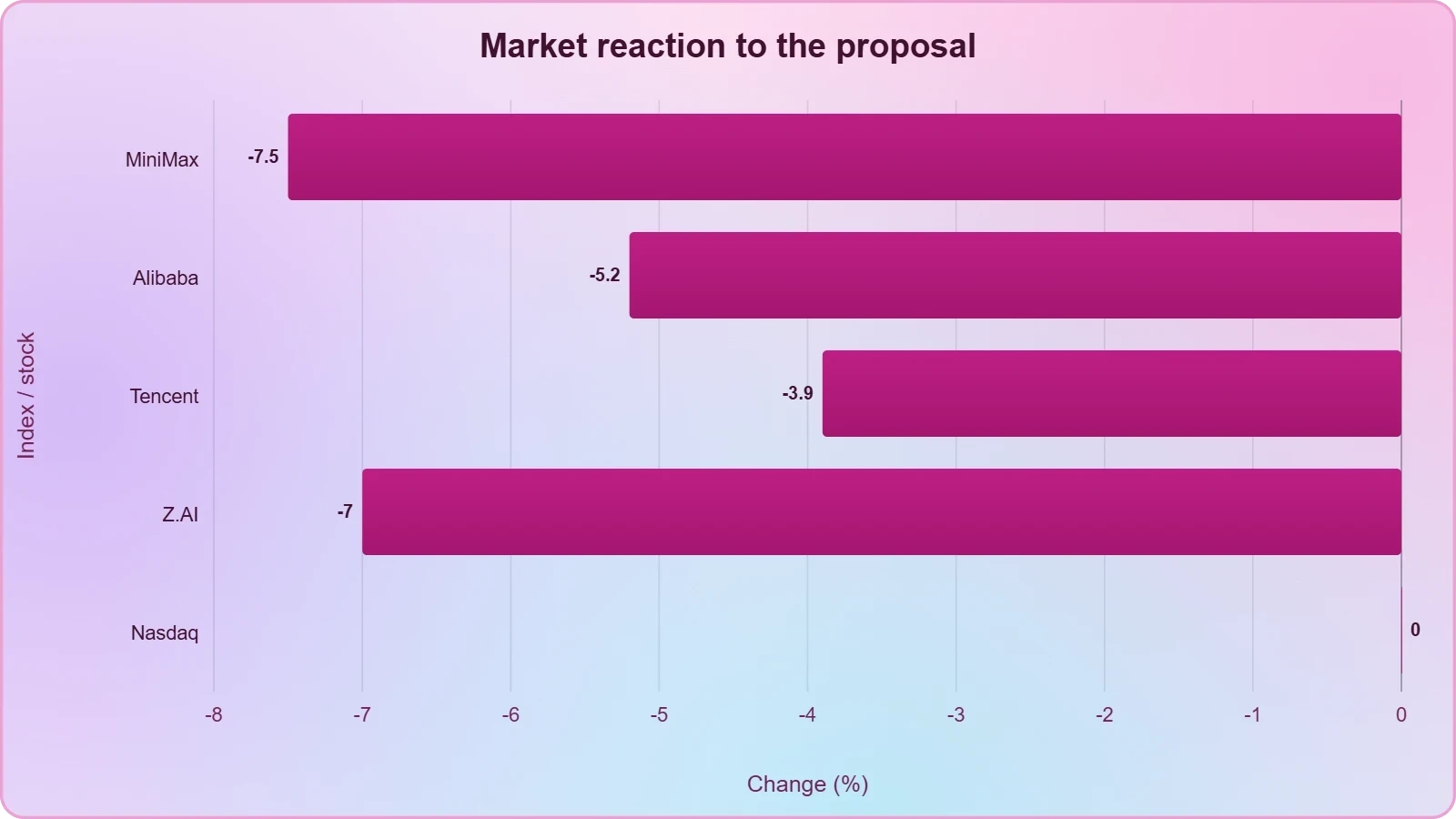
In the United States, technology stocks mostly stabilised after the prior session's sell-off, with the Nasdaq opening flat. Nvidia shares traded unevenly ahead of earnings scheduled after the close. The divergence is instructive: American investors focused on near-term results and governance, while Asian markets priced the structural risk to Chinese AI capacity and the cloud providers that monetise it.
Reading the Sell-Off Correctly
The magnitude of the declines matters less than their distribution. Losses concentrated in Chinese platform and AI names imply that markets assign meaningful probability to enforcement tightening. The muted American reaction suggests investors believe Nvidia's demand base is diversified enough to absorb regional disruption, though that confidence depends heavily on how broadly any new rules are drafted.
Volatility around earnings is compounded by leadership uncertainty. Analysts will scrutinise data center revenue composition, guidance language and any disclosure on compliance costs. A cautious outlook could amplify the sell-off; a confident one might reassure markets that demand from sovereign and Western hyperscalers offsets any Southeast Asian contraction.
- 01
- 02
- 03
- 04
We Also Published
Strategic Consequences for the Region and the Industry
The proposed rules, if enacted, would force Southeast Asian governments into an uncomfortable choice between investment inflows and alignment with American security priorities. Jurisdictions that built entire industrial strategies around data center attraction may find their flagship projects subject to end-user scrutiny they cannot satisfy without alienating their anchor tenants. The resulting uncertainty could chill new commitments.
For the global AI industry, the episode exposes a deeper structural tension. Compute is increasingly delivered as a service, yet the legal architecture governing its most critical component remains anchored to physical trade. Until verification regimes mature, enforcement will rely on corporate diligence, intelligence assessments and diplomatic leverage, all of which are slower and less certain than a customs inspection.
Compliance as Competitive Advantage
Firms that can demonstrate robust end-use monitoring may find compliance itself becomes a commercial asset. Hyperscalers with transparent customer vetting could win sovereign contracts that opaque operators cannot. Conversely, providers that cannot document workload provenance risk exclusion from the most lucrative Western and government markets, a penalty that may prove more durable than any single enforcement action.
Nvidia's new board committee reflects this logic. Export control compliance is being institutionalised because regulators and investors now treat it as a proxy for corporate reliability. The company that supplies the world's most contested technology must demonstrate that its governance can withstand scrutiny of who ultimately benefits from its products.
What to Watch Next
Three variables will determine how this episode resolves. The first is the scope of the proposed rules: whether they target specific end users, particular chip classes, or the entire offshore hosting model. The second is host government posture, since enforcement without local cooperation is largely symbolic. The third is Nvidia's earnings guidance, which will reveal how much regional demand the company has already priced into its outlook.
Beyond the immediate news cycle, the deeper question concerns precedent. If Washington successfully extends export controls to remote compute access, it establishes a template for governing other dual-use digital services. That shift would reshape international trade law, corporate compliance practice and the competitive strategies of every firm whose products can be delivered across borders without physical shipment.
Signals Worth Monitoring
Investors and policymakers should track regulatory filings from Southeast Asian data center operators, any expansion of entity listings tied to Megaspeed, and the language Nvidia uses to describe compliance costs. Diplomatic readouts from Malaysia, Indonesia, Thailand and Singapore will indicate whether the region intends to negotiate carve-outs or resist the framework collectively.
The broader lesson is that technological capability now outpaces the legal categories designed to contain it. Export controls built for a world of shipping containers must adapt to a world of API calls, or they will be circumvented by architecture rather than intent. The Southeast Asian data center boom is simply the most visible symptom of that mismatch.
From our network :
- Forbidden Matrix Patterns and Visible Lattice Points: A Geometric DictionaryExplore how multidimensional 0–1 matrices encode geometric truths, linking forbidden patterns to visible lattice points and hypergraph theory, with applications in combinatorics and computational geometry.
- The Hidden Cost of AI Convenience: Why Over-Permissioned Agents Are a Security Time BombDiscover why AI agents with excessive permissions create dangerous single points of failure, and learn how implementing least privilege principles can protect your organization from exploitation.
- Live Online English Classes for Kids: Do They Actually Reduce Anxiety?A ten-week study reveals that synchronous online English classes can significantly reduce child language anxiety while improving listening and reading skills. Discover what makes these programs effective and how parents can select the right one.
- How AI Agents Will Change the Way We Manage Personal FinancesExplore how AI agents are transforming personal finance through automated budgeting, bill payment, and investment management, while examining the critical security protocols and governance frameworks required for safe deployment.
- CISA’s Ten-Advisory Wave: Why Generic Patching Fails in OT and How to Build Product-Specific PlaybooksCISA released ten ICS advisories in one week, exposing critical infrastructure risks. Generic patching fails in OT. Learn to build product-specific remediation playbooks.
- University Language Proficiency Exams: Why Institutional Tests Demand Different Preparation Than IELTS and TOEFLDiscover why university-specific language proficiency examinations differ fundamentally from IELTS and TOEFL, and learn strategic preparation approaches for institutional assessment success.
- The Final Descent: How ESA Retired the Legendary Cluster Constellation After 24 Years of Space Weather ScienceAfter 24 years mapping Earth’s magnetosphere, ESA’s Cluster mission concluded with a precisely controlled reentry over the South Pacific. This analysis explores the scientific legacy, engineering decisions, and debris mitigation principles behind one of space exploration’s most responsible retirements.
- Mobile Learning and VR in English: What Global Evidence Reveals About Effective Language TechnologyA systematic review across 14 countries reveals which language-learning technologies genuinely work. Mobile learning, AI, and VR show measurable benefits when pedagogically integrated. This evidence-based guide helps educators and learners select technology that delivers real return on investment.
- Committed Mediterranean Precipitation Decline: Why Emissions Cuts Alone Cannot Restore Winter RainsNew NOAA research reveals that Mediterranean winter rains may decline irreversibly even with emissions cuts. Explore the science of committed climate change and regional impacts.
RESOURCES
- US AI chip curbs threaten Southeast Asia data centre boom, shares ...reuters.com12 hours ago ... Shares of data centre and chip supply chain companies in Southeast Asia tumbled, as fresh US curbs on advanced chip…
- Trump's New A.I. Chip Rules Rattle Southeast Asianytimes.com5 hours ago ... The rules, which take effect in 90 days, will require overseas data center operators to obtain a license from the…
- US to curb China's access to AI chips as Trump heads to Asiareuters.com1 day ago ... Rule gives overseas data centers that serve Chinese AI ... US AI chip curbs threaten Southeast Asia data centre boom,…
- The Geopolitical Debates Over Controlling Cloud Computecarnegieendowment.orgMay 5, 2026 ... ... Southeast Asian data centers to train their latest ... data centers that use U.S. chips by imposing license conditions…
- U.S. requires AI chip export licenses for Southeast Asia data centersqz.com4 hours ago ... The interim Commerce Department rule also adds requirements for overseas data centers that supply computing power to China-based firms.
- U.S. closes loophole that let Chinese companies use top AI chipsnbcnews.com4 hours ago ... ... chips to data center customers in Southeast Asian countries. Trump ... As part of a new rule, data center…
- US Hits Asia Data Centers With AI Chip Curbs As Trump Visitsbloomberg.com8 hours ago ... President Donald Trump is targeting Southeast Asia in Washington's rush to tighten China's access to the world's most advanced chips, ...
- After Nvidia scandal, Commerce Department moves to curb remote ...cbsnews.com1 day ago ... ... chips by renting computing resources through data centers in Southeast Asia. ... data centers in countries not subject to…
- Beyond the spy scandal: What the Nvidia-Megaspeed case reveals ...atlanticcouncil.org5 days ago ... ... data centers across Southeast Asia. And while much attention has ... Why exporting advanced chips to China endangers US…
- How new US chip restrictions on South East Asia will hit China - BBCbbc.com6 hours ago ... But the new rules are unlikely to derail the data centre boom as a ... AI chips from tech giant…
- China AI firms tap Nvidia power overseas as U.S. weighs crackdowncnbc.comAug 19, 2026 ... Chinese AI firms are reportedly accessing advanced Nvidia computing power through data ... chips' compute power via data centers in…
- Beyond the Matrix: AI Governance Gaps in Southeast Asia - CSIScsis.orgAug 26, 2025 ... ... requirements on data quality ... AI training data into Malaysian data centers. Using U.S. export restricted chips housed in…
- Trump administration moves to block China from indirect access to ...pbs.org22 hours ago ... ... chips housed in Southeast Asian data centers, including facilities in Malaysia. "The rule is designed to ensure that existing…
- How Jensen Huang Built the Backdoor Route That Keeps Beijing in ...wsj.com2 days ago ... Massive data centers in Southeast Asia exploited a gap in U.S. export controls, providing crucial computing power for Chinese companies…
- US tightens AI chip export curbs to close China's overseas data ...scmp.com1 day ago ... New rules target Chinese firms' remote access to advanced US chips hosted abroad, including at data centres in Southeast Asia.
- 01
- 02
- 03
- 04
- 05
- 06
- 07
- 08
0 Comments