ITV's decision to trim £30 million from its cost base during 2026 arrives at a moment when the arithmetic of free-to-air broadcasting has turned unforgiving. The London-listed broadcaster, home to Coronation Street and I'm a Celebrity… Get Me Out of Here!, told investors that advertising revenue across its television and streaming division would contract by 5% to 10% in the final quarter — the very window that traditionally carries the Christmas advertising bonanza. For the full year, the decline is projected at 2% to 3%, a modest-sounding figure that nonetheless signals a structural shift rather than a seasonal wobble.
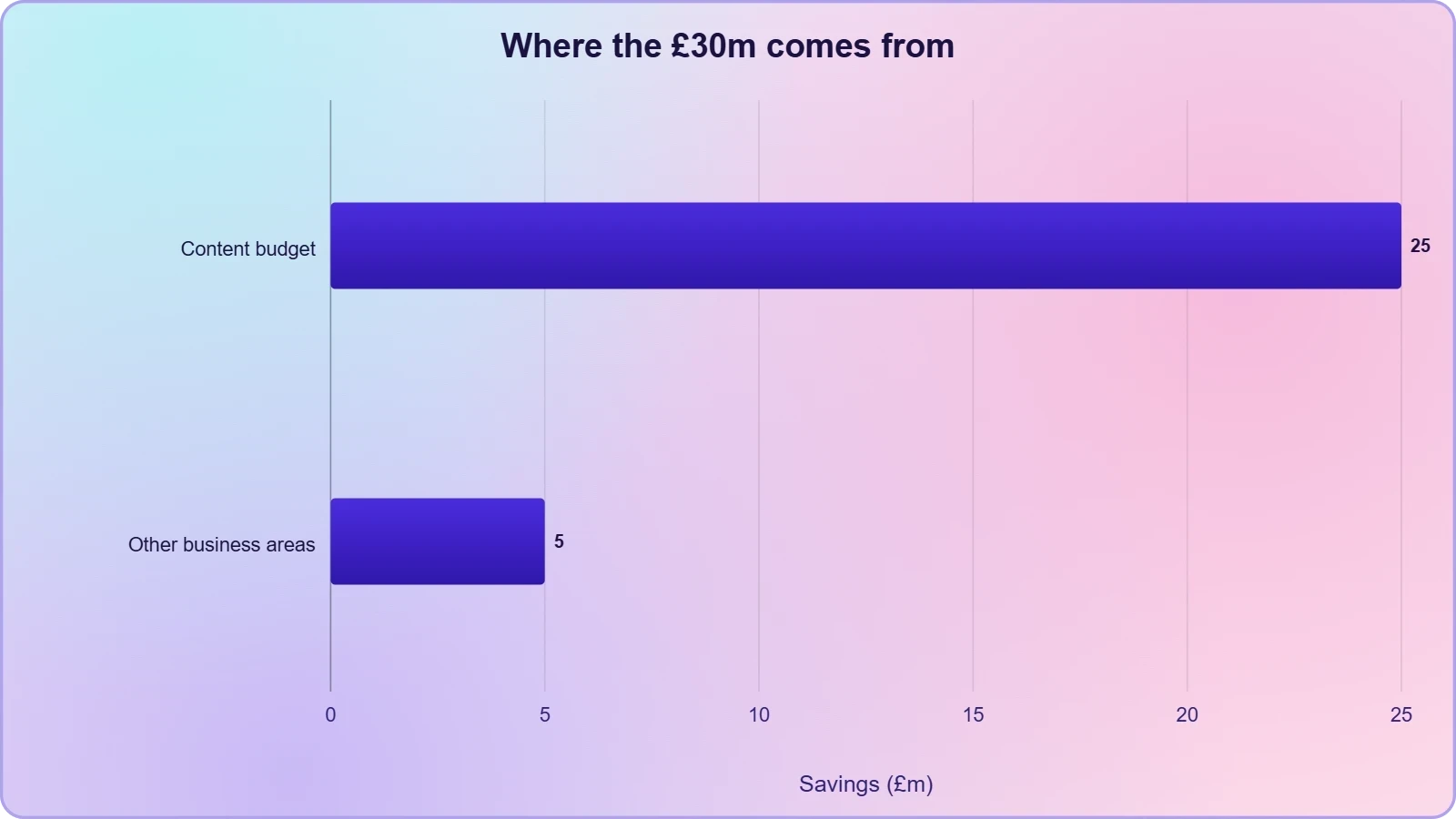
The mechanics of the savings plan matter as much as the headline number. Roughly £25 million will be extracted from the content budget, with the burden falling disproportionately on smaller external commissions, many of which will simply be deferred into 2027 rather than cancelled outright. The remaining £5 million comes from elsewhere in the business. Crucially, ITV insists the programme will not involve staff cuts — a claim that will be tested against the reality of a broadcaster already operating in a leaner configuration than a decade ago.
Behind the cost-cutting sits a larger corporate drama: ITV's agreement to sell its television and streaming arm to Sky for £1.6 billion, a transaction chief executive Carolyn McCall has framed as the company's route to survival. That deal now faces regulatory scrutiny after the culture secretary issued a public interest intervention notice, triggering parallel investigations by Ofcom and the Competition and Markets Authority. The concerns are substantial — a combined entity controlling roughly 86% of linear news and current affairs viewing in Britain, and questions about US political influence given Sky's ownership by Comcast.
On This Page
TL;DR ITV is cutting £30 million in costs during 2026 as advertising sales weaken, with £25 million coming from the content budget and smaller external commissions pushed into 2027. The broadcaster expects fourth-quarter ad revenue to fall 5%–10% and full-year sales to decline 2%–3%, blaming economic uncertainty, competition from global streaming platforms, and new pre-9pm restrictions on advertising less healthy food. No staff cuts are planned. Meanwhile, ITV's £1.6 billion sale of its television and streaming business to Sky faces a public interest intervention notice, with Ofcom and the CMA examining media plurality and US political influence concerns. ITV shares have lost roughly a fifth of their value this year.
The Anatomy of a £30 Million Retreat
Cost reduction programmes at legacy broadcasters rarely announce themselves with drama; they arrive as line items, deferrals, and quiet rescheduling. ITV's £30 million target for 2026 follows precisely that pattern. The company has been explicit that the savings are temporary in character, a phrasing that carries its own subtext: this is not a restructuring of the operating model but a bridging measure designed to protect margins while the Sky transaction works its way through regulatory channels. The distinction between permanent and temporary savings will matter enormously to analysts modelling ITV's standalone viability should the sale collapse.
The allocation of the cuts reveals where ITV believes it can absorb pain with least damage to its core franchise. Content budgets are the largest discretionary lever available to any broadcaster, and £25 million extracted from commissioning is a meaningful sum relative to ITV's overall programming spend. By concentrating the reduction on smaller external commissions rather than flagship productions, management is protecting the schedule's marquee titles while accepting a thinner pipeline of mid-budget factual, entertainment, and drama projects that often serve as the industry's training ground for independent production talent.
Why the Content Budget Bore the Brunt
Commissioning budgets function as a broadcaster's circulatory system: they feed the independent production sector, sustain regional production hubs, and generate the intellectual property that later travels internationally. Cutting £25 million from this artery is therefore never a neutral act. Smaller independent producers, who lack the balance sheet to absorb deferred commissions, will feel the squeeze most acutely. The decision to push projects into 2027 rather than cancel them offers a stay of execution, but it also creates a bottleneck: a deferred slate landing in a single year compresses commissioning windows and intensifies competition for slots.
There is a strategic logic buried in the timing. ITV's studios division, which will remain with the company after the Sky sale, produces content for ITV itself and for rival broadcasters and streamers. Protecting that division's output while trimming third-party commissions preserves the asset that underpins ITV's post-sale future. The studios arm delivered five of the UK's ten most-watched dramas in the third quarter of 2026, including The Gentlemen for Netflix and The Blame for ITV — evidence that the production engine remains commercially potent even as the advertising engine sputters.
The £5 Million Question
The residual £5 million in savings, drawn from "other parts of the business," is deliberately vague in the company's public framing. Such opacity is standard corporate practice, but it invites scrutiny. Back-office consolidation, technology contracts, property costs, and marketing spend are the usual suspects. What matters for investors is the credibility of the no-staff-cuts pledge. ITV has already undergone significant headcount reduction in recent years, and further cuts would carry reputational and industrial relations risk at precisely the moment the company needs a stable narrative around its Sky transaction.
Analysts will also watch whether the £30 million figure holds. Cost programmes announced alongside revenue warnings have a habit of expanding as conditions deteriorate. If the fourth-quarter advertising decline lands at the pessimistic end of the 5%–10% range, and if the pre-9pm advertising restrictions bite harder than modelled, management may find itself revisiting the target before the year is out. The temporary framing provides rhetorical cover for exactly that eventuality.
We Also Published
The Advertising Winter Beneath the Christmas Lights
Advertising markets are sentiment made visible, and the sentiment surrounding British television advertising in late 2026 is distinctly cautious. ITV's projection of a 5% to 10% fourth-quarter decline lands with particular force because the final three months of the calendar year are when retailers, supermarkets, and streaming services traditionally spend most heavily to capture festive demand. A contraction in that window cannot be dismissed as a timing quirk; it suggests advertisers are reallocating budgets rather than merely deferring them, shifting spend toward platforms where targeting is granular and measurement is immediate.
Carolyn McCall's diagnosis identifies two distinct pressures. The first is macroeconomic: continuing uncertainty in the wider UK economy has made advertisers reluctant to commit to large upfront campaigns, favouring shorter lead times and performance-linked spending. The second is structural: global streaming platforms have built sophisticated digital advertising businesses that compete directly for the same brand budgets ITV once regarded as its own. The distinction matters because the first pressure is cyclical and may ease, while the second is permanent and will not.
The Pre-9pm Restriction and Its Unintended Arithmetic
New rules introduced during 2026 restricting television advertising for less healthy food before 9pm have added a further constraint that ITV explicitly cites. The policy's public health rationale is straightforward, but its commercial arithmetic is less so. Food and drink advertising has long been a reliable revenue pillar for commercial broadcasters, and restricting it during the pre-watershed hours removes inventory precisely when family viewing peaks. For a broadcaster already contending with structural decline, the regulation functions as an accelerant, compressing the revenue base faster than diversification can compensate.
There is an irony worth noting: the restrictions push advertisers toward streaming platforms, many of which operate outside the same regulatory perimeter or apply different rules. The policy may therefore achieve a partial public health objective while simultaneously weakening the domestic broadcasting ecology that produces British news, drama, and children's programming. ITV's decision to cite the rules in its trading statement is a signal to policymakers as much as to investors — a reminder that regulatory costs land on balance sheets.
Reading the Share Price Reaction
ITV shares fell by as much as 5% in early trading on the Wednesday of the announcement, extending a decline that has erased roughly a fifth of the company's market value since the start of the year. As a constituent of London's FTSE 250, ITV sits among mid-cap companies where sentiment can shift sharply on single announcements. The market's reaction reflects not merely the £30 million savings figure but the revenue trajectory behind it: a company cutting costs while sales fall is, by definition, managing decline rather than pursuing growth.
Yet the share price also embeds the Sky transaction. Investors are effectively pricing two scenarios simultaneously — completion of the £1.6 billion sale, which would crystallise value and leave a leaner studios-focused business, and regulatory blockage, which would return ITV to standalone status with a shrinking advertising base and a cost programme described as temporary. The spread between those outcomes explains much of the volatility, and it will persist until Ofcom and the CMA conclude their work.
The Sky Transaction and the Politics of Media Plurality
The £1.6 billion sale of ITV's television and streaming business to Sky represents the most consequential corporate move in British broadcasting since the consolidation wave of the 2000s. Carolyn McCall's description of the deal as ITV's route to survival is unusually blunt for a chief executive, and it signals that management views standalone free-to-air broadcasting as a structurally challenged business model. The transaction would leave ITV with its studios division — a production house making shows for ITV, rival broadcasters, and global streamers — while transferring the channels, streaming platform, and advertising sales operation to Sky.
Regulatory scrutiny was always inevitable, but the form it has taken is significant. The culture secretary's public interest intervention notice triggers parallel investigations by Ofcom and the Competition and Markets Authority, examining both competition effects and media plurality. The specific concerns identified are weighty: a combined broadcaster accounting for approximately 86% of linear news and current affairs viewing in Britain, and the potential for US political influence on editorial independence given Sky's ownership by Comcast, the American media giant.
Why 86% of News Viewing Concentrates Regulatory Minds
Media plurality is a concept that resists neat quantification, but the 86% figure provides regulators with a vivid anchor. Linear news and current affairs viewing — the scheduled bulletins, the rolling coverage, the political interviews — remains the primary source of information for a substantial portion of the British public, particularly older audiences who consume news through television rather than digital platforms. Concentrating that viewing in a single corporate entity raises questions not merely about competition but about the diversity of editorial voice available to citizens.
The Comcast dimension adds a geopolitical layer. Sky has been American-owned since 2018, and the prospect of the UK's largest commercial news provider sitting within a US media conglomerate's portfolio invites scrutiny of editorial independence safeguards. Regulators will examine commitments around newsroom autonomy, board composition, and the ring-fencing of editorial decision-making. Similar debates surrounded News Corp's attempted acquisition of Sky, which foundered on plurality concerns — a precedent that will inform both the CMA's analysis and the political atmosphere surrounding the current review.
The Studios Pivot and Its Dependencies
If the sale completes, ITV becomes a production-led business competing in the global content market. The early evidence is mixed but not discouraging: studios revenue fell 1% in the first nine months of 2026, a modest decline in a year when many production houses have struggled with commissioning slowdowns across the industry. The division's creative track record — five of the UK's ten most-watched dramas in the third quarter, including The Gentlemen for Netflix — demonstrates that ITV's production capability travels well beyond its own channels.
Yet a studios-only ITV would be a smaller, more volatile company, exposed to the commissioning decisions of streaming platforms and the cyclicality of global content spending. The £1.6 billion proceeds would provide balance sheet strength and potentially fund acquisitions or shareholder returns, but they would not replace the scale of a broadcaster. The strategic bet is that content production, unshackled from the declining advertising business, offers better long-term growth. That bet will be tested by whether the studios division can win commissions independently of the relationships ITV's channels once provided.
- 01
- 02
- 03
- 04
An Industry-Wide Reckoning, Not an ITV Story
ITV's difficulties are frequently reported as a single company's problem, but the evidence points to something broader: a structural reckoning across British public service broadcasting. The BBC intends to cut as many as 2,000 jobs, a reduction of extraordinary scale for an organisation already operating under licence fee constraints and political pressure. Channel 4 is planning layoffs of its own. The common thread is not mismanagement but a shared revenue model — advertising and public funding — that is being eroded by the migration of audiences and advertiser budgets to global platforms.
The economics are remorseless. Linear television viewing declines year on year, particularly among younger demographics, while streaming consumption rises. Advertising follows attention, and attention has fragmented across subscription services, social platforms, and short-form video. Public service broadcasters retain significant reach, especially for news and live events, but reach alone no longer sustains the budgets required to produce distinctive British content. The result is a sector-wide contraction in commissioning, employment, and ambition that no single cost programme can reverse.
The BBC's 2,000 and Channel 4's Layoffs
The BBC's planned reduction of up to 2,000 jobs represents one of the largest single workforce contractions in the corporation's history. Its causes are distinct from ITV's — the licence fee settlement, inflationary pressure on production costs, and the political imperative to demonstrate efficiency — but the effect is convergent: less money for content, fewer opportunities for independent producers, and a thinner ecosystem of creative employment. When the BBC sneezes, the UK production sector catches cold, because the corporation remains the single largest commissioner of British content.
Channel 4's position is complicated by its publicly owned but commercially funded structure. Its remit requires distinctive, risk-taking programming, yet its advertising-dependent revenue base is exposed to precisely the same pressures afflicting ITV. Layoffs at Channel 4 reduce its capacity to commission from independent producers, many of them small companies in the nations and regions. The cumulative effect across ITV, the BBC, and Channel 4 is a contraction in the domestic commissioning market that independent producers describe as the most difficult conditions in a generation.
What Consolidation Means for Viewers
For audiences, the immediate consequences are subtle but real. Fewer commissions mean less risk-taking: broadcasters facing revenue pressure gravitate toward proven formats, established talent, and returning series. The mid-budget drama, the experimental comedy, the regional documentary — these are the categories most vulnerable when content budgets contract. Over time, the diversity of British programming narrows, and the training ground for new writers, directors, and producers shrinks accordingly.
There is also a news dimension. If the Sky transaction completes, the consolidation of news production and distribution raises questions about the range of editorial perspectives available on television. Regulators have identified this explicitly, and their conclusions will shape not only ITV's future but the plurality of British media for a generation. The cost-cutting at ITV is, in this sense, a symptom of a much larger question: how a democracy funds and sustains diverse, independent broadcasting when the market no longer does so automatically.
Reading the Signals for Investors and Policymakers
For investors, ITV presents a puzzle composed of three interlocking variables: the trajectory of advertising revenue, the credibility of the cost programme, and the probability of the Sky transaction completing. Each variable influences the others. A sharper advertising decline strengthens the case for the sale but may also invite regulatory scepticism about the merged entity's market power. A blocked sale returns ITV to standalone status with a cost base it has already described as temporarily reduced, raising questions about what permanent restructuring would follow.
The valuation arithmetic is instructive. ITV has lost roughly a fifth of its market value since January 2026, yet the £1.6 billion Sky consideration is substantial relative to that diminished market capitalisation. Shareholders are effectively being asked to accept near-term earnings deterioration in exchange for a transformational exit from the advertising business. The risk is timing: the deal is not expected to complete until the second half of 2027, leaving more than a year of trading exposure during which advertising conditions could deteriorate further.
The Regulatory Calendar as a Catalyst
The Ofcom and CMA investigations will dominate ITV's corporate calendar through 2027. Both bodies will examine the plurality implications of concentrating 86% of linear news viewing in a single entity, and both will consider whether Comcast's ownership of Sky creates risks to editorial independence. The precedent of previous Sky transactions, where plurality concerns proved decisive, suggests the review will be rigorous. Any conditions imposed — newsroom governance commitments, content investment obligations, or structural remedies — will shape the economics of the deal for both parties.
Policymakers face a parallel set of questions. The pre-9pm advertising restrictions were designed with public health objectives in mind, but their interaction with a fragile broadcasting ecology deserves scrutiny. If regulation accelerates the migration of advertising to platforms outside the domestic regulatory perimeter, it may undermine the very public service content it seeks to protect. The broader challenge is designing a funding framework that sustains British broadcasting in an era when the market alone will not.
What to Watch Through 2027
Several indicators will reveal how the story develops. The first is ITV's fourth-quarter advertising performance against the 5%–10% guidance; a result at the better end would suggest the cyclical component is easing, while a worse outcome would pressure the cost programme. The second is the studios division's commissioning wins, particularly from global streamers, which will indicate whether the post-sale business can grow independently. The third is the regulatory timetable: any delay to the Ofcom and CMA reviews pushes completion beyond the second half of 2027 and extends ITV's exposure.
Beyond the company, the health of the independent production sector will serve as a barometer. Deferred commissions landing in 2027, combined with BBC and Channel 4 cutbacks, could create a commissioning crunch that outlasts any single broadcaster's cost programme. The UK's creative industries have demonstrated resilience before, but the current convergence of pressures — structural advertising decline, regulatory costs, public funding constraints, and global platform competition — is without recent precedent. How ITV, the BBC, Channel 4, and policymakers respond will determine the shape of British broadcasting for a decade.
The Wider Meaning: When Advertising Stops Paying for Television
The ITV story compresses a decade of media transformation into a single trading statement. Advertising, the revenue model that funded British commercial television since the 1950s, is no longer sufficient to sustain the content budgets that audiences expect. The migration of advertiser spending to platforms with superior targeting and measurement is not a temporary shift; it is a permanent reallocation of the global advertising market. Broadcasters can respond by cutting costs, consolidating, or diversifying into production — and ITV is attempting all three simultaneously.
The human consequences extend beyond balance sheets. Cost programmes that defer commissions translate into fewer productions, fewer freelance contracts, and fewer opportunities for the creative workforce that makes British television distinctive. The BBC's 2,000 job cuts and Channel 4's layoffs compound the effect. Behind every deferred commission is a production company uncertain about its pipeline, a writer whose script waits another year, and a regional crew whose skills may migrate to other industries before the next project arrives.
Survival, Plurality, and the Public Interest
Carolyn McCall's framing of the Sky sale as ITV's route to survival is a candid admission that the standalone advertising-funded broadcaster is no longer viable at scale. Yet survival for ITV may come at a cost to media plurality if the combined entity's dominance of linear news viewing narrows the range of editorial voices available to the public. Regulators must weigh these considerations carefully: a failing broadcaster serves nobody, but a consolidated one may serve democracy less well than a competitive market would.
The public interest intervention notice ensures these questions will be examined in the open. Ofcom's plurality analysis and the CMA's competition assessment will produce evidence about what concentration means for viewers, advertisers, and the political process. Whatever the outcome, the review will establish precedents for how Britain regulates media ownership in an era when the distinction between broadcasters, streamers, and platforms has blurred beyond recognition.
A Sector Seeking a New Settlement
What British broadcasting requires is not another cost programme but a new settlement between public funding, commercial revenue, and regulatory obligation. The licence fee faces political and demographic pressure. Advertising is structurally declining. Subscription growth in the UK market is approaching saturation. The creative industries, meanwhile, remain one of the country's most successful export sectors, with ITV's studios division demonstrating that British production talent competes globally.
The policy challenge is to preserve the public goods that broadcasting delivers — impartial news, distinctive British content, investment in regional production — while allowing commercial operators to adapt to market realities. ITV's £30 million savings and its Sky transaction are symptoms of a system under strain, not solutions to it. The deeper work of designing a sustainable funding model for British broadcasting remains unfinished, and the decisions taken over the next two years will shape what audiences watch, and what they know, for decades.
From our network :
- Forbidden Matrix Patterns and Visible Lattice Points: A Geometric DictionaryExplore how multidimensional 0–1 matrices encode geometric truths, linking forbidden patterns to visible lattice points and hypergraph theory, with applications in combinatorics and computational geometry.
- Live Online English Classes for Kids: Do They Actually Reduce Anxiety?A ten-week study reveals that synchronous online English classes can significantly reduce child language anxiety while improving listening and reading skills. Discover what makes these programs effective and how parents can select the right one.
- Committed Mediterranean Precipitation Decline: Why Emissions Cuts Alone Cannot Restore Winter RainsNew NOAA research reveals that Mediterranean winter rains may decline irreversibly even with emissions cuts. Explore the science of committed climate change and regional impacts.
- How AI Agents Will Change the Way We Manage Personal FinancesExplore how AI agents are transforming personal finance through automated budgeting, bill payment, and investment management, while examining the critical security protocols and governance frameworks required for safe deployment.
- The Hidden Cost of AI Convenience: Why Over-Permissioned Agents Are a Security Time BombDiscover why AI agents with excessive permissions create dangerous single points of failure, and learn how implementing least privilege principles can protect your organization from exploitation.
- The Final Descent: How ESA Retired the Legendary Cluster Constellation After 24 Years of Space Weather ScienceAfter 24 years mapping Earth’s magnetosphere, ESA’s Cluster mission concluded with a precisely controlled reentry over the South Pacific. This analysis explores the scientific legacy, engineering decisions, and debris mitigation principles behind one of space exploration’s most responsible retirements.
- CISA’s Ten-Advisory Wave: Why Generic Patching Fails in OT and How to Build Product-Specific PlaybooksCISA released ten ICS advisories in one week, exposing critical infrastructure risks. Generic patching fails in OT. Learn to build product-specific remediation playbooks.
- University Language Proficiency Exams: Why Institutional Tests Demand Different Preparation Than IELTS and TOEFLDiscover why university-specific language proficiency examinations differ fundamentally from IELTS and TOEFL, and learn strategic preparation approaches for institutional assessment success.
- Mobile Learning and VR in English: What Global Evidence Reveals About Effective Language TechnologyA systematic review across 14 countries reveals which language-learning technologies genuinely work. Mobile learning, AI, and VR show measurable benefits when pedagogically integrated. This evidence-based guide helps educators and learners select technology that delivers real return on investment.
RESOURCES
- Sky ITV merger: TV ad market share decline - LinkedInlinkedin.comDec 1, 2025 ... ... advertising revenue - down from 30% in 2010 to 11.4% this year. In 2003, Sky and ITV collectively had…
- ITV in Sky Talks, Reports 2025 Studios Profit Drop, Ad Revenue Fallhollywoodreporter.comMar 4, 2026 ... ITV reported a slight drop in full-year ITV Studios profit record for 2025, and advertising revenue also fell as the…
- ITV in talks to sell media division to Sky owner Comcast for £1.6bnlinkedin.comNov 7, 2025 ... ... Acquisition #Media #TV #Broadcasting #Advertising #Business ... ITV's M&E business remains highly exposed to declining advertising revenues ...
- ITV PLC Affirmed At 'BBB-/A-3' On Proposed Sale O - S&P Globalspglobal.comJul 6, 2026 ... ... advertising revenue. Although its disposal will reduce exposure to the structural decline in linear TV viewing and volatility of…
- Fall in ad revenue forces ITV to make cuts before £1.6bn takeoverbusinesscloud.co.uk8 hours ago ... Despite the fall in demand for advertising, its CEO said the £1.6 billion sale of the business to Sky was…
- How Can Sky Improve ITV as an advertising proposition?creative.salonJul 9, 2026 ... ... Sky's £1.6bn takeover of ITV. Last year, ITV reported a fall of 5 per cent in ad revenue from…
- Week in Review: Culture Secretary Intervenes in Sky/ITV Deal ...videoweek.com5 days ago ... ... sales business. Top Stories Culture Secretary Intervenes in Sky's ITV Acquisition The UK's culture secretary Lisa Nandy this week…
- Comcast's Sky advances talks to acquire ITV unit with performance ...reuters.comMay 13, 2026 ... Performance-based payout reflects UK broadcast market volatility and declining ad revenue ... ITV, Comcast and Sky declined to comment.
- ITV Reports $4.6 Billion Revenue for 2025 as Sky Sale Talks Continuevariety.comMar 4, 2026 ... ITV's Media & Entertainment division posted total revenue of £1.991 billion ($2.65 billion), down 5%, as a decline in total…
- ITV Cutting $40M From Media & Entertainment Budget Due To Weak ...uk.finance.yahoo.com7 hours ago ... Media & Entertainment revenue was also virtually flat at £1.4B, with digital revenue helping offset the advertising declines. Producer- ...
- ITV Q1 2026 results: Looking forward to the World Cupendersanalysis.comMay 14, 2026 ... Comcast/Sky is in preliminary discussions to acquire ITV's broadcast and streaming operations. ... ITV's advertising revenue held broadly flat YoY ...
- ITV reports 'solid' H1 in first results since Sky deal announcementuk.themedialeader.comAug 7, 2026 ... ... advertising was offset by a decline in profitability at ITV Studios. Total advertising revenue increased 3% to £850m, including…
- Sky and ITV broadcast: Creating a British streaming championendersanalysis.comNov 13, 2025 ... Television remains the most effective medium for brand advertisers—despite the decline in viewing—with broadcasters' digital innovation and SVOD ...
- Advertisers look for advantage in Sky's ITV deal - Digidaydigiday.comJul 9, 2026 ... But whether ITVX and Sky parent Comcast's own streaming services might end up merged, or how the combined companies might…
- 01
- 02
- 03
- 04
- 05
- 06
- 07
- 08
0 Comments