
The listing of Anthropic on Nasdaq was meant to be a coronation, a moment when the artificial intelligence economy finally received its most prestigious public validation. Instead, the debut became a cautionary tale compressed into barely twenty-four hours. Shares of the AI safety company surged on their first day of trading, drawing in momentum funds, retail traders, and institutional allocators eager to own a piece of the generative AI story. By Friday's opening bell, that enthusiasm had inverted violently, with the stock shedding more than ten percent and dragging a cohort of high-multiple technology names down with it. The reversal was not an isolated corporate event but a symptom of something larger moving through global markets.
What makes the episode instructive is the collision of two narratives that rarely appear together. On one side sits the extraordinary optimism surrounding artificial intelligence, a sector that has absorbed hundreds of billions in capital on the promise of transforming productivity, software, and labor itself. On the other sits the older, colder logic of equity markets, where valuations are tested against discount rates, earnings visibility, and the willingness of investors to hold risk through uncertainty. When a newly minted AI champion falls double digits the day after its record debut, the market is not rejecting the technology. It is repricing the speed and certainty with which that technology converts into durable profit.
The rout that enveloped Anthropic extended well beyond a single ticker. Global equities weakened in tandem, with European bourses opening lower, Asian markets closing in the red, and Wall Street's major indices under pressure as bond yields and rate expectations reshaped the calculus for growth stocks. For readers trying to make sense of the noise, this analysis separates signal from spectacle. It examines why a celebrated listing can reverse so sharply, how the mechanics of modern market structure amplify such moves, what the episode reveals about AI valuation discipline, and which structural lessons investors should carry forward into an era where artificial intelligence and public markets are becoming inseparable.
On This Page
TL;DR Anthropic's shares fell more than ten percent at Friday's Wall Street open, one day after a record-breaking Nasdaq debut, as part of a broad global equity selloff. The reversal illustrates how quickly sentiment can shift for high-multiple AI listings, how index inclusion and options activity magnify volatility, and why investors should distinguish between enthusiasm for a technology and the discipline of valuing the businesses that commercialize it. The episode is less a verdict on artificial intelligence than a reminder that public markets price timing, risk, and cash flow as ruthlessly as they price innovation.
The Anatomy of a One-Day Reversal
A record-breaking debut followed by a double-digit decline is one of the most psychologically jarring patterns in equity markets, because it compresses the entire emotional arc of speculation into a single news cycle. On the first day, scarcity works in the issuer's favor: the float is limited, demand is pent up, and underwriters deliberately price shares below where they expect the market to clear. That engineered underpricing produces the celebrated first-day pop, which media coverage then frames as validation of the company's genius. The second day removes the scaffolding. With the float expanding and the underwriters' stabilization bids no longer obliged to support the price, the stock must stand on ordinary supply and demand, and that is precisely when the more sober assessment begins.
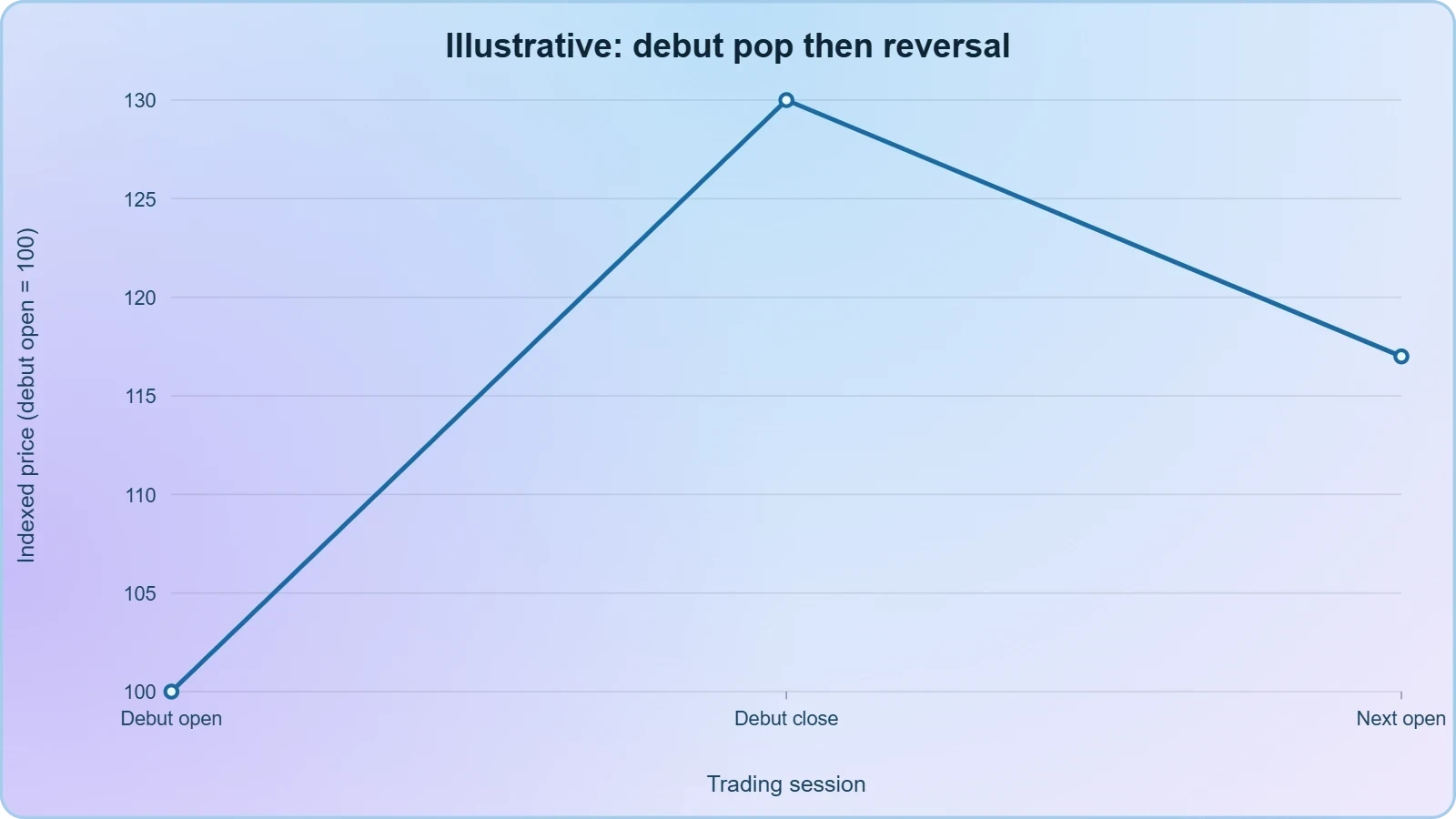
For Anthropic, the timing could hardly have been more exposed. A Friday open in a week already unsettled by rate expectations and cross-asset volatility gave sellers a convenient exit and gave buyers little reason to step in aggressively. When a newly listed name falls sharply, portfolio managers who received allocations face pressure to lock in gains or cut losses, and momentum-driven funds that bought the debut strength are forced to unwind. The result is a reflexive cascade in which the price decline itself becomes the reason for further selling, a dynamic that has little to do with the company's underlying research pipeline or enterprise contracts.
Why Debut Pops Are Structurally Fragile
Underwriters routinely price initial public offerings below the level they believe the market will bear, a practice that reduces the risk of a failed deal and rewards early allocators. The visible consequence is the first-day jump that headlines celebrate, but the hidden consequence is a built-in gravitational pull once trading normalizes. Investors who received shares at the offer price have an immediate profit, and many are institutionally mandated to realize it. That selling arrives precisely when the broader public is being invited to buy, creating an asymmetry between informed early holders and later entrants who absorb the supply. Anthropic's reversal fits this template almost too neatly.
The fragility is compounded when the issuer is a private company of unusual strategic importance. Anthropic sits at the center of a geopolitical and commercial contest over frontier models, backed by major cloud partners and watched closely by regulators on both sides of the Atlantic. That prominence attracts a wider and less patient shareholder base than a typical enterprise software listing, including thematic funds and retail participants who trade on narrative rather than discounted cash flow. When the narrative wobbles, the shareholder register itself becomes a source of volatility, because it contains many holders with short time horizons and few reasons to defend the price.
The Role of Market Microstructure
Modern equity markets amplify moves that would once have unfolded over weeks. A large share of daily volume is executed by algorithmic market makers whose quoting behavior tightens when volatility rises, thinning liquidity exactly when it is most needed. Options activity adds another layer: dealers who sold downside protection hedge their exposure by selling the underlying, mechanically reinforcing a decline. For a newly listed stock with limited history and no established options chain, these effects can be especially pronounced, because there is no deep base of long-term holders to absorb the shock.
Index inclusion rules matter as well. Newly public companies often enter broad indices quickly, which forces passive funds to buy regardless of valuation, but that mechanical demand can reverse when the stock underperforms and rebalancing rules trigger sales. The interplay of passive flows, dealer hedging, and momentum strategies means that a single disappointing session can generate price action far exceeding what any fundamental news would justify. Understanding this machinery is essential for anyone tempted to interpret a ten percent move as a considered verdict on a company's prospects.
The Global Rout Beyond a Single Ticker
Anthropic's decline did not occur in a vacuum, and treating it as a standalone story would miss the more important signal. Global equities were already under pressure as investors recalibrated expectations for interest rates, with bond yields shaping the discount rates applied to long-duration assets. Technology and growth names, whose valuations depend heavily on profits projected years into the future, are the most sensitive to such shifts. When the cost of capital rises or its future path becomes less certain, the present value of distant cash flows falls, and the market reprices accordingly. A newly listed AI company is simply the most visible expression of that arithmetic.
The rout spanned regions and sectors, from European bourses to Asian exchanges, reflecting a shared exposure to the same macro variables rather than a series of independent local shocks. Correlations tend to rise during stress, and this episode followed that pattern: assets that normally trade on idiosyncratic fundamentals began moving together as portfolio managers reduced risk across the board. For Anthropic, the practical consequence was that its first real test as a public company coincided with a moment when the market had little appetite for anything expensive, speculative, or newly listed.
Interest Rates as the Hidden Hand
The single most powerful variable in this story is not artificial intelligence at all but the price of money. When expectations for central bank policy shift, the entire term structure of discount rates moves, and assets whose value is concentrated in distant future earnings feel the change most acutely. A company promising transformative profits in 2032 is worth less today if the rate used to discount those profits has risen. This is not a judgment about whether the technology works; it is arithmetic, and it applies with equal force to every growth company regardless of how compelling its narrative may be.
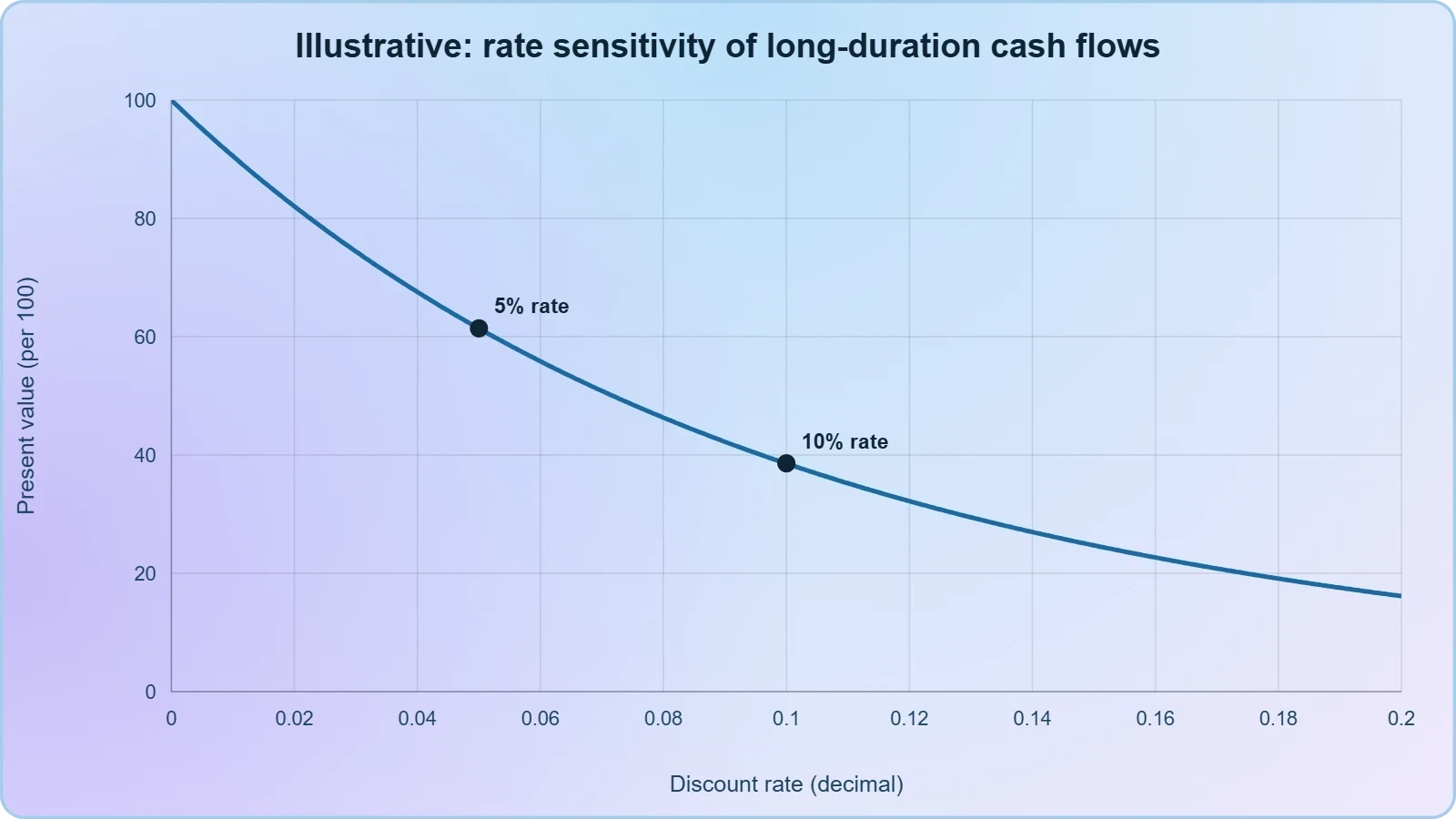
For AI companies specifically, the sensitivity is heightened because so much of their valuation rests on terminal assumptions about market size and margin structure. Analysts build models in which revenue compounds at extraordinary rates for a decade, and small changes in the discount rate or the terminal growth assumption produce large swings in the implied share price. When the macro backdrop turns less forgiving, those assumptions are questioned simultaneously across the sector, producing the kind of synchronized decline that characterized Friday's session. Anthropic's fall was therefore both company-specific and sector-wide, a distinction that matters enormously for interpretation.
Sentiment, Narrative, and Reflexivity
Markets are not merely calculators of present value; they are social systems in which narratives coordinate expectations. The AI narrative has been unusually powerful because it combines technological novelty, enormous capital expenditure, and a plausible claim to reshape the economy. That power cuts both ways. When the narrative is ascendant, it justifies valuations that conventional metrics cannot, and skeptics are dismissed as people who do not understand the future. When it stumbles, the same narrative becomes a liability, because investors who bought on story alone have no valuation floor to anchor their conviction.
Reflexivity completes the loop. Falling prices reduce the paper wealth of founders and employees, constrain the ability of companies to raise capital or use stock as acquisition currency, and can even affect customer confidence in a young vendor's durability. None of these effects need be large to matter, because they interact. A ten percent decline is not catastrophic in isolation, but it changes the incentives of everyone holding the stock, and those changed incentives can produce further declines. This is why the second day of trading often matters more than the first for understanding a company's true market standing.
We Also Published
Valuing Artificial Intelligence in Public Markets
The deeper question raised by Anthropic's reversal is how public markets should value companies whose central asset is research capability rather than a mature product line. Traditional valuation frameworks rely on revenue, margins, and reinvestment needs, all of which are observable for established businesses but highly uncertain for frontier AI developers. These companies spend heavily on compute, talent, and safety research, often before meaningful revenue arrives, and their competitive position depends on staying at the technological frontier, which requires continuous expenditure with no guaranteed return. Public investors must therefore price a moving target with limited historical data.
That uncertainty does not make AI companies uninvestable, but it does demand a different discipline. Rather than extrapolating recent growth, investors should examine the durability of competitive advantage, the structure of customer contracts, the concentration of revenue among a few large partners, and the capital intensity required to maintain parity. Anthropic's ties to major cloud providers are both a strength and a dependency, and its enterprise focus offers recurring revenue but exposes it to the procurement cycles of large organizations. These are the questions that matter over years, and they are precisely the questions that a single trading session cannot answer.
From Private Hype to Public Scrutiny
Private markets tolerate ambiguity in ways public markets do not. Venture investors can hold a position for a decade, mark it infrequently, and support a company through periods of heavy losses on the strength of a long-term thesis. Once a company lists, that patience is replaced by quarterly reporting, analyst estimates, and daily price discovery. The transition is jarring even for mature businesses, and for a frontier AI developer it is transformative, because every research setback, every competitive announcement, and every shift in compute costs becomes immediately visible in the share price.
Anthropic's debut exposed this transition in unusually sharp relief. The company's private valuation had been set in a series of negotiated rounds with strategic investors who understood the technology and accepted long horizons. The public market, by contrast, contains participants with wildly different time frames and information sets, and it aggregates their views continuously. The ten percent decline was not a repudiation of the private thesis; it was the public market discovering that its own consensus was less firm than the debut suggested. That discovery process is uncomfortable but ultimately informative.
What a Fair Price Actually Requires
Arriving at a defensible valuation for an AI company requires explicit assumptions about the size of the addressable market, the share the company can capture, the margins available at scale, and the capital required to sustain its position. Each assumption carries wide error bars, and small changes compound into large differences in implied value. A useful discipline is to invert the question: instead of asking what the company is worth, ask what must be true for the current price to be justified. That reframing forces investors to confront the specific operational milestones that would validate or undermine the market's expectations.
For Anthropic, the milestones are reasonably clear. Sustained enterprise revenue growth, diversification beyond a handful of large customers, evidence that safety-focused development does not impair commercial competitiveness, and a credible path to positive free cash flow would all support a higher valuation over time. Conversely, slowing adoption, price competition from open-weight models, or escalating compute costs would compress it. None of these factors can be assessed from a single day's trading, which is why the rout should be read as a prompt for analysis rather than a conclusion.
- 01
- 02
- 03
- 04
Reading the Signal in the Noise
Investors watching a dramatic decline naturally search for a cause proportionate to the effect, but markets rarely provide one. Much of what happened to Anthropic on Friday can be explained by mechanics rather than fundamentals: the unwinding of debut momentum, the absence of stabilization support, the thin liquidity of a newly listed name, and a macro backdrop hostile to expensive growth assets. Recognizing these mechanical drivers is not an excuse for ignoring fundamentals; it is a precondition for evaluating them properly, because it prevents the mistake of treating price action as information when it is often merely the residue of positioning.
The more durable signal lies in the questions the episode raises. How much of the AI sector's valuation depends on assumptions that have never been tested in a downturn? What happens to capital expenditure plans if public markets become less generous? Which companies have revenue models that can survive a period of tighter financial conditions, and which are dependent on continuous fundraising? These questions will shape returns over the next several years far more than any single trading session, and they deserve the attention that headlines tend to consume.
Lessons for Retail and Institutional Investors
For individual investors, the episode offers a practical warning about buying into debut strength. The first day of trading is designed to generate excitement, and the participants selling into that excitement are often the best-informed holders in the market. Waiting for the initial volatility to settle, reading the first quarterly report, and assessing whether the business meets its own stated milestones is a slower approach, but it aligns the investor's time horizon with the information available. Patience is not a guarantee of returns, but it reduces the probability of paying a premium for someone else's exit.
For institutions, the lesson concerns position sizing and liquidity assumptions. A newly listed AI company may appear to offer diversification within a technology allocation, but its correlations with other growth names rise precisely when diversification is most valuable. Stress-testing a portfolio against a scenario in which AI valuations compress sharply is a useful exercise, and the results often reveal that exposure is more concentrated than the headline weights suggest. The rout was a live stress test, and the portfolios that weathered it best were those that had already asked uncomfortable questions about their assumptions.
The Road Ahead for AI Listings
The pipeline of AI companies considering public listings is unlikely to disappear because of one difficult session, but the terms of those listings may change. Issuers and underwriters will recalibrate pricing ranges, accept smaller first-day pops, and prepare investors for volatility rather than promising a smooth ascent. The era in which any company with an AI narrative could command a premium simply by listing is probably closing, replaced by a more discriminating environment in which revenue quality, margin structure, and capital efficiency matter again. That shift is healthy, even if it is uncomfortable for those who benefited from the earlier regime.
Anthropic itself remains a serious enterprise with substantial research capabilities, significant strategic partnerships, and a genuine position in the frontier model race. A ten percent decline does not alter those facts, nor does it resolve the questions about long-term profitability that any thoughtful investor must confront. What the episode does is remind us that public markets are a continuous referendum on expectations, and that the gap between a compelling story and a durable business is measured not in headlines but in the disciplined accumulation of evidence over time.
Frameworks for Navigating AI Market Volatility
Volatility in AI-linked equities is likely to remain elevated for the foreseeable future, because the sector combines rapid technological change with enormous capital requirements and intense competitive pressure. Investors need frameworks rather than forecasts, structures that help them interpret events without pretending to predict them. One useful approach is to separate the technology thesis from the investment thesis: the former concerns whether AI will transform the economy, which is increasingly settled, while the latter concerns which specific companies will capture the resulting value and at what price. Confusing the two is the most common error in periods of enthusiasm.
A second framework involves monitoring leading indicators of commercial traction rather than sentiment. Enterprise contract announcements, usage growth, pricing trends, and the disclosed economics of major partnerships provide more reliable signals than share price momentum. A third involves watching the capital cycle: when AI companies can raise equity cheaply, they invest aggressively and competition intensifies; when capital becomes scarce, discipline returns and weaker players consolidate. Understanding where the sector sits in that cycle helps investors anticipate shifts in margin structure and competitive dynamics before they appear in reported results.
Position Sizing and Risk Management
The mathematics of drawdowns is unforgiving, and it deserves more attention than it usually receives. A fifty percent decline requires a one hundred percent gain to recover, which means that avoiding large losses matters more than capturing every upside move. For volatile AI names, position sizing should reflect the wide range of plausible outcomes rather than a single point estimate. Investors who size positions as though the base case is certain are effectively betting on the narrowest part of the distribution, and the market has a habit of reminding them that the tails are fatter than models suggest.
Risk management also involves recognizing when a position has become a narrative commitment rather than an analytical one. If the reasons for holding a stock have shifted from specific operational expectations to a general belief in the technology, that is a signal to reassess. The discipline of writing down the conditions under which an investment thesis would be invalidated, and then monitoring those conditions honestly, is one of the few reliable protections against the psychological pull of a compelling story. Anthropic's reversal is a useful case study precisely because the story remained intact while the price did not.
Regulatory and Geopolitical Overhangs
Any assessment of AI equities must account for the policy environment, which is becoming more consequential with each passing quarter. Governments in the United States, Europe, and Asia are actively developing frameworks for model safety, data governance, and competition, and these frameworks will shape the addressable market for frontier developers. Regulatory clarity can be a tailwind, reducing uncertainty and enabling enterprise adoption, but it can also impose compliance costs and constrain certain business models. For a company like Anthropic, whose identity is bound up with safety research, regulation may prove more of an opportunity than a threat, but the outcome is far from settled.
Geopolitics adds a further layer. Export controls on advanced semiconductors, restrictions on cross-border data flows, and the strategic competition between major economies over AI capability all affect the cost and availability of the inputs that frontier developers depend on. These are not abstract concerns; they translate directly into capital expenditure, supply chain risk, and the pace at which new models can be trained. Investors who model AI companies without accounting for these constraints are implicitly assuming a stability in the policy environment that recent years have not delivered, and that assumption deserves explicit scrutiny.
Conclusion: What the Anthropic Reversal Teaches
The most important lesson from Anthropic's brief and turbulent public debut is that markets and technologies operate on different clocks. Technological change unfolds over years and decades, driven by research breakthroughs, engineering capacity, and adoption curves that are slow to start and difficult to predict. Markets, by contrast, price expectations continuously and can reverse in hours. The gap between these two clocks creates both opportunity and hazard: opportunity for investors patient enough to let fundamentals compound, and hazard for those who mistake a moment of enthusiasm for a permanent re-rating. The ten percent decline was a reminder of which clock was ticking.
A second lesson concerns the nature of validation. A record-breaking debut is often described as the market endorsing a company, but it is more accurately described as the market expressing a temporary imbalance between supply and demand. True validation arrives later, through sustained revenue growth, expanding margins, and the quiet accumulation of evidence that the business can stand on its own. Anthropic has the resources and the partnerships to pursue that path, but the path runs through quarters and years, not through a single Friday session. Investors who understand this distinction will be better positioned than those who react to every headline.
Finally, the episode underscores the value of frameworks over predictions. No one knows precisely how the AI economy will evolve, which companies will dominate, or what valuations will prove justified. What can be known is how to think about these questions: by separating technology from business model, by monitoring commercial traction rather than sentiment, by sizing positions for a range of outcomes, and by writing down the conditions under which a thesis would fail. These disciplines do not eliminate uncertainty, but they make it manageable. In a sector defined by rapid change, that is the most durable advantage an investor can cultivate.
From our network :
- Live Online English Classes for Kids: Do They Actually Reduce Anxiety?A ten-week study reveals that synchronous online English classes can significantly reduce child language anxiety while improving listening and reading skills. Discover what makes these programs effective and how parents can select the right one.
- CISA’s Ten-Advisory Wave: Why Generic Patching Fails in OT and How to Build Product-Specific PlaybooksCISA released ten ICS advisories in one week, exposing critical infrastructure risks. Generic patching fails in OT. Learn to build product-specific remediation playbooks.
- The Hidden Cost of AI Convenience: Why Over-Permissioned Agents Are a Security Time BombDiscover why AI agents with excessive permissions create dangerous single points of failure, and learn how implementing least privilege principles can protect your organization from exploitation.
- Mobile Learning and VR in English: What Global Evidence Reveals About Effective Language TechnologyA systematic review across 14 countries reveals which language-learning technologies genuinely work. Mobile learning, AI, and VR show measurable benefits when pedagogically integrated. This evidence-based guide helps educators and learners select technology that delivers real return on investment.
- Committed Mediterranean Precipitation Decline: Why Emissions Cuts Alone Cannot Restore Winter RainsNew NOAA research reveals that Mediterranean winter rains may decline irreversibly even with emissions cuts. Explore the science of committed climate change and regional impacts.
- How AI Agents Will Change the Way We Manage Personal FinancesExplore how AI agents are transforming personal finance through automated budgeting, bill payment, and investment management, while examining the critical security protocols and governance frameworks required for safe deployment.
- The Final Descent: How ESA Retired the Legendary Cluster Constellation After 24 Years of Space Weather ScienceAfter 24 years mapping Earth’s magnetosphere, ESA’s Cluster mission concluded with a precisely controlled reentry over the South Pacific. This analysis explores the scientific legacy, engineering decisions, and debris mitigation principles behind one of space exploration’s most responsible retirements.
- University Language Proficiency Exams: Why Institutional Tests Demand Different Preparation Than IELTS and TOEFLDiscover why university-specific language proficiency examinations differ fundamentally from IELTS and TOEFL, and learn strategic preparation approaches for institutional assessment success.
- Forbidden Matrix Patterns and Visible Lattice Points: A Geometric DictionaryExplore how multidimensional 0–1 matrices encode geometric truths, linking forbidden patterns to visible lattice points and hypergraph theory, with applications in combinatorics and computational geometry.
RESOURCES
- Selloff wipes out nearly $1 trillion from software and services stocks ...reuters.comFeb 4, 2026 ... Selloff has been overdone, analyst says; Software and service stocks shed $830 billion in market value in six trading days…
- Anthropic faces valuation pushback on $1.5T IPO following market ...finance.yahoo.comNov 5, 2026 ... That rout followed midterm elections that empowered a cohort of AI-skeptical lawmakers and introduced local moratoriums, a political shift ...
- Anthropic Crypto Bets Imply $1.7 Trillion Despite AI Rout - Bloombergbloomberg.com2 days ago ... Crypto futures tied to Anthropic's stock market debut have fallen alongside artificial intelligence stocks, but they still imply a valuation…
- Anthropic AI tool sparks US$285 bil rout in software, financial ...sg.finance.yahoo.comFeb 3, 2026 ... ... Stock Exchange Group plc. Asian software stocks also slid, with ... Harvey AI was valued at US$5 billion in…
- Major Investors Are Skeptical Anthropic IPO Can Achieve $1.5 ... - WSJwsj.comNov 5, 2026 ... Other investors say October financial results could lessen blow of market rout. ... Anthropic Shares Are a Rational Bet on…
- Anthropic among big fallers in global stock market rout | Money Newsnews.sky.com4 hours ago ... Big tech declines have renewed speculation about a potential bursting of artificial intelligence valuation and debt bubbles.
- A new AI automation tool from Anthropic sparked a $285 billion rout ...facebook.comFeb 4, 2026 ... ... stock market debut of the artificial intelligence company, Anthropic. ... shares at $78, which could lead to a $1.4…
- Anthropic IPO Valuation Talk Falls To $1.3 Trillion After The AI Stock ...forbes.comNov 7, 2026 ... It also tells us the market is still pricing AI on revenue, which keeps our bubble test reading early. Investors…
- Stock Market Today: Anthropic Stock Slides as Tech Rout Deepenswsj.com2 hours ago ... The Nasdaq is sliding as investors continue to pull money out of AI stocks, and Anthropic shares are down 10%,…
- Anthropic Crypto Bets Imply $1.7 Trillion Value Despite AI Routca.finance.yahoo.com2 days ago ... Crypto futures tied to Anthropic's stock market debut have fallen alongside artificial intelligence stocks, but they still imply a ...
- Anyone else think Anthropic's valuation is going to plummet? - Redditreddit.comJul 14, 2026 ... US AI giants are losing market share among corporate clients because more of them are running open source models (many…
- Anthropic's IPO Roadshow Explained - Leverage Sharesleverageshares.comNov 10, 2026 ... 4Forbes, Anthropic IPO Valuation Talk Falls To $1.3 Trillion After The AI Stock Rout, as of November 7, 2026. Article…
- AI stocks bounce back after trillions wiped from market values - BBCbbc.comNov 6, 2026 ... The tech-heavy Nasdaq stock index closed in positive territory following a market rout ... How did Anthropic's stock market debut…
- Anthropic, PBC (ANT) Stock Price, Chart & Newsstockanalysis.comTelltale signs of AI fears reaching fever pitch as the tech pain continues. 3 hours ago - Barrons. Anthropic shares fall in pre-market trade…
- AI software scramble: Anthropic triggers stock market slide - Axiosaxios.comFeb 3, 2026 ... Software stocks are getting dumped as investors price in a world where AI could replace software services. Why it matters:…
- 01
- 02
- 03
- 04
- 05
- 06
- 07
- 08
0 Comments