Election night in the United States is less a single moment than a rolling sequence of deadlines, each one governed by its own state law, time zone, and administrative temperament. When voters across the country cast ballots on Tuesday, November 3, 2026, the midterm elections will decide thousands of races, from U.S. Senate and gubernatorial contests to congressional districts and state legislative seats. Understanding when polls close and when results become available is essential for anyone following the returns, because the timing of a declaration often reveals as much about a state's counting machinery as it does about the outcome itself.
The 2026 midterms arrive at a moment of intense scrutiny over how votes are counted and reported. Several states have revised their procedures for processing mail ballots, and the sequence of reporting has become a subject of public debate. The practical consequence is that viewers should expect a staggered evening rather than a single verdict. Early closures in Indiana and Kentucky will produce fragments of results, while the busiest window around 8 p.m. Eastern will release a flood of data from nearly half the states. Knowing the schedule in advance prevents confusion when one race is called while another remains unresolved for hours.
This guide reconstructs the election-night timeline in Eastern Standard Time, drawing on the reporting compiled by The Hindu, and expands it with context on why certain states count quickly while others lag. It examines the competitive House and Senate races to watch, the mechanics behind early declarations, and the structural reasons why a clear national picture may not emerge until well after midnight. The aim is to give readers a disciplined framework for interpreting the evening's flow of information rather than reacting to every isolated number.
On This Page
- The Architecture of Election Night Timing
- The First Wave: Indiana, Kentucky, and the 7 p.m. Cluster
- The 7:30 p.m. Window: North Carolina, Ohio, and West Virginia
- The 8 p.m. Surge: Nearly Half the States Report
- Reading the Returns Without Misreading Them
- What the 2026 Timeline Means for the National Picture
TL;DR Polls for the 2026 U.S. midterm elections close in a staggered sequence beginning in parts of Indiana and Kentucky, with the busiest window arriving at 8 p.m. Eastern when nearly half the states finish voting. Key Senate races in Georgia, South Carolina, North Carolina and Ohio, alongside gubernatorial contests in Georgia and Ohio, will shape the night. States such as Florida and North Carolina typically count quickly, while Pennsylvania and New Hampshire often take longer to reach meaningful completion. Results are declared district by district and state by state, so a definitive national picture may not emerge until the early hours of the following morning.
The Architecture of Election Night Timing
Election-night scheduling is not arbitrary. It reflects a patchwork of state constitutions, legislative statutes, and local administrative capacity that has evolved over decades. Each state sets its own poll closing times, and those times are further complicated by time zones that split individual states. Indiana, for instance, spans both Eastern and Central time, which is why its statewide winners cannot be declared until the last polls close at 7 p.m. Eastern. Kentucky follows a similar pattern. These structural realities mean that the first numbers to appear are often partial and unrepresentative, drawn from the easternmost counties that close earliest.
The sequence of closures creates a rhythm that experienced observers learn to read. Early evening brings scattered results from a handful of states, the middle hours deliver the bulk of the data, and the late hours are reserved for the largest and most logistically complex states. Understanding this rhythm helps distinguish between a genuine delay and a normal counting process. A state that has not reported by 10 p.m. is not necessarily malfunctioning; it may simply be following a procedure designed to prioritize accuracy over speed, particularly when mail ballots require verification and signature matching.
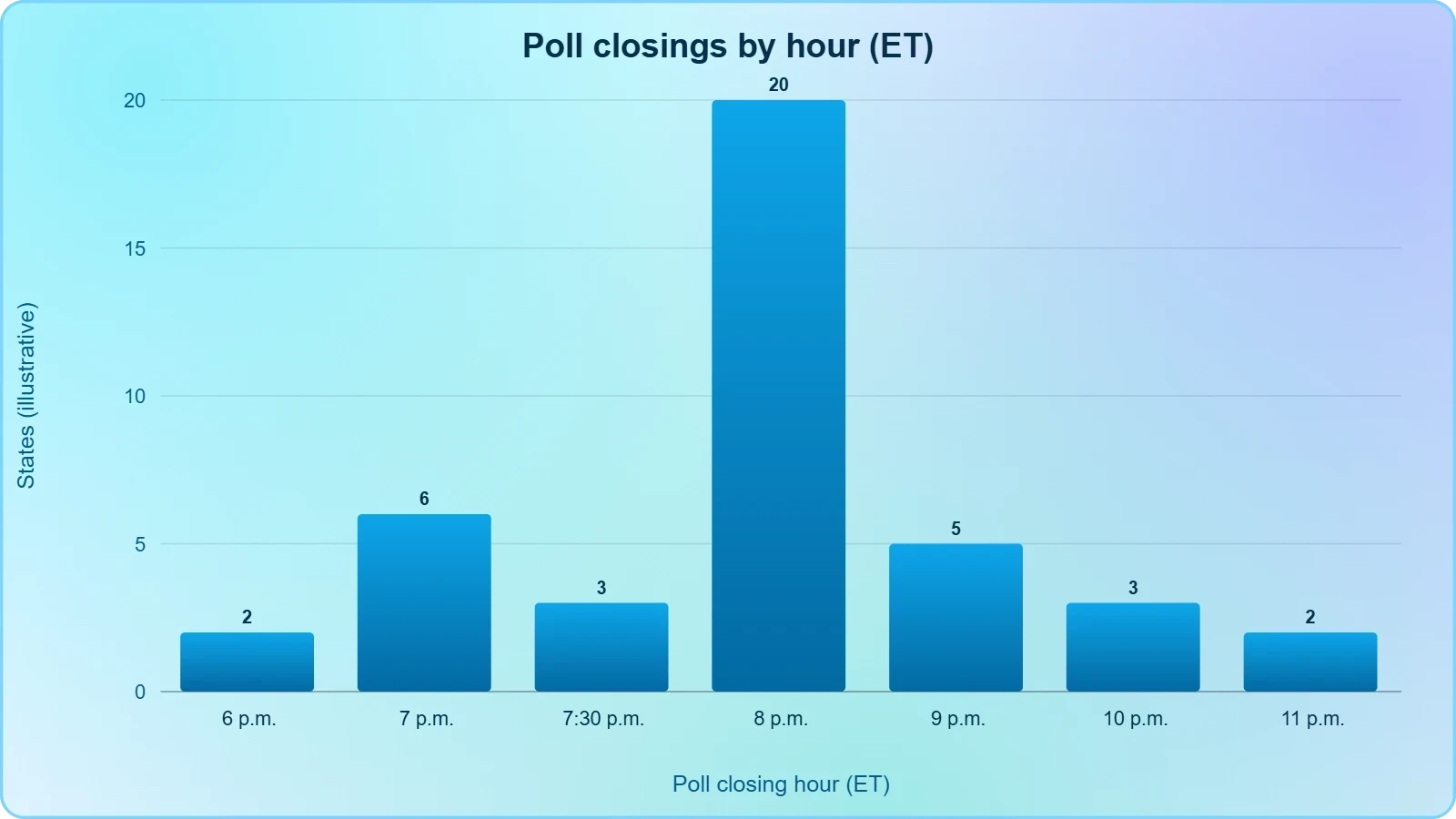
Why Poll Closing Times Vary Across States
Poll closing times are established by state law and generally reflect local preferences about when citizens can conveniently vote. Some states close polls at 7 p.m. to accommodate early risers and rural commuters, while others extend to 9 p.m. to allow urban workers time to reach polling places after their shifts. The variation is compounded by time zones: a state like Florida, which straddles Eastern and Central time, cannot declare statewide winners until the western panhandle closes an hour after the peninsula. These legal and geographic realities create the staggered map that defines every American election night.
The consequence for viewers is that declarations arrive in waves rather than as a single announcement. A Senate race in one state may be called while a House race in a neighboring state remains too close to project. This is not inconsistency but the natural product of independent state systems operating in parallel. The Associated Press and major networks calibrate their calls against these schedules, refusing to project a winner until the remaining uncounted votes cannot plausibly alter the outcome. That discipline is what gives a called race its authority.
The Difference Between Closing and Counting
A poll closing is a legal event; a count is an administrative process. When polls close, election officials begin the laborious work of reconciling machines, processing absentee and mail ballots, and verifying provisional votes. In some states, mail ballots cannot even be opened until Election Day, which guarantees a delay. In others, preprocessing allows officials to begin tabulating before polls close, producing near-instant results. This divergence explains why Florida can report 90 percent of its vote within an hour of closing while Pennsylvania may take until late evening to reach the halfway mark.
The gap between closing and counting has become a focal point of public anxiety, particularly after recent elections in which early leads shifted as mail ballots were tallied. That phenomenon, sometimes called a "blue shift" or "red shift" depending on the direction, is a function of which ballots are counted first, not evidence of irregularity. States that count in-person votes before mail ballots will show one pattern; states that process mail ballots first will show another. Recognizing this mechanical reality is essential for interpreting the evening without alarm.
The First Wave: Indiana, Kentucky, and the 7 p.m. Cluster
The earliest signals emerge from Indiana and Kentucky, where most polls close at 6 p.m. Eastern. Statewide winners in both states, however, cannot be declared until the last polls close at 7 p.m., because portions of each state fall in the Central Time Zone. Results may nonetheless be declared earlier in the easternmost congressional districts, where counting begins immediately. Competitive U.S. House races to watch include Indiana's 5th District and Kentucky's 6th District, both of which could offer early indications of broader national trends before the larger states report.
At 7 p.m., the tempo accelerates sharply. All polls close in six states, including Georgia, South Carolina, and Virginia. These states typically finish most of their counting on election night, which makes them valuable bellwethers. In 2024, their counts reached the halfway mark during the 8 p.m. hour and were roughly 90 percent complete between 10:21 p.m. and 12:07 a.m. That pattern suggests viewers should expect meaningful signals from these states within two to three hours of closure, with near-final figures arriving before midnight.
Georgia and South Carolina: Senate Bellwethers
Georgia and South Carolina anchor the early Senate map. Georgia's Senate contest has drawn national attention, and its counting process has been refined over successive cycles to deliver relatively prompt results. South Carolina's Senate race, while less competitive in recent years, still contributes to the national narrative. Both states close polls at 7 p.m. and generally report efficiently, making them useful for gauging the direction of the evening before the larger battlegrounds weigh in. Their House races, particularly in suburban districts, offer additional texture on shifting coalitions.
Virginia, also closing at 7 p.m., provides a third data point. Its congressional districts include several competitive seats that could shift control of the House. Virginia's counting is typically swift, and its results often serve as an early proxy for suburban sentiment nationwide. Together, these three states form a cluster that can deliver a preliminary read on the national mood well before the 8 p.m. wave arrives, though observers should resist drawing firm conclusions from partial returns.
Florida's Split Time Zone and the 8 p.m. Wait
Florida presents a distinctive case. Most Florida polls close at 7 p.m., including those in every competitive congressional district, but statewide winners cannot be declared until polls close in the Central Time Zone at 8 p.m. This one-hour lag reflects the panhandle's alignment with Central Time. Despite the delay in statewide declarations, Florida usually counts quickly, with results from much of the state beginning to arrive during the 7 p.m. hour. In 2024, 90 percent of Florida's vote had been counted by 8:07 p.m., a testament to the state's investment in efficient tabulation machinery.
The Florida model illustrates how administrative preparation shapes perception. Because the state processes mail ballots early and maintains robust equipment, it avoids the prolonged uncertainty that afflicts slower jurisdictions. For viewers, Florida offers a rare combination: early partial results and rapid completion. The competitive congressional districts, particularly in the central and southern parts of the state, will be watched closely for signs of which party is outperforming expectations, even as the statewide gubernatorial and Senate picture waits for the panhandle.
The 7:30 p.m. Window: North Carolina, Ohio, and West Virginia
At 7:30 p.m., polls close in North Carolina, Ohio, and West Virginia. All three counted votes relatively quickly in 2024, reaching the halfway point around 7:30 a.m. the following morning and about 90 percent by the 9:30 a.m. hour. That timeline is slower than the 7 p.m. cluster, reflecting the larger volume of ballots and, in some cases, procedural rules that delay the processing of mail votes. Viewers should therefore temper expectations: these states will not deliver swift verdicts, but they will provide steady, reliable data through the night and into the next day.
The key contests in this window are substantial. North Carolina hosts a closely watched U.S. Senate race, while Ohio features both a Senate contest and a gubernatorial race. West Virginia, though smaller, contributes to the Senate map. These races matter because they sit at the intersection of national and regional politics, and their outcomes could determine control of the Senate. The slower counting pace means that early leads in these states should be treated with caution until the mail ballots are fully incorporated.
Ohio's Dual Senate and Gubernatorial Contests
Ohio offers a rare combination: a competitive Senate race and a gubernatorial contest on the same ballot. That pairing increases turnout and complicates the count, since more ballots must be processed and more races must be tabulated. The state's counting machinery is generally robust, but the volume of data means that definitive calls may not arrive until the early morning hours. Observers should watch the urban-rural split in early returns, which often foreshadows the final margin, while remembering that late-arriving mail ballots can shift the balance.
The gubernatorial race adds a layer of intrigue because it operates on a different electoral rhythm than the Senate contest. Voters may split their tickets, producing outcomes that diverge from national trends. Ohio's status as a bellwether has diminished in recent cycles, but its results remain instructive for understanding the broader regional realignment. The state's 7:30 p.m. closure places it in the middle of the evening's sequence, bridging the early cluster and the 8 p.m. wave.
North Carolina's Senate Race and Counting Pace
North Carolina's Senate race is among the most consequential of the cycle, and its counting pace reflects the state's careful approach to mail ballots. State law allows officials to begin processing absentee ballots before Election Day, which accelerates the count, but the sheer volume of votes means that full results take time. In 2024, the state reached its halfway mark around 7:30 a.m. and 90 percent by the 9:30 a.m. hour. That schedule suggests viewers should expect a long night followed by a morning of consolidation.
The state's political geography, divided between growing urban centers and rural counties, makes early returns particularly volatile. A lead that appears comfortable at midnight may narrow as mail ballots from urban areas are counted. This pattern is not unique to North Carolina, but it is especially pronounced there. Understanding the sequence of counting, rather than reacting to the first numbers, is the key to interpreting the state's results accurately.
The 8 p.m. Surge: Nearly Half the States Report
The 8 p.m. hour is the busiest period of the evening, with polls fully or partially closing in nearly half the states, including Florida, Maine, New Hampshire, and Pennsylvania. This surge transforms the evening from a trickle of scattered results into a torrent of data. Florida, as noted, usually counts quickly, with results from much of the state beginning to arrive during the 7 p.m. hour and 90 percent counted by 8:07 p.m. in 2024. The other states in this window vary widely in their speed, creating a complex picture that requires careful navigation.
Maine and New Hampshire, though smaller, contribute to the Senate and gubernatorial maps. Pennsylvania, the largest and most consequential of the group, is also among the slowest. In 2024, Pennsylvania and New Hampshire reached the halfway mark at 10:12 p.m., a full two hours after polls closed. That delay reflects the state's rules on mail ballot processing, which prevent officials from opening envelopes until Election Day. The result is a predictable lag that observers should anticipate rather than interpret as a problem.
Pennsylvania's Deliberate Pace
Pennsylvania's counting process is shaped by a legal framework that prioritizes verification over speed. Mail ballots cannot be preprocessed, which means that a large volume of votes must be opened, verified, and tabulated after polls close. In 2024, the state reached its halfway mark at 10:12 p.m., and full completion took considerably longer. This deliberate pace is not a sign of dysfunction but a consequence of rules designed to ensure integrity. Viewers should expect Pennsylvania to remain unresolved well into the night, with meaningful signals emerging only after the initial in-person votes are supplemented by mail ballots.
The political significance of Pennsylvania's timing cannot be overstated. As a pivotal state in both presidential and midterm cycles, its results often determine national outcomes. The delay means that the overall picture may remain incomplete until the early morning hours. Patience is therefore not merely a virtue but a practical necessity. Premature conclusions based on partial returns from Pennsylvania have misled observers in past cycles, and the same risk applies in 2026.
New Hampshire and Maine: Smaller but Significant
New Hampshire and Maine close polls at 8 p.m. and generally count at a moderate pace. New Hampshire's smaller population allows for relatively quick tabulation, though its 2024 benchmark of reaching the halfway mark at 10:12 p.m. suggests a slower process than the early cluster. Maine's ranked-choice voting system, used in some races, can extend the counting timeline if no candidate crosses the threshold for an outright win. These states matter because their Senate and gubernatorial contests can tip the balance in a closely divided national landscape.
The interplay between these smaller states and the larger battlegrounds illustrates the fragmented nature of American election administration. Each state operates its own system, and the results arrive on their own schedule. For viewers, the lesson is to track each state individually rather than expecting a unified national narrative. The 8 p.m. surge delivers volume, but it does not deliver clarity; that comes later, as the individual state counts mature.
- 01
- 02
- 03
- 04
We Also Published
Reading the Returns Without Misreading Them
The most important skill on election night is knowing what not to conclude. Early returns are not predictions; they are snapshots of a partial count, often skewed by the order in which ballots are processed. A candidate who leads at 9 p.m. may trail by midnight, not because votes changed but because different types of ballots were counted at different times. This phenomenon has become more pronounced as mail voting has expanded, and it will shape the 2026 midterms just as it shaped previous cycles. Recognizing the mechanics behind the numbers is the surest defense against misinformation.
The discipline of waiting for sufficient data is embedded in the practices of the Associated Press and major networks, which refuse to call races until the remaining votes cannot alter the outcome. That standard exists because premature calls erode public trust. Viewers can adopt the same discipline by treating early leads as provisional and by focusing on the percentage of votes counted rather than the raw totals. A lead of ten thousand votes means little if only twenty percent of the precincts have reported, and a deficit can vanish once the remaining ballots are tallied.
The Role of the Associated Press and Network Calls
The Associated Press has called U.S. elections since 1848, and its process relies on a network of race callers who analyze vote totals, exit polls, and historical patterns. Networks such as ABC, CBS, NBC, and CNN maintain their own decision desks, which operate independently but often reach similar conclusions. These calls are not guesses; they are statistical judgments grounded in the remaining vote's composition. When a race is called, it means the analysts have determined that the trailing candidate cannot mathematically close the gap, given the ballots still outstanding.
Understanding this process helps viewers calibrate their expectations. A race that remains uncalled is not necessarily close; it may simply be waiting for a sufficient volume of votes to justify a projection. The decision desks are cautious by design, and their caution is a feature, not a bug. In an era of heightened skepticism about election integrity, the credibility of these calls depends on their willingness to wait rather than compete for speed.
Why Some States Count Faster Than Others
The speed of a state's count depends on three factors: the volume of mail ballots, the rules governing their processing, and the capacity of local election offices. States that allow preprocessing of mail ballots, such as Florida and North Carolina, can tabulate quickly because the work begins before Election Day. States that prohibit preprocessing, such as Pennsylvania, must wait until polls close to begin the laborious task of opening envelopes and verifying signatures. The difference is structural, not political, and it explains most of the variation in reporting times.
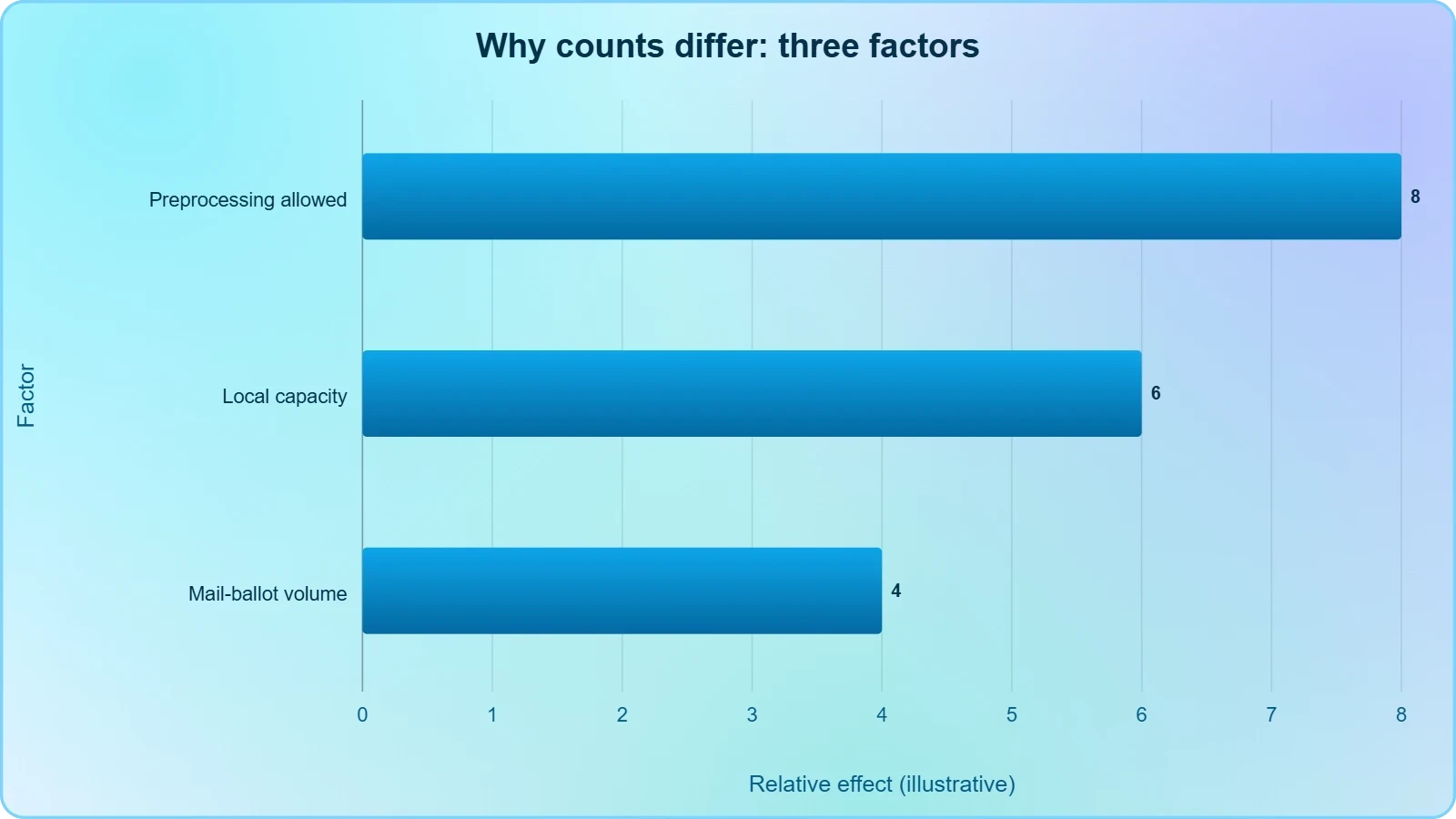
Local capacity matters as well. Urban counties with large budgets and experienced staff can process ballots more rapidly than rural counties with limited resources. This disparity can produce uneven reporting within a single state, with urban areas sometimes lagging behind rural ones despite having more voters. The result is a patchwork of partial results that can obscure the true picture until the count is complete. Viewers should therefore resist the temptation to generalize from a single county's returns.
What the 2026 Timeline Means for the National Picture
The staggered schedule of the 2026 midterms carries implications that extend beyond the mechanics of counting. Because the Senate and House majorities may hinge on a handful of states with divergent reporting speeds, the national picture will likely remain incomplete until the early morning hours of November 4. Georgia, North Carolina, and Ohio, all pivotal to Senate control, are not expected to deliver definitive results before midnight. Pennsylvania, equally consequential, may take even longer. The result is a night of accumulating fragments rather than a single decisive moment.
This fragmentation is not a flaw in the system but a reflection of American federalism. Each state administers its own elections, and the Constitution reserves that authority to the states. The variation in timing is the price of a decentralized system that prioritizes local control over national uniformity. For citizens, the practical takeaway is to plan for a long evening and to seek information from authoritative sources rather than social media speculation. The count will unfold at its own pace, and the wisest posture is patient attention.
Senate Control and the States That Decide It
Senate control in 2026 will likely be determined by a small set of contests. Georgia, North Carolina, and Ohio are the most prominent, with South Carolina and Maine playing supporting roles. Each of these states has its own counting rhythm, and the sequence in which they report will shape the narrative of the night. A strong early showing in Georgia could set expectations that later states confirm or contradict. The interplay between these contests means that the Senate majority may not be known until the final votes are tallied in the slowest jurisdictions.
The House map is broader but no less dependent on timing. Competitive districts in Florida, Indiana, Virginia, and North Carolina will report at different speeds, creating a mosaic of partial results. The party that performs well in the early-reporting districts may appear to have an advantage, but late-counted mail ballots could alter the balance. The lesson of recent cycles is that the final House margin often emerges only after days of counting, particularly in states that allow mail ballots to arrive after Election Day.
Preparing for a Long Count
The most prudent approach for observers is to prepare for a count that extends beyond election night. Several states accept mail ballots that arrive after Election Day, provided they are postmarked by the deadline, which means that final results may not be available for days. This is not a new phenomenon; it has been a feature of American elections for years. The 2026 midterms will follow the same pattern, and viewers should calibrate their expectations accordingly rather than treating the absence of a result as evidence of a problem.
Patience, in this context, is a form of civic discipline. The integrity of the count depends on allowing officials the time to verify ballots and reconcile totals. Rushing to judgment undermines that process and fuels unnecessary suspicion. The better approach is to follow the state-by-state timeline, to note the percentage of votes counted, and to wait for authoritative calls. The evening will deliver drama enough without the need for premature conclusions, and the final picture will be more reliable for the waiting.
From our network :
- The Final Descent: How ESA Retired the Legendary Cluster Constellation After 24 Years of Space Weather ScienceAfter 24 years mapping Earth’s magnetosphere, ESA’s Cluster mission concluded with a precisely controlled reentry over the South Pacific. This analysis explores the scientific legacy, engineering decisions, and debris mitigation principles behind one of space exploration’s most responsible retirements.
- Live Online English Classes for Kids: Do They Actually Reduce Anxiety?A ten-week study reveals that synchronous online English classes can significantly reduce child language anxiety while improving listening and reading skills. Discover what makes these programs effective and how parents can select the right one.
- Mobile Learning and VR in English: What Global Evidence Reveals About Effective Language TechnologyA systematic review across 14 countries reveals which language-learning technologies genuinely work. Mobile learning, AI, and VR show measurable benefits when pedagogically integrated. This evidence-based guide helps educators and learners select technology that delivers real return on investment.
- CISA’s Ten-Advisory Wave: Why Generic Patching Fails in OT and How to Build Product-Specific PlaybooksCISA released ten ICS advisories in one week, exposing critical infrastructure risks. Generic patching fails in OT. Learn to build product-specific remediation playbooks.
- The Hidden Cost of AI Convenience: Why Over-Permissioned Agents Are a Security Time BombDiscover why AI agents with excessive permissions create dangerous single points of failure, and learn how implementing least privilege principles can protect your organization from exploitation.
- Forbidden Matrix Patterns and Visible Lattice Points: A Geometric DictionaryExplore how multidimensional 0–1 matrices encode geometric truths, linking forbidden patterns to visible lattice points and hypergraph theory, with applications in combinatorics and computational geometry.
- How AI Agents Will Change the Way We Manage Personal FinancesExplore how AI agents are transforming personal finance through automated budgeting, bill payment, and investment management, while examining the critical security protocols and governance frameworks required for safe deployment.
- University Language Proficiency Exams: Why Institutional Tests Demand Different Preparation Than IELTS and TOEFLDiscover why university-specific language proficiency examinations differ fundamentally from IELTS and TOEFL, and learn strategic preparation approaches for institutional assessment success.
- Committed Mediterranean Precipitation Decline: Why Emissions Cuts Alone Cannot Restore Winter RainsNew NOAA research reveals that Mediterranean winter rains may decline irreversibly even with emissions cuts. Explore the science of committed climate change and regional impacts.
RESOURCES
- Resources will be updated soon.
- 01
- 02
- 03
- 04
- 05
- 06
- 07
- 08
0 Comments