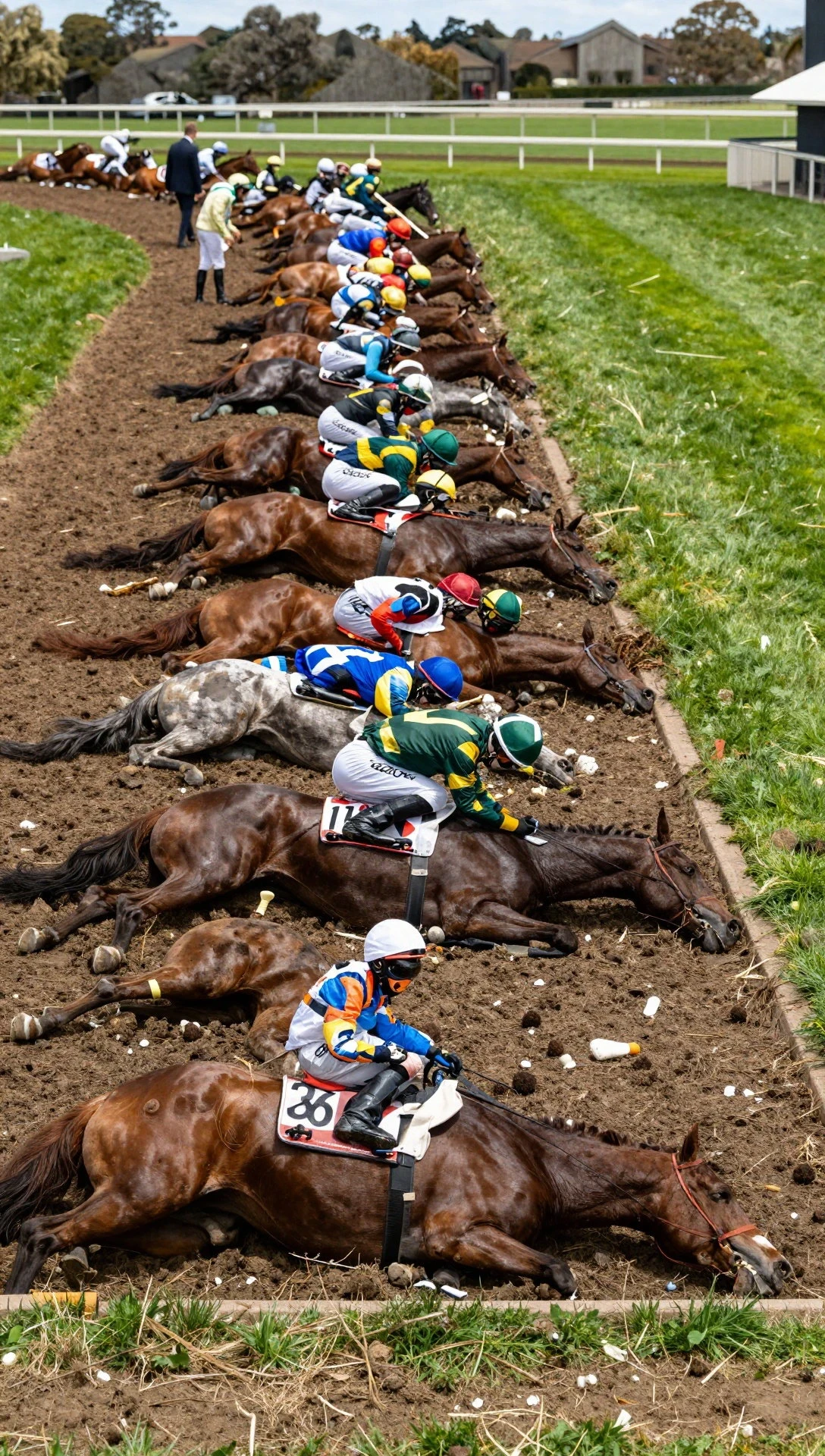
The death of a Melbourne Cup runner is rarely a matter of public consequence once the carnival crowds disperse, yet the case of So You Are has become an uncomfortable examination of what happens to racehorses after the applause fades.
The five-year-old gelding finished eighth behind Point of Law at Flemington on November 3, and within a fortnight his body was discovered at a licensed waste facility in Sydney, photographed in a dumpster by a construction worker who then posted footage to Facebook. The image travelled faster than any official explanation could, and Racing NSW stewards opened an inquiry almost immediately.
What separates this episode from routine animal-welfare stories is the chain of admitted responsibility. Trainer Bjorn Baker confirmed the horse died from a severe case of colic following emergency treatment at a specialist equine hospital, and he expressed deep distress at how the remains were handled. Dr.
On This Page
- The Sequence of Events From Race Day to Discovery
- Institutional Responses and the Language of Apology
- The Regulatory Framework Governing Equine Disposal
- Welfare, Public Trust and the Racing Social Licence
- Media Exposure and the Mechanics of Reputational Damage
- What This Case Reveals About Animal Aftercare Systems
- The Road Ahead for Racing NSW and the Industry
Jonathan Lumsden, managing partner of REC Equine Specialists, acknowledged that a contracted service provider collected the body and delivered it to landfill, conceded the outcome was unacceptable and disrespectful, and accepted full responsibility on behalf of the hospital that chose both the provider and the arrangements.
The regulatory dimension adds a further layer of difficulty. Racing NSW maintains that a licensed landfill is the preferred destination for animals euthanized with chemicals, a position embedded in industry guidelines currently under review, while simultaneously insisting burial should have occurred promptly and respectfully. Those two propositions sit awkwardly together, and the gap between them is precisely where public trust erodes.
This analysis traces the incident from Flemington to the waste centre, examines the veterinary and regulatory frameworks involved, and considers what the investigation must deliver.
TL;DR So You Are, an eight-place finisher in the 2025 Melbourne Cup, died of colic after emergency treatment and was euthanized humanely under anesthesia. His body was collected by a contracted provider and taken to a licensed Sydney landfill, where a construction worker filmed it in a dumpster and posted the footage online. Trainer Bjorn Baker and the treating hospital both expressed distress, with REC Equine Specialists accepting full responsibility for the handling arrangements. Racing NSW has opened an inquiry, describes the images as completely unacceptable, and says it will act if wrongdoing is established. The case exposes unresolved tension between chemical-disposal guidance and expectations of dignified aftercare.
The Sequence of Events From Race Day to Discovery
Reconstructing the timeline matters because each interval carries its own accountability. So You Are contested the Melbourne Cup on November 3, finishing mid-field in a race won by Point of Law. At some point afterward he developed severe colic, a gastrointestinal condition that remains one of the leading causes of death in Thoroughbreds and can deteriorate with frightening speed even under intensive veterinary supervision.
The horse was transferred to a specialist equine hospital for emergency treatment, but the intervention failed. He was euthanized humanely under anesthesia, a detail the treating practice has emphasized because it speaks to welfare at the end of life.
The subsequent handling of the carcass, rather than the death itself, became the controversy when footage surfaced on Tuesday, November 17, showing the body at a licensed waste centre.
The Veterinary Emergency and the Decision to Euthanize
Colic encompasses a spectrum of abdominal conditions, from simple spasms to strangulating lesions that cut off blood supply to sections of intestine. When conservative management fails, surgery becomes the remaining option, and even then outcomes are uncertain.
The decision to euthanize under anesthesia reflects a clinical judgment that further suffering could not be justified, and it is a decision made by veterinarians rather than trainers or owners.
Dr. Lumsden's account places the death firmly within accepted veterinary practice. The horse received emergency care, the condition proved unresponsive, and euthanasia was performed with the animal unconscious. Nothing in the available record suggests the death itself involved neglect.
The controversy begins at the moment the body left the hospital's care and entered a commercial disposal chain that evidently failed to meet the standards the hospital now says it expected.
How the Body Reached a Sydney Waste Facility
REC Equine Specialists engaged a contracted service provider to collect the remains, and that provider transported them to a licensed landfill. Racing NSW has stated the horse was being held temporarily, awaiting burial, when the video was recorded, which implies an intended final step that had not yet occurred. Whether that explanation satisfies the public is another question entirely.
The construction worker who discovered the body did not encounter a regulated transfer in progress; he encountered a dead racehorse in a dumpster and reached for his phone. That instinct, entirely human, transformed a procedural failure into a reputational crisis. Racing authorities now find themselves explaining the difference between temporary holding and abandonment to an audience that reasonably sees little distinction between the two.
We Also Published
Institutional Responses and the Language of Apology
Three institutions have spoken publicly, and each has chosen its words with evident care. Baker framed the matter in emotional terms, describing a much-loved horse who deserved dignity and respect after death. Lumsden adopted the vocabulary of corporate accountability, accepting full responsibility while pointing to a provider whose conduct he says he is now investigating alongside Racing NSW. The regulator, for its part, has combined sympathy for public distress with a reminder that its own guidelines permit landfill disposal.
These registers do not quite meet. The trainer speaks of a beloved animal; the hospital speaks of contractual arrangements; the regulator speaks of chemical residues and preferred options. Each is legitimate within its own frame, yet the cumulative effect is a diffusion of responsibility that leaves no single party clearly answerable for the specific failure the public witnessed. That diffusion is the central governance problem the inquiry must resolve.
Bjorn Baker's Statement and the Trainer's Position
A trainer occupies an awkward position in cases like this. Baker was not present at the hospital, did not select the disposal provider, and learned of the mishandling only after the footage circulated. His public statement nonetheless carried the moral weight of the relationship, because trainers are the human face of a horse's career and the public instinctively holds them responsible for its afterlife.
His language, that the horse was much loved and deserved to be treated with dignity and respect after death, articulates an expectation that formal regulations do not capture. Rules govern disposal; they do not govern reverence.
The gap between what the rules require and what the racing community feels it owes its animals is where reputational damage accumulates, and Baker's statement acknowledged that gap without pretending to close it.
REC Equine Specialists and Contracted Disposal
Lumsden's admission is unusually direct for a veterinary practice facing public scrutiny. He did not dispute the facts, did not deflect toward the landfill operator, and did not hide behind the guidelines. He stated that the hospital chose the provider and the arrangements, that it takes full responsibility, and that what occurred was unacceptable and disrespectful. He also apologized, which institutions often resist.
The practical question now is what that responsibility produces. Accepting fault is the beginning of accountability, not its conclusion. The hospital says it is working with the provider and Racing NSW to establish what went wrong and to prevent recurrence, which implies a review of collection protocols, verification of final disposition, and possibly a change of contractor. Whether those commitments are documented publicly will determine whether the apology retains credibility.
The Regulatory Framework Governing Equine Disposal
Beneath the emotional response lies a technical problem that regulators have grappled with for years. Horses euthanized with barbiturates and other controlled substances cannot simply be buried in open ground in many jurisdictions, because the chemicals persist in soil and can poison scavengers or leach into waterways.
Licensed landfill disposal emerged as a pragmatic answer, and Racing NSW has confirmed that its guidelines, currently under review, treat landfill as the preferred option for chemically euthanized animals.
That guidance is defensible on environmental grounds. It becomes problematic when translated into practice without accompanying standards for handling, timing, and presentation. A landfill is a legitimate destination; a dumpster at a waste centre is not an acceptable staging point, and the distinction between the two is precisely what the guidelines fail to specify with sufficient clarity. The review now underway must address that omission directly.
Why Landfill Disposal Is Permitted
The chemistry drives the policy. Euthanasia solutions typically contain pentobarbital or similar agents that remain biologically active in carcasses for extended periods. Burial in permeable soil risks groundwater contamination, and rendering carries its own complications when residues enter the food chain. Landfill, properly managed, contains those risks within an engineered environment designed for exactly this kind of containment.
Environmental regulators in several countries have reached comparable conclusions, which lends the Racing NSW position a measure of technical authority. The difficulty is that public expectations of animal dignity operate on an entirely different register from environmental risk management.
A policy can be scientifically sound and still feel, to a racing audience, like an abandonment of the obligations owed to a horse that gave its performance to the sport.
The Gap Between Guidance and Practice
Guidelines describe destinations; they rarely prescribe the choreography of transfer. Who verifies that a collected body reaches its intended facility? What time limits apply to temporary holding? What documentation accompanies the carcass? These operational questions determine whether a policy functions as intended or collapses at the first point of commercial subcontracting, and the So You Are case suggests the current answers are inadequate.
Racing NSW has said burial should have occurred in a timely and respectful manner, which implicitly concedes that neither condition was met. The regulator now faces a choice between tightening the guidelines and enforcing the ones already in force. Both are necessary. A review that produces revised language without corresponding verification mechanisms would leave the same structural vulnerability in place for the next unfortunate case.
Welfare, Public Trust and the Racing Social Licence
Australian racing has spent the better part of a decade defending its social licence, the informal permission society grants an industry to operate. Investigations into whip use, jumps racing fatalities, and the fate of retired racehorses have each tested that permission.
The So You Are case belongs to the same family of controversies because it concerns what happens to horses once their competitive utility ends, which is precisely the question critics argue the industry has never answered convincingly.
The specific facts here are less damning than the symbolism. A horse died of natural causes despite veterinary intervention, was euthanized humanely, and then was mishandled by a contractor. No allegation of cruelty to a living animal has been made.
Yet the image of a Melbourne Cup runner in a dumpster communicates something no press release can neutralize, because it confirms a suspicion the public already harbours about the distance between racing's self-presentation and its operational realities.
Aftercare Beyond the Finishing Post
Aftercare has become the industry's most visible welfare commitment, with rehoming programmes, retirement registers, and traceability requirements expanding across jurisdictions. Those initiatives address living horses, however, and the So You Are case exposes an adjacent gap in provisions for the dead. Dignified end-of-life handling is the logical extension of aftercare, and its absence undermines the credibility of the broader programme.
Public trust is cumulative and asymmetric. Years of investment in welfare reform can be eroded by a single photograph, and the erosion is faster when the explanation involves contractual complexity rather than straightforward error. Racing bodies would be well advised to treat disposal standards as a reputational asset rather than an administrative afterthought, because the audience watching is not confined to punters and participants.
What the Inquiry Must Establish
Racing NSW has committed to appropriate action if wrongdoing is found, which sets the outer boundary of the inquiry's remit. Within that boundary lie several questions. Did the provider breach its contractual obligations? Did the hospital exercise adequate diligence in selecting and supervising it? Were the guidelines themselves deficient, or were they adequate but unenforced? Each answer carries different remedial consequences.
The most valuable outcome would be a published account of what failed and what changes as a result. Investigations that conclude with confidential sanctions satisfy regulators but leave public concern unaddressed. Given that the footage was broadcast nationally, the inquiry's credibility depends on transparency, and the racing authority should anticipate that expectation rather than resist it.
- 01
- 02
- 03
- 04
Media Exposure and the Mechanics of Reputational Damage
The Sydney Morning Herald broke the story on Tuesday, and CNN carried it internationally within hours. That trajectory, from a construction worker's Facebook video to global coverage, illustrates how thoroughly the media environment has changed for institutions that once managed bad news through controlled disclosure.
There is no longer a window in which an organisation can investigate quietly before public attention arrives; attention arrives first, and the investigation follows.
The video itself is the decisive artefact. Text-based reporting of a mishandled carcass would have generated modest coverage; moving images of a racehorse in a dumpster generated outrage. Racing authorities now operate in an environment where any lapse, however localized, can be documented by any bystander with a phone, and their crisis protocols must assume that possibility rather than treat it as exceptional.
From Facebook Video to National Coverage
The construction worker's decision to film and post was not investigative journalism; it was spontaneous documentation. Yet it performed the function that formal oversight had failed to perform, surfacing a failure that would otherwise have remained invisible. This inversion, where private citizens supply the transparency that regulators are meant to guarantee, is a recurring feature of contemporary accountability.
For Racing NSW, the lesson is that its stewardship is now continuously observable. Stewards can inspect licensed premises, but they cannot inspect every contractor's vehicle or every landfill staging area. The public can, and increasingly does. Regulatory design must therefore incorporate external observation as a predictable input rather than an unwelcome intrusion.
Lessons for Sporting Bodies and Contractors
The most transferable lesson concerns subcontracting. When an institution outsources a sensitive function, it outsources the activity but not the reputational consequence. The hospital's name appeared in coverage alongside the landfill, and its acceptance of responsibility was the only response that could have preserved its standing. Institutions that treat contractors as reputational firewalls discover, usually painfully, that the firewall does not hold.
A second lesson concerns speed. The gap between the video's appearance and the first substantive institutional response shaped the story's framing. Statements issued within hours can define the narrative; statements issued after a news cycle has formed must contest a narrative already fixed. Racing NSW and REC Equine Specialists moved relatively quickly, but the footage had already done its work.
What This Case Reveals About Animal Aftercare Systems
Strip away the racing context and a more general problem emerges. Societies have built elaborate systems for the treatment of living animals and comparatively little infrastructure for their remains, particularly when those remains carry chemical restrictions. Veterinary practices, farms, zoos, and racing stables all confront the same question: who is responsible for dignified disposal, and how is that responsibility verified once a contractor takes possession?
The So You Are case suggests the answer is often nobody in particular. Responsibility fragments across trainer, hospital, provider, and regulator, and each party can plausibly claim to have fulfilled its own narrow role. Fragmented accountability is not the same as absent accountability, but it produces the same outcome when something goes wrong, which is a failure that everyone can disclaim and no one can correct in advance.
Accountability Across the Chain of Custody
A functioning chain of custody requires documentation at every transfer. The party relinquishing a carcass should record the recipient, the intended destination, and the expected timeframe; the recipient should confirm arrival and final disposition. Such systems are routine in waste management and pharmaceutical logistics, and their absence in equine aftercare is a design flaw rather than an inevitability.
Implementing them would impose costs on practices and providers, and those costs would eventually reach owners. That is a legitimate objection but not a decisive one, because the reputational cost of a single dumpster photograph vastly exceeds the administrative burden of a tracking system. The industry should treat the current controversy as an argument for investment rather than an argument for defensiveness.
Designing Better End-of-Life Protocols
Effective protocols would combine clear destination rules with operational specifics: maximum holding times, approved temporary storage conditions, verification of delivery, and audit rights over contractors. They would also distinguish between the environmental question, which landfill answers reasonably well, and the dignity question, which it does not answer at all unless the handling is conducted with evident care.
Dignity, in this context, is not sentimentality. It is the visible performance of respect that sustains public consent for animal use in sport and agriculture alike. A horse that ran in the Melbourne Cup and ended in a dumpster tells the public something about priorities, and the industry's response over the coming months will determine whether that message becomes its settled reputation.
The Road Ahead for Racing NSW and the Industry
The immediate task belongs to Racing NSW, which must complete its inquiry, publish findings sufficient to satisfy public interest, and demonstrate that its guidelines have been strengthened where they proved inadequate. The regulator's early statements have been appropriately firm, describing the images as completely unacceptable and committing to action if wrongdoing is established. Firmness in language must now be matched by specificity in remedy.
Beyond the inquiry lies a broader industry obligation. Australian racing depends on public tolerance, and that tolerance is renewed annually through visible commitments to welfare. The So You Are case has revealed a blind spot in those commitments, located precisely at the boundary between life and disposal.
Addressing it is not merely a compliance exercise; it is an investment in the industry's continued acceptance by a public that watches closely.
Regulatory Reform and Enforcement Priorities
Reform should proceed on two tracks simultaneously. The first is textual, revising guidelines to specify holding conditions, timeframes, and verification requirements for chemically euthanized animals. The second is operational, establishing audit mechanisms that confirm contractors are performing as contracted rather than assuming compliance from the existence of a licence.
Enforcement priorities should follow risk. Disposal chains involving multiple subcontractors, remote facilities, or high-value animals warrant closer scrutiny than single-provider arrangements. The So You Are case involved a prominent horse and a major hospital, which suggests that failures are not confined to the margins of the industry. If the well-resourced cases can fail, the under-resourced ones almost certainly do.
Rebuilding Confidence After the Inquiry
Confidence is rebuilt through demonstrated change rather than declared intention. The hospital's acceptance of responsibility provides a foundation, but it must be followed by evidence that its procurement and oversight practices have altered. The regulator's inquiry provides a mechanism, but its value depends on publication. The trainer's expression of grief provides a human register, but sentiment alone does not reform systems.
Racing has survived previous welfare controversies by adapting, often under pressure, and the pattern is likely to repeat here. The measure of this episode will be whether the adaptation extends to the unglamorous administrative territory of carcass handling.
If it does, So You Are's death will have produced something more durable than an apology, and the industry will be marginally more deserving of the trust it asks the public to extend.
From our network :
- CISA’s Ten-Advisory Wave: Why Generic Patching Fails in OT and How to Build Product-Specific PlaybooksCISA released ten ICS advisories in one week, exposing critical infrastructure risks. Generic patching fails in OT. Learn to build product-specific remediation playbooks.
- Forbidden Matrix Patterns and Visible Lattice Points: A Geometric DictionaryExplore how multidimensional 0–1 matrices encode geometric truths, linking forbidden patterns to visible lattice points and hypergraph theory, with applications in combinatorics and computational geometry.
- University Language Proficiency Exams: Why Institutional Tests Demand Different Preparation Than IELTS and TOEFLDiscover why university-specific language proficiency examinations differ fundamentally from IELTS and TOEFL, and learn strategic preparation approaches for institutional assessment success.
- Committed Mediterranean Precipitation Decline: Why Emissions Cuts Alone Cannot Restore Winter RainsNew NOAA research reveals that Mediterranean winter rains may decline irreversibly even with emissions cuts. Explore the science of committed climate change and regional impacts.
- Mobile Learning and VR in English: What Global Evidence Reveals About Effective Language TechnologyA systematic review across 14 countries reveals which language-learning technologies genuinely work. Mobile learning, AI, and VR show measurable benefits when pedagogically integrated. This evidence-based guide helps educators and learners select technology that delivers real return on investment.
- How AI Agents Will Change the Way We Manage Personal FinancesExplore how AI agents are transforming personal finance through automated budgeting, bill payment, and investment management, while examining the critical security protocols and governance frameworks required for safe deployment.
- Live Online English Classes for Kids: Do They Actually Reduce Anxiety?A ten-week study reveals that synchronous online English classes can significantly reduce child language anxiety while improving listening and reading skills. Discover what makes these programs effective and how parents can select the right one.
- The Hidden Cost of AI Convenience: Why Over-Permissioned Agents Are a Security Time BombDiscover why AI agents with excessive permissions create dangerous single points of failure, and learn how implementing least privilege principles can protect your organization from exploitation.
- The Final Descent: How ESA Retired the Legendary Cluster Constellation After 24 Years of Space Weather ScienceAfter 24 years mapping Earth’s magnetosphere, ESA’s Cluster mission concluded with a precisely controlled reentry over the South Pacific. This analysis explores the scientific legacy, engineering decisions, and debris mitigation principles behind one of space exploration’s most responsible retirements.
RESOURCES
- Melbourne Cup horse So You Are found dead in a waste facility ...cnn.com6 hours ago ... The Sydney Morning Herald newspaper reported Tuesday that racing stewards were investigating after a construction worker saw a dead horse…
- The dead body of Melbourne Cup horse So You Are was found in a ...facebook.com1 hour ago ... The dead body of Melbourne Cup horse So You Are was found in a waste facility in Sydney less than…
- Melbourne Cup horse found dead in waste facility, sparking an inquirycp24.com4 hours ago ... The dead body of Melbourne Cup horse So You Are was found in a waste facility in Sydney less than…
- Investigation launched after dead body of Melbourne Cup horse ...nz.news.yahoo.com9 hours ago ... Racing NSW has launched an inquiry after the horse was found in a waste facility in Sydney.
- Melbourne Cup horse So You Are found dead in a waste facility ...mundoamerica.com6 hours ago ... The Sydney Morning Herald newspaper reported Tuesday that racing stewards were investigating after a construction worker saw a dead horse…
- Discovery of dead Melbourne Cup horse in a skip sparks investigationindependent.co.uk9 hours ago ... Racing NSW has launched an inquiry after the horse was found in a waste facility in Sydney.
- Body of Melbourne Cup horse found dumped in Sydney skip - BBCbbc.com10 hours ago ... Trainer Bjorn Baker - who shared news of the horse's death ... The waste management company that runs the landfill…
- Dead Melbourne Cup racehorse So You Are found dumped in ...scmp.com7 hours ago ... Racing stewards were investigating after a construction worker saw a dead horse in a dumpster at a licensed waste centre…
- Melbourne Cup racehorse So You Are found dead in a skipnytimes.com1 hour ago ... Investigation launched after ... The body of a leading dead race horse has been found dumped in a skip at…
- CTV News on X: "Melbourne Cup horse So You Are found dead in a ...x.com4 hours ago ... Melbourne Cup horse So You Are found dead in a waste facility, sparking an inquiry https://t.co/0yPbIS1drL.
- Investigation launched after dead body of Melbourne Cup horse ...newswav.com9 hours ago ... His remains were then found by a construction worker in a skip at a waste facility, who posted a video…
- Melbourne Cup horse found dead in skip bin by member of publictelegraph.co.uk9 hours ago ... ... horse at a Sydney waste facility that has been identified as So You Are. An investigation has been launched…
- Melbourne Cup Horse Found in Waste Bin, Investigation Launchedmedya.press5 hours ago ... The incident has raised questions about the handling of the animal's remains following its death. So You Are, a five-year-old…
- Body of Melbourne Cup horse So You Are found in skip binradioroyal.org8 hours ago ... The dead body of Melbourne Cup horse So You Are was found in a waste facility in Sydney less than…
- Melbourne Cup runner So You Are found in Sydney waste skipessexcountynews.co.uk6 hours ago ... Later that day, video footage emerged of a dead horse in a skip at the Lucas Heights waste facility in…
- 01
- 02
- 03
- 04
- 05
- 06
- 07
- 08
0 Comments